UX Designer Job Description Template

Free Word download β€’ Edit online β€’ Save & share with Drive β€’ Export to PDF

2 pagesβ€’20–30 min to fillβ€’Difficulty: Standardβ€’Signature requiredβ€’Legal review recommended
Learn more ↓
FreeUX Designer Job Description Template

At a glance

What it is
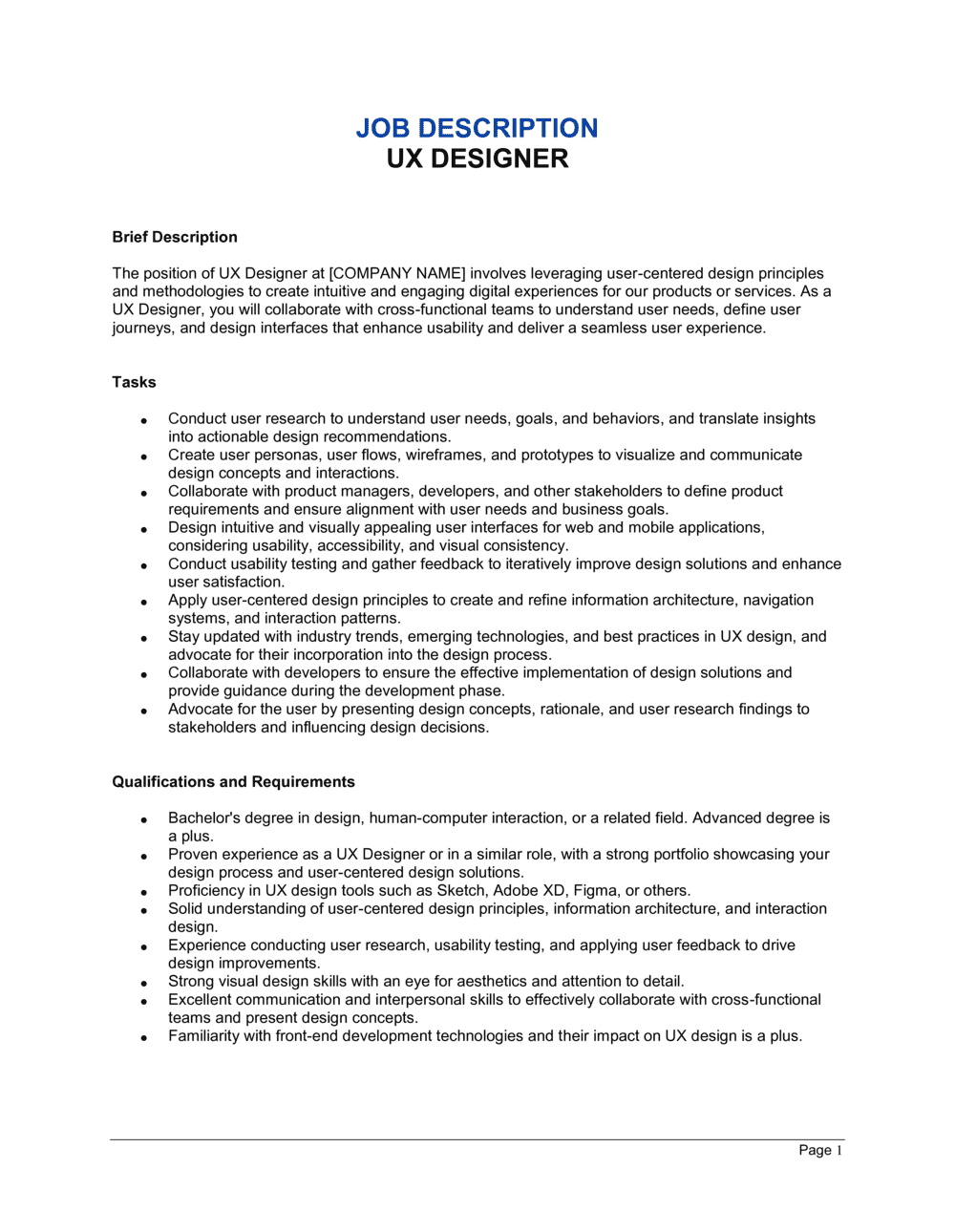
A UX Designer Job Description is a formal document that defines the scope of a UX Designer role β€” including responsibilities, required qualifications, compensation range, reporting structure, and binding obligations such as IP assignment and confidentiality. This free Word download gives employers a structured, legally grounded starting point they can edit online and export as PDF for posting, onboarding, or attachment to an employment contract.
When you need it
Use it before posting a UX Designer vacancy, when formalizing an existing employee's role scope, or when attaching a role-specific schedule to an employment contract. A signed job description protects both parties by establishing a documented record of agreed duties and expectations.
What's inside
Role summary and reporting structure, core responsibilities and deliverables, required and preferred qualifications, compensation and benefits overview, intellectual property assignment, confidentiality obligations, and performance expectations. Together these sections create a single reference document that supports hiring, onboarding, performance reviews, and termination proceedings.

What is a UX Designer Job Description?

A UX Designer Job Description is a formal document that defines the full scope of a User Experience Designer's role within an organization β€” including responsibilities, required qualifications, compensation, performance expectations, and binding legal obligations such as intellectual property assignment and confidentiality. Unlike a casual posting copied from a job board, a properly drafted UX designer job description functions as a legally grounded schedule to an employment contract, creating an enforceable record of what the employee is accountable for and what rights the company retains over the work they produce. It covers everything from the design tools the employee is expected to use to the user research data they must keep confidential, and it provides the documented baseline that supports hiring decisions, onboarding, performance reviews, and β€” when necessary β€” termination proceedings.

Why You Need This Document

Without a signed, role-specific job description, your company faces concrete exposure on three fronts. First, any design files, prototypes, or user research created by the designer may not legally belong to you β€” especially if the designer works remotely on personal equipment β€” because generic offer letters rarely include the device-agnostic IP assignment language that closes this gap. Second, a departing designer who takes unreleased product flows, proprietary design systems, or user research data to a competitor faces no enforceable confidentiality or non-solicitation obligation if those terms were never documented and signed. Third, performance disputes and wrongful termination claims become credibility contests rather than contract interpretation exercises when there is no written record of what the employee was hired to deliver. A completed, executed UX Designer Job Description eliminates all three risks for the cost of thirty minutes β€” and provides the documented foundation that makes every subsequent HR conversation, from a 90-day check-in to a separation agreement, straightforward rather than contested.

Which variant fits your situation?

If your situation is…Use this template
Hiring a junior UX Designer with 0–2 years of experienceJunior UX Designer Job Description
Defining a senior or lead UX Designer role with team oversightSenior UX Designer Job Description
Engaging a freelance UX Designer for a fixed projectIndependent Contractor Agreement
Hiring a UX researcher focused on user testing and analysisUX Researcher Job Description
Posting for a combined UI/UX role at a small companyUI/UX Designer Job Description
Formalizing the full employment relationship beyond the job descriptionEmployment Agreement
Hiring a product designer with end-to-end ownership of design systemsProduct Designer Job Description

Common mistakes to avoid

❌ Copying a generic UX job description from a job board without customization

Why it matters: A generic document provides no enforceable performance baseline and signals to candidates that the company has not thought carefully about the role β€” reducing offer acceptance rates.

Fix: Customize the role summary, responsibilities, and required tools to reflect your actual product, tech stack, and team structure before posting or executing.

❌ Omitting the salary range in pay-transparency jurisdictions

Why it matters: California, Colorado, New York, and Washington mandate salary ranges in job postings β€” non-compliance triggers regulatory fines and reputational risk in a talent market where candidates share compensation data publicly.

Fix: Check the posting location against current pay-transparency laws and include the approved compensation band in the compensation clause before publishing.

❌ Limiting IP assignment to work created on company premises

Why it matters: UX Designers routinely work on personal laptops and store files in personal cloud accounts. A location-restricted clause leaves Figma files, user research recordings, and prototypes outside the company's legal ownership.

Fix: Use device-agnostic IP assignment language covering all work 'created in connection with the Company's business or products, regardless of where or on what device it was produced.'

❌ Signing the job description after the employee's start date

Why it matters: In common-law jurisdictions β€” the US, Canada, the UK, and Australia β€” an employee who has already started work has provided no new consideration for post-start restrictions, potentially voiding the IP assignment and non-solicitation clauses.

Fix: Execute the job description and any attached employment agreement before or on the employee's first day. If late execution is unavoidable, provide documented additional compensation as fresh consideration at the time of signing.

❌ Defining responsibilities so broadly that performance management is impossible

Why it matters: Clauses like 'own all UX for the company' cannot be measured, making it legally difficult to justify a performance-based dismissal or document a promotion criteria gap.

Fix: Write 6–8 specific, measurable responsibilities and attach a Schedule A with quantified KPIs that both parties sign at onboarding.

❌ No governing law or integration clause

Why it matters: Without a governing law clause, courts apply their own conflict-of-laws analysis β€” which may produce unexpected results for remote workers in a different state or country from the employer.

Fix: Add a governing law clause specifying the jurisdiction and an integration clause confirming the job description and the employment agreement together constitute the full agreement on the employee's role.

The 10 key clauses, explained

Role title, department, and reporting line

In plain language: States the official job title, the department the role sits within, and the manager or team lead the employee reports to directly.

Sample language
Position Title: UX Designer | Department: [DEPARTMENT NAME] | Reports To: [TITLE β€” e.g., Head of Product / Design Director] | Location: [CITY / REMOTE / HYBRID]

Common mistake: Using an informal title like 'designer' that differs from payroll records β€” mismatches complicate visa sponsorships, background checks, and W-2 reporting.

Role summary and objectives

In plain language: A 3–5 sentence paragraph defining the purpose of the role, the problems it solves, and how it contributes to the company's product or business goals.

Sample language
The UX Designer will own the end-to-end design process for [PRODUCT / FEATURE AREA], translating user research and business requirements into intuitive, accessible digital experiences. This role is central to [COMPANY NAME]'s goal of achieving [PRODUCT OBJECTIVE] by [DATE / MILESTONE].

Common mistake: Writing a generic role summary copied from a job board without referencing the company's actual product or user base β€” candidates disengage and the document provides no performance baseline.

Core responsibilities and deliverables

In plain language: A prioritized list of the employee's primary duties β€” what they are accountable for producing, maintaining, or improving on a regular basis.

Sample language
Key responsibilities include: (a) conducting user research and usability tests for [PRODUCT AREA]; (b) producing wireframes, prototypes, and high-fidelity mockups in [TOOL]; (c) contributing to and maintaining [COMPANY NAME]'s design system; (d) collaborating with [ENGINEERING / PRODUCT / MARKETING] to deliver designs within sprint cycles.

Common mistake: Listing responsibilities so broadly (e.g., 'own all design') that there is no measurable basis for performance review or evidence of role misalignment during a dispute.

Required and preferred qualifications

In plain language: Distinguishes the minimum qualifications that make a candidate eligible (required) from the experience that would make them competitive (preferred).

Sample language
Required: [X]+ years of UX design experience; proficiency in [FIGMA / SKETCH / ADOBE XD]; portfolio demonstrating end-to-end UX process. Preferred: experience in [INDUSTRY / PLATFORM]; familiarity with [ACCESSIBILITY STANDARD β€” e.g., WCAG 2.1 AA]; exposure to [AGILE / SCRUM] workflows.

Common mistake: Marking every desirable qualification as 'required,' which narrows the candidate pool unnecessarily and can create disparate-impact liability if the requirements lack business justification.

Compensation, classification, and benefits

In plain language: States the salary range or hourly rate, FLSA classification (exempt or non-exempt), payment frequency, and reference to the company's benefits program.

Sample language
Base salary: [$MIN]–[$MAX] per year, paid bi-weekly. Classification: Exempt under the FLSA professional exemption. Benefits: Employee is eligible for the Company's standard benefits program as in effect from time to time, including health, dental, vision, and [401(k) / RRSP] matching.

Common mistake: Omitting the salary range in jurisdictions that legally mandate pay transparency (Colorado, California, New York, Washington) β€” non-compliance triggers regulatory penalties and reputational damage.

Intellectual property assignment

In plain language: Assigns to the employer all design work, prototypes, research deliverables, and other creative output produced by the employee in connection with their role.

Sample language
All work product, designs, prototypes, user research, and related materials created by Employee in the course of employment, or relating to the Company's business or products, are the sole property of [COMPANY NAME] and are hereby irrevocably assigned to the Company.

Common mistake: Limiting IP assignment to work created 'on company premises' β€” remote UX Designers routinely work on personal devices, leaving designs, Figma files, and research data outside the clause's reach.

Confidentiality and data handling

In plain language: Prohibits the employee from disclosing unreleased product designs, user research data, customer information, and business strategy during and after employment.

Sample language
Employee shall not, during or after employment, disclose or use any Confidential Information of the Company without prior written consent. Confidential Information includes unreleased product designs, user research data, customer lists, and any non-public business or technical information.

Common mistake: Failing to specify that user research data β€” which may include personal data of study participants β€” is covered, creating GDPR or CCPA compliance gaps when research participants' information is mishandled after departure.

Non-solicitation

In plain language: Restricts the departing employee from recruiting the company's employees or soliciting its clients or design partners for a defined period after leaving.

Sample language
For [12] months following separation, Employee shall not (a) solicit or recruit any employee of the Company, or (b) solicit any client, customer, or vendor of the Company with whom Employee had direct contact during the preceding [24] months.

Common mistake: Using a non-solicitation period longer than 12 months for a design role without documented justification β€” courts in several jurisdictions reduce or void excessive durations, potentially voiding the clause entirely.

Performance expectations and review cycle

In plain language: Sets the standards against which the employee's performance will be measured and states when formal reviews occur.

Sample language
Performance will be evaluated against the KPIs set out in Schedule A (Design Quality Metrics, Research Velocity, Cross-Functional Collaboration Score). Formal reviews occur every [6 / 12] months, with a 90-day check-in following the start date.

Common mistake: Leaving performance standards entirely undefined in the job description β€” without documented benchmarks, it becomes legally difficult to justify a performance-based termination.

Governing law and amendment

In plain language: Specifies which jurisdiction's law governs the document and requires any changes to be made in writing and signed by both parties.

Sample language
This Job Description is governed by the laws of [STATE / PROVINCE / COUNTRY]. It may be amended only by a written document signed by both [COMPANY NAME] and Employee. This document supplements and is incorporated into the Employment Agreement dated [DATE].

Common mistake: Treating the job description as a standalone contract without referencing the governing employment agreement β€” courts may treat inconsistencies between the two documents as grounds for the employee to claim the more favorable terms.

How to fill it out

  1. 1

    Enter the role details and reporting structure

    Fill in the official job title exactly as it will appear on payroll, the department, the direct manager's title, and whether the role is on-site, remote, or hybrid. Confirm the title matches your HRIS before posting.

    πŸ’‘ Use the same job title across the job description, offer letter, and employment contract β€” inconsistencies create problems with background checks and visa applications.

  2. 2

    Write a role summary specific to your product

    Replace any generic placeholder language with a 3–5 sentence description of what your UX team actually works on, who the users are, and what the hire will own. Reference a specific product area or platform.

    πŸ’‘ Candidates read the role summary to decide whether to apply. Specific details β€” 'designing onboarding flows for a B2B SaaS platform used by 50,000 SMBs' β€” attract better-fit applicants than 'designing great user experiences.'

  3. 3

    List responsibilities in priority order

    Order the core responsibilities from highest time allocation to lowest. Aim for 6–8 specific, measurable duties rather than an exhaustive list of 15+ vague tasks.

    πŸ’‘ Tie at least two responsibilities to a measurable output β€” 'reduce onboarding drop-off by X%' or 'deliver tested prototypes within each 2-week sprint' β€” to support performance reviews later.

  4. 4

    Separate required from preferred qualifications

    Required qualifications should represent the floor below which the candidate cannot perform the role. Preferred qualifications are competitive differentiators. Keep the required list to 4–6 items.

    πŸ’‘ In jurisdictions with pay equity or disparate-impact regulations, each required qualification should have a documented business justification β€” years of experience thresholds above what the role genuinely needs can attract EEOC or HRTO scrutiny.

  5. 5

    Set the salary range and confirm FLSA or equivalent classification

    Enter the minimum and maximum of your approved compensation band for this role. Confirm whether the role qualifies as exempt under the FLSA professional exemption (US) or equivalent classification in your jurisdiction.

    πŸ’‘ Colorado, California, New York, and Washington require salary ranges in job postings by law. Including them proactively also speeds up offer negotiations by setting mutual expectations early.

  6. 6

    Tailor the IP assignment and confidentiality clauses

    Expand the IP assignment clause to name the specific tools and file types the designer will use β€” Figma files, Miro boards, research recordings, and prototypes. Ensure the confidentiality clause explicitly covers user research participant data.

    πŸ’‘ For remote UX Designers, add a sentence confirming that IP assignment covers work created on personal devices when related to the company's business.

  7. 7

    Attach Schedule A with performance KPIs

    Move detailed performance metrics β€” design quality criteria, sprint delivery rates, research cadence β€” to a separate Schedule A that the employee initials at signing. This lets you update KPIs without amending the main document.

    πŸ’‘ Have the employee initial Schedule A separately to confirm they reviewed and agreed to the specific metrics, not just the general performance expectations clause.

  8. 8

    Execute before the start date and store the signed copy

    Both parties must sign before the employee's first day. Post-start-date signatures risk voiding restrictive covenants in common-law jurisdictions without fresh consideration. Store the fully executed copy in your HRIS or document management system.

    πŸ’‘ Use an e-signature tool that timestamps execution β€” this prevents disputes about when each party signed and whether the signature predated the start date.

Frequently asked questions

What is a UX designer job description template?

A UX designer job description template is a structured document that defines the scope, responsibilities, qualifications, compensation, and legal obligations of a UX Designer role. It functions both as a recruitment posting and, when signed, as a binding schedule to an employment contract. A well-drafted template covers role-specific details β€” design tools, research methodologies, sprint workflows β€” alongside standard legal clauses for IP assignment, confidentiality, and non-solicitation.

What should a UX designer job description include?

At minimum: official job title and reporting structure, a role summary tied to the company's actual product, prioritized core responsibilities, separated required and preferred qualifications, a compensation range, FLSA or equivalent employment classification, IP assignment language covering design files and research data, confidentiality obligations, non-solicitation terms, and a performance expectations section with a review cadence. Missing any of these creates gaps that surface during hiring disputes or post-employment IP claims.

Is a signed job description legally binding?

A signed job description is generally enforceable as a schedule to an employment contract when it contains consideration (compensation), mutual obligations, and is executed before the employee begins work. On its own, a job description may not constitute a complete contract, but when incorporated by reference into a formal employment agreement and signed by both parties, it creates binding obligations β€” particularly for IP assignment, confidentiality, and non-solicitation clauses.

Do I need to include a salary range in a UX designer job description?

In California, Colorado, New York, and Washington state, employers are legally required to include a salary range in job postings. Several other US states and Canadian provinces are introducing similar requirements. Even where not legally mandated, including a salary range typically reduces time-to-fill by 20–30% by filtering mismatched candidates early and accelerating offer negotiations with qualified applicants.

What is the difference between a UX designer job description and an employment contract?

A job description defines the scope of the role β€” responsibilities, qualifications, tools, and performance expectations. An employment contract is the comprehensive legal governing document that covers salary, benefits, IP assignment, non-compete, termination, severance, and governing law in full legal detail. Best practice is to execute both: the employment contract as the primary agreement and the job description as a signed schedule incorporated by reference.

How do I protect my company's IP when hiring a UX designer?

Include a broad IP assignment clause in both the job description and the employment contract. The clause should cover all design files, prototypes, wireframes, user research recordings, and related materials created in connection with the company's business β€” regardless of what device was used or where the work was performed. For remote designers using personal Figma accounts, add language explicitly addressing cloud-stored files and personal device output.

Can I use a UX designer job description for a freelance contractor?

A standard employee job description is not appropriate for freelance engagements and can contribute to misclassification risk if the contractor is later treated as an employee. For freelance UX work, use an Independent Contractor Agreement that defines the project scope, deliverables, timeline, payment terms, and IP assignment. Misclassifying a UX Designer as a contractor when the working relationship looks like employment can trigger back taxes, benefit liability, and penalties in most jurisdictions.

What UX-specific qualifications should be listed as required vs. preferred?

Required qualifications should reflect the minimum skill set without which the person cannot perform the core duties β€” typically a portfolio demonstrating end-to-end UX process, proficiency in the design tool your team uses (e.g., Figma), and a minimum years of relevant experience. Preferred qualifications cover specialized skills that improve performance but can be learned on the job β€” WCAG accessibility expertise, experience with a specific platform type, or familiarity with quantitative research methods. Listing too many items as required can create disparate-impact liability if the bar lacks business justification.

How often should a UX designer job description be updated?

Review the job description annually or any time the role scope changes materially β€” new product lines, a shift from generalist to specialist responsibilities, or a change in reporting structure. When updates are significant, have the employee acknowledge the revised description in writing. Outdated job descriptions that no longer reflect actual duties create ambiguity in performance reviews and can undermine termination proceedings if the employee argues they were evaluated against undisclosed expectations.

How this compares to alternatives

vs Employment Agreement

An employment agreement is the primary legal contract governing the full employment relationship β€” compensation, benefits, termination, severance, and governing law in legally binding detail. A UX designer job description defines the scope of the specific role and is typically incorporated as a schedule to the employment agreement. Both documents are needed: the agreement governs the relationship, and the job description governs the work.

vs Independent Contractor Agreement

An independent contractor agreement engages a self-employed UX designer for a specific project without creating an employment relationship β€” no benefits, no tax withholding, no FLSA protections. Using a job description with a contractor introduces misclassification risk. Use a contractor agreement when the designer sets their own hours, uses their own tools, and works across multiple clients simultaneously.

vs Job Offer Letter

A job offer letter confirms compensation and start date to secure a candidate's acceptance β€” it is not a comprehensive legal document. It lacks IP assignment, non-solicitation, performance standards, and detailed responsibilities. A signed UX designer job description combined with an employment contract replaces the offer letter as the governing document once employment begins.

vs Non-Disclosure Agreement

A standalone NDA covers confidentiality obligations only and is typically used before hiring or during a recruitment process to protect product information shared with candidates. A UX designer job description with an embedded confidentiality clause covers post-hire obligations as part of the employment relationship. Both may be appropriate β€” the NDA for pre-hire conversations, the job description clause for the employment term.

Industry-specific considerations

SaaS / Technology

Figma proficiency, design system ownership, sprint delivery cadence, and IP assignment covering proprietary UI component libraries are standard inclusions for SaaS UX roles.

Financial Services

WCAG 2.1 AA accessibility compliance, regulatory data-handling obligations, and confidentiality clauses covering fintech product roadmaps and customer flow data require explicit mention.

Healthcare / MedTech

UX roles in healthcare must address HIPAA-aligned handling of user research data, FDA usability engineering documentation requirements, and patient safety considerations in the scope of duties.

Retail / E-commerce

Conversion rate optimization deliverables, A/B testing ownership, and cross-functional responsibilities spanning mobile app and web storefronts are typically defined in the core responsibilities clause.

Professional Services / Agencies

Client-facing deliverable ownership, multi-project workload expectations, and non-solicitation clauses covering agency clients are particularly important given the direct client exposure of in-house UX Designers.

Education / EdTech

Accessibility-first design requirements under ADA and Section 508, learner-research confidentiality, and collaboration with instructional designers should be reflected in the responsibilities and qualifications clauses.

Jurisdictional notes

United States

At-will employment applies in 49 states; the FLSA professional exemption generally covers UX Designers earning above $684/week with primary duties of creative or intellectual work. California, Colorado, New York, and Washington require salary ranges in postings. California also limits post-employment non-solicitation clauses and restricts IP assignment for inventions developed entirely on personal time under Labor Code Β§2870.

Canada

There is no at-will employment in Canada β€” job descriptions must reference a notice-based termination structure meeting provincial Employment Standards Act minimums. Ontario's ESA requires at least 1 week notice per year of service. Quebec employers must provide French-language documentation for provincially regulated roles. Non-solicitation clauses are enforceable if reasonable in scope and duration; courts scrutinize restrictions beyond 12 months.

United Kingdom

UK employers must provide a written statement of employment particulars on or before day one β€” a signed job description incorporated into the statement satisfies part of this obligation. GDPR applies to user research participant data collected or stored by the UX Designer, requiring explicit reference in the confidentiality clause. Post-employment non-solicitation clauses are enforceable if reasonable and supported by legitimate business interest.

European Union

The EU Transparent and Predictable Working Conditions Directive requires written terms within 7 days of hire. GDPR obligations are particularly relevant for UX Designers who handle user research data β€” the confidentiality clause should explicitly address data subject information. Post-employment non-solicitation enforceability and any financial compensation requirements vary by member state; Germany and France impose stricter standards than most.

Template vs lawyer β€” what fits your deal?

PathBest forCostTime
Use the templateDomestic full-time UX hires at a single US state or Canadian province location, where the role is below director level and equity is not involvedFree30–60 minutes
Template + legal reviewRemote or cross-border UX hires, roles with access to sensitive user data, or positions where IP assignment is commercially critical$300–$600 (1–2 hours of employment counsel review)2–3 days
Custom draftedSenior design leadership hires with equity, heavily regulated industries (fintech, healthtech), or multi-jurisdiction employment with non-compete requirements$1,000–$3,000+1–2 weeks

Glossary

User Experience (UX)
The totality of a user's interaction with a product or service, including usability, accessibility, information architecture, and emotional response.
Information Architecture
The structural design of shared information environments β€” how content and navigation are organized so users can find what they need efficiently.
Wireframe
A low-fidelity schematic of a digital interface showing layout, element placement, and navigation flow without visual design detail.
Prototype
An interactive simulation of a product or feature used to test design decisions with real users before development begins.
Usability Testing
A research method in which representative users attempt tasks on a product while observers record where confusion or failure occurs.
Design System
A shared library of reusable UI components, style guides, and usage guidelines that ensures visual and functional consistency across a product.
IP Assignment
A contractual clause that transfers ownership of work product β€” designs, prototypes, research deliverables β€” from the employee to the employer.
Scope of Work
The defined boundaries of a role's responsibilities, deliverables, and authority, used as the baseline for performance evaluation.
At-Will Employment
An employment arrangement in which either party may end the relationship at any time for any lawful reason without advance notice β€” applicable in most US states.
Non-Solicitation Clause
A post-employment restriction preventing a departing employee from recruiting the employer's staff or soliciting its clients for a defined period.
Reporting Structure
The formal hierarchy that defines who the employee reports to and who, if anyone, reports to them.

Part of your Business Operating System

This document is one of 3,000+ business & legal templates included in Business in a Box.

  • Fill-in-the-blanks β€” ready in minutes
  • 100% customizable Word document
  • Compatible with all office suites
  • Export to PDF and share electronically

Create your document in 3 simple steps.

From template to signed document β€” all inside one Business Operating System.
1
Download or open template

Access over 3,000+ business and legal templates for any business task, project or initiative.

2
Edit and fill in the blanks with AI

Customize your ready-made business document template and save it in the cloud.

3
Save, Share, Send, Sign

Share your files and folders with your team. Create a space of seamless collaboration.

Save time, save money, and create top-quality documents.

β˜…β˜…β˜…β˜…β˜…

"Fantastic value! I'm not sure how I'd do without it. It's worth its weight in gold and paid back for itself many times."

Managing Director Β· Mall Farm
Robert Whalley
Managing Director, Mall Farm Proprietary Limited
β˜…β˜…β˜…β˜…β˜…

"I have been using Business in a Box for years. It has been the most useful source of templates I have encountered. I recommend it to anyone."

Business Owner Β· 4+ years
Dr Michael John Freestone
Business Owner
β˜…β˜…β˜…β˜…β˜…

"It has been a life saver so many times I have lost count. Business in a Box has saved me so much time and as you know, time is money."

Owner Β· Upstate Web
David G. Moore Jr.
Owner, Upstate Web

Run your business with a system β€” not scattered tools

Stop downloading documents. Start operating with clarity. Business in a Box gives you the Business Operating System used by over 250,000 companies worldwide to structure, run, and grow their business.

Free Forever PlanΒ Β·Β No credit card required