Four-Day Work Week Policy Template

Free Word download β€’ Edit online β€’ Save & share with Drive β€’ Export to PDF

3 pagesβ€’20–25 min to fillβ€’Difficulty: Standard
Learn more ↓
FreeFour-Day Work Week Policy Template

At a glance

What it is
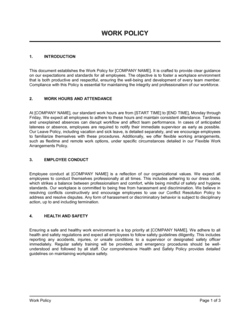
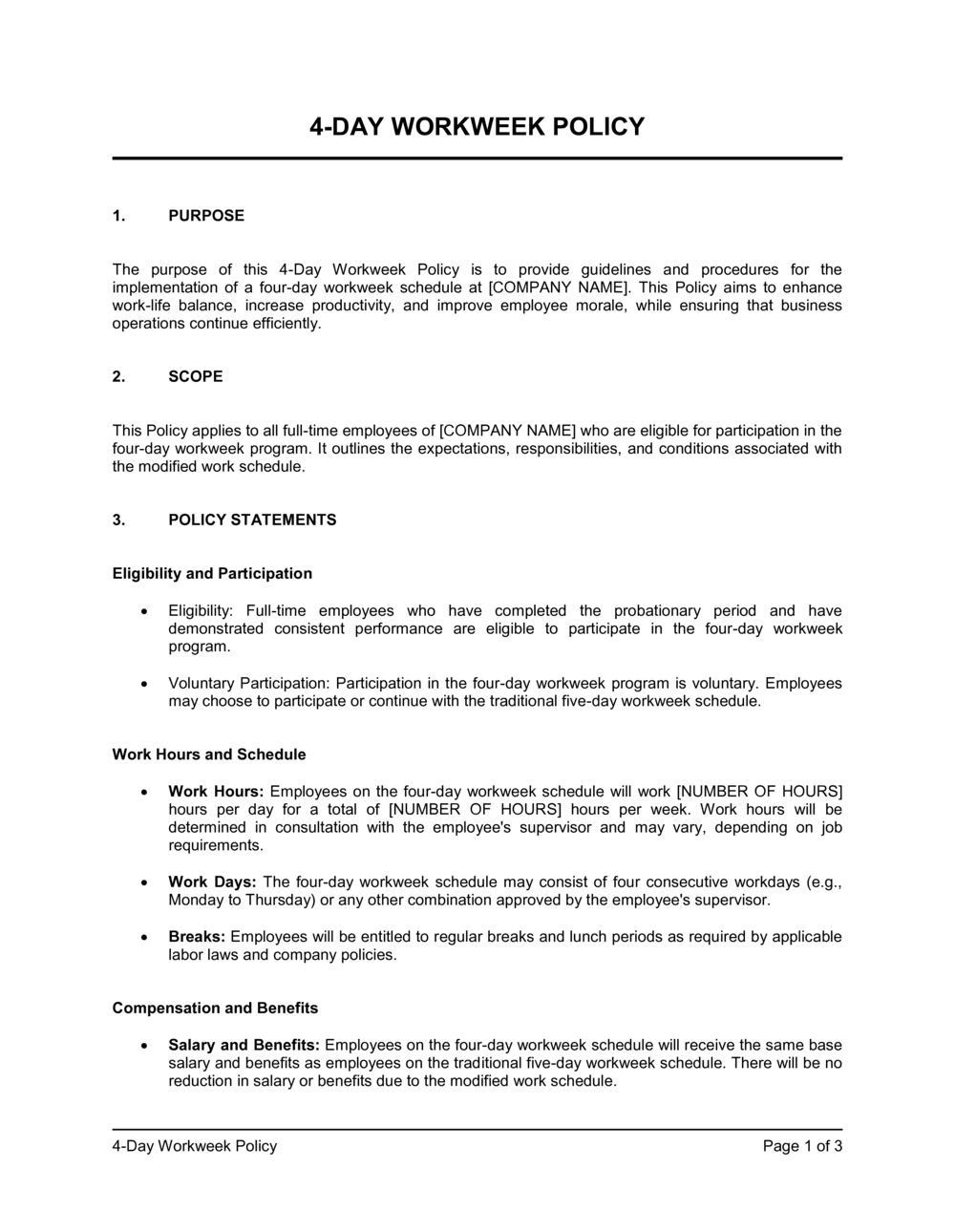
A Four Day Work Week Policy is an internal HR document that defines the terms under which employees work a four-day schedule β€” whether through a compressed 4Γ—10 arrangement, a reduced 32-hour week, or a pilot program. This free Word download gives you a structured, editable template you can tailor to your organization and export as PDF to distribute to your team.
When you need it
Use it when launching a formal four-day week pilot, converting an informal arrangement into a documented policy, or responding to employee requests for a compressed or reduced schedule. Organizations announcing the change company-wide need a written policy before the first affected pay period.
What's inside
Purpose and scope, eligibility criteria, schedule models and working hour requirements, productivity and performance expectations, communication and availability standards, client and customer service provisions, manager responsibilities, and the policy review and amendment process.

What is a Four Day Work Week Policy?

A Four Day Work Week Policy is a formal internal document that defines the terms under which an organization moves employees from a standard five-day schedule to a four-day working arrangement. It specifies which schedule model applies β€” whether a compressed 4Γ—10 structure that preserves 40 total hours, a reduced 32-hour week at full pay, or a time-limited pilot β€” and sets out the eligibility criteria, off-day approval process, output expectations, coverage requirements, and review mechanism that govern the change. Without a written policy, what begins as an informal experiment quickly produces inconsistent manager decisions, coverage gaps, and employee relations problems that undermine the benefit the change was meant to deliver.

Why You Need This Document

Announcing a four-day work week without a written policy creates more problems than the schedule change solves. Employees in different teams end up on different terms depending on their manager's interpretation. Client-facing roles lose coverage without anyone noticing until a deadline is missed. Performance conversations become impossible when no one recorded what output looked like before the change. And when the pilot needs adjustment β€” or reversal β€” there is no documented framework to fall back on. A clear, complete policy gives every manager the same starting point, gives every employee the same understanding of what is expected, and gives leadership the metrics needed to evaluate whether the change is working. This template compresses the drafting work into a structure you can customize and publish in hours rather than weeks.

Which variant fits your situation?

If your situation is…Use this template
Employees work four 10-hour days with the same total hoursCompressed Work Week Policy (4Γ—10)
Employees work 32 hours across four days with reduced total hoursReduced Hours Four Day Work Week Policy
Rolling out the four-day week as a time-limited trialFour Day Work Week Pilot Program Policy
Individual employees requesting a personal compressed scheduleFlexible Work Arrangement Request Form
Remote or hybrid teams adopting a four-day scheduleRemote Work Policy
Formalizing all flexible work options including four-day, remote, and part-timeFlexible Work Policy
Documenting employee time and attendance under a new schedule modelAttendance and Punctuality Policy

Common mistakes to avoid

❌ Applying a uniform Friday off-day to client-facing teams

Why it matters: Clients with five-day service expectations experience a 20% availability reduction at the end of the week β€” the highest-demand period for many service businesses. SLA breaches and client attrition follow within the first quarter.

Fix: Implement a coverage rotation for any team with client commitments so at least one team member is available each business day, including Friday.

❌ Omitting documented productivity baselines

Why it matters: Without a recorded pre-policy baseline, managers cannot objectively assess whether output has declined under the four-day schedule, making it impossible to fairly revoke participation or defend the policy's success.

Fix: Record team and individual output metrics for at least 60 days before the policy effective date and attach them as a reference in the policy appendix.

❌ Making the policy permanent without a pilot period

Why it matters: Operational gaps in coverage, client service, and cross-team coordination are difficult to predict in advance. Permanently adopting the policy before testing it removes the organization's structured ability to course-correct.

Fix: Define a 3- to 6-month pilot with explicit success criteria and a documented decision process. Communicate the pilot framing to employees clearly at launch.

❌ Leaving 'emergency contact on off-days' undefined

Why it matters: Managers interpret urgency differently β€” some treat every deadline as an emergency and contact employees on their off-day routinely, effectively negating the policy's wellbeing benefit and creating legal exposure in jurisdictions with right-to-disconnect rules.

Fix: Define 'emergency' with specific examples (e.g., system outage affecting all clients, regulatory deadline with same-day consequence) and require director-level sign-off before contacting an employee on their scheduled off-day.

The 9 key sections, explained

Purpose and scope

Schedule models and working hours

Eligibility criteria

Productivity and performance expectations

Communication and availability standards

Client and customer service provisions

Manager responsibilities

Pilot period and policy review

Exceptions and amendments

How to fill it out

  1. 1

    Choose your schedule model before editing the template

    Decide whether you are implementing a compressed 4Γ—10 model, a reduced 32-hour week, or a pilot with a specific end date. This decision drives the hours, pay, and performance-expectation language throughout the document.

    πŸ’‘ Survey your team and review client SLAs before committing to a model β€” switching from 4Γ—10 to 32-hour mid-pilot creates confusion and payroll complications.

  2. 2

    Define eligible roles and list exempt positions

    Work through your org chart and identify which roles can realistically operate on a four-day schedule. List exempt roles by specific job title in the eligibility and exceptions sections.

    πŸ’‘ Front-line customer support and operations roles with fixed shift requirements are the most common exemptions β€” document the business rationale for each to reduce employee relations risk.

  3. 3

    Set the off-day selection process and approval chain

    Decide whether employees choose their own off-day subject to manager approval, or whether the company assigns a uniform off-day. Enter the approval steps and the system used to record selections.

    πŸ’‘ A staggered off-day model (some employees off Monday, others off Friday) maintains five-day team coverage without a formal rotation roster β€” consider it for smaller teams.

  4. 4

    Document your productivity baselines

    For each eligible role or team, record the output metrics or KPIs that will be used to evaluate performance under the new schedule. Enter these as specific, measurable targets β€” not general statements.

    πŸ’‘ Use the 90 days before the policy launch to establish baseline metrics. You cannot measure a change from a baseline you never recorded.

  5. 5

    Define communication and availability expectations

    Specify core hours on working days, expected response times, and the threshold for off-day contact. Enter the specific calendar and messaging tools employees must update to reflect their schedule.

    πŸ’‘ Publish a shared team calendar showing each person's off-day β€” this single step reduces 'I didn't know they were off' complaints by more than half.

  6. 6

    Set pilot duration and review metrics

    Enter the pilot start and end dates and list the three to five metrics that will determine whether the policy continues. Assign a named owner for each metric.

    πŸ’‘ Include an employee satisfaction pulse survey as one of your review metrics β€” output data alone misses the wellbeing signal the policy is designed to capture.

  7. 7

    Distribute for manager review before publishing

    Share the draft with all people managers before communicating to employees. Collect feedback on coverage concerns and edge cases, then update the exceptions section accordingly.

    πŸ’‘ Managers who feel included in the policy design enforce it more consistently β€” a 30-minute sync before launch prevents most first-month escalations.

  8. 8

    Publish and confirm employee acknowledgment

    Distribute the final policy to all affected employees and collect a signed or digitally acknowledged receipt. Store acknowledgments in your HR system alongside the signed document.

    πŸ’‘ Send the policy at least two weeks before the effective date β€” same-week distribution signals poor planning and sets a tone of disorganization around a benefit meant to build trust.

Frequently asked questions

What is a four day work week policy?

A four day work week policy is a written HR document that defines the terms under which employees work four days per week instead of the standard five. It covers which schedule model applies (compressed 4Γ—10 or reduced 32-hour), who is eligible, how off-days are selected and approved, what performance expectations remain in place, and how the policy will be reviewed over time.

What is the difference between a compressed work week and a reduced hours model?

A compressed work week keeps total hours the same β€” typically four 10-hour days for a 40-hour week β€” while a reduced hours model cuts total weekly hours, most commonly to 32, usually at the same pay. The 100-80-100 model is the most widely cited version of the reduced hours approach: 100% pay, 80% of standard hours, 100% expected output. The right model depends on your industry, role types, and client obligations.

Does a four day work week policy reduce employee pay?

It depends on the model chosen. A compressed 4Γ—10 schedule does not change total hours or pay. A reduced 32-hour model may or may not reduce pay β€” many organizations implementing the 100-80-100 framework maintain full pay as a deliberate talent and productivity investment. The policy should state explicitly whether compensation is affected, or the absence of that statement will be interpreted inconsistently by employees and managers.

Which roles are typically exempt from a four day work week policy?

Roles that are operationally required to be available five days per week are typically exempt β€” customer support teams with defined SLAs, manufacturing and shift workers, retail floor staff, and roles with regulatory or compliance obligations that require daily coverage. The policy should list exempt roles by specific job title rather than by department to prevent inconsistent application.

How should a company measure the success of a four day work week?

The most reliable measurement framework combines output metrics (project completion rate, sales targets, ticket resolution time), employee wellbeing data (pulse survey scores, absenteeism, voluntary turnover), and client satisfaction indicators. Tracking all three categories prevents a situation where productivity numbers look positive but employee burnout or client experience problems are building underneath.

Does implementing a four day work week require changes to employment contracts?

In most cases, a standalone policy document is sufficient for an at-will or notice-based employment relationship, provided it is distributed with adequate notice and employee acknowledgment is collected. However, if the change reduces contracted hours or pay, an amendment to individual employment agreements is typically required. Employers in the UK, EU, and Canada should confirm whether the change triggers statutory consultation or variation-of-contract obligations before publishing the policy.

What is a reasonable pilot period for a four day work week?

Three to six months is the standard range. Three months captures one full business quarter of performance data. Six months accounts for seasonal variation and allows time for teams to fully adapt their workflows before a final decision is made. The pilot should conclude with a formal review meeting and a written decision communicated to all affected employees within two weeks of the review date.

How do you handle client-facing teams under a four day work week?

The most practical approach is a coverage rotation where team members take staggered off-days so the team has at least partial coverage every business day. Client accounts should have a named backup contact available on all five days. Before launch, review active client SLAs and communicate the change to key accounts with enough lead time to address concerns β€” typically 30 days minimum.

Can a company revert to a five day work week after implementing this policy?

Yes, provided the policy includes a clear amendment and discontinuation clause with an appropriate notice period β€” typically 30 days. Reverting without notice or without a documented operational justification risks damaging employee trust and, in some jurisdictions, may constitute a unilateral variation of working conditions. The pilot-period framing makes a reversion far easier to implement fairly, since employees were informed from the outset that continuation was conditional on results.

How this compares to alternatives

vs Flexible Work Policy

A flexible work policy governs a broad range of schedule arrangements β€” remote work, part-time, adjusted start and end times, and compressed weeks β€” within a single document. A four day work week policy is narrower and more specific, covering only the four-day model in operational detail. Use the broader policy when you want one governing document for all flexible arrangements; use the four-day-specific template when the compressed week is your primary or only flexibility offering and needs its own clear terms.

vs Remote Work Policy

A remote work policy governs where employees work, covering equipment, home office requirements, data security, and availability expectations for distributed teams. A four day work week policy governs when employees work. The two policies address different dimensions and are often implemented together β€” many organizations adopt both simultaneously when redesigning how work is structured.

vs Attendance and Punctuality Policy

An attendance policy sets standards for showing up on time, recording absences, and managing leave β€” it applies to whatever schedule the employee works. A four day work week policy defines what that schedule is. The attendance policy should reference the four-day policy so managers apply absence standards to the correct number of working days per week.

vs Employee Handbook

An employee handbook is a comprehensive reference document covering all HR policies in a single place β€” compensation, leave, conduct, benefits, and schedules. A four day work week policy is a standalone document with more operational depth than a handbook section can accommodate. Most organizations maintain a brief handbook section that points employees to the standalone policy for full terms.

Industry-specific considerations

Technology / SaaS

Asynchronous-first teams adapt well to staggered off-days; the policy pairs with existing remote-work frameworks and helps counter talent attrition to competitors offering similar benefits.

Professional Services

Client SLA review is the critical precondition; billable-hours tracking must be updated to reflect four-day billing cycles, and utilization targets need recalibration for the reduced-hours model.

Marketing and Creative Agencies

Project-based workflows with defined deliverables map cleanly onto four-day output targets; campaign deadline management requires explicit calendar adjustments for off-days.

Retail and Hospitality

Floor and front-of-house roles typically require full exemption or a shift-rotation model rather than a fixed off-day; the policy applies most directly to back-office and management staff.

Template vs pro β€” what fits your needs?

PathBest forCostTime
Use the templateSMBs, startups, and teams implementing a straightforward four-day week without complex SLA or jurisdictional requirementsFree2–4 hours to customize and distribute
Template + professional reviewOrganizations with client-facing teams, unionized workforces, or employees in the UK, EU, or Canada where working-time regulations apply$300–$800 for an HR consultant or employment lawyer review3–5 business days
Custom draftedLarge enterprises with multiple jurisdictions, formal collective bargaining agreements, or regulated industries requiring documented workforce compliance$1,500–$4,000+2–4 weeks

Glossary

Compressed Work Week
A schedule arrangement in which an employee works the same total number of hours (typically 40) across fewer than five days β€” most commonly four 10-hour days.
Reduced Hours Model
A four-day week in which employees work fewer total hours than a standard full-time schedule β€” typically 32 hours β€” at the same or similar pay.
100-80-100 Model
A framework where employees receive 100% of their pay, work 80% of the standard hours, and commit to delivering 100% of expected output.
Coverage Rotation
A scheduling arrangement where different employees take different days off each week to ensure at least partial team availability every business day.
Productivity Baseline
The agreed output metrics or KPIs used to measure whether employee performance is maintained under the new schedule.
Pilot Period
A defined trial duration β€” typically 3 to 6 months β€” during which the four-day week policy is tested before a permanent decision is made.
Asynchronous Communication
Work communication that does not require both parties to be available simultaneously β€” emails, recorded updates, and shared documents β€” essential when teams operate on staggered off-days.
Off-Day
The designated weekday on which an employee does not work under the four-day schedule, distinct from weekend rest days.
Eligibility Criteria
The role, tenure, and performance conditions an employee must meet to participate in the four-day week arrangement.
Policy Review Cycle
The scheduled interval β€” typically every 6 or 12 months β€” at which the organization formally evaluates whether the four-day week policy is meeting its stated objectives.

Part of your Business Operating System

This document is one of 3,000+ business & legal templates included in Business in a Box.

  • Fill-in-the-blanks β€” ready in minutes
  • 100% customizable Word document
  • Compatible with all office suites
  • Export to PDF and share electronically

Create your document in 3 simple steps.

From template to signed document β€” all inside one Business Operating System.
1
Download or open template

Access over 3,000+ business and legal templates for any business task, project or initiative.

2
Edit and fill in the blanks with AI

Customize your ready-made business document template and save it in the cloud.

3
Save, Share, Send, Sign

Share your files and folders with your team. Create a space of seamless collaboration.

Save time, save money, and create top-quality documents.

β˜…β˜…β˜…β˜…β˜…

"Fantastic value! I'm not sure how I'd do without it. It's worth its weight in gold and paid back for itself many times."

Managing Director Β· Mall Farm
Robert Whalley
Managing Director, Mall Farm Proprietary Limited
β˜…β˜…β˜…β˜…β˜…

"I have been using Business in a Box for years. It has been the most useful source of templates I have encountered. I recommend it to anyone."

Business Owner Β· 4+ years
Dr Michael John Freestone
Business Owner
β˜…β˜…β˜…β˜…β˜…

"It has been a life saver so many times I have lost count. Business in a Box has saved me so much time and as you know, time is money."

Owner Β· Upstate Web
David G. Moore Jr.
Owner, Upstate Web

Run your business with a system β€” not scattered tools

Stop downloading documents. Start operating with clarity. Business in a Box gives you the Business Operating System used by over 250,000 companies worldwide to structure, run, and grow their business.

Free Forever PlanΒ Β·Β No credit card required