1
Define the scope and effective date
Name the company, list the employee groups covered (full-time, part-time, fixed-term), and enter the date the policy takes effect. If it replaces any prior written or informal arrangements, state that explicitly.
💡 Add a version number (e.g., v1.0) in the header so future revisions are easy to track and employees can confirm they have the current version.
2
Set specific eligibility criteria
List the minimum tenure, performance standing, and role types that qualify. Where manager discretion plays a role, define the factors managers must consider — role portability, team collaboration needs, and track record.
💡 Cross-reference your job families or role classifications so managers can apply eligibility consistently without needing HR guidance every time.
3
Distinguish your arrangement types clearly
Decide whether you are offering fully remote, hybrid, and occasional options — or only some of these. For hybrid, specify the minimum number of required on-site days per week and whether those days are fixed or flexible.
💡 Pilot hybrid day requirements with one team before locking them into the policy — what works for a sales team rarely works the same way for an engineering team.
4
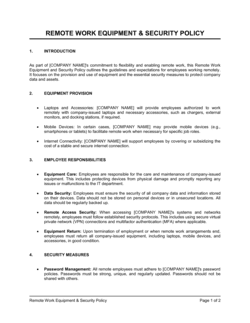
Complete the equipment and expense section
List exactly what the company provides, what the employee must supply, the dollar amount of any home-office stipend or reimbursement cap, and what happens to company equipment at termination.
💡 State internet reimbursement as a monthly dollar cap rather than a percentage — a cap is simpler to administer and audit.
5
Write the data security requirements in plain language
Translate your IT team's security controls into employee-facing rules: which networks are approved, whether VPN is mandatory, which devices are permitted, and how to handle physical documents.
💡 Have your IT or information security lead review this section before publishing — security requirements that conflict with actual IT policy create compliance gaps.
6
Define core hours in the employee's time zone
Set the window during which remote employees must be reachable. State the approved time zones and confirm whether employees in significantly different zones need a separate arrangement.
💡 If your team spans more than three hours of time zone difference, consider a shorter core-hours window (e.g., 10 a.m.–2 p.m. ET) rather than a full business day.
7
Add the approval and revocation process
Include a link to or description of the Remote Work Request Form, the approval chain (manager then HR), and the review frequency. State the notice period for revocation and the grounds that allow immediate revocation.
💡 Requiring a written acknowledgment signed by the employee at the time of approval gives you a clean record if the arrangement is later disputed.
8
Distribute, collect acknowledgments, and store records
Share the final policy with all employees, require a signed or digitally confirmed acknowledgment within a set deadline (typically 10 business days), and store acknowledgment records in your HRIS or personnel files.
💡 Set a calendar reminder to review the policy annually — remote work norms, tax rules, and security standards change fast enough that a two-year-old policy can create real exposure.