Flexible Work Arrangements Policy Template

Free Word download β€’ Edit online β€’ Save & share with Drive β€’ Export to PDF

3 pagesβ€’20–25 min to fillβ€’Difficulty: Standard
Learn more ↓
FreeFlexible Work Arrangements Policy Template

At a glance

What it is
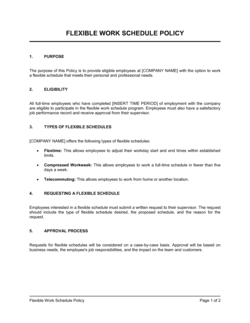
A Flexible Work Arrangements Policy is a formal written document that establishes the rules, eligibility criteria, and approval process for non-traditional work schedules and locations β€” including remote work, hybrid arrangements, compressed workweeks, and flex-time. This free Word download gives you a structured, HR-ready template you can edit online and export as PDF for distribution to employees and managers.
When you need it
Use it when formalizing hybrid or remote work practices that have grown informally, onboarding employees whose roles include schedule flexibility, or standardizing manager decisions to prevent inconsistent or inequitable treatment across teams.
What's inside
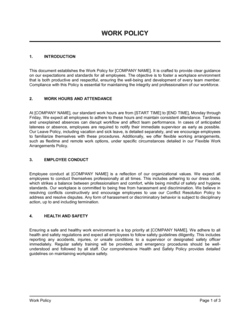
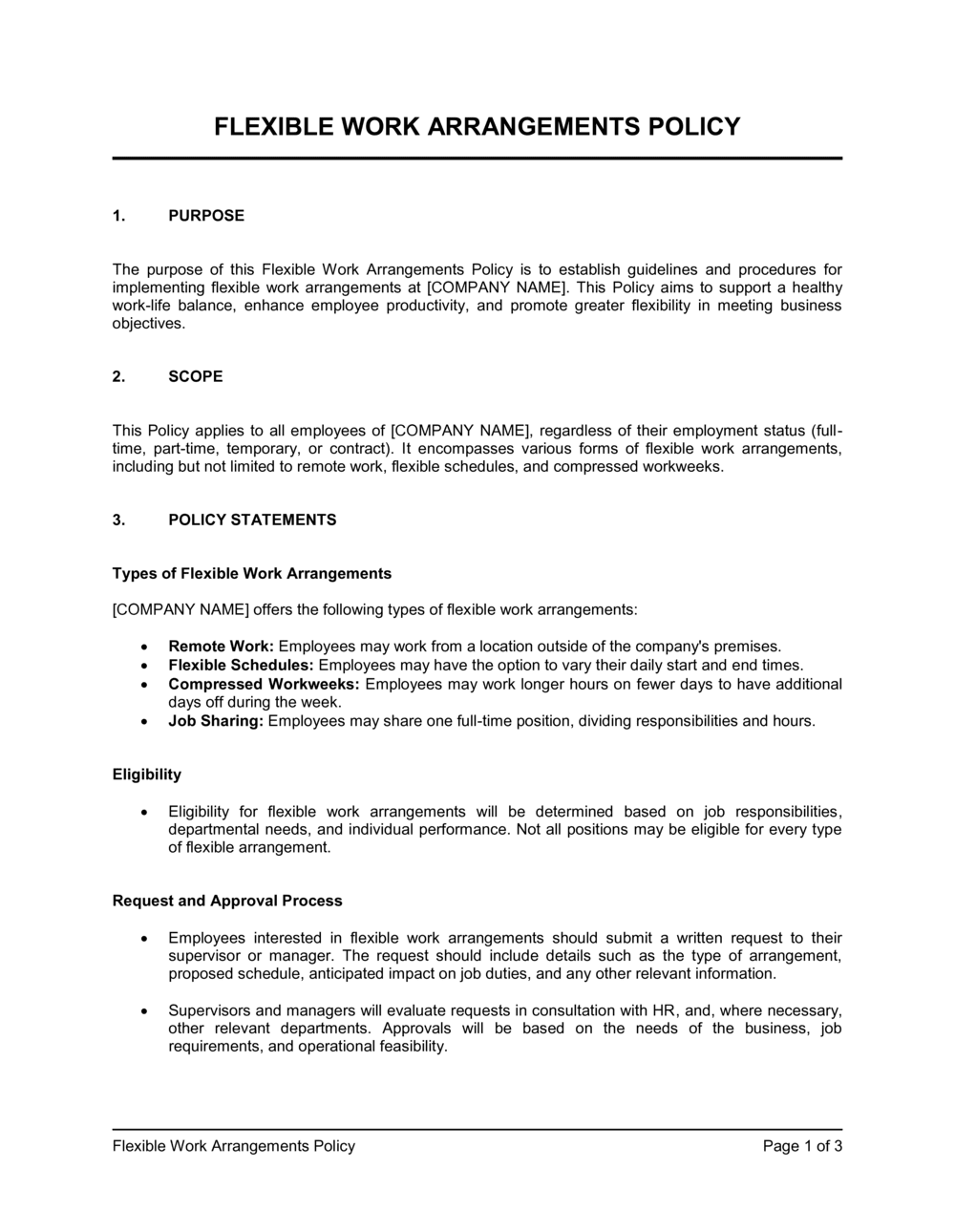
Policy purpose and scope, definitions of each arrangement type, eligibility criteria, the request and approval process, employee and manager responsibilities, performance standards, equipment and expense provisions, and review and termination conditions.

What is a Flexible Work Arrangements Policy?

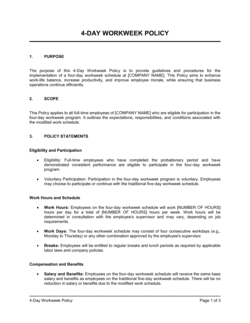
A Flexible Work Arrangements Policy is a formal HR document that defines the types of non-standard work schedules and locations a company permits β€” including remote work, hybrid schedules, compressed workweeks, flex-time, and job sharing β€” along with the eligibility criteria, request and approval process, employee and manager responsibilities, and the conditions under which arrangements can be reviewed or ended. Rather than leaving flexibility decisions to individual manager discretion, it creates a consistent, organization-wide framework that every employee and people manager can apply with confidence.

Why You Need This Document

Without a written policy, flexible work decisions accumulate as informal agreements that are nearly impossible to administer consistently. Managers in different departments apply different standards, employees compare arrangements and raise grievances, and denied requests become difficult to defend when no documented criteria exist. When a performance issue arises with a remote worker, or when business needs require pulling someone back on-site, the absence of a written process makes every conversation contentious. A clear flexible work arrangements policy eliminates the ambiguity: it defines who is eligible, what they can request, how decisions are made, and what happens when circumstances change β€” protecting both employees and the company from the disputes that informal arrangements reliably produce over time.

Which variant fits your situation?

If your situation is…Use this template
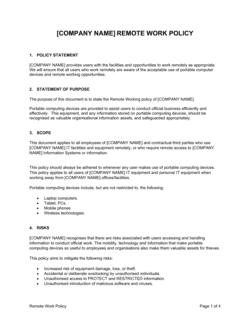
Employees working fully from home on a permanent basisRemote Work Policy
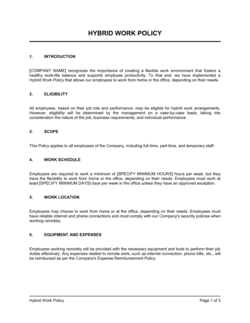
Employees splitting time between office and home on a set scheduleHybrid Work Policy
Formalizing the initial request and approval conversationFlexible Work Arrangement Request Form
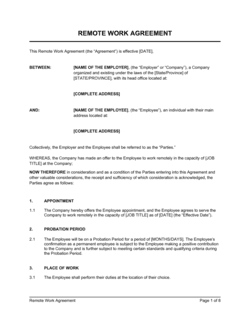
Documenting a specific employee's approved arrangementRemote Work Agreement
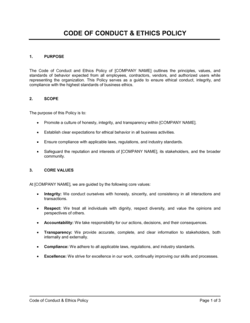
Addressing employee conduct and performance standards for all locationsEmployee Code of Conduct
Setting expectations for communication tools and response timesCommunication Policy
Compiling all HR policies into a single reference documentEmployee Handbook

Common mistakes to avoid

❌ Implying automatic eligibility in the scope section

Why it matters: Language like 'all employees may work flexibly' creates an expectation that denials require justification β€” shifting the burden to the employer in any dispute.

Fix: State explicitly that flexible arrangements are available to eligible employees at the company's discretion and subject to business need and manager approval.

❌ No written approval or denial record

Why it matters: Verbal approvals and denials cannot be audited. If a denied employee claims discrimination or inconsistent treatment, there is no evidence trail to defend the decision.

Fix: Require all FWA decisions β€” approvals and denials β€” to be documented in writing and retained in the employee's HR file for a minimum of 3 years.

❌ Vague availability requirements

Why it matters: Stating that employees must be 'generally available' during business hours generates constant manager-employee friction and makes performance conversations nearly impossible to document.

Fix: Define core hours by specific time range, state the required response time for each communication channel, and list the meeting types that require in-person or video attendance.

❌ No arrangement termination provision

Why it matters: Without a written process for ending an arrangement, employees treat approved flexibility as permanent β€” and any attempt to change it is met with resistance or escalated as a workplace grievance.

Fix: Include a clear modification and termination clause with a defined notice period and a list of conditions that trigger early review.

The 9 key sections, explained

Purpose and scope

Definitions of arrangement types

Eligibility criteria

Request and approval process

Employee responsibilities

Manager responsibilities

Equipment, technology, and expenses

Performance standards and monitoring

Review, modification, and termination of arrangements

How to fill it out

  1. 1

    Define which arrangement types your company will offer

    Decide upfront whether the policy covers remote only, hybrid only, or all arrangement types including compressed workweeks, flex-time, and job sharing. Remove definitions for types you are not prepared to approve.

    πŸ’‘ Starting narrower β€” remote and flex-time only β€” is easier to administer consistently than a policy that covers every possible variation from day one.

  2. 2

    Set specific eligibility thresholds

    Enter the minimum tenure requirement (commonly 6 months), the performance standing requirement (no active PIP), and any role or department exclusions. Be specific enough that any manager can apply the criteria independently.

    πŸ’‘ Run the eligibility criteria past your most skeptical manager before finalizing β€” if they can find edge cases, employees will too.

  3. 3

    Draft the request and approval process with timelines

    Specify the form or method employees use to request an arrangement, who reviews it (manager alone, or manager plus HR), the criteria used to evaluate it, and how long the decision takes.

    πŸ’‘ A 10-business-day turnaround is the most commonly cited approval window β€” long enough for proper review, short enough to feel responsive.

  4. 4

    Define core hours and availability expectations

    Choose a core-hours window that works across your time zones. State expected response times for email and messaging tools (e.g., within 2 hours during core hours). Specify which meetings require in-person attendance.

    πŸ’‘ If your team spans multiple time zones, set core hours in UTC and list the local equivalent for each major location in a footnote.

  5. 5

    Specify equipment provisions and expense reimbursement

    List what the company provides, what the employee supplies, and the monthly stipend amount for internet or phone costs. State the asset-return requirement if the arrangement ends.

    πŸ’‘ A flat monthly stipend (e.g., $50/month for internet) is administratively simpler than receipt-based reimbursement and reduces payroll processing time.

  6. 6

    Add the review and termination provisions

    Set the first review at 90 days, then annually. State the notice period required to modify or end an arrangement (5–10 business days is standard) and the conditions that trigger a review outside the normal cycle.

    πŸ’‘ Include a clause that role changes β€” promotion, transfer, or restructuring β€” automatically trigger a new eligibility review, not an assumed continuation of the existing arrangement.

  7. 7

    Have HR and a senior manager review before publishing

    Circulate the final draft to at least one HR professional and one operational manager who will be approving requests. Check that the criteria are clear, consistently applicable, and free of language that could imply entitlement.

    πŸ’‘ Ask reviewers to draft a hypothetical request denial using only the policy document β€” if they cannot do it confidently, the policy needs more specificity.

Frequently asked questions

What is a flexible work arrangements policy?

A flexible work arrangements policy is a formal document that defines the types of non-standard work schedules and locations a company permits β€” such as remote work, hybrid schedules, compressed workweeks, and flex-time β€” along with eligibility criteria, the request and approval process, and the standards employees must meet to maintain their arrangement. It replaces informal, ad hoc agreements with a consistent framework that applies across the organization.

Do I need a flexible work policy if my team already works flexibly?

Yes. Informal arrangements that work day-to-day become liabilities when an employee's request is denied, when a performance issue arises on a remote worker, or when a manager applies different standards to different employees. A written policy gives HR and managers a defensible, consistent basis for every decision and protects the company if an arrangement is ever challenged as inequitable.

What types of flexible arrangements should the policy cover?

At minimum, cover the arrangement types your company currently approves or is likely to approve β€” remote work, hybrid schedules, and flex-time are the most common. Compressed workweeks and job sharing are worth including if you have roles where they apply. Defining each type clearly prevents employees from requesting combinations the company never intended to offer.

How do I make the policy fair without guaranteeing flexibility to everyone?

Set objective eligibility criteria β€” minimum tenure, no active performance issues, role suitability β€” and apply them consistently. Include explicit language that approval is discretionary and subject to business need. Train managers to document every approval and denial with the same criteria so decisions hold up to scrutiny.

What should core hours be in a flexible work policy?

Core hours are typically a 4–5 hour window in the middle of the business day β€” for example, 10 a.m. to 3 p.m. in the employer's primary time zone β€” during which all employees must be reachable. For teams spanning multiple time zones, consider setting core hours in UTC and publishing local-time equivalents. The window should be wide enough for meaningful collaboration but narrow enough to preserve schedule flexibility.

Can a company revoke a flexible work arrangement?

Yes, provided the policy includes a clear modification and termination provision with a defined notice period β€” typically 5–10 business days. Valid grounds for revocation commonly include performance issues, a change in role or team, a significant change in business operations, or a pattern of availability or communication failures. Without a written termination clause, revocation is harder to defend and more likely to become a grievance.

Should the flexible work policy address equipment and expenses?

Yes. Employees and managers both need to know what equipment the company provides, what the employee is responsible for supplying, and how work-related expenses like internet and phone are handled. Ambiguity on equipment ownership also creates practical problems when an arrangement ends β€” a clear asset-return clause prevents disputes.

How often should a flexible work arrangements policy be reviewed?

Review the policy at least annually, and immediately after any major change to your workforce model β€” a shift from hybrid to fully remote, an office consolidation, or a significant expansion into new time zones. Individual arrangements should be reviewed at 90 days from approval and annually thereafter to confirm they remain workable for both the employee and the business.

How this compares to alternatives

vs Remote Work Policy

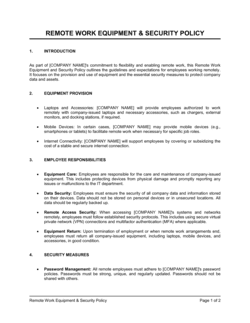
A remote work policy governs employees who work exclusively from a non-office location on a permanent or long-term basis. A flexible work arrangements policy is broader β€” it covers remote work as one of several arrangement types alongside hybrid, compressed workweek, and flex-time. Use the remote work policy when your workforce is fully distributed; use the flexible work policy when you need a single document governing multiple arrangement types.

vs Remote Work Agreement

A remote work agreement is a bilateral document signed by an individual employee and their manager to record the specific terms of that employee's approved arrangement. A flexible work arrangements policy is a company-wide framework document that applies to all employees. The policy governs what is permissible; the agreement documents what was approved for a specific person.

vs Employee Handbook

An employee handbook compiles all HR policies β€” conduct, benefits, leave, compensation, and more β€” into a single reference document. A flexible work arrangements policy is one standalone policy that can be incorporated into the handbook or distributed independently. When your flexible work rules are detailed enough to warrant their own document, maintaining them separately makes annual updates easier.

vs Code of Conduct Policy

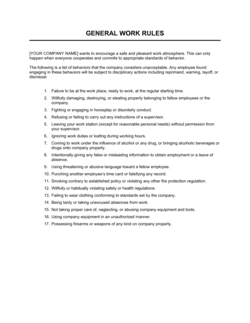
A code of conduct governs employee behavior and ethical standards across all work settings. A flexible work arrangements policy governs where and when work happens. The two documents complement each other β€” employees working flexibly remain subject to conduct standards β€” but address entirely different operational questions.

Industry-specific considerations

Technology / SaaS

Distributed engineering and product teams often span multiple time zones, making core-hours definitions and asynchronous communication standards the most critical sections of the policy.

Professional Services

Client-facing roles require explicit rules on in-person client meeting attendance and availability during client business hours, often making hybrid rather than fully remote arrangements the default.

Financial Services

Regulatory and data-security requirements often restrict remote work for roles with access to sensitive client or trading data, requiring the policy to define which roles are ineligible.

Healthcare

Clinical and patient-facing roles typically cannot be performed remotely, so the policy must clearly distinguish eligible administrative and back-office positions from excluded clinical roles.

Retail / E-commerce

Warehouse, fulfillment, and store operations staff are almost always excluded, making a precise scope and eligibility section essential to prevent requests from roles that cannot work flexibly.

Manufacturing

Flexible arrangements typically apply only to corporate, HR, finance, and sales functions β€” the policy must explicitly exclude production floor roles and address shift-schedule variations separately.

Template vs pro β€” what fits your needs?

PathBest forCostTime
Use the templateHR managers and small business owners formalizing existing informal arrangements for a workforce under 200 employeesFree2–4 hours
Template + professional reviewCompanies in jurisdictions with statutory flexible-working request rights (UK, Australia) or with unionized workforces$300–$800 for an HR consultant or employment lawyer review3–5 business days
Custom draftedEnterprise employers with complex multi-jurisdiction workforces, collective bargaining agreements, or regulated industries requiring location-specific security controls$1,500–$4,0002–4 weeks

Glossary

Flexible Work Arrangement (FWA)
Any formal deviation from standard office hours or location β€” including remote work, compressed workweeks, flex-time, or job sharing β€” approved by the employer.
Remote Work
A work arrangement in which the employee performs their duties from a location other than a company office, typically their home.
Hybrid Work
An arrangement that splits an employee's working time between a company office and a remote location on a defined or flexible schedule.
Compressed Workweek
A schedule in which an employee works their full weekly hours across fewer than five days β€” for example, four 10-hour days instead of five 8-hour days.
Flex-Time
An arrangement allowing employees to choose their own start and end times within defined core hours, as long as total hours requirements are met.
Core Hours
A defined daily window β€” typically 10 a.m. to 3 p.m. β€” during which all employees, regardless of schedule, must be available for meetings and collaboration.
Job Sharing
An arrangement in which two part-time employees share the responsibilities, hours, and pay of one full-time position.
Eligible Position
A role whose duties can be performed effectively outside a standard office environment, as determined by the employee's manager and HR.
Performance Standards
Defined output and availability expectations that apply to an employee under a flexible arrangement, used to evaluate whether the arrangement remains appropriate.
Arrangement Review Period
A scheduled interval β€” typically 90 days or 6 months β€” at which the employer formally evaluates whether an approved flexible arrangement is meeting business needs.

Part of your Business Operating System

This document is one of 3,000+ business & legal templates included in Business in a Box.

  • Fill-in-the-blanks β€” ready in minutes
  • 100% customizable Word document
  • Compatible with all office suites
  • Export to PDF and share electronically

Create your document in 3 simple steps.

From template to signed document β€” all inside one Business Operating System.
1
Download or open template

Access over 3,000+ business and legal templates for any business task, project or initiative.

2
Edit and fill in the blanks with AI

Customize your ready-made business document template and save it in the cloud.

3
Save, Share, Send, Sign

Share your files and folders with your team. Create a space of seamless collaboration.

Save time, save money, and create top-quality documents.

β˜…β˜…β˜…β˜…β˜…

"Fantastic value! I'm not sure how I'd do without it. It's worth its weight in gold and paid back for itself many times."

Managing Director Β· Mall Farm
Robert Whalley
Managing Director, Mall Farm Proprietary Limited
β˜…β˜…β˜…β˜…β˜…

"I have been using Business in a Box for years. It has been the most useful source of templates I have encountered. I recommend it to anyone."

Business Owner Β· 4+ years
Dr Michael John Freestone
Business Owner
β˜…β˜…β˜…β˜…β˜…

"It has been a life saver so many times I have lost count. Business in a Box has saved me so much time and as you know, time is money."

Owner Β· Upstate Web
David G. Moore Jr.
Owner, Upstate Web

Run your business with a system β€” not scattered tools

Stop downloading documents. Start operating with clarity. Business in a Box gives you the Business Operating System used by over 250,000 companies worldwide to structure, run, and grow their business.

Start freeΒ Β·Β No credit card required