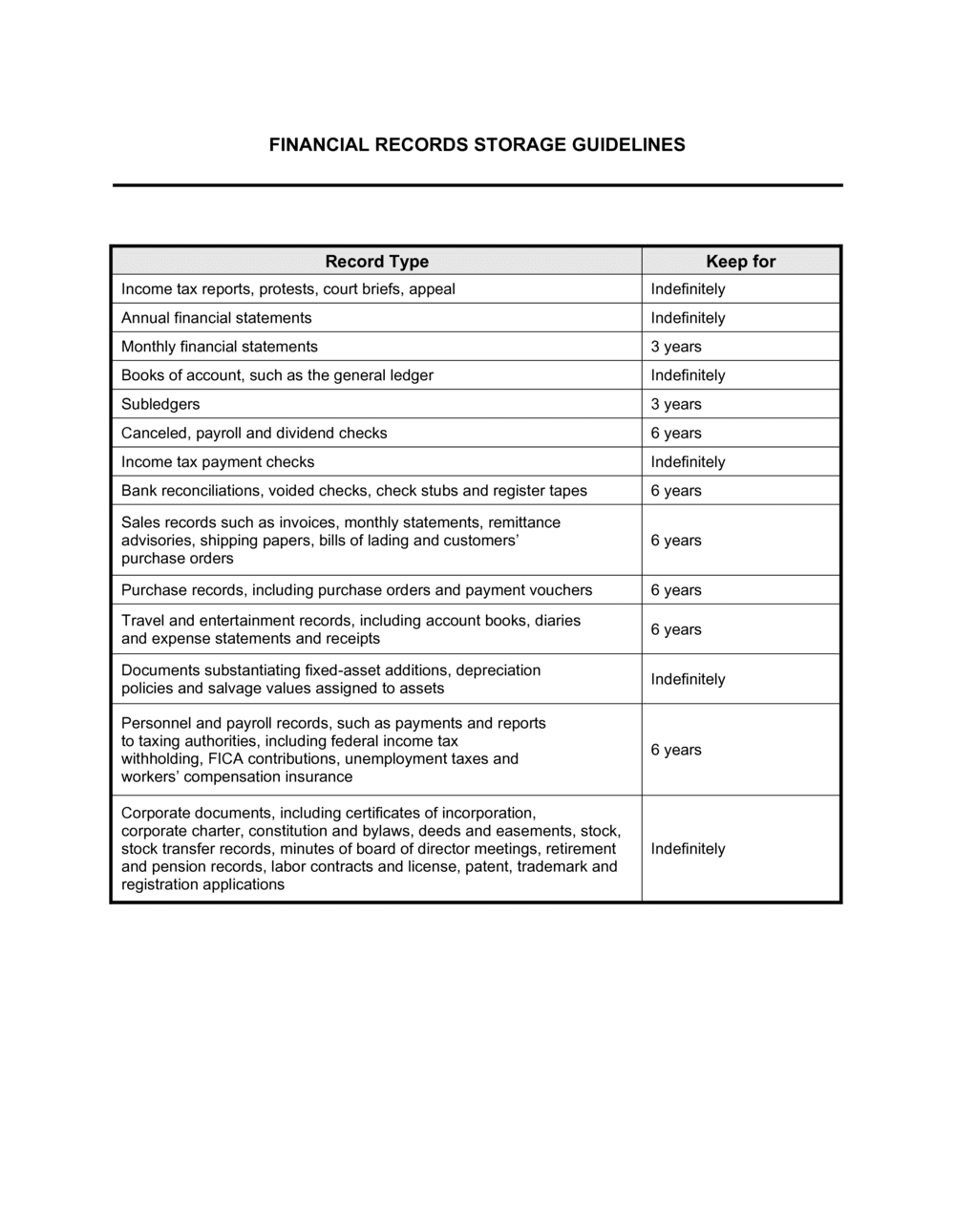
Financial Record Storage Guidelines

Free Word download • Edit online • Save & share with Drive • Export to PDF

1 page20–30 min to fillDifficulty: StandardSignature requiredLegal review recommended
Learn more ↓
FreeFinancial Record Storage Guidelines Template

At a glance

What it is
Financial Record Storage Guidelines is a binding internal policy document that specifies which financial records a business must retain, for how long, in what format, and under what access and security controls. This free Word download gives you a structured, compliance-ready starting point you can edit online and export as PDF for distribution to finance, accounting, IT, and operations teams.
When you need it
Use it when establishing or formalizing your organization's approach to financial recordkeeping — particularly before a tax audit, financial review, regulatory inspection, or when onboarding new accounting or finance staff. It is also essential when migrating from paper to digital record storage or when updating an outdated retention policy to reflect current regulations.
What's inside
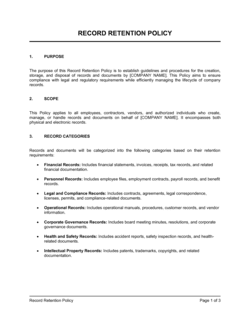
The document covers record classification and retention schedules, physical and digital storage requirements, access controls and authorization levels, destruction and disposal procedures, audit and compliance obligations, and roles and responsibilities for policy enforcement. It also includes a cross-reference table mapping record types to their applicable statutory retention periods.

What is a Financial Record Storage Guidelines document?

Financial Record Storage Guidelines is a binding internal policy document that defines how an organization classifies, stores, secures, and ultimately destroys its financial records in compliance with applicable tax, corporate, and employment law. It translates statutory retention minimums — drawn from IRS rules, provincial legislation, HMRC requirements, and EU directives — into specific operational procedures that finance, accounting, IT, and operations staff can apply consistently. Unlike a general document retention policy, this instrument focuses exclusively on financial records, providing the detailed retention schedule, access control matrix, and destruction certification requirements that auditors and regulators expect to find when they examine a company's compliance program.

Why You Need This Document

Without written financial record storage guidelines, companies face four concrete risks simultaneously. First, records are destroyed too early — the IRS, HMRC, and CRA all impose penalties when required records cannot be produced, and informal retention practices almost always result in gaps precisely in the categories auditors examine most closely. Second, records containing sensitive financial data are disposed of insecurely, creating data breach liability under state, provincial, and EU law. Third, when litigation arises, there is no legal hold mechanism to suspend routine destruction — courts treat the absence of a documented hold process as evidence of spoliation, with consequences ranging from monetary sanctions to adverse jury instructions. Fourth, without named custodians and a review schedule, the policy becomes a dormant document that provides no real protection while giving false assurance of compliance. This template gives your organization a defensible, jurisdiction-aware starting point that closes all four gaps — ready to be signed, distributed, and enforced before your next audit cycle.

Which variant fits your situation?

If your situation is…Use this template
Setting a company-wide policy covering all document typesDocument Retention Policy
Governing financial records specifically for a publicly traded companyFinancial Record Storage Guidelines (Public Company)
Covering HR and personnel file retention alongside financial recordsEmployee Records Retention Policy
Managing electronic records and cloud storage complianceElectronic Records Management Policy
Defining procedures for destroying records at end of retention periodDocument Destruction Policy
Establishing controls for records subject to an active legal holdLegal Hold Notice
Documenting accounting procedures for a specific department or roleAccounting Procedures Manual

Common mistakes to avoid

❌ Using a single retention period for all financial records

Why it matters: Different record types carry different statutory minimums — payroll records, tax returns, contracts, and bank statements are each governed by different laws. A blanket period will either cause premature destruction of legally required records or unnecessary storage costs.

Fix: Build a record-by-record retention schedule cross-referenced to the specific statutes that govern each category, and use the longest applicable period for each type.

❌ No legal hold suspension mechanism

Why it matters: If normal destruction schedules continue during pending litigation or a government audit and relevant records are destroyed, the company may face spoliation sanctions — including adverse inference instructions or monetary penalties.

Fix: Build an explicit legal hold clause into the policy with a signed acknowledgment process, and train record custodians to act on a hold notice within 24 hours of receipt.

❌ Storing electronic records in proprietary formats without a migration plan

Why it matters: Accounting software is discontinued or upgraded regularly. Records stored in obsolete formats become unreadable before their retention period expires, leaving the company unable to produce them in an audit.

Fix: Require export of financial records to PDF/A or another open, non-proprietary format at each fiscal year-end, and test that archived records are readable as part of the annual policy review.

❌ Omitting a destruction certificate requirement

Why it matters: Without a signed destruction certificate, the company cannot prove it followed its own policy when records are destroyed — and auditors treat missing certificates as evidence of either premature or unauthorized destruction.

Fix: Require a signed destruction certificate for every destruction event, store certificates permanently, and include a certificate template as an exhibit to the policy.

❌ Naming a department rather than a specific title as policy owner

Why it matters: When the policy owner is 'Finance' or 'Accounting' rather than a named title, the annual review and compliance monitoring fall through the cracks whenever personnel change — which is exactly when gaps appear.

Fix: Name the CFO or a specific compliance title as policy owner, and define a deputy to assume responsibility during transitions so the policy is never effectively unowned.

❌ Failing to update the policy after regulatory or technology changes

Why it matters: Tax authorities periodically update retention minimums, cloud storage introduces new data residency and security obligations, and an outdated policy provides no protection against regulatory penalties under current rules.

Fix: Schedule a mandatory annual review tied to a fixed calendar month, and add a triggered review requirement any time a relevant statute changes or the company migrates to a new records management system.

The 10 key clauses, explained

Scope and applicability

In plain language: Defines which entities, departments, employees, and record types are covered by the policy, and states that the policy applies to records in all formats — paper, digital, and electronic.

Sample language
This Policy applies to all financial records created, received, or maintained by [COMPANY NAME] and its subsidiaries, including records held by employees, contractors, and third-party service providers acting on the Company's behalf.

Common mistake: Limiting scope to the finance department only — leaving IT, operations, and department heads who store financial data outside the policy's reach and creating unaddressed compliance gaps during audits.

Record classification and retention schedule

In plain language: Categorizes financial records by type — tax filings, invoices, payroll records, bank statements, contracts — and assigns a specific minimum retention period to each category.

Sample language
Tax returns and supporting workpapers: [7] years from filing date. Accounts payable invoices: [7] years. Payroll records: [7] years after the relevant tax year. Bank statements: [7] years. Corporate financial statements: Permanent.

Common mistake: Assigning a single blanket retention period to all financial records instead of mapping each category to its applicable statutory minimum — causing premature destruction of some records and unnecessary storage costs for others.

Physical storage requirements

In plain language: Specifies the conditions under which paper financial records must be stored — secure cabinets, fire-resistant storage, restricted access rooms — and who is authorized to access them.

Sample language
All original paper financial records shall be stored in locked, fire-resistant cabinets or rooms located at [FACILITY ADDRESS]. Access is restricted to personnel listed in Schedule B. Off-site storage arrangements must be pre-approved by [TITLE].

Common mistake: Delegating physical storage to a third-party document management vendor without a written agreement covering retrieval timelines, confidentiality, and destruction authorization — exposing the company to unauthorized disposal or breach.

Digital and electronic storage requirements

In plain language: Sets standards for electronic record storage including backup frequency, encryption, cloud provider requirements, and file format integrity to ensure records remain readable for the full retention period.

Sample language
Electronic financial records shall be stored on Company-approved systems with AES-256 encryption at rest. Backups shall occur daily and be tested quarterly. Records must be maintained in a format readable without proprietary software dependencies beyond [DATE].

Common mistake: Storing electronic records in software-proprietary formats without a migration plan — records become inaccessible mid-retention period when software is discontinued, and re-creation from source documents may be impossible.

Access controls and authorization levels

In plain language: Defines tiered access — who can view, edit, approve, or destroy financial records — and requires multi-factor authentication for sensitive financial data.

Sample language
Access to financial records is tiered as follows: Level 1 (view only) — all finance staff; Level 2 (view and edit) — accounting managers and above; Level 3 (view, edit, and authorize destruction) — CFO and designated compliance officer only.

Common mistake: Granting broad read/write access to financial records without a role-based permission structure — creating an undetectable audit trail problem and increasing the risk of unauthorized alteration or premature deletion.

Legal hold procedures

In plain language: Requires immediate suspension of all scheduled destruction for records identified as relevant to litigation, a regulatory investigation, or a government audit, and specifies the notification and documentation process.

Sample language
Upon receipt of a legal hold notice issued by [GENERAL COUNSEL / EXTERNAL COUNSEL], all destruction schedules for identified record series are immediately suspended. The record custodian shall acknowledge receipt in writing within [2] business days and segregate affected records.

Common mistake: Relying on informal email chains to communicate legal holds rather than a documented, signed acknowledgment process — leaving the company unable to prove that key employees received and acted on the hold instruction.

Record destruction and disposal procedures

In plain language: Sets the approved methods and authorization requirements for destroying financial records at the end of their retention period, including requirements for destruction certificates.

Sample language
Financial records approved for destruction shall be shredded using a cross-cut shredder meeting DIN 66399 Level P-4 for paper, and NIST 800-88 sanitization guidelines for electronic media. A Destruction Certificate signed by [TITLE] must be completed and retained permanently.

Common mistake: Discarding financial records in standard recycling or trash without a shredding or sanitization step — a common cause of data breach liability and regulatory penalties, particularly for records containing account numbers or personally identifiable financial information.

Roles and responsibilities

In plain language: Names the specific titles responsible for policy administration, record custodianship, compliance monitoring, and annual policy review.

Sample language
Policy Owner: Chief Financial Officer. Record Custodians: as designated in Schedule B. Compliance Review: Annual review by [CFO / COMPLIANCE OFFICER] each [MONTH]. IT Security Coordination: [IT DIRECTOR / CISO].

Common mistake: Naming a department rather than a specific title as policy owner — creating accountability gaps when personnel change and no individual takes ownership of the annual review or compliance monitoring.

Breach and non-compliance procedures

In plain language: Defines what constitutes a policy violation, the escalation path for reporting breaches, and the disciplinary or remediation consequences.

Sample language
Unauthorized destruction, alteration, or disclosure of financial records constitutes a policy violation. Violations must be reported to [CFO / COMPLIANCE OFFICER] within [24] hours of discovery. Consequences range from retraining to termination and may include regulatory reporting obligations.

Common mistake: Omitting a reporting obligation entirely — without a defined escalation path, employees who discover violations have no guidance, and the company cannot demonstrate a good-faith compliance program to regulators.

Policy review and amendment

In plain language: Requires the policy to be reviewed and updated at least annually, or sooner following a change in applicable law, a regulatory audit finding, or a significant change in business operations or technology.

Sample language
This Policy shall be reviewed no less than annually by [TITLE]. Amendments require approval by [CFO / BOARD / AUDIT COMMITTEE]. All employees covered by this Policy must acknowledge updated versions within [30] days of distribution.

Common mistake: Setting the policy once and treating it as permanent — regulatory retention requirements change, cloud storage technology changes, and a policy that is more than two years old without review is routinely flagged by auditors as evidence of an inactive compliance program.

How to fill it out

  1. 1

    Identify all financial record types your business generates

    List every category of financial document your organization creates, receives, or stores — tax returns, bank statements, payroll records, invoices, contracts, expense reports, and audit workpapers. Organize them into a record series table.

    💡 Cross-reference your chart of accounts with your document categories — every account line typically corresponds to at least one record series that needs a retention period assigned.

  2. 2

    Map each record type to its statutory retention minimum

    For each record series, research the applicable retention minimum under federal and state or provincial tax law, employment law, corporate law, and any industry-specific regulations. Enter the longest applicable period — never the shortest.

    💡 When multiple statutes apply to the same record, always use the longest retention period. A payroll record subject to both a 4-year IRS rule and a 7-year state rule must be kept for 7 years.

  3. 3

    Define physical and digital storage standards

    Specify the approved storage locations and media for each record series — locked cabinets, approved cloud platforms, encrypted servers — and document the backup frequency and access permissions for each.

    💡 Name the specific cloud provider or server environment in the policy rather than using generic language — this prevents employees from defaulting to unapproved personal storage solutions like consumer file-sharing services.

  4. 4

    Establish tiered access controls

    Create a permission matrix mapping each job title or role to the level of access they are authorized to have — view only, view and edit, or view, edit, and authorize destruction. Require multi-factor authentication for Level 2 and Level 3 access.

    💡 Restrict destruction authorization to no more than two named titles to maintain a clear accountability chain and reduce the risk of accidental or unauthorized permanent deletion.

  5. 5

    Document the legal hold notification process

    Write out the specific steps for issuing a legal hold — who issues it, how it is communicated, who must acknowledge it in writing, and how affected records are segregated from the normal destruction schedule.

    💡 Build a simple legal hold acknowledgment form into the policy as an exhibit — a signed acknowledgment is far more defensible than an email chain if the hold is ever disputed in litigation.

  6. 6

    Set destruction procedures and certificate requirements

    Specify the approved shredding or sanitization method for each storage medium and require a signed destruction certificate for every destruction event. Store destruction certificates permanently — they are your proof of compliant disposal.

    💡 If you use a third-party shredding vendor, require them to provide a certificate of destruction with every service and store it alongside the policy records.

  7. 7

    Assign named roles and schedule the annual review

    Complete the roles and responsibilities section with specific job titles — not department names — and enter a calendar month for the annual policy review. Add the review as a recurring compliance calendar item.

    💡 Pair the annual policy review with your fiscal year-end close or external audit preparation — it's a natural trigger that ensures the review actually happens rather than being perpetually deferred.

  8. 8

    Obtain signatures and distribute to all covered staff

    Have the policy signed by the CFO or policy owner and acknowledged in writing by all employees who handle financial records. Store signed acknowledgment forms for the life of each employee's tenure plus the policy's review cycle.

    💡 Send acknowledgment requests through your HR or compliance system rather than email so you can generate a completion report showing which employees have and have not signed.

Frequently asked questions

What are financial record storage guidelines?

Financial record storage guidelines are a binding internal policy document that specifies which financial records a business must keep, for how long, in what format, and under what security and access conditions. They translate statutory retention requirements from tax, corporate, and employment law into operational procedures that finance, accounting, IT, and operations teams can follow consistently. A well-drafted policy protects the company during audits, litigation, and regulatory inspections.

How long should financial records be kept?

Retention periods vary by record type and jurisdiction. In the United States, the IRS generally recommends keeping tax returns and supporting documents for at least 7 years — longer if income was underreported by more than 25%. Payroll records typically require 4 years under federal rules, though many states require 7. Corporate financial statements and board-approved budgets are typically kept permanently. The correct approach is to build a record-by-record schedule using the longest applicable period from all relevant statutes.

Are financial record storage guidelines legally required?

No single law mandates a written financial record storage policy by that name, but the underlying obligations — keeping tax records for a defined period, maintaining payroll documentation, retaining contracts — are legally required in every major jurisdiction. A written policy is the practical mechanism for meeting those obligations consistently and demonstrating good-faith compliance to auditors and regulators. Publicly traded companies are additionally required under Sarbanes-Oxley to maintain audit-related records for 7 years.

What is the difference between a document retention policy and financial record storage guidelines?

A document retention policy is a broader, company-wide instrument covering all document types — HR, legal, operational, and financial. Financial record storage guidelines focus specifically on accounting and financial records, providing the granular retention schedules, access controls, and destruction procedures that a general document policy typically leaves to departmental discretion. Many organizations maintain both: a top-level retention policy and a finance-specific supplement with the detailed schedule.

What happens if financial records are destroyed too early?

Premature destruction of financial records can result in tax audit penalties, inability to defend against claims, adverse inference sanctions in litigation, and regulatory fines. If records are destroyed after a legal hold has been issued — even inadvertently — courts may instruct a jury to assume the destroyed records were unfavorable to the party that destroyed them. Establishing a clear policy with a legal hold mechanism is the most effective defense against this risk.

Does the policy need to cover digital and cloud-stored records?

Yes. Tax authorities and regulators in the US, Canada, the UK, and the EU treat electronic records as equivalent to paper records for retention and production purposes. Cloud-stored financial records must meet the same retention minimums and security standards as physical records. The policy should specify approved cloud providers, encryption requirements, backup frequency, and data residency restrictions — particularly for companies operating in the EU, where GDPR imposes data localization considerations.

Who should sign and own the financial record storage policy?

The policy should be signed by the CFO or, in smaller organizations, the CEO or Controller as policy owner. All employees who handle financial records — including accounts payable clerks, payroll administrators, and department managers with budget responsibility — should provide a written acknowledgment that they have received and understood the policy. IT administrators responsible for electronic storage systems should also sign to confirm their technical controls align with the policy's requirements.

How often should financial record storage guidelines be updated?

At minimum annually, and immediately following any change in applicable tax or corporate law, a regulatory audit finding, or a significant change in storage technology or vendor relationships. Policies that are more than two years old without a documented review are routinely flagged by external auditors as evidence of an inactive compliance program — even if the underlying practices are sound.

What records should never be destroyed?

Certain records are typically designated for permanent retention: corporate financial statements and annual reports, audit reports, tax returns for years in which a significant transaction occurred, minutes of board meetings approving financial matters, records related to asset acquisitions and dispositions, and any records subject to an active legal hold. The policy should include a permanent retention category and name the custodian responsible for safeguarding those records indefinitely.

How this compares to alternatives

vs Document Retention Policy

A document retention policy is a company-wide instrument covering all record types — HR files, contracts, operational documents, and financial records. Financial record storage guidelines are a finance-specific supplement that provides the granular retention schedule, access controls, and destruction procedures that a general policy leaves to departmental discretion. Organizations typically need both: a top-level policy and this detailed financial supplement.

vs Accounting Procedures Manual

An accounting procedures manual documents how transactions are processed, recorded, and reconciled — the day-to-day operational workflow. Financial record storage guidelines govern what happens to the records those transactions produce: how long they are kept, where they are stored, and how they are eventually destroyed. The two documents complement each other but serve distinct compliance and operational functions.

vs Legal Hold Notice

A legal hold notice is an event-driven document issued to suspend normal destruction schedules when litigation or a regulatory investigation arises. Financial record storage guidelines are the standing policy that governs records in the absence of a hold. The guidelines should explicitly reference legal hold procedures and specify how a hold notice overrides the standard retention and destruction schedule.

vs Data Governance Policy

A data governance policy addresses the full lifecycle of organizational data — including personal data, operational data, and intellectual property — with a focus on data quality, privacy, and security. Financial record storage guidelines address the specific retention, access, and destruction requirements for financial records under tax and corporate law. Financial records are a subset of data governance, and the two policies should be cross-referenced to avoid conflicting rules.

Industry-specific considerations

Financial Services

Regulated by SEC, FINRA, and banking regulators requiring 6–7 year retention of trading records, customer account statements, and compliance documentation — with strict electronic storage and audit trail requirements.

Healthcare

Financial records intersect with HIPAA billing and payment data obligations, requiring retention periods that satisfy both IRS rules and state health department requirements, often extending to 10 years for Medicare and Medicaid billing records.

Manufacturing

Cost accounting records, inventory valuations, and capital expenditure documentation must align with depreciation schedules and may be subject to government contract audit requirements under FAR if the manufacturer is a federal supplier.

Professional Services

Client billing records, engagement letters, and trust account documentation carry both firm liability and professional licensing implications, with bar association and CPA board rules imposing retention requirements that may exceed standard IRS minimums.

Retail and E-commerce

Sales tax records, payment processor settlement reports, and inventory purchase documentation must be retained to support multi-state sales tax nexus compliance and chargebacks, with state audit exposure extending up to 10 years in some jurisdictions.

Nonprofit Organizations

IRS Form 990 filings, grant expenditure records, and donor contribution documentation must be retained for at least 7 years to support public disclosure obligations and foundation grant compliance audits.

Jurisdictional notes

United States

The IRS recommends retaining tax records for at least 7 years — 6 years if income was underreported by more than 25%, and indefinitely for fraudulent returns. Sarbanes-Oxley requires public companies to retain audit-related workpapers for 7 years. State-level retention requirements vary significantly and may exceed federal minimums — California and New York both impose 7-year rules for several record types where the federal standard is shorter. Employers must also comply with FLSA and state wage-and-hour record requirements, typically 3–7 years for payroll records.

Canada

The Canada Revenue Agency requires most business records to be kept for a minimum of 6 years from the end of the last tax year to which they relate. Quebec has additional provincial requirements for French-language record maintenance. The Employment Standards Acts in each province set separate payroll record retention minimums, typically 3–5 years after employment ends. Electronic records must meet CRA's Generally Accepted Electronic Record Keeping (GAER) requirements, including audit trail integrity and readable format standards.

United Kingdom

HMRC requires limited companies to retain accounting records for at least 6 years from the end of the accounting period. Sole traders and partnerships must retain records for at least 5 years after the 31 January submission deadline of the relevant tax year. Under Making Tax Digital (MTD), digital records must be maintained in HMRC-compatible software for VAT and income tax purposes. The Companies Act 2006 requires listed companies to retain financial records for 6 years and private companies for 3 years, though the longer HMRC period is the operative standard in practice.

European Union

Retention requirements vary by member state — France requires 10 years for accounting documents, Germany requires 10 years for books of account and 6 years for trade correspondence, and the Netherlands requires 7 years for most financial records. GDPR intersects with financial record retention where records contain personal data: organizations must balance retention obligations under tax law against GDPR's data minimization principle, typically by applying anonymization or pseudonymization to personal data fields in records that must be kept longer than GDPR would otherwise allow. VAT Directive requirements apply uniformly across member states for VAT-related financial records.

Template vs lawyer — what fits your deal?

PathBest forCostTime
Use the templateSmall businesses, sole proprietors, and early-stage companies establishing a first formal recordkeeping policy for a single jurisdictionFree2–4 hours to complete and distribute
Template + legal reviewMulti-state or multi-province businesses, companies subject to industry-specific regulations, or any organization that has received an audit notice$300–$800 for an accountant or compliance attorney review3–5 business days
Custom draftedPublicly traded companies, financial services firms, healthcare organizations, or businesses with operations in multiple countries requiring jurisdiction-specific retention schedules$1,500–$5,000+2–4 weeks

Glossary

Retention Period
The minimum length of time a specific record must be kept before it may lawfully be destroyed, typically set by statute or regulation.
Record Custodian
The designated individual or department responsible for maintaining, protecting, and ensuring proper disposal of a specific category of records.
Legal Hold
A directive suspending the normal destruction of records because they are relevant to pending or reasonably anticipated litigation, audit, or regulatory investigation.
Destruction Certificate
A written record documenting the date, method, and authorization of the destruction of financial documents at the end of their retention period.
Audit Trail
A chronological log of all access, modifications, and transfers applied to a financial record, used to verify its integrity and chain of custody.
Media Migration
The process of transferring records from an obsolete storage format — such as microfiche or legacy software — to a current format while preserving their legal integrity.
Access Control
Technical and administrative measures that restrict who may view, modify, or destroy financial records, typically enforced through permissions and authentication.
Statutory Retention Minimum
The legally mandated shortest period a specific record type must be kept, as defined by tax, corporate, or employment statutes in a given jurisdiction.
Chain of Custody
A documented record of every person who has handled or accessed a specific document from creation through final disposition.
Record Series
A grouping of related records created or used together in the conduct of business activities — such as all accounts payable invoices for a fiscal year.
Disposition Schedule
A timetable listing each record series, its retention period, and the approved destruction or archival action to be taken at the end of that period.

Part of your Business Operating System

This document is one of 3,000+ business & legal templates included in Business in a Box.

  • Fill-in-the-blanks — ready in minutes
  • 100% customizable Word document
  • Compatible with all office suites
  • Export to PDF and share electronically

Create your document in 3 simple steps.

From template to signed document — all inside one Business Operating System.
1
Download or open template

Access over 3,000+ business and legal templates for any business task, project or initiative.

2
Edit and fill in the blanks with AI

Customize your ready-made business document template and save it in the cloud.

3
Save, Share, Send, Sign

Share your files and folders with your team. Create a space of seamless collaboration.

Save time, save money, and create top-quality documents.

★★★★★

"Fantastic value! I'm not sure how I'd do without it. It's worth its weight in gold and paid back for itself many times."

Managing Director · Mall Farm
Robert Whalley
Managing Director, Mall Farm Proprietary Limited
★★★★★

"I have been using Business in a Box for years. It has been the most useful source of templates I have encountered. I recommend it to anyone."

Business Owner · 4+ years
Dr Michael John Freestone
Business Owner
★★★★★

"It has been a life saver so many times I have lost count. Business in a Box has saved me so much time and as you know, time is money."

Owner · Upstate Web
David G. Moore Jr.
Owner, Upstate Web

Run your business with a system — not scattered tools

Stop downloading documents. Start operating with clarity. Business in a Box gives you the Business Operating System used by over 250,000 companies worldwide to structure, run, and grow their business.

Free Forever Plan · No credit card required