1
Identify and confirm the original lease details
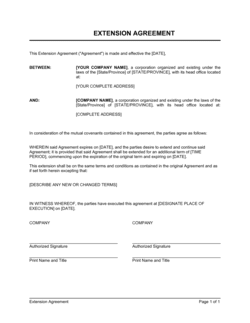
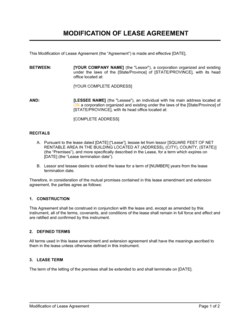
Enter the legal names of landlord and tenant exactly as they appear on the original lease, the property address, and the original lease execution date and expiry date. Pull the original document to verify these details precisely.
💡 If the original lease has been amended before, reference the most recent amendment as the governing document rather than just the original — this prevents arguments about which version controls.
2
Set the new extension term dates
Enter the start date as the day immediately following the original expiry date and calculate the end date based on the agreed extension length. Confirm both dates in writing with the other party before finalising the document.
💡 Use a specific calendar date (e.g., January 1, 2027) rather than a phrase like 'one year from expiry' — relative date language causes disputes if the original expiry date is itself disputed.
3
Agree and enter the rent amount
State the new monthly rent clearly in both numeric and written form. If rent changes from the original, confirm the effective date of the new amount and whether any transition period applies.
💡 If the parties negotiate a rent-free period at the start of the extension, document it explicitly in this clause rather than leaving it as a verbal understanding.
4
Add a rent escalation provision if the term exceeds 12 months
For extensions longer than one year, specify the escalation method — fixed annual percentage (e.g., 3%), CPI index, or market review — and the date on which the first increase takes effect.
💡 Cap CPI increases at a maximum percentage (e.g., 5%) to give both parties certainty when inflation spikes unexpectedly.
5
Confirm conditions and check for defaults
Before signing, verify that the tenant is not in default on rent, operating costs, or any other obligation under the original lease. Document the confirmation in the conditions clause.
💡 Ask the tenant to provide written confirmation of their last three months' rent payments if you do not have a property management system tracking this automatically.
6
Address the security deposit
State explicitly whether the existing deposit continues, is increased proportionally to the new rent, or is partially returned. Calculate any top-up amount based on the new monthly rent multiple used in the original lease.
💡 In jurisdictions with statutory deposit caps (e.g., two months' rent in many US states), verify the new deposit total does not exceed the legal maximum.
7
Execute with both parties' signatures
Both landlord and tenant (and any guarantors) must sign the extension before the original lease expiry date. Use the same signing formalities — witness, corporate seal, or notarization — required by the original lease.
💡 Use Business in a Box eSign to timestamp execution and store the fully-executed copy digitally — a common source of landlord-tenant disputes is a lost or unsigned extension.
8
Register or file the extension if required
In some jurisdictions and for commercial leases above a certain term length, the extension must be registered against the title of the property to be enforceable against third parties. Check local requirements before execution.
💡 Even where registration is not mandatory, filing a notice of lease extension protects the tenant's occupancy rights if the property is sold during the extended term.