Grant of Request for Extension of Time Template

Free Word download β€’ Edit online β€’ Save & share with Drive β€’ Export to PDF

1 pageβ€’15–20 min to fillβ€’Difficulty: Standard
Learn more ↓
FreeGrant of Request for Extension of Time Template

At a glance

What it is
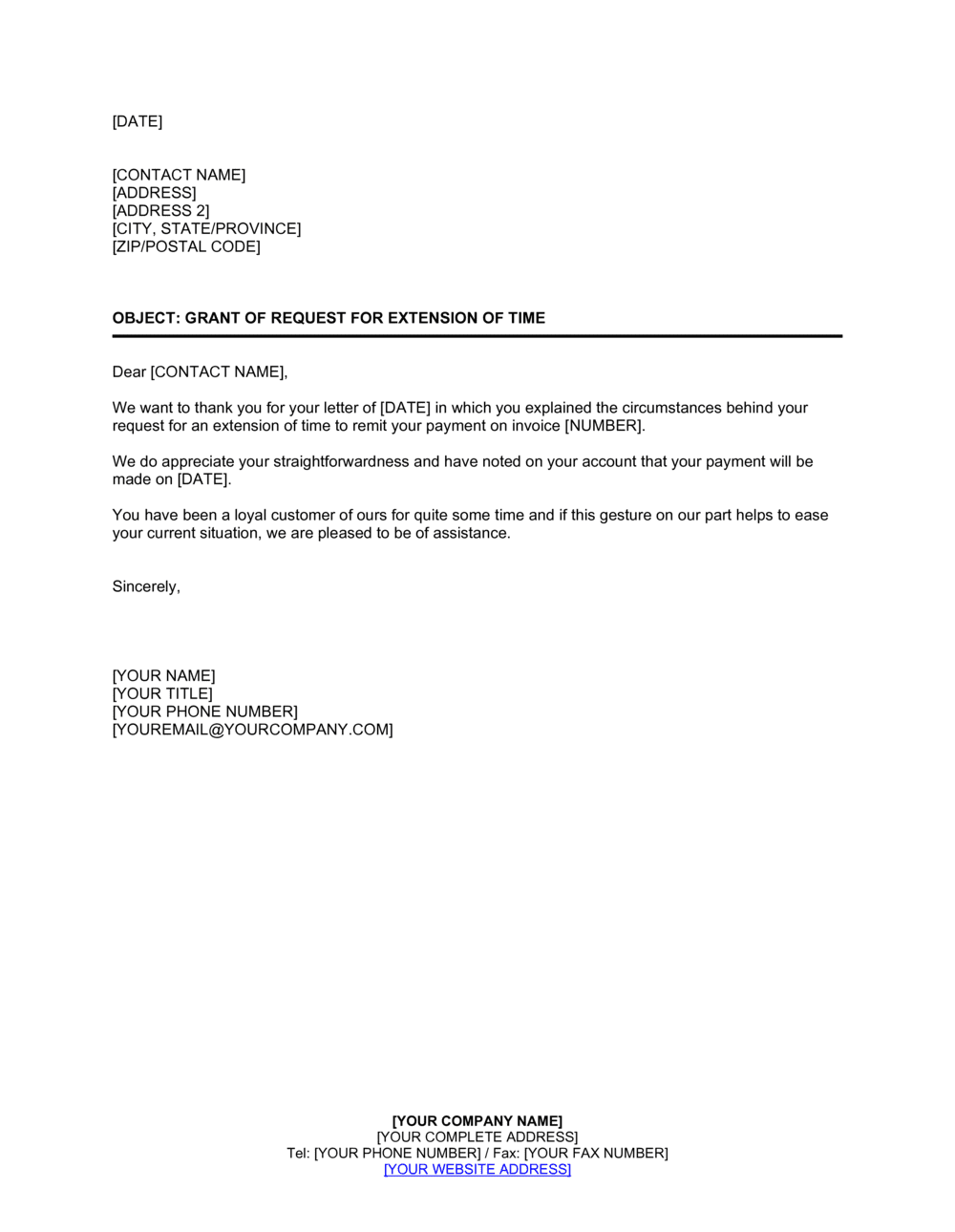
A Grant of Request for Extension of Time is a formal letter issued by a creditor, regulator, contracting authority, or other obligee that officially approves a previously submitted extension request. It confirms the new deadline, references the original obligation being modified, and states any conditions attached to the approval. This free Word download gives you a ready-to-edit template you can complete and send in minutes.
When you need it
Use it whenever you have received a written extension request and want to respond with a clear, documented approval β€” for loan repayment schedules, contract deliverable deadlines, regulatory filings, or any other time-bound obligation.
What's inside
Sender and recipient details, a reference to the original obligation and the extension request, the confirmed new deadline, any conditions of approval, and a closing statement preserving the granting party's rights. The letter is concise by design β€” typically one page β€” so every clause carries weight.

What is a Grant of Request for Extension of Time?

A Grant of Request for Extension of Time is a formal letter issued by a creditor, contracting authority, regulator, or any other party to whom an obligation is owed, confirming that a previously submitted extension request has been approved. It identifies the original obligation being modified, states the new deadline as a specific calendar date, and sets out any conditions the recipient must satisfy for the approval to remain valid. Unlike a casual email reply, this letter creates a clear written record that both parties can reference if a dispute later arises about the agreed timeline or the terms under which additional time was granted.

Why You Need This Document

Responding to an extension request with a verbal agreement or an informal email exposes the granting party to two serious risks. First, without a written confirmation, the recipient may claim they understood the extension to be unconditional β€” making any attached conditions impossible to enforce. Second, courts in many jurisdictions have found that a pattern of informal accommodations, without an explicit reservation of rights, can amount to a waiver of the original enforcement right β€” meaning you may lose the ability to pursue the defaulting party even after the extended deadline passes. A properly structured grant letter closes both gaps: it documents the new deadline with precision, captures every condition in one place, and explicitly preserves all other rights under the original agreement. This template gives you a professional, ready-to-send letter in under 15 minutes.

Which variant fits your situation?

If your situation is…Use this template
Approving a request to defer a scheduled loan or invoice paymentGrant of Request for Extension of Time
Requesting a deadline extension as the obligated partyRequest for Extension of Time
Denying a deadline extension request in writingDenial of Request for Extension of Time
Formally notifying a party that a deadline has been missedNotice of Default Letter
Modifying multiple contract terms including timelinesContract Amendment
Documenting a payment plan after a missed obligationPayment Agreement
Granting a contractor additional time on a construction projectConstruction Extension of Time Letter

Common mistakes to avoid

❌ Specifying a period instead of a fixed date

Why it matters: Phrases like 'an additional 30 days' leave room for the recipient to calculate the start date differently, creating genuine ambiguity about when the new deadline falls.

Fix: Convert any agreed period to a specific calendar date in the letter and use that date consistently throughout.
❌ Omitting the reservation of rights clause

Why it matters: Granting repeated extensions without explicitly reserving your rights can be treated as a waiver of the original enforcement right, weakening your position if the new deadline is also missed.

Fix: Include a standard 'without prejudice' reservation clause in every extension letter, even when the relationship is amicable.

❌ Sending conditions in a separate email rather than in the letter

Why it matters: Conditions not captured in the formal letter are difficult to enforce if the recipient acknowledges the extension but disputes the conditions.

Fix: List every condition in the letter itself, numbered clearly, before the letter is sent β€” follow-up emails confirming terms are not a substitute.

❌ Using a trade name instead of the legal entity name

Why it matters: If the extension is ever disputed, the letter must be traceable to the correct legal entity with standing to modify the original obligation.

Fix: Check the original agreement and use the exact legal entity name as it appears there for both the sender and recipient.

The 8 key clauses, explained

Header and parties

In plain language: Identifies the sender and recipient by full legal name and address, and records the date the letter is issued.

Sample language
[DATE] | [SENDER FULL NAME / ORGANIZATION] | [SENDER ADDRESS] | To: [RECIPIENT FULL NAME / ORGANIZATION] | [RECIPIENT ADDRESS]

Common mistake: Using a trade name instead of the legal entity name β€” if a dispute arises, the letter must identify the correct legal party with standing to grant the extension.

Reference line

In plain language: Cites the original agreement, invoice, filing, or obligation by name, number, and date so the recipient can match it to their records immediately.

Sample language
Re: Grant of Extension of Time β€” [AGREEMENT / INVOICE / FILE NAME], dated [ORIGINAL DATE], Reference No. [REF NUMBER]

Common mistake: Omitting the reference number or original date, which creates ambiguity when a recipient has multiple outstanding obligations with the same party.

Acknowledgment of the extension request

In plain language: Confirms that the granting party received the recipient's request for an extension and identifies when the request was made.

Sample language
We acknowledge receipt of your request dated [REQUEST DATE] for an extension of time in connection with [DESCRIPTION OF OBLIGATION].

Common mistake: Skipping this clause and moving straight to the approval β€” without it, the letter does not establish a clear record that a request was actually made and received.

Approval statement and new deadline

In plain language: The core operative clause: states that the extension is granted and specifies the new deadline as a calendar date.

Sample language
We are pleased to confirm that your request is granted. The new deadline for [OBLIGATION] is [NEW DEADLINE DATE].

Common mistake: Stating a period ('30 additional days') rather than a specific date β€” periods are ambiguous because recipients calculate the start differently, leading to disputes about the actual new deadline.

Conditions of approval

In plain language: Lists any requirements the recipient must meet for the extension to remain valid β€” such as partial payment, submission of documents, or progress updates.

Sample language
This extension is granted subject to the following conditions: (a) [CONDITION 1]; (b) [CONDITION 2]. Failure to satisfy these conditions by [DATE] will render this extension void.

Common mistake: Listing conditions verbally or in a follow-up email rather than in the letter itself β€” conditions not documented in writing are difficult to enforce if the recipient disputes them later.

Reservation of rights

In plain language: States that granting this extension does not waive any other rights the sender holds under the original agreement, preserving all remedies if the new deadline is also missed.

Sample language
This grant of extension is made without prejudice to any rights, remedies, or claims [SENDER NAME] may have under the [AGREEMENT NAME] dated [DATE] or at law.

Common mistake: Omitting this clause entirely β€” courts in many jurisdictions have found that repeated accommodations, without a reservation of rights, can amount to a waiver of the original enforcement right.

Effect on remaining terms

In plain language: Clarifies that only the specified deadline is modified and that all other terms of the original agreement remain unchanged and in full force.

Sample language
Except as expressly set out in this letter, all other terms and conditions of the [AGREEMENT NAME] remain in full force and effect and are not affected by this extension.

Common mistake: Not including this clause when the original agreement contains a 'time is of the essence' provision β€” without it, the extension's scope may be read more broadly than intended.

Closing and authorization

In plain language: Provides a professional closing, the sender's name, title, and signature block, and optionally a line for the recipient to countersign as acknowledgment.

Sample language
Please confirm your acceptance of these terms by signing and returning a copy of this letter by [ACKNOWLEDGMENT DATE]. | Yours sincerely, [AUTHORIZED SIGNATORY NAME], [TITLE], [ORGANIZATION]

Common mistake: Sending the letter without any acknowledgment mechanism β€” if the recipient later claims they never received the extension or disputes the conditions, a signed acknowledgment copy is the fastest way to resolve the dispute.

How to fill it out

  1. 1

    Enter sender and recipient details

    Add the full legal names and addresses of both parties at the top of the letter. Use the legal entity name β€” not a brand or trading name β€” for each party.

    πŸ’‘ Match the entity name exactly to the one used in the original agreement to avoid any argument that a different party issued the letter.

  2. 2

    Complete the reference line

    Insert the name, number, and date of the original agreement or obligation this letter modifies. If a specific clause number is relevant, include it.

    πŸ’‘ A precise reference line lets both parties' accounting and legal teams locate the underlying document instantly β€” this alone prevents most follow-up emails.

  3. 3

    Acknowledge the recipient's request

    State the date the extension request was received. If the request was made verbally, note that too, along with the approximate date and method.

    πŸ’‘ Even a one-sentence acknowledgment creates a documented timeline β€” useful if you need to show the extension was requested before the original deadline, not after.

  4. 4

    State the new deadline as a specific calendar date

    Insert the exact new deadline date in the approval clause. Do not use relative terms like 'an additional 30 days' β€” convert any agreed period to a fixed date.

    πŸ’‘ Use the full date format (e.g., June 30, 2026) rather than a numeric format to eliminate any ambiguity between regional date conventions.

  5. 5

    List all conditions of the extension

    If the extension comes with conditions β€” partial payment, submission of a document, or a progress report β€” list each one explicitly with its own deadline.

    πŸ’‘ Number the conditions (a), (b), (c) rather than writing them as prose so neither party can later claim a condition was ambiguous or missed.

  6. 6

    Include the reservation of rights and effect-on-terms clauses

    Confirm that all other terms of the original agreement remain unchanged and that you are not waiving any rights by granting this extension.

    πŸ’‘ If the original agreement contains a 'time is of the essence' clause, cite it by name here to make clear the extension is a narrow, one-time accommodation.

  7. 7

    Add the authorization block and send for acknowledgment

    Include the authorized signatory's name and title. Add a countersignature line with a return-by date so you receive written confirmation the recipient accepts the terms.

    πŸ’‘ Send the letter by email with a read receipt and retain a copy in the same file as the original agreement β€” not just in your email sent folder.

Frequently asked questions

What is a grant of request for extension of time?

A grant of request for extension of time is a formal letter from a creditor, contracting authority, or regulator confirming that a previously submitted deadline extension request has been approved. It records the new deadline, references the original obligation being modified, and sets out any conditions attached to the approval. It creates a written record that both parties can rely on if a dispute arises later about the agreed timeline.

When should I issue a grant of extension of time letter?

Issue the letter as soon as you decide to approve the extension β€” ideally before the original deadline passes. An approval that arrives after the deadline can create ambiguity about whether a technical default occurred. Sending promptly also gives the recipient clear notice of any attached conditions while there is still time to meet them.

Does granting an extension of time waive my other rights?

Not if the letter includes a clear reservation-of-rights clause. Without one, repeated accommodations can be interpreted by a court as a waiver of the original enforcement right, particularly if you have a history of accepting late performance. The standard approach is to include a without-prejudice statement in every extension letter, confirming that all other rights under the original agreement remain intact.

Should the new deadline be a specific date or a number of additional days?

Always use a specific calendar date. A number of additional days is ambiguous because the recipient may calculate the start date differently β€” from the date of the original deadline, the date of the request, or the date of this letter. Converting any agreed period to a fixed date eliminates that ambiguity and makes the deadline immediately clear to both parties.

Does this letter need to be signed to be valid?

A signature is not strictly required for a letter to be legally effective in most jurisdictions, but including an authorized signatory block is strongly recommended. More importantly, requesting a countersignature from the recipient creates a written acknowledgment that they received the extension, accepted its conditions, and understand the new deadline β€” which resolves most disputes before they escalate.

What is the difference between a grant of extension and a contract amendment?

A grant of extension letter modifies a single deadline while leaving all other contract terms unchanged. A contract amendment is a broader document that can modify any term β€” price, scope, parties, payment schedule, or multiple deadlines at once. For a straightforward one-off deadline change, an extension letter is faster and sufficient. If the change affects multiple provisions or the parties' core obligations, a formal amendment is more appropriate.

Can I attach conditions to an extension of time approval?

Yes, and doing so is common practice. Conditions might include a partial payment before the new deadline, submission of a progress report, or agreement that no further extensions will be granted. List each condition explicitly and numbered in the letter itself β€” not in a follow-up email β€” so the approval and its conditions form a single, unambiguous document.

What happens if the recipient misses the extended deadline?

If the reservation-of-rights clause is in place, you retain all remedies available under the original agreement β€” including enforcement, default notices, or escalation to collections or legal proceedings. The extension letter itself becomes evidence of the agreed new deadline, making it straightforward to demonstrate that a second default occurred. Consider sending a notice of default promptly if the extended deadline passes without performance.

How this compares to alternatives

vs Request for Extension of Time

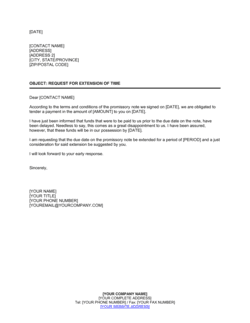
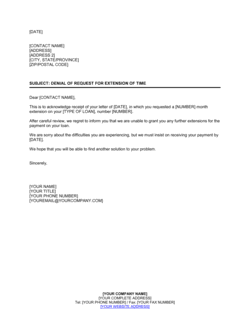
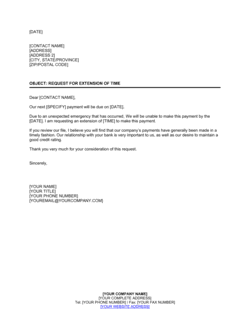
A Request for Extension of Time is the letter the obligated party sends to ask for more time. This Grant letter is the response from the granting party confirming approval. One initiates the process; the other closes it. Both should be retained together as a matched pair in the file for the original obligation.

vs Denial of Request for Extension of Time

A denial letter formally refuses the extension request and confirms the original deadline remains in force. The grant letter approves it. The choice between the two depends on the granting party's decision β€” but either way, a written response is better than silence, which creates ambiguity about whether the request was ever received.

vs Contract Amendment

A contract amendment is a formal document that can modify any term of an existing agreement β€” scope, price, parties, or multiple deadlines simultaneously. An extension of time letter is a narrower instrument that changes only one deadline while explicitly preserving all other terms. Use the letter for a single deadline change; use the amendment when multiple terms need updating at once.

vs Payment Agreement

A payment agreement restructures the full repayment schedule β€” often after a default β€” setting out a new series of instalments and amounts. An extension of time letter simply defers a single existing deadline without restructuring the underlying obligation. If the original payment structure needs to change, not just the due date, a payment agreement is the appropriate document.

Industry-specific considerations

Financial Services and Lending

Loan repayment deferral approvals that must reference the original loan agreement, state the new payment date, and preserve the lender's security interest and default remedies.

Construction and Contracting

Practical completion deadline extensions tied to specific milestone dates, with conditions covering progress reporting and no-damages-for-delay acknowledgments.

Professional Services

Deliverable or reporting deadline extensions between agencies, consultants, and clients, where the scope of work is unchanged but the timeline requires documented modification.

Government and Regulatory

Formal approval of filing, licensing, or compliance deadline extensions that must meet specific regulatory format and record-keeping requirements.

Template vs pro β€” what fits your needs?

PathBest forCostTime
Use the templateCreditors, managers, and business owners granting routine deadline extensions on standard obligationsFree10–15 minutes
Template + professional reviewExtensions involving significant financial exposure, multiple conditions, or a prior missed deadline$100–$300 for a solicitor or contract lawyer review1–2 days
Custom draftedComplex multi-party contracts, regulatory filings with statutory consequences, or situations where a prior default has occurred$300–$1,000+2–5 days

Glossary

Extension of Time
A formal modification to a deadline that gives the obligated party additional time to fulfill a contractual, regulatory, or financial obligation.
Obligee
The party to whom an obligation is owed β€” the creditor, contracting authority, or regulator who grants or denies the extension.
Obligor
The party who owes the obligation and has requested additional time to fulfill it.
Original Obligation
The underlying duty, payment, deliverable, or filing that is subject to the deadline being extended.
Condition Precedent
A requirement that must be satisfied before the extension approval takes effect β€” for example, payment of a partial amount or submission of supporting documentation.
Without Prejudice
A statement indicating that granting the extension does not waive any other rights the granting party holds under the original agreement.
Time of the Essence
A contract clause stating that deadlines are strict and that failure to meet them constitutes a material breach β€” relevant context when deciding whether to grant or document an extension.
Waiver
The voluntary relinquishment of a known right β€” granting an extension without a reservation-of-rights clause may inadvertently waive future enforcement of the original terms.
Effective Date
The date from which the new deadline and any attached conditions become operative, which may differ from the date the letter is sent.

Part of your Business Operating System

This document is one of 3,000+ business & legal templates included in Business in a Box.

  • Fill-in-the-blanks β€” ready in minutes
  • 100% customizable Word document
  • Compatible with all office suites
  • Export to PDF and share electronically

Create your document in 3 simple steps.

From template to signed document β€” all inside one Business Operating System.
1
Download or open template

Access over 3,000+ business and legal templates for any business task, project or initiative.

2
Edit and fill in the blanks with AI

Customize your ready-made business document template and save it in the cloud.

3
Save, Share, Send, Sign

Share your files and folders with your team. Create a space of seamless collaboration.

Save time, save money, and create top-quality documents.

β˜…β˜…β˜…β˜…β˜…

"Fantastic value! I'm not sure how I'd do without it. It's worth its weight in gold and paid back for itself many times."

Managing Director Β· Mall Farm
Robert Whalley
Managing Director, Mall Farm Proprietary Limited
β˜…β˜…β˜…β˜…β˜…

"I have been using Business in a Box for years. It has been the most useful source of templates I have encountered. I recommend it to anyone."

Business Owner Β· 4+ years
Dr Michael John Freestone
Business Owner
β˜…β˜…β˜…β˜…β˜…

"It has been a life saver so many times I have lost count. Business in a Box has saved me so much time and as you know, time is money."

Owner Β· Upstate Web
David G. Moore Jr.
Owner, Upstate Web

Run your business with a system β€” not scattered tools

Stop downloading documents. Start operating with clarity. Business in a Box gives you the Business Operating System used by over 250,000 companies worldwide to structure, run, and grow their business.

Free Forever PlanΒ Β·Β No credit card required