Request to Bank for Extension of Time Template

Free Word download β€’ Edit online β€’ Save & share with Drive β€’ Export to PDF

1 pageβ€’15–20 min to fillβ€’Difficulty: Standard
Learn more ↓
FreeRequest to Bank for Extension of Time Template

At a glance

What it is
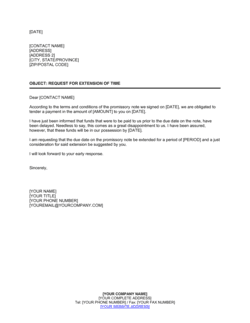
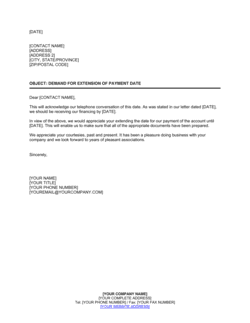
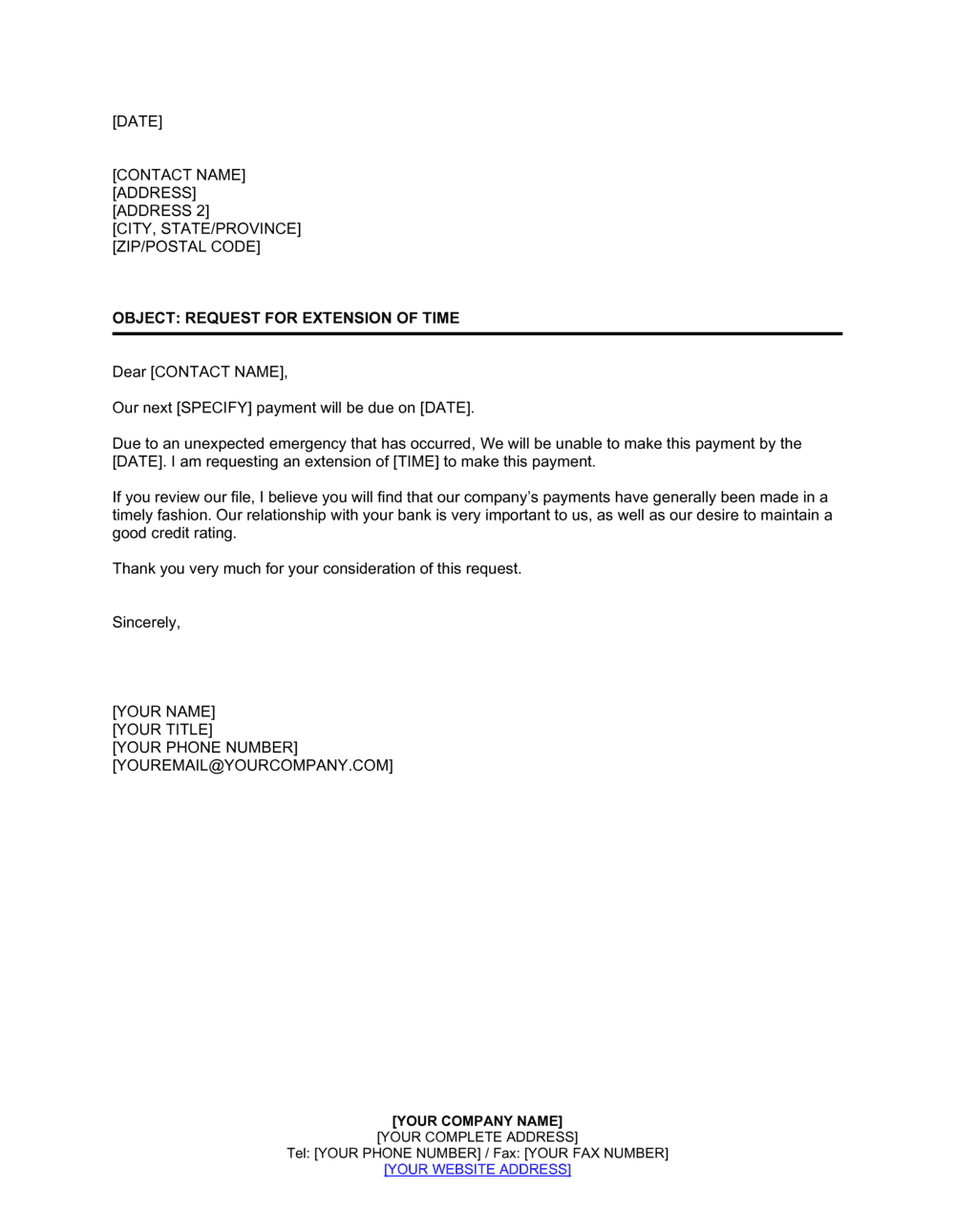
A Request to Bank for Extension of Time is a formal letter a borrower sends to a lender asking for more time to meet a scheduled payment or loan maturity date. This template is a free Word download you can edit in minutes, then print or email to your bank contact along with any supporting documents.
When you need it
Use it when a payment due date or loan maturity is approaching and you cannot meet it as scheduled β€” whether due to a temporary cash flow shortfall, a delayed receivable, or an unexpected business disruption. Sending it early, before the due date, signals good faith and significantly increases the likelihood of approval.
What's inside
Borrower and account details, a clear statement of the extension requested, a factual explanation of the circumstances, a proposed new payment date, any compensating arrangements offered (such as partial payment or additional interest), and a professional closing with contact information.

What is a Request to Bank for Extension of Time?

A Request to Bank for Extension of Time is a formal letter a borrower sends to a lender asking for more time to meet a scheduled loan payment or repay a balance at maturity. It identifies the specific account and due date, explains the circumstances that make the original timeline unworkable, proposes a new payment date, and β€” where possible β€” offers a compensating arrangement such as a partial payment or continued interest accrual during the extension period. Unlike a verbal request, a written letter creates a documented record of the communication, demonstrates professional conduct, and gives the bank's credit team the information it needs to process an approval.

Why You Need This Document

Missing a loan payment without prior communication is one of the fastest ways to damage a banking relationship β€” even a single missed payment can trigger a default notice, late fees, and a negative entry on your business credit file. Sending a well-structured extension request before the due date tells your lender that you are aware of the situation, managing it actively, and committed to repayment β€” which is exactly what a credit committee needs to see to approve an accommodation. Without a formal written request, banks have no record of your intent, no basis for an approval, and no obligation to hold off on enforcement. This template gives you a clear, professional starting point in 15 minutes, so you can focus on resolving the underlying cash flow issue rather than drafting correspondence from scratch.

Which variant fits your situation?

If your situation is…Use this template
Requesting a one-time payment deferral on a term loanRequest to Bank for Extension of Time
Asking a supplier for more time to pay an overdue invoiceRequest for Extension of Time to Pay Debt
Formally proposing a restructured repayment scheduleLoan Modification Agreement
Notifying the bank of difficulty meeting payments before they become overdueHardship Letter to Bank
Requesting the bank renew or roll over a maturing line of creditRequest for Renewal of Line of Credit
Settling an outstanding bank debt for less than the full balanceDebt Settlement Proposal Letter

Common mistakes to avoid

❌ Sending the letter after the due date has passed

Why it matters: A missed payment may already trigger a default notice, late fees, or a negative credit report entry before the bank can act on the request.

Fix: Send the letter at least 10 business days before the due date. Proactive communication is the single most important factor in a lender's willingness to accommodate.

❌ Providing a vague explanation without specific amounts or dates

Why it matters: Loan officers present extension requests to a credit committee β€” vague language gives committee members no basis to assess whether the difficulty is temporary or structural.

Fix: Name the specific event, the dollar amount affected, and the date you expect to resolve it. One factual sentence beats three paragraphs of general explanation.

❌ Failing to specify a new proposed payment date

Why it matters: Without a proposed date, the letter is a complaint rather than a request. Banks need a concrete ask to evaluate and approve.

Fix: State a specific calendar date β€” not a range or a condition such as 'when funds are received.' Pin down a date you are confident you can meet.

❌ Omitting the loan account number

Why it matters: Without it, the letter must be manually matched to an account, which can take days and risks it being filed without action if staff turnover occurs.

Fix: Copy the exact account number from your most recent statement and include it in both the subject line and the opening paragraph.

The 8 key clauses, explained

Header and date block

In plain language: The borrower's name and address, the date, and the bank's name and branch address β€” establishes the formal written record.

Sample language
[BORROWER NAME] [ADDRESS LINE 1] [CITY, STATE, ZIP] [DATE] [BANK NAME] Attn: [LOAN OFFICER NAME] [BRANCH ADDRESS]

Common mistake: Addressing the letter to a branch address without naming a specific loan officer β€” generic letters are slower to route and easier to deprioritize.

Subject line and account reference

In plain language: Identifies the specific loan or account number so the bank can pull the file immediately without back-and-forth.

Sample language
Re: Request for Extension of Time β€” Loan Account No. [ACCOUNT NUMBER], Maturity/Payment Due Date [ORIGINAL DATE]

Common mistake: Omitting the account number. Without it, the letter may sit in a general queue while staff search for the correct file.

Opening statement of the request

In plain language: States clearly and directly what is being asked β€” the extension itself, the amount involved, and the new proposed date.

Sample language
I am writing to respectfully request a [X-day / X-month] extension on the [payment / maturity] of Loan No. [ACCOUNT NUMBER], currently due on [ORIGINAL DATE], to a revised date of [REQUESTED DATE].

Common mistake: Burying the actual request in the middle of the letter after paragraphs of background. Loan officers need to understand what is being asked in the first two sentences.

Explanation of circumstances

In plain language: A concise, factual account of why the extension is needed β€” the specific event or condition that created the shortfall, with dates where possible.

Sample language
As of [DATE], [COMPANY NAME] has experienced [DESCRIPTION OF CIRCUMSTANCE β€” e.g., a delay in the receipt of a $[AMOUNT] receivable from [CLIENT], originally expected on [DATE]]. This shortfall is temporary and directly attributable to [CAUSE].

Common mistake: Writing a vague explanation such as 'cash flow difficulties' without specifics. Lenders approve extensions when they understand the cause and can assess whether it is temporary.

Evidence of ability to repay

In plain language: Demonstrates that the borrower can and will repay β€” references expected incoming funds, a pending transaction, or documented recovery steps.

Sample language
We expect to receive [DESCRIPTION OF INCOMING FUNDS β€” e.g., proceeds from the sale of [ASSET] / payment from [CLIENT]] of approximately $[AMOUNT] by [DATE], which will be applied directly to the outstanding balance.

Common mistake: Skipping this paragraph entirely. Without evidence of repayment capacity, the request reads as an indefinite deferral rather than a time-limited accommodation.

Proposed compensating arrangement

In plain language: Offers something in exchange for the extension β€” such as a partial payment now, agreement to pay accruing interest during the extension period, or additional security.

Sample language
In recognition of the accommodation requested, we propose to remit a partial payment of $[AMOUNT] on [DATE] and to continue paying interest at the applicable rate of [X]% per annum during the extension period.

Common mistake: Making no offer at all. A compensating arrangement is not always required, but proposing one demonstrates good faith and materially improves approval odds.

Affirmation of the lending relationship and track record

In plain language: Briefly references the borrower's history with the bank β€” length of relationship, payment record, and any other accounts held β€” to reinforce trust.

Sample language
We have maintained our banking relationship with [BANK NAME] for [X] years and have met all prior obligations on this and [OTHER ACCOUNTS / LOANS] in a timely manner.

Common mistake: Omitting this paragraph when the borrower has a strong track record. A clean payment history is a significant factor in extension decisions and should be explicitly stated.

Closing with contact details and call to action

In plain language: Thanks the lender for considering the request, provides a direct phone number and email, and invites a meeting or call to discuss further.

Sample language
I appreciate your consideration of this request and am available to discuss at your convenience. Please contact me at [PHONE NUMBER] or [EMAIL ADDRESS]. I look forward to your response by [DATE].

Common mistake: Leaving no specific response deadline. Without a requested response date, the letter can sit without action while the original due date approaches.

How to fill it out

  1. 1

    Enter borrower and bank details

    Fill in your full legal name or business name, your address, and today's date. Then add the bank's name, the specific branch address, and your loan officer's name and title.

    πŸ’‘ Confirm your loan officer's current name from a recent statement or your online banking portal β€” loan portfolios are reassigned, and addressing the wrong person slows the process.

  2. 2

    Reference the exact loan account number and original due date

    Enter the account or loan number exactly as it appears on your statement, and state the original payment or maturity date you are asking to extend.

    πŸ’‘ If you have multiple loans with the same bank, file a separate letter for each β€” combining requests into one letter creates confusion and delays.

  3. 3

    State the request clearly in the opening paragraph

    Write the specific extension you need β€” number of days or months β€” and the new proposed date. Do not qualify or hedge; be direct about what you are asking.

    πŸ’‘ Request slightly more time than you think you need. If you expect funds in 30 days, ask for 45 β€” this avoids a second extension request if anything slips.

  4. 4

    Describe the circumstances factually and briefly

    Explain what happened, when it happened, and why it is temporary. Include specific dollar amounts and dates where you have them. Limit this to two or three sentences.

    πŸ’‘ Stick to facts, not emotion. A factual account of a delayed receivable is more persuasive than a detailed account of personal hardship.

  5. 5

    Describe your repayment plan

    Explain specifically where the funds to repay will come from and by when. Reference a pending receivable, asset sale, refinancing, or other concrete source.

    πŸ’‘ If you have documentation β€” a signed contract, an invoice, or a term sheet β€” mention it and offer to provide it. Supported claims are more credible.

  6. 6

    Add any compensating arrangement you are willing to offer

    Propose a partial payment, continued interest during the extension, or additional collateral if applicable. If you cannot offer anything, skip this clause rather than making a promise you cannot keep.

    πŸ’‘ Even a token partial payment β€” $500 on a $50,000 loan β€” signals commitment and separates this from a borrower who simply isn't paying.

  7. 7

    Proofread and send with supporting documents

    Check that all account numbers, dates, and dollar amounts are accurate. Attach any supporting documentation β€” aging receivables report, sale contract, etc. β€” and send directly to your loan officer.

    πŸ’‘ Send the letter at least 10 business days before the due date. Last-minute requests are harder to process and signal poor financial planning to the lender.

Frequently asked questions

What is a request to bank for extension of time?

A request to bank for extension of time is a formal letter a borrower sends to a lender asking for more time to make a scheduled loan payment or to repay the full balance at maturity. It explains the reason for the request, proposes a new due date, and typically offers some form of compensating arrangement such as a partial payment or continued interest accrual. Sending this letter before the due date is essential β€” it signals good faith and gives the bank time to process the request through its internal approval procedures.

When should I send a loan extension request to my bank?

Send it at least 10 business days before the payment or maturity date is due. The earlier, the better β€” banks require internal credit committee approval for most extensions, and that process takes time. Contacting your loan officer by phone before sending the written letter can also help flag the situation in advance and speed up the formal approval.

Will my bank approve a payment extension request?

Most banks will consider a well-documented, timely extension request from a borrower in good standing, particularly when the difficulty appears temporary and the borrower proposes a credible repayment plan. Approval is not guaranteed and depends on the bank's internal policies, the borrower's credit history, and the strength of the explanation. Offering a compensating arrangement β€” such as a partial payment or agreement to pay interest during the extension β€” improves the odds significantly.

Does an extension request letter need to be notarized or signed?

No. A standard request to bank for extension of time is a formal business letter and does not require notarization or a witnessed signature to be effective. Your printed name and title are sufficient for the initial request. If the bank approves the extension, it will typically issue a written amendment to the loan agreement that both parties will sign.

What should I attach to my extension request letter?

Attach any documentation that supports your explanation and repayment plan β€” for example, an outstanding invoice or aged receivables report showing the delayed payment, a signed purchase agreement for a property sale that will fund repayment, or a term sheet from a refinancing lender. Supporting documents make the request more credible and reduce the back-and-forth that slows approval.

What is the difference between a payment extension and a loan modification?

A payment extension postpones one or more specific due dates without changing the underlying loan terms β€” interest rate, total balance, and amortization schedule remain the same. A loan modification restructures the loan itself, potentially changing the interest rate, extending the overall term, or reducing the principal balance. Extensions are simpler and faster to approve; modifications require more extensive underwriting and documentation.

Can I request an extension if I have already missed a payment?

Yes, but the request becomes significantly harder to approve once a payment has already been missed. At that point, the account may already be flagged as delinquent, late fees may have accrued, and the bank's collections process may have been triggered. Send the letter immediately, acknowledge the missed payment directly, and propose both a cure for the arrears and a plan for the upcoming obligations. Consider calling your loan officer before sending the written letter in this situation.

How long of an extension can I request?

Request only as much time as you genuinely need and can support with a credible repayment plan β€” typically 30 to 90 days for a payment deferral, or 6 to 12 months for a maturity extension on a real estate or business term loan. Asking for more time than is justified by the circumstances raises questions about the borrower's overall financial health and can trigger a more intensive credit review.

How this compares to alternatives

vs Request for Extension of Time to Pay Debt

A request for extension of time to pay debt is addressed to a creditor β€” typically a supplier or trade partner β€” rather than a bank. It covers a commercial payable, not a formal loan agreement. The bank extension letter requires more supporting financial detail and is reviewed through a formal credit process, while a supplier extension is often resolved through a simple phone call or short email.

vs Hardship Letter to Bank

A hardship letter explains a borrower's overall financial difficulty and requests relief β€” which may include an extension, a rate reduction, or a full forbearance plan. A request for extension of time is narrower: it asks for one specific accommodation on one specific date, and is appropriate when the difficulty is temporary and isolated rather than a broader financial crisis.

vs Loan Modification Agreement

A loan modification agreement permanently changes the terms of the underlying loan β€” the rate, the term, or the balance. An extension request asks only for more time on a specific date without changing any other terms. Extensions are simpler to obtain and do not require the full underwriting review that a modification triggers.

vs Demand for Payment Letter

A demand for payment letter is the opposite document β€” it is sent by a creditor to a borrower, not the other way around. Understanding what a demand letter contains helps borrowers recognize the urgency of proactively sending an extension request before the bank initiates collections.

Industry-specific considerations

Real Estate

Bridge loan and mortgage maturity extensions pending a property sale or permanent financing closing, often with a title report and purchase contract as supporting documents.

Retail and E-commerce

Seasonal cash flow gaps β€” such as inventory build-up before a peak period β€” create short-term shortfalls that a 30 to 60 day extension can bridge without structural loan changes.

Construction

Project delays caused by permitting, weather, or subcontractor issues push draw schedules back, making construction loan maturity extensions common and generally well-understood by lenders.

Professional Services

Delayed client payments or an unexpectedly slow billing cycle can create a short-term gap between payroll obligations and available cash, making a brief payment extension a practical bridge.

Template vs pro β€” what fits your needs?

PathBest forCostTime
Use the templateBorrowers with a good payment history requesting a straightforward one-time deferral on a standard term loan or line of creditFree15–30 minutes
Template + professional reviewBorrowers with a complex loan structure, prior missed payments, or a large outstanding balance where the bank relationship is at risk$150–$400 for a review by an accountant or financial advisor1–2 days
Custom draftedBusinesses facing significant debt restructuring, multiple concurrent lenders, or a situation that may require formal forbearance negotiations$500–$2,000+ with a financial advisor or commercial banking attorney3–7 days

Glossary

Maturity Date
The date on which the full outstanding balance of a loan is due to be repaid to the lender.
Payment Deferral
An agreement to postpone one or more scheduled loan payments to a later date, typically without treating the missed payment as a default.
Forbearance
A temporary arrangement in which a lender agrees not to enforce its rights β€” such as charging a default penalty β€” while the borrower addresses a financial difficulty.
Loan Covenant
A condition in a loan agreement that the borrower must meet β€” such as maintaining a minimum cash balance or debt-service coverage ratio.
Default
The failure to meet the terms of a loan agreement, including missing a scheduled payment, which gives the lender the right to demand immediate repayment.
Debt-Service Coverage Ratio (DSCR)
A measure of cash flow available to cover loan payments, calculated as net operating income divided by total debt service β€” lenders typically require a DSCR above 1.25.
Amortization Schedule
A table showing each scheduled loan payment broken down into principal and interest, and the remaining balance after each payment.
Compensating Arrangement
Something extra offered by the borrower in exchange for a concession β€” such as a partial payment upfront, a higher interest rate during the extension period, or additional collateral.
Loan Officer
The bank employee responsible for managing a borrower's account and serving as the primary contact for requests like extensions or modifications.
Good-Faith Payment
A partial payment made to demonstrate intent and commitment even when the borrower cannot meet the full scheduled amount.

Part of your Business Operating System

This document is one of 3,000+ business & legal templates included in Business in a Box.

  • Fill-in-the-blanks β€” ready in minutes
  • 100% customizable Word document
  • Compatible with all office suites
  • Export to PDF and share electronically

Create your document in 3 simple steps.

From template to signed document β€” all inside one Business Operating System.
1
Download or open template

Access over 3,000+ business and legal templates for any business task, project or initiative.

2
Edit and fill in the blanks with AI

Customize your ready-made business document template and save it in the cloud.

3
Save, Share, Send, Sign

Share your files and folders with your team. Create a space of seamless collaboration.

Save time, save money, and create top-quality documents.

β˜…β˜…β˜…β˜…β˜…

"Fantastic value! I'm not sure how I'd do without it. It's worth its weight in gold and paid back for itself many times."

Managing Director Β· Mall Farm
Robert Whalley
Managing Director, Mall Farm Proprietary Limited
β˜…β˜…β˜…β˜…β˜…

"I have been using Business in a Box for years. It has been the most useful source of templates I have encountered. I recommend it to anyone."

Business Owner Β· 4+ years
Dr Michael John Freestone
Business Owner
β˜…β˜…β˜…β˜…β˜…

"It has been a life saver so many times I have lost count. Business in a Box has saved me so much time and as you know, time is money."

Owner Β· Upstate Web
David G. Moore Jr.
Owner, Upstate Web

Run your business with a system β€” not scattered tools

Stop downloading documents. Start operating with clarity. Business in a Box gives you the Business Operating System used by over 250,000 companies worldwide to structure, run, and grow their business.

Free Forever PlanΒ Β·Β No credit card required