1
Retrieve and review the original agreement
Pull the fully executed original contract and any prior amendments. Confirm the exact legal names of both parties, the original execution date, the current expiry date, and the governing law clause.
💡 Copy the party names and agreement title verbatim from the original signature block — any variation, even a missing 'Inc.' or 'Ltd.', can create a legal mismatch.
2
Enter the parties and reference the original agreement
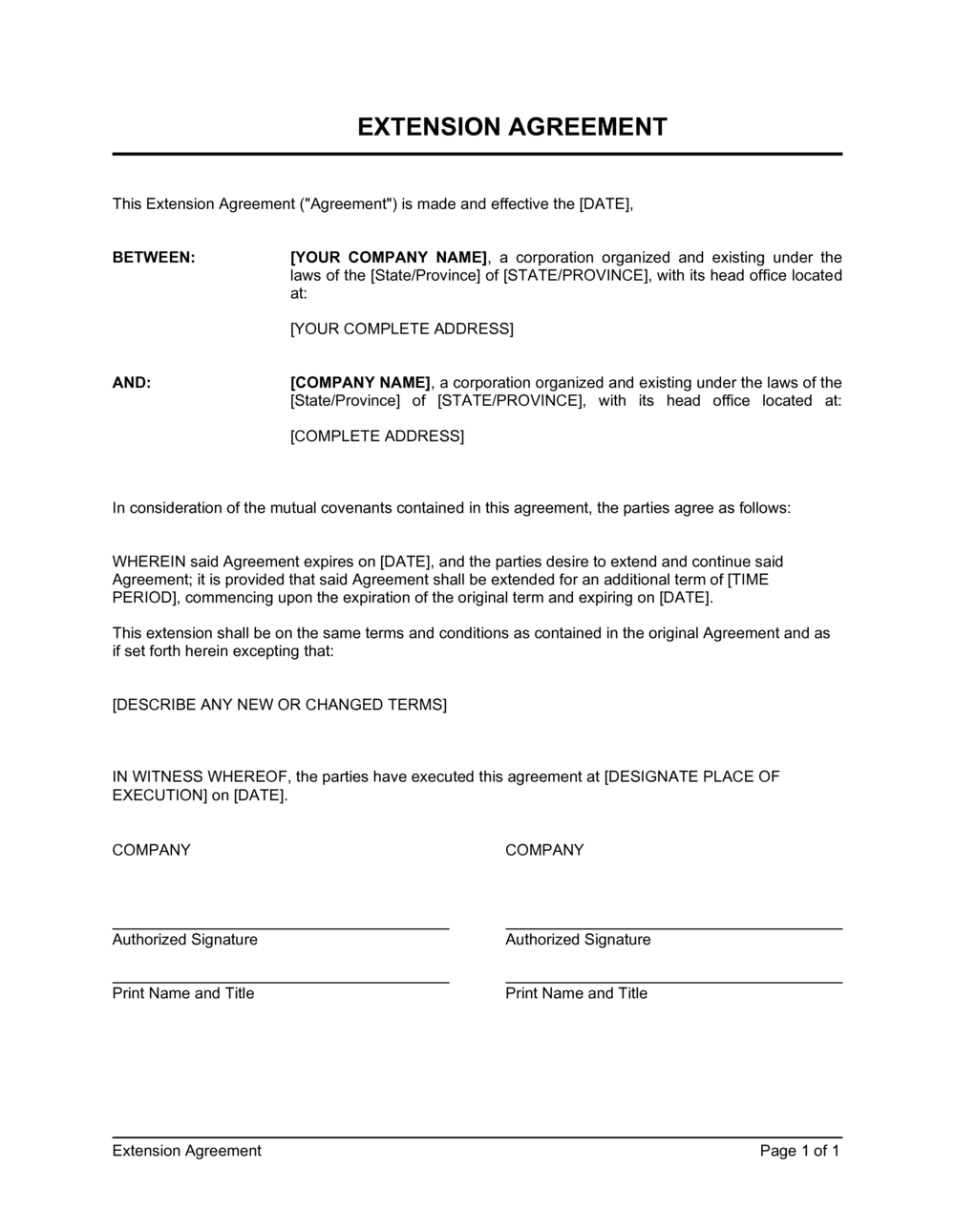
Fill in both parties' full registered legal names and the complete title of the agreement being extended, including its original execution date.
💡 If the original agreement has been previously amended, reference each amendment by date in the recitals so the chain of documents is clear.
3
Set the new end date precisely
Enter the specific calendar date through which the extended term runs. Do not describe the extension only as a duration — always anchor it to a date.
💡 Confirm whether the original contract expires at midnight on the stated end date or at the end of business — and match the Extended Term language to the same convention.
4
Document any updated commercial terms
If the fee, rate, or pricing is changing, enter the new amount and its effective date. Reference the specific section of the original agreement being modified so there is no ambiguity about what replaces what.
💡 State both the old amount and the new amount in the clause — e.g., 'the monthly fee of $X,000 is amended to $Y,000' — to prevent any later dispute about the baseline.
5
Add revised scope or deliverables if applicable
If the services or deliverables are changing during the extended term, describe the changes specifically and reference the schedule or section being modified. Attach a revised schedule if the changes are extensive.
💡 Keep scope changes in a separate extension clause rather than embedding them in the commercial terms clause — this makes future audits and disputes much easier to navigate.
6
Confirm governing law matches the original agreement
Check the original contract's governing law clause and replicate the same jurisdiction in the extension. If the parties have moved or restructured, note any intended change and confirm it is acceptable to both sides.
💡 If the parties are in different jurisdictions, use the same governing law as the original — changing it in an extension can invalidate the choice-of-law clause of the broader agreement.
7
Obtain signatures from authorized representatives before the original expiry
Both parties must sign the extension before the original agreement expires. A post-expiry signature may create a new contract rather than an extension of the original, with different legal consequences.
💡 Use Business in a Box eSign to timestamp execution and generate an audit trail confirming both parties signed before the expiry date.
8
File the executed extension with the original agreement
Store the signed extension alongside the original agreement and all prior amendments as a single complete contract file. Note the new expiry date in your contract management system or calendar.
💡 Set a calendar reminder 60–90 days before the new end date to evaluate whether another extension, a full renewal, or termination is appropriate.