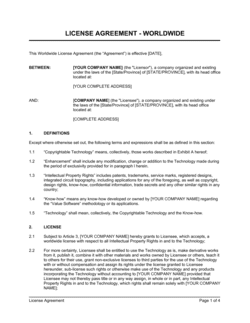
- Licensor
- The party that owns the technology and grants another party the right to use it under defined conditions.
- Licensee
- The party that receives the right to use the licensor's technology, subject to the terms of the agreement.
- Exclusive License
- A grant that prevents the licensor from licensing the same technology to any other party within the agreed scope or territory.
- Non-Exclusive License
- A grant that allows the licensor to license the same technology to multiple parties simultaneously.
- Sublicense
- Permission granted by the licensee to a third party to use the licensed technology, typically requiring the licensor's prior written consent.
- Royalty
- A recurring fee paid by the licensee to the licensor, typically calculated as a percentage of revenue, units sold, or a fixed amount per period.
- Field of Use
- A contractual restriction limiting the licensee's use of the technology to a specific application, industry, or market segment.
- Derivative Work
- A new work based on or incorporating the licensed technology — such as a modified codebase or adapted algorithm — whose ownership must be explicitly addressed in the agreement.
- Source Code Escrow
- An arrangement in which the licensor deposits source code with a neutral third party, which releases it to the licensee if the licensor ceases to support or maintain the technology.
- Improvement
- Any enhancement, update, or modification to the licensed technology — the agreement must specify whether improvements belong to the licensor, the licensee, or are jointly owned.
- Audit Rights
- A contractual right allowing the licensor to inspect the licensee's records to verify that royalty calculations and usage are accurate and within the agreed scope.
- Perpetual License
- A license that grants the right to use the technology indefinitely, as opposed to a term license that expires on a fixed date.