Exclusive Buyer Agency Agreement Template

Free Word download • Edit online • Save & share with Drive • Export to PDF

6 pages25–35 min to fillDifficulty: ComplexSignature requiredLegal review recommended
Learn more ↓
FreeExclusive Buyer Agency Agreement Template

At a glance

What it is
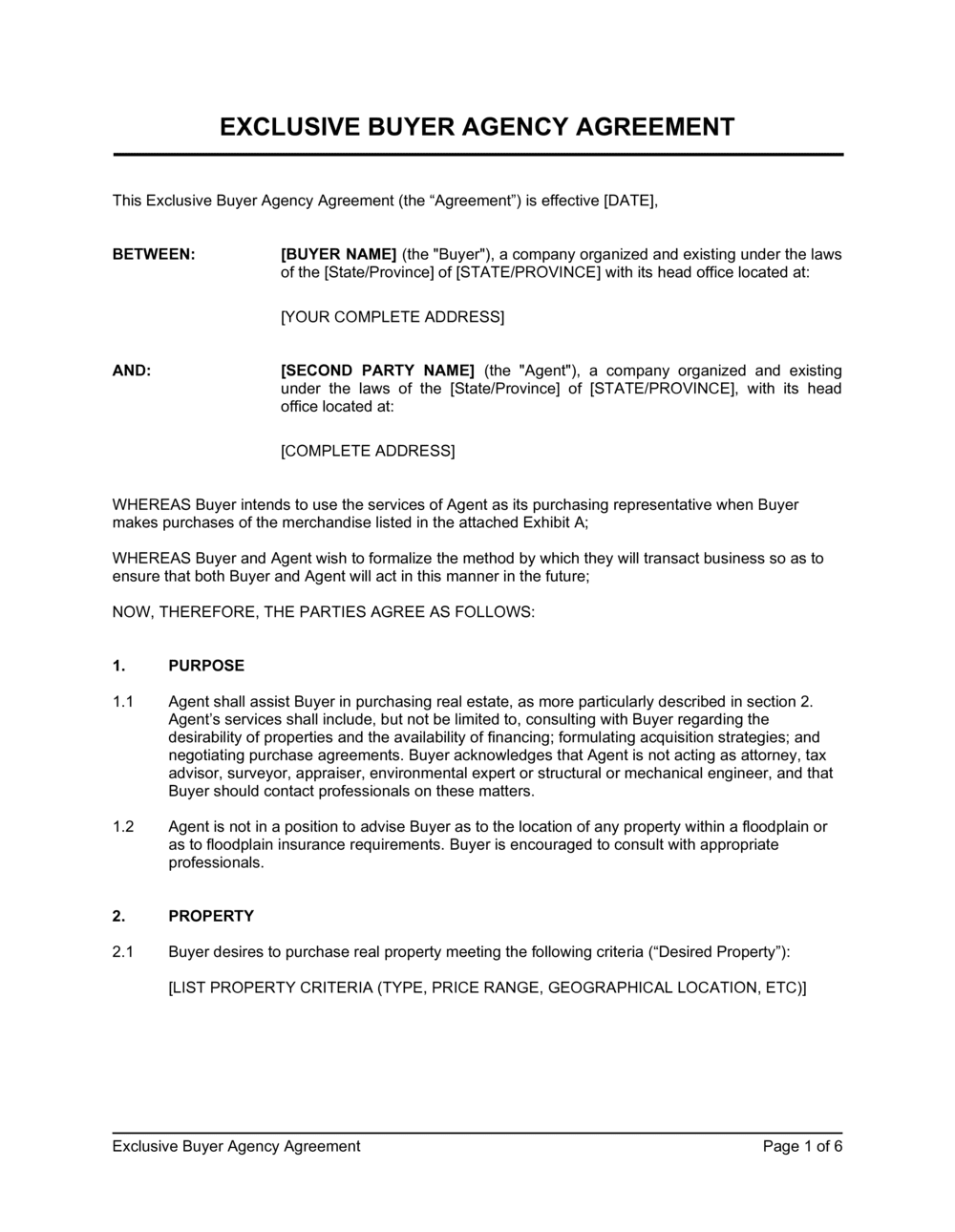
An Exclusive Buyer Agency Agreement is a legally binding contract between a prospective real estate buyer and a licensed real estate agent or broker that grants the agent exclusive rights to represent the buyer in the purchase of a property. This free Word download gives you a professionally structured template you can edit online and export as PDF — covering agent duties, exclusivity scope, compensation, property criteria, and termination in a single document.
When you need it
Use it before a buyer's agent begins actively searching for, showing, or negotiating properties on a buyer's behalf. It formalizes the working relationship, defines the agent's fiduciary duties, and ensures the agent is compensated for their time and effort regardless of which party ultimately pays the commission.
What's inside
Parties and agent credentials, exclusivity clause and term, property search criteria, agent duties and fiduciary obligations, buyer obligations, compensation and commission structure, dual agency disclosure, dispute resolution, and termination conditions.

What is an Exclusive Buyer Agency Agreement?

An Exclusive Buyer Agency Agreement is a legally binding contract between a prospective property buyer and a licensed real estate agent or brokerage that grants the agent the sole and exclusive right to represent the buyer in locating and purchasing real estate for a defined period. It creates formal fiduciary duties — loyalty, confidentiality, full disclosure, and reasonable care — that govern every step of the agent's work on the buyer's behalf, from property search through offer negotiation and closing. Unlike an informal handshake arrangement or a non-exclusive understanding, this agreement commits both parties: the agent invests time and resources in the search knowing they will be compensated, and the buyer receives dedicated, undivided representation knowing the agent is legally obligated to put their interests first.

Why You Need This Document

Without a written exclusive buyer agency agreement, both the buyer and the agent operate without defined rights or obligations — and disputes about commission, confidentiality, and procuring cause become credibility contests rather than contract interpretation. Buyers who skip a formal agreement have no enforceable guarantee that their financial information and negotiating position will be kept confidential, no clear basis to hold an agent accountable for inadequate service, and no agreed process for resolving disagreements without litigation. For agents, working without a signed agreement risks performing months of property searches, showings, and negotiations only to have the buyer purchase directly through a FSBO listing or switch to another agent at the final hour with no commission entitlement. In the post-NAR-settlement landscape in the US, a signed buyer representation agreement is now required before showing MLS-listed properties — making this document a regulatory necessity as well as a professional one. This template gives both parties a clear, fair, and enforceable starting point that protects the relationship from the first showing to the closing table.

Which variant fits your situation?

If your situation is…Use this template
Buyer wants representation without exclusivityNon-Exclusive Buyer Agency Agreement
Purchasing commercial real estate for business useCommercial Buyer Agency Agreement
Agent representing both buyer and seller in the same transactionDual Agency Disclosure and Consent Agreement
Buyer engaging a broker for a referral-only arrangementBuyer Referral Agreement
Seller engaging an agent to list and market a propertyExclusive Listing Agreement
Buyer and seller finalizing property purchase termsReal Estate Purchase Agreement
Agent earning a referral fee for introducing a buyer to another agentReal Estate Referral Agreement

Common mistakes to avoid

❌ Executing the agreement after showings have already begun

Why it matters: In several US states, an exclusivity or commission clause signed after the agent has already shown property may be unenforceable for lack of consideration — the buyer gave nothing new in exchange for the obligation.

Fix: Sign the agreement before visiting any property, including open houses attended with the agent. Use a timestamped e-signature to document the pre-showing execution date.

❌ Omitting a post-termination commission tail

Why it matters: Without a tail clause, a buyer can terminate the agreement the day before closing on a property the agent identified and negotiated, eliminating the commission entirely and leaving the agent uncompensated for months of work.

Fix: Include a 30–90 day tail period with a written list of all properties identified during the term, maintained by the agent and acknowledged by the buyer at signing.

❌ Failing to address the buyer-paid commission gap after the NAR settlement

Why it matters: Since August 2024, MLS rules in the US no longer permit blanket offers of buyer-agent compensation from the seller's side — buyers may now owe their agent directly if the seller does not offer a matching commission.

Fix: Add explicit language stating that if the seller's cooperating commission is less than the agreed rate, the buyer is responsible for the shortfall, and confirm the buyer has reviewed and understands this obligation.

❌ Using vague geographic or property criteria

Why it matters: A buyer who discovers a property independently and argues it falls outside the agreement's scope will prevail if the criteria are broad enough to support multiple interpretations, voiding the exclusivity clause.

Fix: Define the search area by MLS zone or county, state a hard price ceiling, and list specific property types — single-family, condo, and multi-family should each be listed separately if all are in scope.

❌ Omitting dual agency disclosure before obtaining consent

Why it matters: Blanket consent to dual agency without a substantive explanation of its limitations has been found insufficient by courts and real estate commissions — exposing the agent to license sanctions and commission forfeiture.

Fix: Attach the jurisdiction-required dual agency disclosure form, have the buyer sign it separately, and explain in plain language that the agent cannot fully advocate for the buyer's price position in a dual-agency situation.

❌ Naming only the individual agent rather than the licensed brokerage

Why it matters: In most US states and Canadian provinces, the real estate license is held by the brokerage, not the individual agent — an agreement naming only the agent may be void or unenforceable, and commission claims unsupported.

Fix: Name both the individual agent and the brokerage as parties, confirm the brokerage's registered legal entity name, and have an authorized brokerage representative co-sign the agreement.

The 9 key clauses, explained

Parties and Agent Credentials

In plain language: Identifies the buyer and the agent or brokerage by legal name, license number, and contact details, establishing who is bound by the agreement.

Sample language
This Exclusive Buyer Agency Agreement ('Agreement') is entered into on [DATE] between [BUYER FULL NAME] ('Buyer') and [AGENT FULL NAME], License No. [LICENSE NUMBER], affiliated with [BROKERAGE NAME] ('Agent').

Common mistake: Naming the individual agent instead of — or in addition to — the licensed brokerage. In most jurisdictions the brokerage holds the license, and an agreement naming only the agent may be unenforceable if the agent changes firms mid-term.

Exclusivity and Term

In plain language: Grants the agent the sole and exclusive right to represent the buyer for a defined period and specifies the start and end dates of that exclusivity.

Sample language
Buyer grants Agent the exclusive right to locate and negotiate the purchase of property on Buyer's behalf from [START DATE] through [END DATE] ('Term'). Buyer agrees not to engage any other agent or broker during the Term.

Common mistake: Setting the term longer than 90 days without an early-termination clause. A buyer whose needs change or who is dissatisfied with service has no exit, creating disputes and potential litigation.

Property Search Criteria

In plain language: Defines the geographic area, property type, price range, size, and features that bound the agent's search obligations and the scope of the exclusivity clause.

Sample language
Agent shall search for residential properties in [CITY / COUNTY / MLS AREA], priced between $[MINIMUM] and $[MAXIMUM], with a minimum of [X] bedrooms and [X] bathrooms, of type [SINGLE FAMILY / CONDO / MULTI-FAMILY].

Common mistake: Using overly broad criteria — for example, 'any property in the state' — that makes it impossible to determine when a buyer's self-found property falls inside or outside the exclusivity scope.

Agent Duties and Fiduciary Obligations

In plain language: Enumerates the agent's obligations to the buyer — including loyalty, confidentiality, full disclosure, due diligence, and the duty to negotiate in the buyer's best interest.

Sample language
Agent shall: (a) act in Buyer's best interests at all times; (b) disclose all material facts known to Agent that may affect Buyer's decision; (c) maintain confidentiality of Buyer's financial information and negotiating position; (d) conduct due diligence on properties presented to Buyer.

Common mistake: Omitting a confidentiality obligation. Without it, there is no contractual basis to prevent the agent from disclosing the buyer's maximum budget or motivation to a listing agent — directly harming the buyer's negotiating position.

Buyer Obligations

In plain language: States what the buyer must do: work exclusively through the agent, provide accurate financial information, and notify the agent promptly of any property they encounter independently.

Sample language
Buyer agrees to: (a) work exclusively with Agent during the Term; (b) promptly notify Agent of any property Buyer becomes aware of through any source; (c) provide accurate information regarding Buyer's financial qualification and purchase timeline.

Common mistake: Failing to include the notification obligation for self-discovered properties. Without it, a buyer who finds a FSBO listing and attempts to transact directly faces a commission dispute with no contractual clarity on who is owed what.

Compensation and Commission

In plain language: Specifies the agent's commission amount or percentage, who is expected to pay it (seller, buyer, or both), and when the commission is earned and payable.

Sample language
Agent's compensation shall be [X]% of the final purchase price ('Commission'). Commission is earned upon the closing of a transaction for any property identified during the Term. If the seller's listing broker does not offer a cooperating commission of at least [X]%, Buyer agrees to pay the shortfall directly.

Common mistake: Not addressing the scenario where the seller's listing broker offers a cooperating commission below the agreed rate — leaving the agent under-compensated and creating a dispute at closing.

Dual Agency Disclosure and Consent

In plain language: Discloses the possibility that the agent's brokerage may also represent the seller in a transaction and obtains the buyer's informed written consent to that arrangement if it arises.

Sample language
Buyer acknowledges that Agent's brokerage may represent the seller of a property Buyer wishes to purchase. In the event of such dual agency, Buyer [consents to / does not consent to] dual representation and understands that Agent's duties to Buyer will be limited as described in the attached Dual Agency Disclosure.

Common mistake: Obtaining a blanket consent at signing without explaining the practical limitations of dual agency — courts have found such consents insufficient when the buyer later claims the agent failed to protect their interests in a dual-agency transaction.

Termination and Early Exit

In plain language: Sets the conditions under which either party may terminate the agreement before the end date, the required notice period, and whether the commission obligation survives termination.

Sample language
Either party may terminate this Agreement upon [X] days' written notice. If Buyer purchases a property identified by Agent during the Term within [X] months following termination, Buyer remains obligated to pay Agent's Commission.

Common mistake: No tail provision after termination. Without a post-termination commission tail, a buyer can terminate the day before closing on a property the agent found and sourced, avoiding the commission entirely.

Dispute Resolution and Governing Law

In plain language: Specifies which jurisdiction's law governs the agreement and the mechanism — mediation, arbitration, or litigation — for resolving disputes between buyer and agent.

Sample language
This Agreement is governed by the laws of [STATE / PROVINCE]. Any dispute arising hereunder shall first be submitted to non-binding mediation through [ASSOCIATION / MEDIATOR]. If mediation fails, disputes shall be resolved by binding arbitration in [CITY], administered by [AAA / JAMS / LOCAL ASSOCIATION].

Common mistake: Omitting a mandatory mediation step before arbitration. Real estate disputes are expensive to arbitrate — a mediation requirement resolves the majority of commission disputes in hours rather than months.

How to fill it out

  1. 1

    Identify all parties with full legal names and license numbers

    Enter the buyer's full legal name as it will appear on any purchase offer, and the agent's full name, license number, and brokerage's registered name. Confirm the brokerage's legal entity name matches its license registration.

    💡 Ask the brokerage for its registered legal entity name from the state or provincial real estate commission — trade names often differ from the licensed entity.

  2. 2

    Set the term and exclusivity period

    Enter a specific start and end date. A 60–90 day initial term is standard for most residential searches. Include an early-termination clause allowing either party to exit with written notice of 7–14 days.

    💡 Avoid open-ended terms or auto-renewal clauses without a cap — they create the impression of a perpetual obligation and can make the agreement unenforceable in some jurisdictions.

  3. 3

    Define the property search criteria precisely

    Enter the geographic area (by city, county, or MLS zone), price range with a hard maximum, property type, and minimum size or bedroom count. Narrow criteria protects both parties from scope disputes.

    💡 If the buyer is open to multiple property types, list each one explicitly rather than writing 'any residential property' — vague criteria make exclusivity disputes harder to resolve.

  4. 4

    Complete the agent duties section

    Confirm all six standard fiduciary duties are listed: loyalty, confidentiality, disclosure, obedience, reasonable care, and accounting. Add any jurisdiction-specific statutory duties required by the applicable real estate commission.

    💡 Some US states and Canadian provinces require a specific statutory form that lists fiduciary duties verbatim — use the template as a supplement to, not a replacement for, that required form.

  5. 5

    Specify the commission rate and payment waterfall

    Enter the commission percentage or flat fee, specify what happens if the cooperating commission from the seller's side falls short, and confirm whether the buyer is responsible for any gap. State the exact closing event that triggers payment.

    💡 Since the NAR settlement (effective August 2024), sellers are no longer required to offer buyer-agent compensation through MLS — address this directly by specifying the buyer's obligation to pay if no seller-side commission is offered.

  6. 6

    Address dual agency with informed written consent

    Complete the dual agency section with the buyer's specific consent or refusal. Attach the jurisdiction-required dual agency disclosure form and have the buyer acknowledge it separately.

    💡 Some states — including Florida and Colorado — have moved to 'transaction broker' status rather than dual agency. Use the correct terminology for the applicable jurisdiction.

  7. 7

    Insert the termination tail period

    Set a post-termination commission period — typically 30–90 days — during which a commission is still owed if the buyer closes on a property the agent identified during the term.

    💡 Keep a written log of every property shown or introduced during the term, with dates and addresses, to support any commission claim during the tail period.

  8. 8

    Execute before any property showings begin

    Both parties must sign before the agent shows any property. Post-showing signatures raise enforceability questions and, in some US states, render the exclusivity clause void.

    💡 Use a timestamped e-signature platform so the execution date is independently verifiable — particularly important for the tail-period calculation if a dispute arises later.

Frequently asked questions

What is an exclusive buyer agency agreement?

An exclusive buyer agency agreement is a legally binding contract between a prospective property buyer and a licensed real estate agent or brokerage that grants the agent the sole right to represent the buyer in purchasing real estate for a defined period. It formalizes the agent's fiduciary duties, establishes the commission structure, and prevents the buyer from working with other agents during the term. Both parties benefit — the agent is assured compensation for their time, and the buyer receives committed, focused representation.

Is a buyer agency agreement legally required?

Requirements vary by jurisdiction. As of August 2024, the NAR settlement requires US buyers to sign a written buyer representation agreement before an agent can show them a property listed on an MLS. Several US states — including Texas, North Carolina, and Maryland — had already mandated written buyer agency agreements by statute. In Canada, most provincial real estate regulators require a written service agreement before representation begins. The UK and EU do not have a universal mandate but standard practice strongly favors a signed terms-of-business letter.

What is the difference between an exclusive and a non-exclusive buyer agency agreement?

An exclusive agreement binds the buyer to one agent for the full term — the agent earns a commission on any property the buyer purchases during that period, whether or not the agent found it. A non-exclusive agreement allows the buyer to work with multiple agents simultaneously and typically requires a commission only if that specific agent procures the property. Exclusive agreements give agents a stronger incentive to invest time and resources in the search; non-exclusive agreements offer buyers more flexibility but less dedicated service.

Who pays the buyer's agent commission?

Historically, the seller paid both the listing and buyer-agent commission from sale proceeds. Following the August 2024 NAR settlement in the US, sellers are no longer required to offer buyer-agent compensation through MLS. Compensation is now negotiated directly between buyer and agent and documented in the buyer agency agreement. In practice, many sellers still offer to cover buyer-agent fees as an incentive, but buyers should be prepared to pay their agent directly — or negotiate seller coverage as a concession in their offer.

How long should a buyer agency agreement last?

A 60–90 day initial term is standard for most residential searches in active markets. Complex searches — commercial acquisitions, relocation buyers, or slow inventory markets — may warrant 120–180 days. Avoid open-ended agreements; a defined end date with an early-termination clause protects both parties. Most agreements also include a 30–90 day post-termination tail during which a commission is still owed if the buyer closes on a property the agent identified during the term.

Can I cancel an exclusive buyer agency agreement?

You can cancel if the agreement includes an early-termination clause — most professionally drafted agreements do. Termination typically requires written notice of 7–14 days and may still trigger a commission obligation if you purchase a property introduced by the agent during the tail period. Without an early-termination clause, you may be bound for the full term. If a dispute arises, many agreements require mediation before either party can pursue other remedies.

What is a commission tail clause in a buyer agency agreement?

A commission tail — sometimes called a protection period — is a clause that preserves the agent's right to a commission for a defined period after the agreement ends or is terminated. If the buyer closes on a property the agent identified or showed during the agreement's term, the agent earns their commission even if the agreement has since expired. A typical tail runs 30–90 days and requires the agent to provide a written list of identified properties at or before termination to establish the scope of the protection.

What happens if I find a property myself while under an exclusive buyer agency agreement?

Under most exclusive agreements, the buyer is obligated to notify the agent promptly of any property discovered independently, including FSBO listings, properties found online, or open-house visits made without the agent. If the buyer proceeds to purchase the property without involving the agent, the exclusivity clause typically still entitles the agent to their commission. To avoid disputes, buyers should route all property inquiries through their agent for the full agreement term.

Does a buyer agency agreement need to be notarized?

Notarization is generally not required for a buyer agency agreement in the US, Canada, or the UK. The agreement becomes binding upon the valid signatures of both parties with the exchange of consideration — typically the agent's promise to search and the buyer's promise of exclusivity and compensation. Some commercial or high-value transactions may benefit from notarization for additional evidentiary weight, but it is not a standard requirement.

Do I need a lawyer to review a buyer agency agreement?

For a standard residential buyer agency agreement, a licensed real estate agent or agent's designated brokerage typically handles preparation, and legal review is not required. Consider consulting a real estate lawyer when the transaction involves commercial property, the buyer is a corporate entity or trust, the commission structure is non-standard, or the agreement contains unusual exclusivity or penalty provisions. A 1-hour legal review typically costs $200–$400 and is worth the cost for purchases above $1M or for cross-border acquisitions.

How this compares to alternatives

vs Non-Exclusive Buyer Agency Agreement

A non-exclusive agreement allows the buyer to engage multiple agents simultaneously and typically requires a commission only from the agent who actually procures the property. An exclusive agreement binds both parties for a set term — the agent earns a commission on any purchase made during that period. Exclusive agreements produce more committed agent effort; non-exclusive agreements preserve buyer flexibility at the cost of diluted agent incentive.

vs Exclusive Listing Agreement

An exclusive listing agreement is signed by a property seller, granting an agent the sole right to market and sell the property. An exclusive buyer agency agreement is signed by the buyer, granting an agent the sole right to represent them in purchasing. One governs the seller side of a transaction; the other governs the buyer side. In a standard MLS transaction, both agreements may exist simultaneously for the same property.

vs Real Estate Purchase Agreement

A buyer agency agreement governs the relationship between the buyer and their agent — duties, exclusivity, and compensation. A purchase agreement governs the transaction between the buyer and the seller — price, contingencies, closing date, and title transfer. The agency agreement is signed first to establish representation; the purchase agreement is signed later when an offer is made on a specific property.

vs Independent Contractor Agreement

An independent contractor agreement defines a service relationship between a business and a self-employed individual, typically for project-based work with no agency or fiduciary component. A buyer agency agreement creates fiduciary duties — loyalty, confidentiality, and full disclosure — that do not exist in a standard contractor arrangement. Using a generic contractor agreement for real estate representation fails to satisfy the statutory and regulatory requirements that govern licensed agents.

Industry-specific considerations

Residential Real Estate

Standard 60–90 day terms covering single-family homes and condos, with commission rates now negotiated directly following the 2024 NAR settlement.

Commercial Real Estate

Longer terms of 6–12 months, flat-fee or tiered commission structures, and exclusivity scoped to specific asset classes such as office, retail, or industrial.

Property Investment and Development

Multi-property acquisition programs requiring the agent to source off-market deals, with commission tied to each individual closing rather than a single transaction.

Corporate Relocation

Agreements coordinated between the buyer, the employer's relocation management company, and the local buyer's agent, with commission split or reimbursement arrangements specified.

Jurisdictional notes

United States

Following the August 2024 NAR settlement, buyers must sign a written buyer representation agreement before an agent can show MLS-listed properties. Commission structures are now fully negotiated — sellers are no longer required to offer buyer-agent compensation through the MLS. Several states including Texas (TREC Form BRA), North Carolina, and Maryland have mandatory statutory forms that must be used instead of or alongside a custom agreement. Non-exclusive and exclusive structures are both permitted; state real estate commission rules govern fiduciary duty language.

Canada

Each province regulates buyer representation separately. Ontario requires a Buyer Representation Agreement (BRA) on the OREA standard form before the agent can submit an offer. British Columbia uses a Buyer Agency Agreement under BCREA guidelines with a designated agency model. Quebec requires a brokerage contract for purchase (contrat de courtage à l'achat) in French for provincially-regulated transactions. Agents in Canada owe statutory fiduciary duties that cannot be contracted away, and commission arrangements must be disclosed in writing.

United Kingdom

Buyer's agents — sometimes called property finders or buying agents — are less common in the UK than in North America but are regulated under the Estate Agents Act 1979 and, for consumer clients, the Consumer Protection from Unfair Trading Regulations 2008. There is no MLS equivalent; buyer's agents typically charge the buyer directly, either as a retainer plus success fee or a percentage of the purchase price (commonly 1–2.5%). Written terms of engagement are best practice and required under the Consumer Contracts Regulations 2013 for off-premises agreements.

European Union

Buyer agency representation is less formalized across the EU than in North America, and practice varies significantly by member state. In Germany, France, and Spain, agents may represent both buyer and seller (dual agency) and commission structures differ — German buyers often pay a buyer's commission (Käuferprovision) of 3–3.57% directly. GDPR obligations apply to any personal data collected about the buyer during the search process and must be addressed in the agreement or a separate privacy notice. Written representation agreements are not universally mandated but are strongly recommended for cross-border acquisitions.

Template vs lawyer — what fits your deal?

PathBest forCostTime
Use the templateStandard residential buyer representation with a licensed agent in a single state or provinceFree15–20 minutes
Template + legal reviewCommercial acquisitions, corporate buyer entities, non-standard commission arrangements, or cross-state transactions$200–$400 for a 1-hour real estate lawyer review1–2 days
Custom draftedMulti-property acquisition programs, institutional buyers, cross-border purchases, or agreements with complex exclusivity or penalty provisions$800–$2,500+3–7 days

Glossary

Exclusive Buyer Agency
A contractual arrangement granting a single agent or brokerage the sole right to represent a buyer in property transactions for a defined period and geography.
Fiduciary Duty
A legal obligation requiring the agent to act in the buyer's best interests, including duties of loyalty, confidentiality, disclosure, obedience, and reasonable care.
Commission
The fee paid to the buyer's agent, typically expressed as a percentage of the purchase price or a flat fee, earned upon the successful closing of a transaction.
Dual Agency
A situation where a single agent or brokerage represents both the buyer and the seller in the same transaction — permitted in some jurisdictions with written consent, prohibited in others.
Exclusivity Clause
The contractual provision that prevents the buyer from working with any other agent or broker during the agreement's term and obligates the buyer to pay the agent's commission regardless of who finds the property.
Showing
An agent-facilitated visit by the buyer to a listed or unlisted property under consideration for purchase.
Procuring Cause
The legal standard used to determine which agent is entitled to a commission by establishing who initiated the chain of events leading to a completed sale.
Cooperating Broker
A broker who brings a ready, willing, and able buyer to a transaction listed by a different brokerage and shares the commission as agreed in the MLS or a separate co-brokerage agreement.
Property Search Criteria
The defined parameters — location, price range, property type, size, and features — used to guide the agent's search and bound the exclusivity clause.
Earnest Money
A deposit made by the buyer at the time of offer to demonstrate good faith; typically applied to the purchase price at closing or forfeited if the buyer defaults.
MLS (Multiple Listing Service)
A shared database of property listings maintained by real estate brokerages that allows cooperating agents to find and show properties listed by other brokers.

Part of your Business Operating System

This document is one of 3,000+ business & legal templates included in Business in a Box.

  • Fill-in-the-blanks — ready in minutes
  • 100% customizable Word document
  • Compatible with all office suites
  • Export to PDF and share electronically

Create your document in 3 simple steps.

From template to signed document — all inside one Business Operating System.
1
Download or open template

Access over 3,000+ business and legal templates for any business task, project or initiative.

2
Edit and fill in the blanks with AI

Customize your ready-made business document template and save it in the cloud.

3
Save, Share, Send, Sign

Share your files and folders with your team. Create a space of seamless collaboration.

Save time, save money, and create top-quality documents.

★★★★★

"Fantastic value! I'm not sure how I'd do without it. It's worth its weight in gold and paid back for itself many times."

Managing Director · Mall Farm
Robert Whalley
Managing Director, Mall Farm Proprietary Limited
★★★★★

"I have been using Business in a Box for years. It has been the most useful source of templates I have encountered. I recommend it to anyone."

Business Owner · 4+ years
Dr Michael John Freestone
Business Owner
★★★★★

"It has been a life saver so many times I have lost count. Business in a Box has saved me so much time and as you know, time is money."

Owner · Upstate Web
David G. Moore Jr.
Owner, Upstate Web

Run your business with a system — not scattered tools

Stop downloading documents. Start operating with clarity. Business in a Box gives you the Business Operating System used by over 250,000 companies worldwide to structure, run, and grow their business.

Free Forever Plan · No credit card required