1
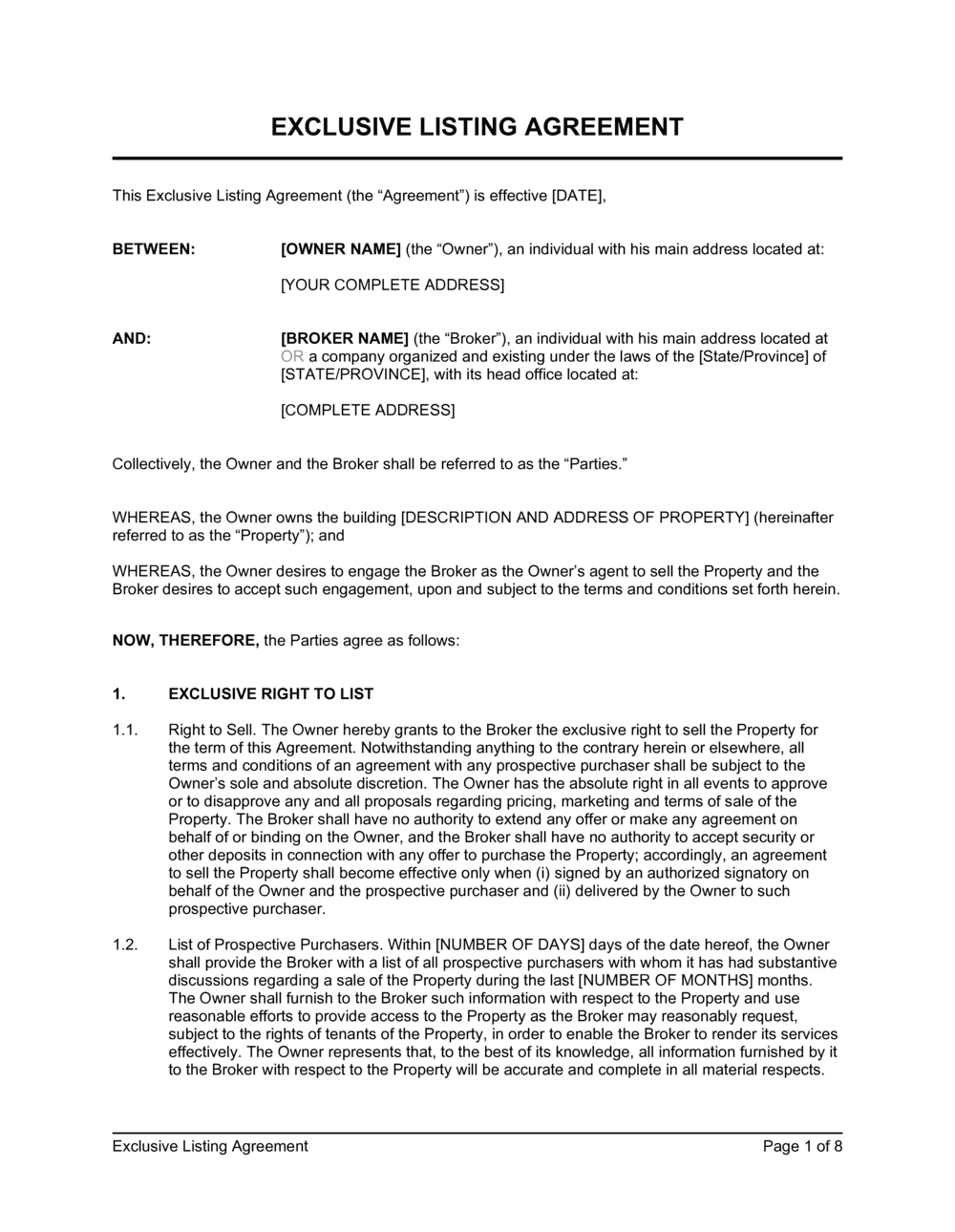
Identify parties using full legal names
Enter the seller's full legal name — individual or registered entity — and the broker's licensed brokerage name exactly as it appears on the broker's state or provincial license. Using a personal name when the licensed entity is an LLC creates an enforceability gap.
💡 Verify the broker's license number and include it in the agreement — several states require the license number to appear on listing contracts.
2
Provide a complete legal property description
Enter the full legal description from the property's title deed or land registry record, not just the street address. For business listings, describe the assets being sold by category (real property, equipment, goodwill, customer contracts).
💡 Pull the legal description from the most recent title insurance commitment or the county assessor's parcel record to avoid transcription errors.
3
Set the listing period with specific start and end dates
Enter a fixed calendar start and end date. Typical residential listing periods run 90 to 180 days; commercial and business sales commonly run 6 to 12 months. Avoid open-ended terms.
💡 For a first engagement with a new broker, consider a 90-day initial term with a mutual option to extend — it keeps the broker accountable without permanently locking you in.
4
Define the commission rate and protection period
State the commission as a percentage of the gross sale price, confirm whether it covers a cooperating broker's split, and set the tail period (typically 90 to 180 days) during which the broker is owed commission on post-expiry sales to introduced buyers.
💡 Require the broker to deliver a written list of buyer names at or before expiration to document which buyers fall within the protection period — this prevents disputes months later.
5
List specific broker marketing obligations
Replace vague 'best efforts' language with concrete deliverables: MLS listing within 3 business days, professional photography, minimum number of showings or open houses, and a bi-weekly written marketing update.
💡 Tie at least one obligation to a calendar deadline — 'MLS entry within 3 business days of execution' is enforceable; 'prompt MLS entry' is not.
6
Complete the seller representations and disclosure section
Confirm ownership, authority to sell, and any known material defects. Attach a separate property disclosure statement if required by applicable law — reference it in this clause rather than attempting to replicate it in the agreement.
💡 In jurisdictions with mandatory seller disclosure forms (e.g., California, Ontario), attach the completed statutory form as an exhibit and cross-reference it here.
7
Address dual agency consent explicitly
Choose whether to consent to or prohibit dual agency and initial or sign that specific provision. If you consent, confirm the broker's obligation to disclose and manage the conflict before making any offer.
💡 If dual agency is permitted, insert a reduced commission rate for dual-agency transactions — the broker is doing half the adversarial work and the reduction is standard practice in many markets.
8
Execute before any marketing activity begins
Both parties must sign and date the agreement before the broker takes any marketing action — photographs, MLS entry, or advertising. Marketing a property before a signed listing agreement can create implied agency liability in some jurisdictions.
💡 Use electronic signature with timestamped audit trails. In the US, ESIGN and UETA give e-signatures the same legal effect as wet signatures for real estate listing agreements in most states.