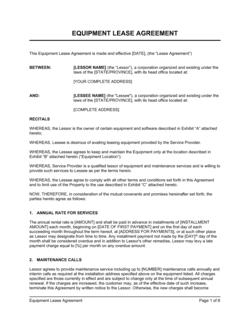
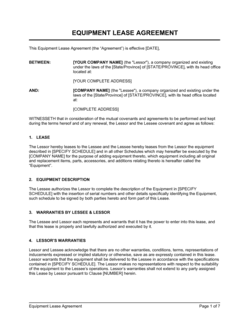
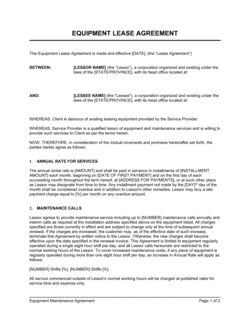
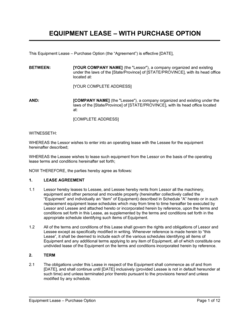
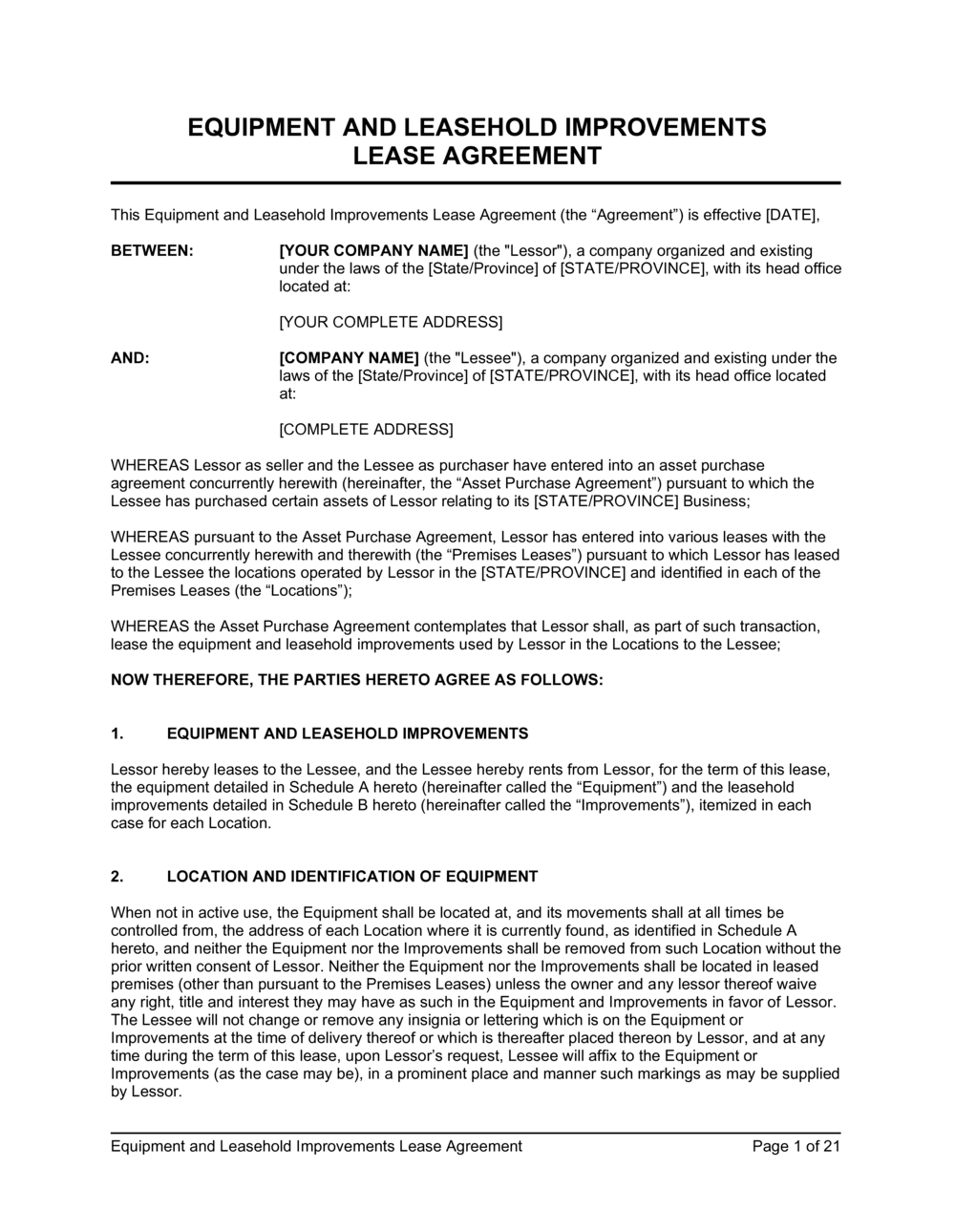
Equipment and Leasehold Improvements Lease Agreement Long Template

Free Word download • Edit online • Save & share with Drive • Export to PDF

21 pages35–45 min to fillDifficulty: ComplexSignature requiredLegal review recommended
Learn more ↓
FreeEquipment and Leasehold Improvements Lease Agreement Long Template

At a glance

What it is
An Equipment and Leasehold Improvements Lease Agreement (Long Form) is a comprehensive legally binding contract between a lessor and a lessee that governs the rental of physical equipment alongside any tenant-funded improvements made to a leased premises. This free Word download covers the full lifecycle of the arrangement — from delivery and installation through maintenance obligations, permitted alterations, and end-of-term return or buyout — in a single detailed document you can edit online and export as PDF.
When you need it
Use it when a business is leasing significant equipment — machinery, technology systems, medical devices, or industrial tools — and also making structural or cosmetic improvements to the space in which that equipment operates. It is especially critical when the combined value of the equipment and improvements creates material financial exposure for either party.
What's inside
Parties and equipment description, lease term and rent schedule, delivery and acceptance, permitted leasehold improvements and restoration obligations, maintenance and repair allocation, insurance requirements, default and remedies, indemnification, and end-of-term options including purchase, renewal, and return conditions.

What is an Equipment and Leasehold Improvements Lease Agreement?

An Equipment and Leasehold Improvements Lease Agreement is a comprehensive legally binding contract between a lessor and a lessee that governs two interrelated transactions simultaneously: the rental of tangible equipment — machinery, technology systems, medical devices, or industrial tools — and the lessee's right to make structural or cosmetic alterations to the leased premises in which that equipment will be installed and operated. Unlike a standard equipment lease, this long-form agreement addresses the full lifecycle of a combined arrangement — from delivery, installation, and acceptance through maintenance obligations, permitted improvement scope, insurance requirements, default and remedies, and end-of-term return, renewal, or purchase options. It is used when the financial stakes of the equipment and premises improvements together make a detailed, enforceable written record essential for both parties.

Why You Need This Document

Without a combined written agreement, lessors and lessees operating under informal arrangements or mismatched separate contracts face significant exposure on multiple fronts simultaneously. A lessee who makes $200,000 in premises improvements with no written lease protection can be evicted before recouping that investment. A lessor with no defined restoration obligation can inherit a purpose-built space they cannot re-let without costly demolition. Missing insurance minimums leave a multi-million-dollar equipment installation underprotected. And end-of-term disputes over equipment condition, improvement ownership, and restoration costs are among the most litigated commercial lease issues in every major jurisdiction. This long-form template eliminates those gaps by documenting every material obligation in a single executed document — giving both parties a clear, enforceable record from day one through the final inspection.

Which variant fits your situation?

If your situation is…Use this template
Leasing equipment only with no premises improvementsEquipment Lease Agreement
Short-term or month-to-month equipment rentalEquipment Rental Agreement
Leasing commercial premises with tenant improvement allowance onlyCommercial Lease Agreement
Financing equipment with an option to own from day oneEquipment Finance Agreement
Subleasing equipment to a third party under an existing master leaseEquipment Sublease Agreement
Leasing vehicles or a fleet alongside facility improvementsVehicle Lease Agreement
Sale-leaseback arrangement on equipment already ownedSale and Leaseback Agreement

Common mistakes to avoid

❌ Tying rent commencement to delivery rather than acceptance

Why it matters: If equipment arrives damaged or fails initial testing, the lessee starts paying rent on unusable equipment — creating an immediate dispute and potential payment default.

Fix: Link rent commencement to a signed acceptance certificate issued after the lessee has inspected and confirmed the equipment is in good working order.

❌ No detailed Schedule B for permitted improvements

Why it matters: Without a specific approved scope, any alteration the lessee makes is potentially unauthorized, and the lessor may demand costly removal of improvements the lessee believed were permitted.

Fix: Attach a Schedule B listing every permitted improvement with enough detail — dimensions, materials, contractor requirements — to distinguish it from unauthorized work.

❌ Omitting the lessor's restoration election deadline

Why it matters: A lessee who does not know until the last week of a lease whether they must demolish improvements cannot budget for removal costs, and post-lease possession disputes frequently follow.

Fix: Require the lessor to notify the lessee of their restoration election at least 60–90 days before lease expiry so the lessee can plan and budget accordingly.

❌ Generic insurance minimums that do not reflect equipment value

Why it matters: A property insurance minimum written at $500,000 for equipment now worth $2M leaves a $1.5M uninsured gap that falls entirely on the lessor if the lessee defaults or the equipment is destroyed.

Fix: Tie the property insurance minimum to the current replacement value of the equipment and require annual recertification of that figure alongside the insurance certificate.

❌ No definition of 'normal wear and tear' for equipment return

Why it matters: Without an agreed standard, the lessor and lessee inevitably disagree on what damage exceeds normal use — leading to security deposit disputes, repair cost claims, and litigation.

Fix: Attach a return condition checklist as a schedule and conduct a joint inspection at least 30 days before lease end, documenting findings in writing signed by both parties.

❌ Using an at-will or month-to-month term for a capital improvement arrangement

Why it matters: Leasehold improvements are long-lived investments. A month-to-month lease exposes the lessee to termination before they recoup improvement costs, and the lessor to sudden vacancy in a specialized space.

Fix: Set a minimum lease term long enough for the lessee to amortize the improvement costs — typically matching the depreciation schedule of the improvements, often 5–10 years.

The 10 key clauses, explained

Parties, Equipment Description, and Premises Identification

In plain language: Identifies the lessor and lessee as legal entities and precisely describes the equipment being leased — make, model, serial number, quantity — along with the address of the premises where it will be installed.

Sample language
This Lease Agreement is entered into on [DATE] between [LESSOR LEGAL NAME], a [STATE/PROVINCE] [ENTITY TYPE] ('Lessor'), and [LESSEE LEGAL NAME], a [STATE/PROVINCE] [ENTITY TYPE] ('Lessee'). The Equipment leased hereunder consists of [DESCRIPTION, MAKE, MODEL, SERIAL NUMBER], to be installed at [PREMISES ADDRESS] ('Premises').

Common mistake: Using a trade name instead of the registered legal entity name for either party. This creates enforcement ambiguity if the operating name differs from the legal entity, especially on default or insurance claims.

Lease Term, Commencement, and Renewal Options

In plain language: Sets the start date, duration, and end date of the lease, and specifies any renewal options — including notice periods required to exercise them and whether rent adjusts on renewal.

Sample language
The initial Lease Term shall commence on [COMMENCEMENT DATE] and expire on [EXPIRY DATE] ('Initial Term'). Lessee shall have [NUMBER] option(s) to renew for successive periods of [X] months each, exercisable by written notice no later than [X] days prior to expiry. Rent during any renewal term shall be [FIXED / ADJUSTED BY CPI / RENEGOTIATED].

Common mistake: Omitting the renewal notice deadline. If no deadline is specified, a lessee who misses an informal window may lose the renewal right and face renegotiation at market rates.

Rent, Payment Schedule, and Late Charges

In plain language: States the base rent amount, payment frequency, accepted payment methods, and the late charge or interest rate that applies to overdue amounts.

Sample language
Lessee shall pay Lessor base rent of $[AMOUNT] per month, due on the [FIRST] day of each calendar month. Payments shall be made by [METHOD] to [ACCOUNT/ADDRESS]. Any payment not received within [X] days of the due date shall accrue a late charge of [X]% per month on the outstanding balance.

Common mistake: No late charge clause at all, or one that mirrors the jurisdictional maximum without checking it. Courts in some jurisdictions treat excessive late fees as unenforceable penalties — cap them at a commercially reasonable rate.

Delivery, Installation, and Acceptance

In plain language: Specifies who bears the cost and responsibility for delivering and installing the equipment, and how the lessee formally accepts it as fit for purpose — which typically starts the rent obligation.

Sample language
Lessor shall deliver the Equipment to the Premises no later than [DATE]. Lessee shall inspect the Equipment within [X] business days of delivery and provide written notice of any defects. Failure to provide timely notice shall constitute acceptance of the Equipment in good working order, and the Lease Term and rent obligation shall commence upon acceptance.

Common mistake: Starting rent from the delivery date rather than the acceptance date. If equipment arrives damaged or incomplete, the lessee may owe rent on equipment they cannot use — always tie rent commencement to a signed acceptance certificate.

Leasehold Improvements — Permitted Work and Approval Process

In plain language: Defines what alterations the lessee may make to the premises to accommodate the equipment, what requires prior written consent from the lessor, and the standards to which the work must be performed.

Sample language
Lessee may make improvements to the Premises as described in Schedule B ('Permitted Improvements') without prior consent. Any additional alterations require Lessor's written consent, not to be unreasonably withheld. All work shall be performed by [LICENSED CONTRACTORS / APPROVED CONTRACTOR LIST], in compliance with applicable building codes, and at Lessee's sole cost and expense.

Common mistake: No Schedule B detailing the approved improvements. A vague reference to 'reasonable alterations' creates disputes about what was actually permitted — attach a detailed scope with drawings or specifications.

Maintenance, Repair, and Condition Obligations

In plain language: Allocates responsibility for routine maintenance, preventive service, and major repairs between the lessor and lessee for both the equipment and the improved premises.

Sample language
Lessee shall maintain the Equipment in good working order and perform all routine maintenance per the manufacturer's guidelines at Lessee's expense. Lessor shall be responsible for structural repairs to the Premises. Lessee shall promptly notify Lessor in writing of any equipment malfunction or damage to the Premises exceeding $[THRESHOLD].

Common mistake: Assigning all maintenance to the lessee without distinguishing structural from operational repairs. For long-term leases, unexpected major structural costs can become a financial burden the lessee cannot absorb, leading to default.

Insurance Requirements

In plain language: Requires both parties to maintain specified insurance coverages — property, liability, and business interruption — and to provide certificates of insurance naming the other party as an additional insured.

Sample language
Lessee shall, at its expense, maintain (a) commercial general liability insurance with limits of not less than $[X] per occurrence and $[X] aggregate; (b) property insurance covering the Equipment at full replacement value; and (c) business interruption insurance. Lessee shall provide Lessor with certificates of insurance naming Lessor as additional insured within [X] days of execution.

Common mistake: Specifying coverage limits in the contract without indexing them to inflation or market norms. A $1M liability limit written in 2015 may be materially inadequate by 2026 — set a periodic review obligation or index to CPI.

Restoration Obligations at Lease End

In plain language: States whether the lessee must remove leasehold improvements and restore the premises to original condition at lease end, or whether the lessor may elect to retain them — and who bears the cost either way.

Sample language
Upon expiry or earlier termination, Lessee shall, at Lessor's election, either (a) remove all Permitted Improvements and restore the Premises to their original condition, or (b) surrender the Premises with Permitted Improvements intact. Lessor shall notify Lessee of its election no later than [X] days prior to the expiry date. Costs of removal and restoration shall be borne by [LESSEE / AS AGREED].

Common mistake: No deadline for the lessor to elect retention or removal. Without one, the lessee cannot plan demolition costs or timing, and post-lease disputes over who owes what are common.

Default, Remedies, and Cure Period

In plain language: Defines what constitutes a default — missed payment, unauthorized use, failure to insure, or abandonment — and what remedies the lessor may pursue, including the notice and cure period before action is taken.

Sample language
An event of Default shall occur if: (a) Lessee fails to pay rent within [X] days of the due date; (b) Lessee makes unauthorized alterations; (c) Lessee fails to maintain required insurance; or (d) Lessee abandons the Premises. Lessor shall provide written notice of Default, and Lessee shall have [X] days to cure. Upon failure to cure, Lessor may terminate this Agreement, repossess the Equipment, and pursue all available legal remedies.

Common mistake: Setting too short a cure period — 3 days for a payment default is common in template boilerplate but may be void in jurisdictions requiring longer statutory notice. Check applicable landlord-tenant or UCC rules before finalizing.

End-of-Term Options — Purchase, Renewal, and Return

In plain language: Specifies the lessee's options at lease expiry: purchase the equipment at a stated or fair-market price, renew under new or existing terms, or return the equipment in a defined condition with an inspection process.

Sample language
At the expiration of the Lease Term, Lessee shall have the option to (a) purchase the Equipment at a price of $[FIXED PRICE] or fair market value as determined by [METHOD]; (b) renew this Agreement for [TERM] upon mutual written agreement; or (c) return the Equipment to Lessor at [RETURN LOCATION] in good working order, normal wear and tear excepted. Lessee must exercise its election in writing no later than [X] days prior to expiry.

Common mistake: No definition of 'normal wear and tear' or an inspection process. Without an agreed standard, disputes over equipment condition at return are almost inevitable — attach a return condition checklist as a schedule.

How to fill it out

  1. 1

    Identify the parties using full legal entity names

    Enter the lessor's and lessee's registered legal names, entity types, states or provinces of incorporation, and principal addresses. Do not use trade names or DBAs in the party block.

    💡 Pull entity names directly from your state or provincial business registry to avoid spelling or punctuation mismatches that complicate enforcement.

  2. 2

    Describe the equipment precisely

    List each piece of equipment with its make, model, serial number, quantity, and estimated replacement value. For multiple items, use a Schedule A and incorporate it by reference in the main agreement.

    💡 Photograph the equipment and attach the photos as an exhibit at execution — this eliminates return-condition disputes about pre-existing damage.

  3. 3

    Set the lease term, commencement date, and renewal options

    Enter the exact start and end dates, any renewal periods with their duration and rent adjustment mechanism, and the written notice deadline the lessee must meet to exercise each option.

    💡 For long-term leases (3 years or more), include a CPI escalation clause on renewal rent rather than a fixed percentage — it protects the lessor against inflation without requiring renegotiation.

  4. 4

    Define the rent schedule and late charge

    State the base rent amount, payment frequency, and due date. Add a late charge of 1–2% per month on overdue amounts, and confirm this rate is below the usury ceiling in the applicable jurisdiction.

    💡 Specify the payment method — ACH, wire, or check — and the exact payee account details in the payment clause to prevent misdirected payments.

  5. 5

    Attach a Schedule B for permitted leasehold improvements

    List every improvement the lessee is authorized to make — electrical, plumbing, cabinetry, flooring, HVAC — with a description specific enough to distinguish approved from unauthorized work.

    💡 Require the lessee to obtain and provide copies of all building permits for Schedule B work before construction begins. Unpermitted improvements can void the lessor's property insurance.

  6. 6

    Allocate maintenance and repair responsibilities

    Specify which party handles routine maintenance, preventive servicing, emergency repairs, and structural repairs. Reference the manufacturer's maintenance schedule for the equipment.

    💡 For high-value equipment, require the lessee to maintain a manufacturer-authorized service contract and provide annual service records to the lessor.

  7. 7

    Insert insurance coverage minimums and certificate requirements

    Set liability and property insurance minimums appropriate to the equipment value and premises size. Require the lessee to deliver a certificate naming the lessor as additional insured within 10 days of signing.

    💡 Ask your insurance broker what coverage limits are standard for your industry and equipment class — generic boilerplate minimums are often inadequate for specialized machinery.

  8. 8

    Confirm the default clause, cure periods, and end-of-term options

    Review the default triggers and cure periods against the statutory minimums in the governing jurisdiction. Confirm the end-of-term election deadline gives the lessee enough lead time to arrange financing for a buyout or logistics for a return.

    💡 Have both parties initial the end-of-term options clause separately at signing — it is the most frequently disputed provision and a separate initial signals clear acknowledgment.

Frequently asked questions

What is an equipment and leasehold improvements lease agreement?

An equipment and leasehold improvements lease agreement is a legally binding contract that governs the rental of physical equipment alongside any structural or cosmetic alterations a tenant makes to the leased premises to accommodate that equipment. It sets out rent, maintenance responsibilities, permitted improvement scope, restoration obligations, insurance requirements, and end-of-term options in a single document. The long form is used when equipment value, improvement complexity, or lease duration makes a detailed written record essential.

Who typically signs this type of agreement?

The lessor — which may be the building landlord, an equipment leasing company, or a third-party financier — and the lessee, typically a business occupying the premises. In some arrangements, a separate equipment lessor and a separate building landlord are both parties, which requires careful coordination to ensure the two agreements are consistent on improvement rights and return obligations.

What is the difference between equipment lease agreements and leasehold improvement agreements?

A standalone equipment lease agreement covers only the rental of tangible machinery or tools and does not address modifications to the physical space. A leasehold improvement agreement addresses the tenant's right to alter the premises. The long-form combined agreement is used when both apply simultaneously — for example, a dental practice leasing dental chairs installed in a custom clinical build-out — because the two sets of obligations are interdependent and must be governed consistently.

Who is responsible for maintaining leased equipment?

Maintenance allocation depends on the specific contract terms. In most commercial equipment leases, routine maintenance and consumables are the lessee's responsibility, while the lessor may be obligated to address major mechanical failure caused by manufacturing defects. The agreement should explicitly reference the manufacturer's maintenance schedule and state which party must maintain a service contract. Ambiguity here is one of the most common sources of lease disputes.

Do leasehold improvements become the landlord's property?

Generally yes, unless the lease provides otherwise. In most jurisdictions, improvements that are permanently affixed to the premises — cabinetry, flooring, electrical upgrades — become the landlord's property at the end of the lease unless the tenant has a contractual right or obligation to remove them. The agreement should explicitly state whether the tenant must restore the premises and who bears the removal cost, to avoid disputes at lease expiry.

What happens if the lessee defaults on the lease?

Upon a defined event of default — typically missed rent, unauthorized alterations, or failure to maintain insurance — the lessor must typically provide written notice and a cure period before pursuing remedies. Remedies may include lease termination, repossession of the equipment, acceleration of remaining rent obligations, and recovery of costs to restore the premises. The specific remedies and timelines must comply with applicable state, provincial, or national law — generic boilerplate cure periods are sometimes shorter than statutory minimums.

Can the lessee purchase the equipment at the end of the lease?

Yes, if the agreement includes an end-of-term purchase option. This option is typically stated as a fixed price, a percentage of original cost, or fair market value determined by an agreed methodology. The lessee must usually exercise the option in writing before a stated deadline — often 60 to 90 days before lease expiry. Without a written purchase option in the agreement, the lessee has no contractual right to acquire the equipment and must negotiate separately.

Is this agreement governed by real property law or personal property law?

Combined agreements covering both equipment and leasehold improvements often sit at the intersection of two bodies of law. The equipment component is typically governed by the Uniform Commercial Code (UCC) in the US, or analogous personal property statutes elsewhere, while the premises component may be governed by real property and landlord-tenant law. This dual character is one reason legal review is recommended — ensuring that the governing law clause and remedies provisions are consistent across both components.

Do I need a lawyer to draft this agreement?

For straightforward short-term equipment leases with minimal improvements, a well-structured template is typically sufficient. Legal review is strongly recommended when the combined value of equipment and improvements exceeds $50,000, when the lease term is five years or longer, when the lessee is making substantial structural changes to the premises, or when the agreement spans multiple jurisdictions. A lawyer review typically costs $500–$1,500 and is a proportionate investment relative to the financial exposure.

How this compares to alternatives

vs Equipment Lease Agreement (Short Form)

A short-form equipment lease covers rental of a single piece of equipment with minimal complexity — payment terms, return condition, and basic default provisions. It does not address leasehold improvements, restoration obligations, or multi-year renewal structures. Use the long form whenever the lessee is also making premises alterations or the equipment is permanently installed.

vs Commercial Lease Agreement

A commercial lease agreement governs the rental of premises only — not equipment. It may include a tenant improvement allowance clause, but it does not regulate the leasing of specific tangible assets or the obligations associated with their installation and return. Where both a premises lease and an equipment lease are needed, either document them in separate agreements or use this combined long-form template.

vs Equipment Finance Agreement

An equipment finance agreement is a financing instrument — the business acquires ownership of the equipment over time through installment payments, with the lender holding a security interest until payoff. An equipment lease agreement transfers only the right to use the equipment; ownership remains with the lessor. Finance agreements are appropriate when the intent is eventual ownership; lease agreements are appropriate when use without ownership is the goal.

vs Vehicle Lease Agreement

A vehicle lease agreement is tailored to motor vehicles — covering registration, insurance minimums, mileage limits, and DMV transfer obligations — none of which appear in an equipment and leasehold improvements lease. Use a vehicle lease for cars, trucks, or fleet assets. Use this template for stationary or installed equipment combined with premises improvements.

Industry-specific considerations

Healthcare and dental practices

High-value diagnostic and treatment equipment — MRI machines, dental chairs, surgical systems — installed in custom clinical build-outs requiring HIPAA-compliant facility modifications and specific decommissioning obligations.

Food and beverage

Commercial kitchen equipment — ovens, refrigeration, ventilation systems — permanently installed in leased restaurant spaces, where restoration obligations and health code compliance interact directly with lease terms.

Manufacturing and industrial

Heavy machinery anchored to reinforced floors or integrated with purpose-built utilities, requiring structural improvement approvals, load-bearing certifications, and specialized removal procedures at lease end.

Retail and fitness

POS systems, custom fixtures, gym equipment, and HVAC installations in leased retail or studio spaces where brand standards dictate both the equipment specification and the premises fit-out scope.

Technology and data centers

Server racks, UPS systems, and cooling infrastructure installed in colocation or office space, where power and structural improvements are significant capital investments requiring clear ownership and removal terms.

Professional services

Specialized A/V, security, and communications equipment installed in law firms, financial services offices, or medical practices, combined with high-end interior improvements that require careful restoration clause drafting.

Jurisdictional notes

United States

Equipment leases in the US are governed by Article 2A of the Uniform Commercial Code, while leasehold improvement obligations are subject to state real property and landlord-tenant law — creating a dual legal framework within a single agreement. Non-compete remedies, cure period minimums, and security deposit handling vary significantly by state. California, New York, and Texas each impose distinct rules on landlord remedies and tenant improvement ownership at lease end.

Canada

Canadian equipment leases are governed provincially — Ontario's Personal Property Security Act (PPSA) and equivalent provincial statutes regulate security interests in leased equipment. Commercial tenancy legislation varies by province and sets minimum notice and remedies rules. Quebec civil law applies distinct concepts of lease and improvement ownership that differ materially from common-law provinces, and French-language documentation may be required for Quebec operations.

United Kingdom

In the UK, equipment leases are regulated under the Consumer Credit Act 1974 (for certain transactions), the Sale of Goods Act, and common-law contract principles. Leasehold improvements are governed by landlord and tenant law, including the Landlord and Tenant Act 1954 for business tenancies, which grants certain renewal rights. Dilapidations obligations — the UK equivalent of restoration — are strictly regulated and frequently the subject of end-of-lease disputes; a schedules of condition attached at commencement is standard practice.

European Union

EU member states have no harmonized equipment lease statute; each jurisdiction applies its own civil or commercial code. IFRS 16 requires lessees to recognize most lease assets and liabilities on their balance sheets, affecting how equipment leases are structured and disclosed for EU-regulated entities. GDPR considerations arise where equipment processes personal data — data handling obligations should be addressed in the agreement or a separate DPA. France, Germany, and the Netherlands each impose distinct tenant protection rules on commercial leases.

Template vs lawyer — what fits your deal?

PathBest forCostTime
Use the templateBusinesses leasing equipment under $50,000 in value with straightforward, pre-approved improvements in a single jurisdictionFree45–90 minutes
Template + legal reviewLeases involving $50,000–$500,000 in combined equipment and improvement value, multi-year terms, or complex restoration obligations$500–$1,5003–5 business days
Custom draftedHigh-value specialized installations, cross-border arrangements, heavily regulated industries, or leases with sale-leaseback or financing components$2,000–$8,000+2–4 weeks

Glossary

Lessor
The party who owns the equipment and/or the leased premises and grants the right to use them in exchange for rent payments.
Lessee
The business or individual who rents the equipment and occupies the premises, taking on maintenance and use obligations under the agreement.
Leasehold Improvement
Any structural, cosmetic, or functional alteration a tenant makes to a leased space — such as installing cabinetry, electrical upgrades, or plumbing — to accommodate their business operations.
Lease Term
The defined period during which the lessee has the right to use the equipment and occupy the premises, from the commencement date to the expiry or early termination date.
Base Rent
The fixed periodic payment — monthly, quarterly, or annually — the lessee pays for use of the equipment and space, excluding operating expenses and variable charges.
Restoration Obligation
The lessee's contractual duty to return the premises and equipment to their original condition at lease end, removing any improvements unless the lessor consents to retain them.
Default
A breach of a material obligation under the lease — typically failure to pay rent, unauthorized alterations, or neglect of maintenance — that triggers the lessor's remedies.
End-of-Term Option
A contractual right granted to the lessee at lease expiry to purchase the equipment at fair market value or a fixed price, renew the lease, or return the equipment.
Depreciation
The reduction in the value of leased equipment over time due to wear, use, or obsolescence — relevant when calculating fair market value buyout prices and insurance replacement costs.
Personal Property Tax
A jurisdiction-specific tax levied on the assessed value of tangible business equipment, which the lease must allocate to either the lessor or lessee.
Force Majeure
A clause excusing a party's non-performance when extraordinary events beyond their control — floods, earthquakes, or government orders — prevent fulfillment of lease obligations.
Quiet Enjoyment
The lessor's covenant guaranteeing the lessee undisturbed use of the equipment and premises for the duration of the lease, provided the lessee is not in default.

Part of your Business Operating System

This document is one of 3,000+ business & legal templates included in Business in a Box.

  • Fill-in-the-blanks — ready in minutes
  • 100% customizable Word document
  • Compatible with all office suites
  • Export to PDF and share electronically

Create your document in 3 simple steps.

From template to signed document — all inside one Business Operating System.
1
Download or open template

Access over 3,000+ business and legal templates for any business task, project or initiative.

2
Edit and fill in the blanks with AI

Customize your ready-made business document template and save it in the cloud.

3
Save, Share, Send, Sign

Share your files and folders with your team. Create a space of seamless collaboration.

Save time, save money, and create top-quality documents.

★★★★★

"Fantastic value! I'm not sure how I'd do without it. It's worth its weight in gold and paid back for itself many times."

Managing Director · Mall Farm
Robert Whalley
Managing Director, Mall Farm Proprietary Limited
★★★★★

"I have been using Business in a Box for years. It has been the most useful source of templates I have encountered. I recommend it to anyone."

Business Owner · 4+ years
Dr Michael John Freestone
Business Owner
★★★★★

"It has been a life saver so many times I have lost count. Business in a Box has saved me so much time and as you know, time is money."

Owner · Upstate Web
David G. Moore Jr.
Owner, Upstate Web

Run your business with a system — not scattered tools

Stop downloading documents. Start operating with clarity. Business in a Box gives you the Business Operating System used by over 250,000 companies worldwide to structure, run, and grow their business.

Start free · No credit card required