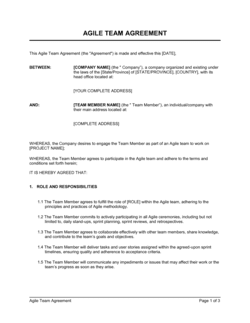
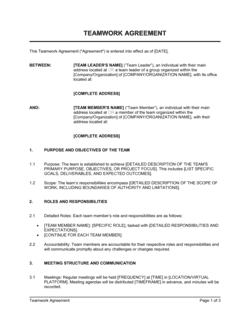
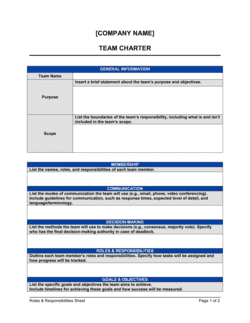
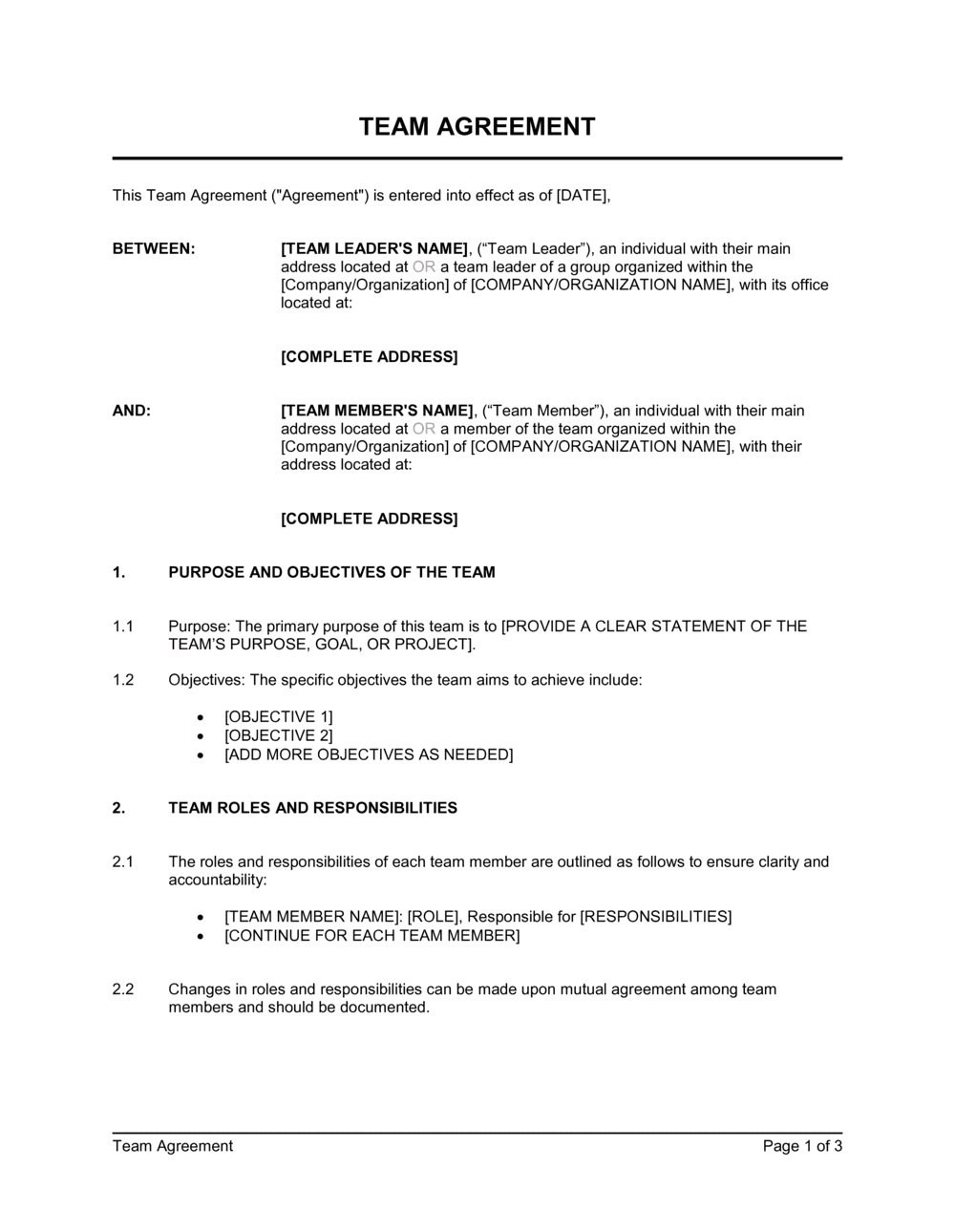
Team Agreement Template

Free Word download β€’ Edit online β€’ Save & share with Drive β€’ Export to PDF

3 pagesβ€’25–30 min to fillβ€’Difficulty: Standardβ€’Signature requiredβ€’Legal review recommended
Learn more ↓
FreeTeam Agreement Template

At a glance

What it is
A Team Agreement is a binding legal document that formalizes the working relationship among members of a business team, project group, or co-founding unit. This free Word download lets you define roles, responsibilities, decision-making authority, compensation or profit-sharing, IP ownership, and exit procedures β€” all in a single editable document you can export as PDF and sign before work begins.
When you need it
Use it when two or more people are joining forces on a business venture, project, or ongoing collaboration where money, IP, or strategic decisions are at stake. It is especially important before the team invests significant time or capital, when each member's contribution differs, or when the team operates without a formal partnership or shareholder agreement.
What's inside
Team member identification and roles, scope of work and responsibilities, decision-making procedures, compensation and profit-sharing terms, intellectual property ownership, confidentiality obligations, dispute resolution procedures, and exit or termination conditions.

What is a Team Agreement?

A Team Agreement is a binding legal document that formalizes the working relationship among two or more people collaborating on a shared business venture, project, or creative initiative. It establishes each member's defined role, scope of responsibilities, decision-making authority, compensation or profit-sharing formula, intellectual property ownership, confidentiality obligations, and the process for resolving disputes or managing a member's departure. Unlike a handshake arrangement or an informal email thread, a properly executed team agreement creates enforceable obligations on all sides β€” and eliminates the ambiguity that invariably becomes a source of conflict when money, IP, or control are at stake.

Why You Need This Document

Teams that operate without a written agreement do not operate without rules β€” they operate under whatever rules local law defaults to, which typically means each member is treated as a general partner with unlimited personal liability for the team's debts and no clear ownership of jointly created IP. The cost of discovering this after a dispute is significant: a single disagreement over who owns the product, who controls the client relationship, or who gets paid what can dissolve a team that has already invested months of work and real capital. A signed team agreement, executed before any shared work begins, closes these gaps at the cost of an hour and a document review. This template gives you a complete, editable starting point covering every clause that matters β€” so your team can focus on building rather than litigating.

Which variant fits your situation?

If your situation is…Use this template
Formalizing a co-founding relationship before entity formationCo-Founder Agreement
Two or more parties operating an ongoing business togetherPartnership Agreement
Engaging an individual contributor on a defined projectIndependent Contractor Agreement
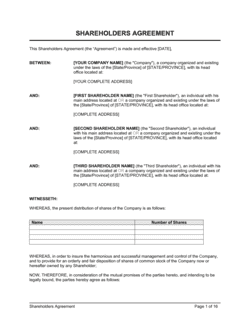
Establishing how shareholders govern a corporationShareholders Agreement
Defining responsibilities for a single short-term projectProject Collaboration Agreement
Protecting shared confidential information between collaborating partiesMutual Non-Disclosure Agreement
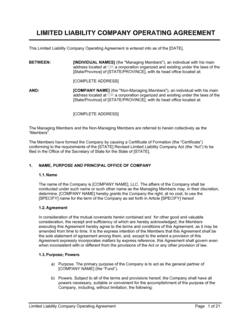
Formalizing an LLC's operating rules and member responsibilitiesLLC Operating Agreement

Common mistakes to avoid

❌ Vague scope of responsibilities

Why it matters: When members' roles overlap or are undefined, disputes over who owns a decision or deliverable become personal rather than contractual β€” and there is no written standard to resolve them.

Fix: Assign each functional area to exactly one member as the responsible party, and specify in writing what authority they hold within that area.

❌ No time-commitment clause

Why it matters: Perceived imbalance in effort is the most common reason informal team agreements collapse. Without a documented standard, the over-contributing member has no contractual basis to address the problem.

Fix: Include a minimum weekly-hours commitment for each member and tie a material shortfall to the exit provision so the remedy is clear.

❌ Requiring unanimous consent for all decisions

Why it matters: A deadlock on a routine operational decision β€” a vendor choice, a social media post, a minor expense β€” can halt progress entirely and creates a mechanism for one member to hold the team hostage.

Fix: Reserve unanimous consent for truly strategic decisions: adding members, dissolving the team, spending above a defined threshold, and amending the agreement itself.

❌ No IP ownership clause

Why it matters: If each member retains individual ownership of what they create, the team's product or service is legally fragmented β€” making it unsalable, unlicensable, and impossible to transfer to a future entity without renegotiating with every contributor.

Fix: Include an explicit IP assignment clause vesting all jointly created work product in the team collectively or in a named future entity, executed at signing.

❌ No removal procedure for non-performing members

Why it matters: Without documented grounds and a process for removal, a non-contributing member who refuses to exit can block decisions, continue receiving distributions, and prevent the team from moving forward.

Fix: Define specific grounds for involuntary removal β€” sustained failure to meet time commitments, material breach, or unanimous vote of the remaining members β€” and the notice and handover process that follows.

❌ Signing after the team's work has already started

Why it matters: In common-law jurisdictions, restrictive clauses β€” confidentiality, non-solicitation, IP assignment β€” may be unenforceable if no new consideration accompanies a post-commencement signing.

Fix: Execute the agreement before the first meeting, code commit, or client interaction. If late execution is unavoidable, document a specific new benefit provided to each member at the time of signing.

The 10 key clauses, explained

Parties and team member identification

In plain language: Names and identifies every individual bound by the agreement, including their legal names, contact details, and the date the agreement takes effect.

Sample language
This Team Agreement ('Agreement') is entered into as of [DATE] by and among [TEAM MEMBER 1 FULL NAME] ('Member 1'), [TEAM MEMBER 2 FULL NAME] ('Member 2'), and [TEAM MEMBER 3 FULL NAME] ('Member 3'), collectively referred to as the 'Team.'

Common mistake: Listing nicknames or trade names instead of legal names. If a dispute escalates, enforcement becomes complicated when the named party cannot be legally identified.

Purpose and scope of work

In plain language: Describes the team's shared objective and maps specific responsibilities to each member, preventing overlap and clarifying accountability.

Sample language
The Team is formed for the purpose of [PROJECT / VENTURE DESCRIPTION]. Member 1 is responsible for [FUNCTION]. Member 2 is responsible for [FUNCTION]. Member 3 is responsible for [FUNCTION].

Common mistake: Writing scope so broadly β€” 'Member 1 is responsible for all business development' β€” that no measurable accountability exists. Vague scope is the leading cause of co-founder disputes.

Decision-making and voting procedures

In plain language: Establishes which decisions require unanimous consent, which require a majority, and who holds a casting vote or veto to break deadlocks.

Sample language
Day-to-day operational decisions may be made by any Member acting within their defined scope. Strategic decisions β€” including [EXAMPLES: entering new markets, expenditures over $[X], adding new team members] β€” require unanimous written consent of all Members.

Common mistake: Requiring unanimous consent for every decision. As teams scale or disagreements arise, unanimous-consent requirements for operational matters create paralysis.

Time commitment and performance expectations

In plain language: States the minimum hours or availability each member commits to the team and the consequences if those commitments are not met.

Sample language
Each Member agrees to dedicate a minimum of [X] hours per week to the Team's activities. Failure to meet this commitment for more than [X] consecutive weeks constitutes a material breach and triggers the exit procedures in Section [X].

Common mistake: Omitting any time-commitment clause entirely. When one member perceives another as undercontributing, the lack of a documented standard makes the dispute nearly impossible to resolve fairly.

Compensation and profit sharing

In plain language: Sets out whether members are paid a fixed amount, receive a percentage of revenue or profit, or work on a deferred-compensation basis β€” and specifies when and how payments are made.

Sample language
Net profits of the Team shall be distributed to Members in the following proportions: Member 1 β€” [X]%; Member 2 β€” [X]%; Member 3 β€” [X]%. Distributions shall be made [monthly / quarterly] within [15] days of the close of each period, subject to a minimum cash reserve of $[AMOUNT].

Common mistake: Agreeing to split revenue before expenses rather than net profit. A 50/50 revenue split that ignores one member's disproportionate expenses can create resentment and financial disputes within the first quarter.

Intellectual property ownership

In plain language: Determines who owns work product, code, designs, or other IP created by team members β€” whether it belongs to the team collectively, one designated member, or a future entity.

Sample language
All work product, inventions, software, creative works, and improvements developed by any Member in connection with the Team's activities are the joint property of the Team and shall be assigned to [DESIGNATED ENTITY / HELD JOINTLY] upon execution of this Agreement.

Common mistake: No IP clause at all β€” or one that vests IP in the individual member who created it. If the team dissolves, each member walking away with their own piece makes the product unworkable for any successor entity or acquirer.

Confidentiality

In plain language: Requires each member to keep the team's business information, strategies, client data, and financial details confidential, both during and after their participation.

Sample language
Each Member agrees to hold in strict confidence all Confidential Information of the Team and to use such information solely for the benefit of the Team. 'Confidential Information' includes but is not limited to business strategies, financial data, client lists, and proprietary processes.

Common mistake: Using a confidentiality clause that expires when the member leaves the team. Confidential information β€” particularly client data and product roadmaps β€” remains sensitive long after departure.

Dispute resolution

In plain language: Establishes a step-by-step process for resolving disagreements β€” typically starting with direct negotiation, escalating to mediation, and finally to arbitration or litigation.

Sample language
The Members agree to attempt to resolve any dispute first through good-faith negotiation for [15] days. If unresolved, the dispute shall be submitted to mediation administered by [ORGANIZATION] in [CITY]. If mediation fails, disputes shall be resolved by binding arbitration under the rules of [AAA / OTHER BODY].

Common mistake: Skipping directly to litigation as the dispute mechanism. Court proceedings are expensive, public, and adversarial β€” mediation and arbitration clauses preserve business relationships and reduce resolution time and cost significantly.

Exit, withdrawal, and termination

In plain language: Defines how a member voluntarily leaves, how the team can remove a member for cause, what happens to that member's share of IP and compensation, and whether non-compete or non-solicitation restrictions apply post-exit.

Sample language
A Member may withdraw voluntarily with [30] days' written notice. Upon withdrawal or removal for cause, the departing Member forfeits all rights to future distributions but retains [X]% of accrued compensation earned to the exit date. The departing Member shall not solicit Team clients or Members for [12] months following exit.

Common mistake: No mechanism to remove a non-performing member. Without a documented removal procedure, teams with a dysfunctional member are effectively trapped β€” the member can block decisions and continue drawing compensation indefinitely.

Governing law and amendments

In plain language: States which jurisdiction's law governs the agreement, how the agreement can be amended, and that it constitutes the entire agreement between the parties.

Sample language
This Agreement is governed by the laws of [STATE / PROVINCE / COUNTRY]. Amendments require the written consent of all Members. This Agreement constitutes the entire agreement among the Members and supersedes all prior oral or written understandings.

Common mistake: No entire-agreement clause. Without it, prior email conversations, Slack messages, and verbal commitments can be introduced as contractual terms that override or supplement the written document.

How to fill it out

  1. 1

    Identify all team members with their legal names

    Enter each member's full legal name, address, and email address in the parties section. Confirm that all intended parties are listed β€” anyone not named is not bound.

    πŸ’‘ Cross-reference each name against a government-issued ID before signing to prevent enforcement issues if a dispute arises later.

  2. 2

    Define the team's purpose and each member's scope

    Write a clear one-to-two sentence description of the team's shared goal, then list each member's specific responsibilities with enough detail to create measurable accountability.

    πŸ’‘ Avoid overlapping responsibility areas β€” if two members share a function, specify who holds the final decision authority for that area.

  3. 3

    Set the decision-making thresholds

    Identify which categories of decision require unanimous consent (strategic, financial above a threshold, adding members) and which can be made unilaterally within a member's defined scope.

    πŸ’‘ Consider designating a 'managing member' with a casting vote for operational deadlocks β€” unanimous consent on everything is the single most common cause of team paralysis.

  4. 4

    Agree on compensation and profit-sharing percentages

    Enter each member's share of net profit or revenue, the payment schedule, and any minimum cash reserve the team must maintain before distributions are made.

    πŸ’‘ Base the profit-share percentages on each member's total contribution β€” time, capital, and expertise β€” not on equal splits by default. Equal splits feel fair at formation and often become the primary grievance within six months.

  5. 5

    Address intellectual property ownership explicitly

    State clearly whether IP belongs to the team collectively, a designated legal entity, or a specific member. If a future entity will hold IP, name the intended structure and timeline for the transfer.

    πŸ’‘ If the team is building toward incorporation, include a clause requiring each member to execute an IP assignment to the new entity within a set number of days of formation.

  6. 6

    Complete the exit and removal provisions

    Set the voluntary withdrawal notice period, the grounds for involuntary removal, and what happens to a departing member's share of accrued compensation, future distributions, and IP rights.

    πŸ’‘ Run a 'worst-case scenario' test: if the least-aligned member exits tomorrow, does this clause produce a fair and workable outcome for the remaining team?

  7. 7

    Select the governing law and dispute resolution mechanism

    Choose the jurisdiction whose laws will govern the agreement β€” typically where the majority of members reside or where the team's primary business activity occurs. Select mediation followed by arbitration as the default dispute path.

    πŸ’‘ Arbitration clauses should specify the administering body (e.g., AAA, JAMS, or a local equivalent) and the seat of arbitration to avoid procedural disputes before the substantive issue is even reached.

  8. 8

    Sign before any work begins

    All members must sign the agreement β€” physically or via a recognized e-signature platform β€” before any shared work, IP creation, or financial contribution takes place.

    πŸ’‘ In common-law jurisdictions, an agreement signed after work has already started may require documented fresh consideration β€” a new benefit or payment β€” to make post-formation restrictions enforceable.

Frequently asked questions

What is a team agreement?

A team agreement is a binding legal document that defines the terms under which two or more people collaborate on a shared business, project, or creative endeavor. It sets out each member's role, responsibilities, decision-making authority, compensation or profit share, IP ownership, and the process for resolving disputes or handling a member's exit. It functions as the foundational governance document for teams that operate without a formal corporate structure.

Is a team agreement legally binding?

Yes β€” a team agreement is generally enforceable as a contract when it identifies the parties, states clear obligations on both sides, and is signed by all members before work begins. As with any contract, the enforceability of specific clauses β€” particularly non-compete and IP-assignment provisions β€” depends on the jurisdiction and whether the clause is reasonable in scope. Consider having a lawyer review the agreement before signing if the stakes are high.

What is the difference between a team agreement and a partnership agreement?

A partnership agreement governs a formal legal partnership β€” a recognized business entity under which partners share unlimited liability for the firm's debts and obligations. A team agreement governs the internal working relationship among collaborators regardless of entity type, and is often used before a formal entity is created. If your team is operating as a general partnership without realizing it, local partnership law will fill the gaps your team agreement leaves β€” which is why formalizing the arrangement early matters.

Who should sign a team agreement?

Every individual whose contribution β€” whether time, capital, IP, or relationships β€” is material to the team's success should sign. This includes co-founders, project co-leads, revenue-sharing collaborators, and any member with access to confidential information or jointly created IP. Advisors and part-time contributors who are not sharing in economics or IP typically use separate advisor or contractor agreements.

When should a team agreement be signed?

Before any shared work begins β€” ideally at the first working meeting where responsibilities are allocated or resources are committed. Waiting until a dispute arises or a member wants to leave is the most common mistake teams make. In common-law jurisdictions, IP assignment and restrictive covenant clauses signed after work has started may require fresh consideration to be enforceable.

Does a team agreement replace a shareholders agreement or LLC operating agreement?

No. A team agreement is a starting point, most useful before or during early-stage collaboration before a formal entity exists. Once the team incorporates or forms an LLC, a shareholders agreement or operating agreement becomes the governing document for ownership and governance. The team agreement can bridge the gap and establish baseline obligations that carry over into the new entity structure, but it does not create equity rights or protect members under corporate law.

Can a team agreement be amended after signing?

Yes β€” team agreements can be amended by written agreement of all members, or by whatever threshold the amendment clause specifies. Avoid oral amendments; if the agreement is later disputed, verbal changes are nearly impossible to prove. Use a short written amendment addendum signed by all parties and attach it to the original agreement.

What happens if a team member leaves without following the exit clause?

A member who departs without complying with the notice period, handover obligations, or non-solicitation restrictions can be held in breach of contract. Remedies typically include forfeiture of accrued but unpaid compensation, injunctive relief to enforce non-solicitation, and damages for losses caused by the abrupt departure. The enforceability of these remedies depends on the specific clause language and applicable jurisdiction.

Do I need a lawyer to draft a team agreement?

For most early-stage teams with straightforward roles and no complex IP or equity arrangements, a well-structured template is sufficient to establish the core framework. Engage a lawyer when the team's IP is commercially significant, when cross-border members are involved, when the compensation structure is complex, or when the agreement is intended to bridge the gap to a formal equity arrangement. A one-to-two hour template review typically costs $300–$600 and is worthwhile for any team where a member dispute would materially damage the venture.

How this compares to alternatives

vs Partnership Agreement

A partnership agreement creates a formal legal partnership entity with defined capital contributions, profit and loss sharing, and joint liability. A team agreement governs internal collaboration without necessarily forming a legal entity β€” making it more flexible for early-stage teams, project collaborations, and pre-incorporation arrangements. Once the team forms a legal partnership, the partnership agreement supersedes the team agreement.

vs Shareholders Agreement

A shareholders agreement governs the relationship among equity holders in a corporation, covering share transfers, pre-emption rights, drag-along and tag-along provisions, and board composition. A team agreement predates equity structure and focuses on working relationships, roles, and IP. Teams that incorporate should transition from a team agreement to a shareholders agreement within the new entity.

vs Independent Contractor Agreement

An independent contractor agreement defines a service relationship between a client and a self-employed individual, with clear deliverables and payment terms but no shared ownership or decision-making. A team agreement creates a collaborative relationship among co-equal contributors with shared stakes in the outcome. If one party is clearly directing the work and the other executing it for pay, a contractor agreement is the right instrument.

vs LLC Operating Agreement

An LLC operating agreement is the governing document for a limited liability company, establishing member ownership percentages, management authority, capital accounts, and dissolution procedures under state law. A team agreement operates outside any formal entity and carries no statutory protections. Teams planning to form an LLC should treat the team agreement as a transitional document and execute an operating agreement at incorporation.

Industry-specific considerations

Technology / SaaS

IP assignment covers software, algorithms, and data models; equity vesting milestones are referenced; remote-team time-commitment clauses address distributed collaboration.

Creative and marketing agencies

Joint ownership of creative deliverables, client non-solicitation after departure, and revenue-sharing tied to billable project milestones rather than fixed salaries.

Professional services

Client relationship ownership on exit, referral-fee splitting, billing rate and utilization commitments, and professional indemnity coordination among collaborating practitioners.

Construction and trades

Subcontractor collaboration on joint bids, profit sharing on project completion, liability allocation for on-site decisions, and handover of project documentation on member exit.

Jurisdictional notes

United States

Team agreements are enforceable contracts under standard common-law principles across all US states. If no formal entity exists, local partnership law may treat the team as a general partnership β€” exposing members to joint and several liability. Non-compete clauses within team agreements face the same state-by-state enforceability limits as employment non-competes; California, Minnesota, and Oklahoma restrict them significantly. IP assignment clauses should reference 'work made for hire' carefully β€” the term has a specific statutory meaning under the Copyright Act that does not automatically apply to independent collaborators.

Canada

In Canada, an unincorporated team operating for profit may be treated as a general partnership under provincial partnership legislation, creating unlimited personal liability for each member. Quebec applies civil law rather than common law, which affects how contractual obligations and IP ownership are interpreted β€” French-language contracts are required for provincially regulated entities in Quebec. Non-solicitation and confidentiality clauses must be reasonable in scope to be enforceable; courts will not rewrite an overbroad restriction and may void it entirely.

United Kingdom

UK law recognizes team agreements as binding contracts under the Contracts Act framework, provided there is offer, acceptance, and consideration. Unincorporated teams trading together risk being treated as a general partnership under the Partnership Act 1890, with attendant unlimited liability. Post-termination restrictions β€” non-compete and non-solicitation β€” must go no further than is reasonably necessary to protect a legitimate business interest; courts will not enforce restrictions that are unreasonably wide in duration or scope. IP created in the course of collaboration defaults to joint ownership under the Copyright, Designs and Patents Act 1988 unless explicitly assigned.

European Union

EU member states apply varying national contract laws to team agreements, but all must comply with GDPR where confidential information includes personal data about clients, users, or third parties. Several member states β€” including France and Germany β€” apply mandatory employment-law protections to collaborators who exhibit characteristics of an employed relationship, regardless of how the agreement labels the arrangement. Post-contractual non-compete restrictions typically require financial compensation to be enforceable in France, Germany, and the Netherlands. IP ownership defaults vary by country; explicit assignment language is essential to override local defaults.

Template vs lawyer β€” what fits your deal?

PathBest forCostTime
Use the templateEarly-stage teams with simple role divisions, no complex IP, and domestic members in a single jurisdictionFree30–60 minutes
Template + legal reviewTeams with commercially significant IP, complex profit-sharing structures, or members in different jurisdictions$300–$6002–5 days
Custom draftedCo-founding teams preparing for immediate incorporation, venture investment, or complex equity arrangements$1,500–$4,000+1–2 weeks

Glossary

Team Member
Any individual identified in the agreement as a party bound by its terms, whether compensated, equity-holding, or contributing in kind.
Scope of Work
The specific tasks, deliverables, and areas of responsibility assigned to each team member under the agreement.
Decision-Making Authority
The defined threshold β€” unanimous, majority, or designated lead β€” required for the team to take specific types of binding actions.
Profit Sharing
The formula that determines how net revenue or profit generated by the team's work is divided among members.
Intellectual Property Assignment
A clause transferring ownership of any work product, inventions, or creative output produced by team members to a designated party or the team collectively.
Confidentiality Obligation
A binding requirement that team members not disclose each other's sensitive information, business strategies, or client data outside the team.
Deadlock
A situation where team members cannot reach a required majority or unanimous vote on a decision, preventing the team from moving forward.
Exit Provision
The contractual process a team member must follow to leave the team, including notice periods, handover obligations, and the effect on their share of IP or compensation.
Sweat Equity
An ownership or compensation stake earned through labor and time contributed rather than cash investment.
Good-Faith Obligation
A general duty, implied or express, for each party to act honestly and fairly toward the other team members in carrying out the agreement.
Non-Solicitation
A restriction preventing a departing team member from recruiting remaining members or approaching shared clients for a defined period after leaving.

Part of your Business Operating System

This document is one of 3,000+ business & legal templates included in Business in a Box.

  • Fill-in-the-blanks β€” ready in minutes
  • 100% customizable Word document
  • Compatible with all office suites
  • Export to PDF and share electronically

Create your document in 3 simple steps.

From template to signed document β€” all inside one Business Operating System.
1
Download or open template

Access over 3,000+ business and legal templates for any business task, project or initiative.

2
Edit and fill in the blanks with AI

Customize your ready-made business document template and save it in the cloud.

3
Save, Share, Send, Sign

Share your files and folders with your team. Create a space of seamless collaboration.

Save time, save money, and create top-quality documents.

β˜…β˜…β˜…β˜…β˜…

"Fantastic value! I'm not sure how I'd do without it. It's worth its weight in gold and paid back for itself many times."

Managing Director Β· Mall Farm
Robert Whalley
Managing Director, Mall Farm Proprietary Limited
β˜…β˜…β˜…β˜…β˜…

"I have been using Business in a Box for years. It has been the most useful source of templates I have encountered. I recommend it to anyone."

Business Owner Β· 4+ years
Dr Michael John Freestone
Business Owner
β˜…β˜…β˜…β˜…β˜…

"It has been a life saver so many times I have lost count. Business in a Box has saved me so much time and as you know, time is money."

Owner Β· Upstate Web
David G. Moore Jr.
Owner, Upstate Web

Run your business with a system β€” not scattered tools

Stop downloading documents. Start operating with clarity. Business in a Box gives you the Business Operating System used by over 250,000 companies worldwide to structure, run, and grow their business.

Start freeΒ Β·Β No credit card required