Team Charter Template

Free Word download β€’ Edit online β€’ Save & share with Drive β€’ Export to PDF

2 pagesβ€’20–30 min to fillβ€’Difficulty: Standardβ€’Signature requiredβ€’Legal review recommended
Learn more ↓
FreeTeam Charter Template

At a glance

What it is
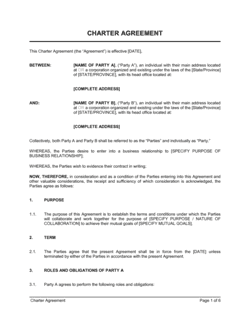
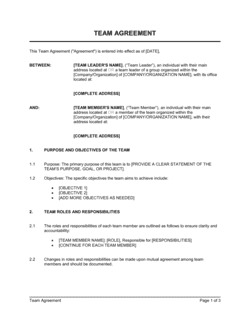
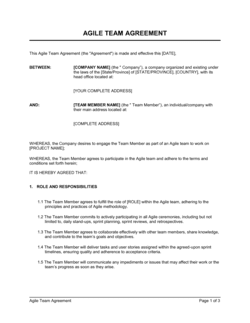
A Team Charter is a formal governing document that establishes a team's purpose, membership, decision-making authority, operating norms, and accountability structure in writing. This free Word download gives you a structured, signable template you can edit online and export as PDF β€” aligning every member before work begins and providing a reference point throughout the team's lifecycle.
When you need it
Use it at the formation of any new team β€” project task force, cross-functional working group, standing committee, or newly assembled department β€” before the first deliverable is due. It is equally valuable when restructuring an existing team whose roles and decision rights have drifted or become unclear.
What's inside
Team purpose and scope, membership roster with defined roles, goals and success metrics, decision-making authority matrix, operating norms and communication protocols, conflict resolution procedures, amendment process, and signature block for all members.

What is a Team Charter?

A Team Charter is a formal governing document that establishes a team's purpose, membership, decision-making authority, operating norms, conflict resolution procedures, and accountability structure in a single signed agreement. It functions as the team's internal constitution β€” defining not just what the team is supposed to accomplish, but precisely how it will make decisions, handle disagreements, and measure success. Unlike an informal kickoff slide deck or a verbal working agreement, a signed team charter creates documented obligations that every member and the sponsoring executive have explicitly accepted.

Why You Need This Document

Teams that begin work without a charter spend a disproportionate share of early collaboration time relitigating basic governance questions β€” who has authority over which decisions, how disagreements get resolved, and what the team is actually responsible for. Without written, signed norms, these disputes surface at the worst possible moments: when a deadline is approaching, when a key member leaves, or when a stakeholder assigns out-of-scope work informally and the team has no documented mandate to decline it. A team charter eliminates that ambiguity before it becomes expensive. It protects the team lead from being bypassed on decisions, protects members from undefined time demands, and protects the sponsor from being drawn into conflicts the team should be resolving itself. This template gives you a structured, signable document you can tailor and execute in under two hours β€” before your team's first substantive working session.

Which variant fits your situation?

If your situation is…Use this template
Governing a time-limited project with a defined deliverable and end dateProject Team Charter
Establishing a standing committee or advisory board with ongoing mandateCommittee Charter
Documenting working agreements for an agile scrum or product squadAgile Team Working Agreement
Formalizing the governance of a newly formed department or business unitDepartment Charter
Aligning a co-founding team on equity, roles, and decision authorityCo-Founder Agreement
Defining the mandate and authority of a nonprofit board committeeBoard Committee Charter
Setting governance for a joint venture or partnership working groupJoint Venture Agreement

Common mistakes to avoid

❌ Vague purpose statement with no measurable outcome

Why it matters: A team with no clear success criterion cannot evaluate its own performance or know when its mandate is fulfilled, leading to indefinite operation and scope creep.

Fix: Rewrite the purpose clause using the format '[ACTION] to achieve [MEASURABLE OUTCOME] by [DATE]' and have the sponsor approve the metric before the charter is signed.

❌ Omitting member time commitments

Why it matters: When workload pressure rises, members deprioritize the team without any documented obligation β€” and there is no basis for the team lead or sponsor to intervene.

Fix: Add a percentage time commitment and, for members above 20%, obtain written acknowledgment from their line manager before the charter takes effect.

❌ Requiring unanimous consent for all team decisions

Why it matters: A single dissenting member can block any decision indefinitely, turning routine choices into protracted negotiations and stalling the team's output.

Fix: Classify decisions into tiers and reserve unanimous consent for charter amendments only; use simple majority or team-lead determination for operational and tactical decisions.

❌ No conflict resolution clause

Why it matters: Without a defined process, interpersonal disputes escalate directly to the sponsor with no structure, consuming executive time and damaging team cohesion.

Fix: Include a mandatory direct-resolution step with a five-business-day window before any escalation to the team lead or sponsor is permitted.

❌ Circulating the charter for email acknowledgment instead of signatures

Why it matters: An email acknowledgment is ambiguous β€” members can dispute which version they reviewed or whether they agreed to specific clauses, particularly decision rights and operating norms.

Fix: Require dated signatures β€” wet or electronic β€” from every member and the sponsor on the final agreed version before work begins.

❌ No scope exclusions clause

Why it matters: Without explicit exclusions, stakeholders outside the team informally assign adjacent work, consuming capacity and blurring accountability for outcomes that were never part of the mandate.

Fix: List at least three specific functions, decisions, or deliverables that are expressly outside the team's mandate and require a charter amendment to include.

The 10 key clauses, explained

Team purpose and mandate

In plain language: States why the team exists, what specific problem or opportunity it addresses, and the authority under which it operates.

Sample language
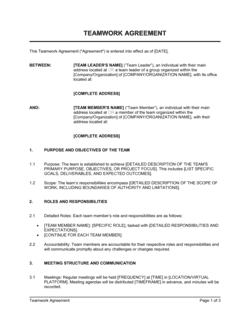
The [TEAM NAME] ('Team') is established by [SPONSOR NAME / ORGANIZATION] to [PURPOSE STATEMENT]. The Team is authorized to [SCOPE OF AUTHORITY] and is accountable for [PRIMARY DELIVERABLE OR OUTCOME].

Common mistake: Writing a vague purpose statement like 'improve performance' with no measurable outcome β€” the team has no basis to evaluate whether it succeeded or when it can disband.

Membership roster and roles

In plain language: Lists every member by name and title, assigns a role to each (lead, member, advisor, sponsor), and states the expected time commitment.

Sample language
The Team shall consist of the following members: [NAME], [TITLE], Team Lead ([X]% time commitment); [NAME], [TITLE], Member ([X]% time commitment); [NAME], [TITLE], Sponsor (advisory only).

Common mistake: Listing members without time commitments β€” when workload conflicts arise, members claim they were never told how much time the role required, and the team stalls.

Goals, deliverables, and success metrics

In plain language: Defines the team's specific goals, the deliverables it will produce, the timelines for each, and the measurable criteria that define success.

Sample language
The Team shall achieve the following goals by [DATE]: (1) [GOAL 1], measured by [METRIC]; (2) [GOAL 2], measured by [METRIC]. Final deliverable: [DESCRIPTION] submitted to [SPONSOR] by [DATE].

Common mistake: Using outputs (meetings held, reports written) as success metrics instead of outcomes (decisions made, targets achieved) β€” the team can hit every output and still fail its mandate.

Decision-making authority and process

In plain language: Defines which categories of decisions the team can make independently, which require sponsor approval, and the mechanism for reaching team decisions β€” consensus, majority vote, or team lead determination.

Sample language
The Team Lead has final authority over [CATEGORY A] decisions. Decisions in [CATEGORY B] require a simple majority of members present at quorum. Decisions in [CATEGORY C] require written approval from the Sponsor prior to implementation.

Common mistake: Treating all decisions as requiring full consensus β€” this creates deadlock on routine operational choices and slows execution materially.

Operating norms and communication protocols

In plain language: Sets the behavioral standards the team agrees to follow, including meeting cadence, attendance expectations, communication channels, response time norms, and document management.

Sample language
The Team shall meet [weekly / bi-weekly] on [DAY] at [TIME]. Members agree to respond to [CHANNEL] messages within [X] business hours. Meeting notes shall be posted to [PLATFORM] within [X] hours of each session.

Common mistake: Leaving communication norms oral rather than written β€” within 60 days, members have different recollections of what was agreed, and norm violations cannot be documented.

Conflict resolution procedure

In plain language: Describes the step-by-step process for resolving disagreements within the team, including informal resolution, escalation to the team lead, and escalation to the sponsor.

Sample language
Members shall first attempt to resolve disputes directly within [X] business days. Unresolved disputes shall be raised to the Team Lead, who shall issue a written determination within [X] days. If unresolved, either party may escalate to the Sponsor, whose decision is final.

Common mistake: Omitting a conflict resolution clause entirely β€” interpersonal disputes then have no structured path, and the sponsor is drawn into routine disagreements with no defined authority to resolve them.

Scope boundaries and exclusions

In plain language: Explicitly lists what is outside the team's mandate to prevent scope creep and clarify where authority ends.

Sample language
The Team's mandate expressly excludes: (a) [EXCLUDED FUNCTION OR DECISION]; (b) [EXCLUDED FUNCTION OR DECISION]. Any request to extend scope must be submitted in writing to the Sponsor and requires a charter amendment.

Common mistake: Defining only what the team does, not what it does not do β€” adjacent teams or stakeholders then assign work informally, and the team's capacity is consumed by out-of-scope requests.

Term and renewal

In plain language: States how long the team operates, the conditions under which it dissolves automatically, and the process for renewing or extending the mandate.

Sample language
This Charter is effective [START DATE] and expires on [END DATE] or upon delivery of [FINAL DELIVERABLE], whichever occurs first. The Charter may be renewed by written agreement of the Team Lead and Sponsor at least [X] days before expiry.

Common mistake: Omitting an expiry date on project teams β€” the team continues meeting and consuming resources after its mandate has been fulfilled, with no clear mechanism to wind down.

Amendment and dissolution process

In plain language: Defines how the charter can be modified and under what conditions the team is formally disbanded, including what happens to in-progress work.

Sample language
This Charter may be amended by written agreement signed by the Team Lead and a majority of members, with [X] days' prior notice. The Team may be dissolved by the Sponsor at any time upon [X] days' written notice, at which point all in-progress work shall be transferred to [DESIGNATED OWNER].

Common mistake: Requiring unanimous consent to amend the charter β€” one member can block updates indefinitely, freezing the team in outdated operating procedures.

Signatures and effective date

In plain language: Records the date the charter takes effect and captures signatures from all members and the sponsor, confirming they have read and agreed to the terms.

Sample language
By signing below, each party agrees to the terms of this Team Charter and commits to fulfilling their responsibilities as defined herein. Effective Date: [DATE]. [MEMBER NAME] _________________ Date: _______

Common mistake: Circulating the charter for 'acknowledgment' by email rather than obtaining dated signatures β€” without signatures, members later dispute whether they agreed to the norms or decision-rights allocation.

How to fill it out

  1. 1

    Define the team purpose and mandate

    Write a two-to-three sentence purpose statement identifying the specific problem or opportunity the team addresses, the authority it is granted, and the primary outcome it is accountable for producing.

    πŸ’‘ If you cannot state the purpose in three sentences without hedging, the mandate is not yet clear enough to charter β€” resolve that ambiguity with the sponsor before drafting anything else.

  2. 2

    List all members with roles and time commitments

    Enter each member's legal name, job title, assigned role, and estimated weekly time commitment as a percentage of their working hours. Include the sponsor as a named party even if their involvement is advisory only.

    πŸ’‘ Time commitments above 30% of a member's working week typically require sign-off from their direct manager β€” get that alignment before the charter is signed.

  3. 3

    Set specific goals, deliverables, and success metrics

    For each goal, write a measurable success criterion β€” a number, a date, or a defined outcome rather than an activity. List every deliverable with its owner and due date.

    πŸ’‘ Use the format '[OUTCOME] as measured by [METRIC] by [DATE]' for each goal. Vague targets make the charter unenforceable and milestone reviews contentious.

  4. 4

    Map decision authority by category

    List the main categories of decisions the team will face. For each, assign one of three authority levels: team lead decides independently, team decides by majority, or sponsor approval required. Consider using a RACI matrix as a schedule to the charter.

    πŸ’‘ Limit sponsor-approval decisions to three to five high-stakes categories β€” more than that and the team cannot operate without constant escalation.

  5. 5

    Document operating norms and communication protocols

    Agree on meeting cadence, attendance requirements (including what constitutes a quorum), primary communication channels, expected response times, and where documents are stored and version-controlled.

    πŸ’‘ Run a brief team session to agree on norms before drafting this clause β€” norms written unilaterally by the team lead are rarely followed as consistently as those the whole team co-created.

  6. 6

    Write the conflict resolution and escalation path

    Define a three-step escalation path: direct resolution between parties, team lead determination, and sponsor decision. Assign a time limit to each step so disputes do not stall indefinitely.

    πŸ’‘ Include a provision that the team lead may request a 48-hour 'cooling-off period' before any escalation is filed β€” this resolves a significant share of interpersonal conflicts before they become formal.

  7. 7

    State the term, renewal, and dissolution conditions

    Set an explicit end date or completion condition for project teams, or a renewal review cycle for standing teams. Name the person responsible for initiating renewal or wind-down and the handoff process for in-progress work.

    πŸ’‘ Schedule a calendar reminder 30 days before the charter expiry date so renewal discussions begin before the deadline, not after.

  8. 8

    Obtain dated signatures from all members and the sponsor

    Send the final draft to all parties for review at least five business days before the team's first working session. Collect wet or electronic signatures with dates before any substantive work begins.

    πŸ’‘ Use a consistent eSign tool so all signatures carry the same timestamp format β€” mismatched dates on a multi-party document can create questions about which version each party actually agreed to.

Frequently asked questions

What is a team charter?

A team charter is a written governing document that defines a team's purpose, membership, roles, decision-making authority, operating norms, and accountability structure. It is signed by all members and the sponsoring executive before the team begins substantive work. Unlike an informal working agreement, a signed team charter creates documented obligations that can be referenced when disputes arise or priorities shift.

When should you create a team charter?

Create a team charter at the formation of any new team β€” project task force, cross-functional working group, standing committee, or newly assembled department β€” before the first deliverable is assigned. It is equally valuable when restructuring an existing team whose roles, decision rights, or norms have drifted. The earlier the charter is signed, the less costly it is to align expectations.

What is the difference between a team charter and a project charter?

A project charter formally authorizes a project and is typically issued by an executive sponsor β€” it focuses on scope, budget, timeline, and business case. A team charter focuses on the people executing the work: how they will make decisions, resolve conflicts, communicate, and hold each other accountable. Many teams need both documents β€” the project charter defines what is being done; the team charter defines how the team will work together to do it.

Is a team charter legally binding?

A signed team charter is generally enforceable as an internal governance document when it clearly identifies all parties, contains specific obligations, and is executed with dated signatures. However, it typically operates within the bounds of existing employment agreements and company policies rather than replacing them. For high-stakes arrangements β€” such as cross-company working groups or co-founder teams β€” consider having a lawyer review the charter to confirm it is appropriately binding in your jurisdiction.

How long should a team charter be?

A complete team charter for a standard project or working group typically runs four to eight pages, including schedules. One to two pages covering purpose, roles, and goals is sufficient for small, short-term teams with a narrow mandate. Cross-functional teams with complex decision rights, standing committees, or groups with multi-year mandates warrant a longer, more detailed document with a RACI matrix and formal escalation procedures as appendices.

Who should sign a team charter?

Every team member listed in the membership roster should sign the charter, along with the named sponsor or authorizing executive. For cross-company working groups, a representative with signing authority from each participating organization should execute the document. Signatures confirm that each party has read, understood, and agreed to the terms β€” including the decision-rights allocation and conflict resolution procedure.

How often should a team charter be updated?

Review the charter whenever significant membership changes occur, when the team's mandate expands or contracts materially, or at least annually for standing teams. Project teams should review their charter at each major phase gate. Changes require the amendment process defined in the charter itself β€” typically written notice and signatures from the team lead and a majority of members.

What happens if a team operates without a charter?

Without a charter, decision authority is ambiguous, role boundaries are contested, and conflicts have no structured resolution path. Research on team effectiveness consistently shows that teams without documented norms spend a disproportionate share of early collaboration time relitigating basic governance questions β€” time that could otherwise go to the work itself. In cross-company or legally sensitive contexts, the absence of a charter can also expose organizations to liability if a dispute escalates outside the team.

Can a team charter be used for a remote or distributed team?

Yes, and a written charter is arguably more important for remote and distributed teams than for co-located ones. When team members work across time zones and rarely interact face-to-face, documented operating norms β€” communication channels, response time expectations, meeting cadence, and decision-making processes β€” replace the informal alignment that happens naturally in a shared office. Remote teams without charters report higher rates of miscommunication, duplicated effort, and unresolved conflict.

How this compares to alternatives

vs Project Charter

A project charter formally authorizes a project β€” defining scope, budget, timeline, and business case β€” and is issued by an executive sponsor to authorize the project manager to proceed. A team charter governs the people doing the work: how they make decisions, resolve conflicts, and hold each other accountable. Most projects need both documents; the project charter defines what is being built, and the team charter defines how the team will build it together.

vs Co-Founder Agreement

A co-founder agreement is a legally binding contract between founding shareholders covering equity splits, vesting schedules, IP assignment, and buyout rights β€” it has direct financial and ownership consequences. A team charter governs operational collaboration and decision-making authority without transferring equity or creating financial obligations. Founding teams typically need both: the co-founder agreement for the shareholder relationship and the team charter for day-to-day operating governance.

vs RACI Matrix

A RACI matrix is a single-purpose responsibility assignment tool that maps tasks to team members as Responsible, Accountable, Consulted, or Informed. It has no clauses governing norms, conflict resolution, decision authority, or team term. A team charter is the governing parent document β€” the RACI matrix is typically included as a schedule to the charter, not a substitute for it.

vs Joint Venture Agreement

A joint venture agreement is a formal legal contract between two or more independent organizations creating a shared commercial entity or project β€” it governs profit sharing, IP ownership, liability, and exit rights. A team charter operates within a single organization or as a lightweight governance layer for cross-organizational working groups. When two companies are genuinely sharing commercial risk and reward, a joint venture agreement provides the necessary legal structure that a team charter alone cannot.

Industry-specific considerations

Technology / SaaS

Agile squad working agreements, cross-functional product squads with defined sprint commitments, and engineering decision-rights matrices separating technical from product authority.

Professional Services

Client engagement teams with defined billable roles, escalation paths to engagement partners, and scope boundaries that prevent informal scope additions from eroding project margins.

Healthcare

Multidisciplinary clinical teams where decision authority must align with licensing and credentialing requirements, and where conflict resolution procedures intersect with patient safety protocols.

Manufacturing

Cross-functional continuous improvement or safety teams with defined authority to pause production, escalation paths to plant management, and shift-schedule-aware meeting norms.

Jurisdictional notes

United States

Team charters are enforceable as internal governance documents under general contract principles in all US states when signed by parties with authority to bind themselves. They do not override existing employment contracts, collective bargaining agreements, or at-will employment rights. In California, ensure that operating norms and performance obligations in the charter do not inadvertently create implied contractual modifications to at-will employment status.

Canada

In Canada, a signed team charter can create enforceable internal obligations, but it operates within the bounds of provincial employment standards legislation and existing employment agreements. Teams operating across provinces should be aware that procedural norms β€” particularly around discipline and performance expectations embedded in the charter β€” may be assessed against the applicable provincial Employment Standards Act. Quebec employers should ensure the charter is available in French for employees in that province.

United Kingdom

A team charter in the UK functions as an internal governance document and does not replace statutory employment rights under the Employment Rights Act 1996. Obligations embedded in the charter β€” particularly around performance, decision authority, and conduct norms β€” should be consistent with the employer's existing policies and contracts of employment to avoid creating implied contractual terms that conflict with statutory minimums. For cross-organizational working groups, consider whether the charter creates a worker relationship subject to IR35 or agency worker regulations.

European Union

EU member state employment law varies significantly, but team charters generally operate as internal procedural documents rather than standalone employment contracts. In jurisdictions with strong works council rights β€” Germany, the Netherlands, France β€” material changes to how a team operates, including decision rights and monitoring norms, may require works council consultation before implementation. GDPR implications should be considered where the charter references performance monitoring, communication tracking, or data access by team members.

Template vs lawyer β€” what fits your deal?

PathBest forCostTime
Use the templateInternal project teams, cross-functional working groups, and standing committees within a single organizationFree1–2 hours
Template + legal reviewCross-company working groups, teams with significant IP or confidentiality implications, or senior leadership teams with complex decision-rights arrangements$200–$6001–3 days
Custom draftedJoint ventures, regulated industries with governance compliance requirements, or executive committees where the charter has direct legal or contractual significance$1,000–$3,000+1–2 weeks

Glossary

Team Charter
A written agreement that defines a team's purpose, membership, roles, decision rights, operating norms, and accountability structure.
Scope
The defined boundaries of what a team is and is not responsible for β€” the specific problems, functions, or deliverables within its mandate.
Decision Rights
A documented allocation of who has authority to make which categories of decisions β€” independently, with consultation, or requiring consensus.
RACI Matrix
A responsibility assignment tool mapping tasks to team members as Responsible, Accountable, Consulted, or Informed.
Operating Norms
Agreed behavioral standards governing how the team communicates, makes decisions, resolves disagreements, and holds each other accountable day to day.
Quorum
The minimum number of members who must be present or participating for a team meeting or vote to be considered valid.
Escalation Path
The defined route by which unresolved disputes or decisions beyond the team's authority are elevated to a sponsor, executive, or external party.
Sponsor
A senior individual outside the team β€” typically an executive or department head β€” who has delegated authority to the team and provides resources and air cover.
Amendment Clause
The provision specifying the process by which the team charter itself may be modified β€” typically requiring written notice and agreement from a defined majority or all members.
Working Agreement
A subset of charter norms focused specifically on day-to-day collaboration practices such as meeting cadence, response time expectations, and tool usage.
Deliverable
A specific, tangible output β€” report, decision, product, or recommendation β€” that the team is committed to producing by a defined date.

Part of your Business Operating System

This document is one of 3,000+ business & legal templates included in Business in a Box.

  • Fill-in-the-blanks β€” ready in minutes
  • 100% customizable Word document
  • Compatible with all office suites
  • Export to PDF and share electronically

Create your document in 3 simple steps.

From template to signed document β€” all inside one Business Operating System.
1
Download or open template

Access over 3,000+ business and legal templates for any business task, project or initiative.

2
Edit and fill in the blanks with AI

Customize your ready-made business document template and save it in the cloud.

3
Save, Share, Send, Sign

Share your files and folders with your team. Create a space of seamless collaboration.

Save time, save money, and create top-quality documents.

β˜…β˜…β˜…β˜…β˜…

"Fantastic value! I'm not sure how I'd do without it. It's worth its weight in gold and paid back for itself many times."

Managing Director Β· Mall Farm
Robert Whalley
Managing Director, Mall Farm Proprietary Limited
β˜…β˜…β˜…β˜…β˜…

"I have been using Business in a Box for years. It has been the most useful source of templates I have encountered. I recommend it to anyone."

Business Owner Β· 4+ years
Dr Michael John Freestone
Business Owner
β˜…β˜…β˜…β˜…β˜…

"It has been a life saver so many times I have lost count. Business in a Box has saved me so much time and as you know, time is money."

Owner Β· Upstate Web
David G. Moore Jr.
Owner, Upstate Web

Run your business with a system β€” not scattered tools

Stop downloading documents. Start operating with clarity. Business in a Box gives you the Business Operating System used by over 250,000 companies worldwide to structure, run, and grow their business.

Free Forever PlanΒ Β·Β No credit card required