Inclusion Policy Template

Free Word download β€’ Edit online β€’ Save & share with Drive β€’ Export to PDF

3 pagesβ€’20–25 min to fillβ€’Difficulty: Standard
Learn more ↓
FreeInclusion Policy Template

At a glance

What it is
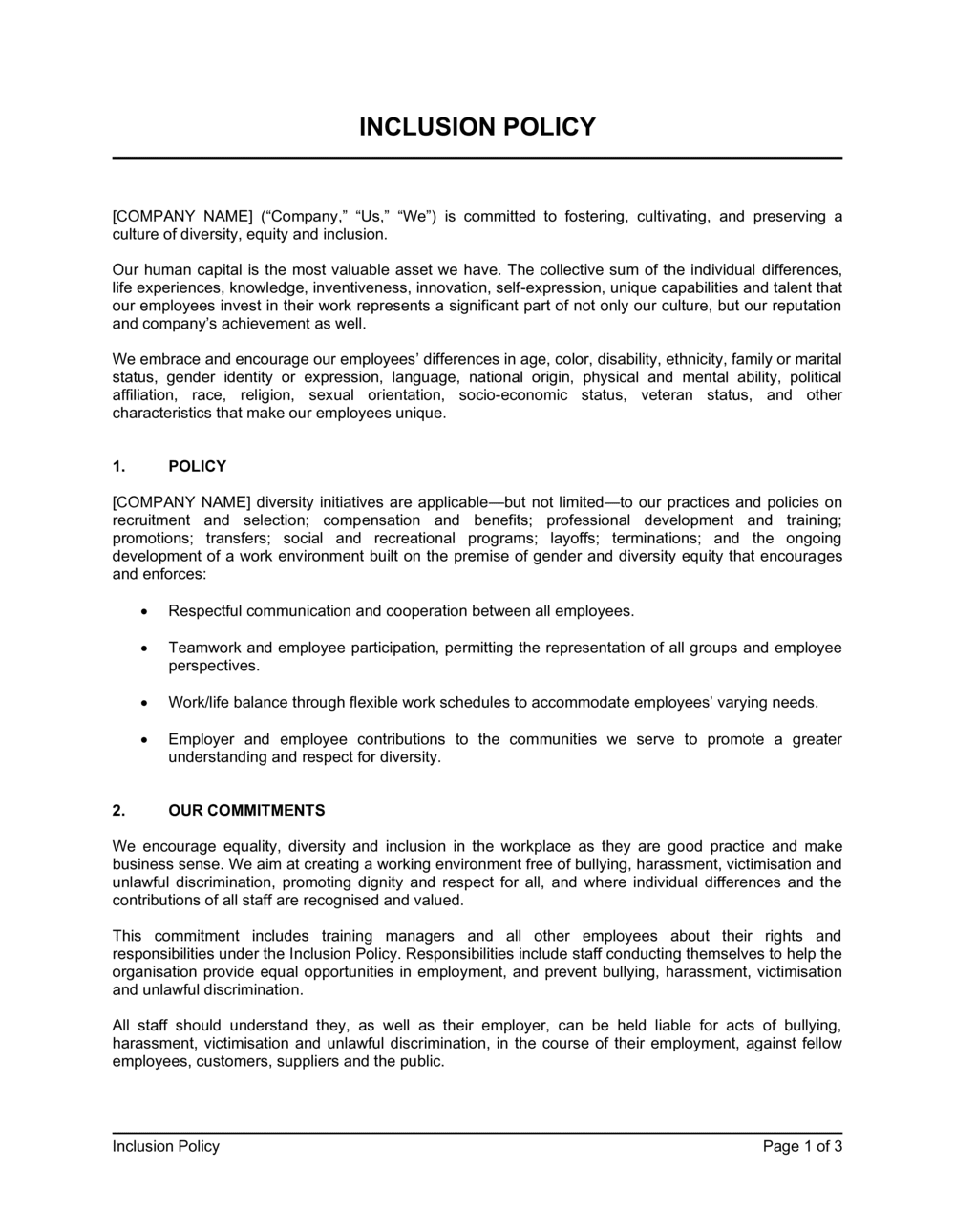
An Inclusion Policy is a formal written statement that defines a company's commitment to creating a workplace where all employees are treated equitably, regardless of race, gender, age, disability, religion, sexual orientation, or other protected characteristics. This free Word download gives you a structured, editable starting point you can tailor to your organization's size and culture, then export as PDF for distribution to staff and stakeholders.
When you need it
Use it when onboarding new employees, updating your employee handbook, responding to a regulatory audit, or formalizing DEI commitments ahead of a funding round, client contract, or supplier diversity certification.
What's inside
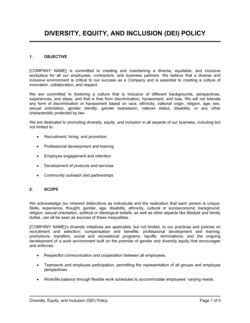
A commitment statement, definitions of key terms, scope and applicability, protected characteristics, specific inclusion obligations for managers and employees, accommodation procedures, reporting and complaint channels, and accountability and review mechanisms.

What is an Inclusion Policy?

An Inclusion Policy is a formal organizational document that defines a company's commitment to creating a workplace where every employee is treated with dignity and equity, regardless of race, gender, age, disability, religion, sexual orientation, or other protected characteristics. It translates high-level DEI values into specific behavioral expectations, accommodation procedures, reporting channels, and accountability mechanisms that employees and managers can act on. Unlike a general code of conduct, an inclusion policy focuses specifically on the conditions that determine whether each person in the organization feels respected, heard, and able to contribute fully β€” covering everything from hiring practices and promotion decisions to how complaints are investigated and resolved.

Why You Need This Document

Without a written inclusion policy, DEI commitments remain aspirational statements that offer no operational guidance and no legal protection. When an employee files a discrimination or exclusion complaint, the first question investigators and courts ask is whether the employer had a clear, communicated policy and took reasonable steps to enforce it β€” the absence of a written policy is treated as evidence of indifference. Beyond compliance, a documented policy sends a concrete signal to current and prospective employees that inclusion is a managed organizational priority, not a banner on the careers page. Investors, enterprise clients, and government contracting programs increasingly require suppliers and partners to produce written DEI policies as a condition of doing business. This template gives you a complete, structured starting point that covers every essential component β€” from protected characteristics and manager obligations to reporting channels and review cycles β€” so you can move from intention to implementation in a single afternoon.

Which variant fits your situation?

If your situation is…Use this template
Creating a broad DEI strategy document alongside the policyDiversity and Inclusion Plan
Documenting procedures for handling discrimination complaintsAnti-Discrimination Policy
Setting expectations for respectful employee conductCode of Conduct
Addressing harassment specifically in addition to inclusionAnti-Harassment Policy
Outlining accommodations for employees with disabilitiesReasonable Accommodation Policy
Packaging the inclusion policy within a full employee policy manualEmployee Handbook
Communicating inclusion values to external vendors and partnersSupplier Diversity Policy

Common mistakes to avoid

❌ Policy covers only statutory minimums

Why it matters: A policy that only restates the law signals compliance theater rather than genuine commitment, which damages retention and employer brand among the candidates and employees you most want to attract.

Fix: Expand protected characteristics and behavioral expectations beyond the legal floor to reflect the organization's specific values and workforce demographics.

❌ No defined reporting channel alternative to the direct manager

Why it matters: Employees cannot report incidents to the same person they are reporting against. A single-channel policy suppresses complaints, drives issues underground, and increases discrimination liability.

Fix: Establish at least two independent reporting channels β€” HR, a designated DEI contact, or an anonymous ethics hotline β€” and list both in the policy.

❌ Training commitment with no delivery mechanism

Why it matters: Stating that training will be provided and then not providing it is worse than saying nothing β€” it creates a documented gap between policy and practice that plaintiffs' attorneys exploit in discrimination cases.

Fix: Before publishing the policy, confirm the training budget, platform, and schedule. Update the policy only to reflect what the company can actually deliver.

❌ No accountability owner or success metrics

Why it matters: A policy without a named owner and measurable outcomes is never enforced and never improves. When an incident occurs, the absence of metrics makes it impossible to demonstrate good-faith effort.

Fix: Assign a specific title or committee as policy owner, define three to five quantifiable metrics, and commit to reporting outcomes to leadership on a defined cadence.

❌ Policy never reviewed after initial publication

Why it matters: Employment law, case law, and organizational demographics change. A policy drafted in 2020 may omit protections added by statute or organizational commitments made since then, creating gaps between stated policy and legal obligation.

Fix: Set a mandatory annual review cycle with a named owner and calendar anchor. Document each review β€” even if no changes are made β€” to demonstrate ongoing due diligence.

❌ Non-retaliation clause buried or omitted

Why it matters: Fear of retaliation is the single most common reason employees do not report inclusion violations. A policy that does not prominently prohibit retaliation effectively has no complaint mechanism.

Fix: Place the non-retaliation statement in a clearly labeled standalone section, not a sub-clause of the complaint procedure, and reinforce it verbally during onboarding and training.

The 9 key sections, explained

Purpose and commitment statement

Scope and applicability

Protected characteristics

Inclusive behaviors and manager obligations

Reasonable accommodation procedures

Reporting and complaint procedure

Investigation and non-retaliation

Training and awareness

Accountability, metrics, and policy review

How to fill it out

  1. 1

    Insert your company name and effective date

    Replace all [COMPANY NAME] placeholders throughout the document and add the policy's effective date in the header. Confirm the document version number if you maintain a version-controlled policy library.

    πŸ’‘ Use the effective date β€” not the drafting date β€” to avoid ambiguity about when obligations began.

  2. 2

    Define the scope of coverage

    Confirm who the policy covers β€” full-time staff, part-time, contractors, interns β€” and where it applies, including remote work arrangements and off-site events.

    πŸ’‘ If your workforce includes a significant contractor population, explicit contractor coverage closes a common compliance gap.

  3. 3

    Review and expand the protected characteristics list

    Start from the statutory minimum for your jurisdiction and add any additional characteristics your organization has specifically committed to protecting. Align this list with your anti-harassment and anti-discrimination policies for consistency.

    πŸ’‘ Inconsistency between policies β€” one lists 'gender identity,' another omits it β€” creates confusion and potential legal exposure.

  4. 4

    Customize manager obligations to reflect your structure

    Adapt the manager obligations section to reflect how your organization makes hiring, promotion, and performance decisions. If you use structured interview panels or calibration committees, reference them here.

    πŸ’‘ Naming specific processes (e.g., 'structured competency-based interviews') makes the obligation concrete and auditable.

  5. 5

    Set up the reporting channels

    Enter the specific contact details β€” name, email, or hotline number β€” for each reporting channel. Confirm at least two independent channels so no single manager controls all complaint routing.

    πŸ’‘ Test each reporting channel before publishing the policy β€” a broken hotline or an email that bounces immediately undermines trust.

  6. 6

    Specify the accommodation request process

    Define who receives accommodation requests, the interactive process steps, and the maximum response timeline. Align this section with any existing disability or religious accommodation procedures.

    πŸ’‘ A response timeline of 5–10 business days is standard; longer timelines create unnecessary hardship and increase legal risk.

  7. 7

    Assign ownership and set the review cycle

    Name the specific role or committee responsible for policy oversight, define the metrics to be tracked, and set a calendar reminder for the annual review.

    πŸ’‘ Tie the review cycle to an existing annual process β€” performance review season or a board meeting β€” so it does not get skipped.

  8. 8

    Distribute and obtain acknowledgment

    Publish the policy in your employee handbook and intranet, send it to all current staff, and collect signed acknowledgment β€” digital or paper β€” confirming each employee has read it.

    πŸ’‘ Store signed acknowledgments in each employee's personnel file; they are your primary defense if a future complaint claims the employee was unaware of the policy.

Frequently asked questions

What is an inclusion policy?

An inclusion policy is a formal written document that defines a company's commitment to ensuring all employees are treated equitably and with respect, regardless of characteristics such as race, gender, age, disability, or sexual orientation. It sets out specific behavioral expectations, reporting procedures, accommodation processes, and accountability mechanisms that translate DEI values into day-to-day operational practice.

Is an inclusion policy legally required?

In most jurisdictions, no single law mandates a standalone inclusion policy by that name. However, anti-discrimination laws in the US, UK, EU, Canada, and Australia require employers to take active steps to prevent and address discrimination and harassment. A written inclusion policy β€” properly communicated and enforced β€” is the standard mechanism for demonstrating those steps. Government contractors, publicly listed companies, and organizations with certain certifications often face explicit written-policy requirements.

What is the difference between an inclusion policy and a diversity policy?

A diversity policy focuses on the composition of the workforce β€” who is represented across roles, levels, and demographics. An inclusion policy focuses on the workplace experience β€” whether all employees feel respected, heard, and able to contribute. In practice, the two are often combined in a single DEI policy, but treating them as distinct helps organizations address both representation gaps and cultural barriers separately.

Who should own the inclusion policy in an organization?

Ownership typically sits with the HR director or, in larger organizations, a dedicated Chief Diversity Officer or DEI committee. What matters more than title is that the owner has the authority to investigate complaints, mandate training, and report outcomes to senior leadership. Policies assigned to junior HR coordinators without decision-making authority are rarely enforced effectively.

How often should an inclusion policy be reviewed?

At minimum, once every 12 months β€” aligned to a fixed organizational calendar event such as annual performance reviews or a board meeting. Additional reviews are warranted after a significant workplace incident, a change in employment law, an acquisition, or a shift in the organization's DEI commitments. Document each review, even if no changes are made, to demonstrate ongoing attention to the policy.

Should an inclusion policy apply to contractors and vendors?

Yes, for most organizations. Incidents involving contractors and vendors occur in your workplace and affect your employees. Limiting the policy to direct employees creates a visible gap that damages trust and may not satisfy the duty-of-care standard applied by employment tribunals and courts when assessing whether a company took all reasonable steps to prevent discrimination.

How do I communicate an inclusion policy to employees?

Distribute it via your employee handbook and intranet on or before the effective date, send a personal communication from a senior leader explaining why the policy matters, include it in onboarding for all new hires, and collect signed acknowledgment from every employee. Annual training sessions reinforce the content and create a documented record of ongoing communication.

What metrics should we track to measure inclusion policy effectiveness?

Useful metrics include: representation by gender, race, and other demographics at each level of the organization; promotion and pay equity rates across demographic groups; complaint volume, resolution time, and outcome distribution; training completion rates; and employee engagement or belonging scores from your annual survey. Tracking at least three of these and reporting them to leadership annually converts the policy from a static document into a management tool.

Can a small business use this template without a dedicated HR team?

Yes. The template is designed to scale from a 10-person startup to a multi-location business. For small businesses without an HR team, assign policy ownership to the founder or office manager, use an external HR consultant or employment lawyer for the initial review, and set up a simple anonymous reporting channel β€” a dedicated email address or a low-cost ethics hotline service β€” before publishing.

How this compares to alternatives

vs Anti-Harassment Policy

An anti-harassment policy addresses a specific category of misconduct β€” unwanted conduct of a sexual, racial, or other protected-characteristic nature β€” with a focus on prohibition and complaint procedures. An inclusion policy is broader, covering the full range of behaviors, systems, and practices that affect whether employees feel they belong. Organizations need both: the anti-harassment policy handles incidents; the inclusion policy shapes the culture that prevents them.

vs Code of Conduct

A code of conduct sets general behavioral expectations for all employees across a wide range of topics β€” integrity, conflicts of interest, social media use, and workplace behavior. An inclusion policy focuses specifically on equitable treatment and belonging across protected characteristics. The code of conduct references and reinforces the inclusion policy; neither replaces the other.

vs Employee Handbook

An employee handbook is a comprehensive reference document covering all employment policies, procedures, and benefits. An inclusion policy is a standalone document that is typically embedded within the handbook as a dedicated section. Maintaining it as a standalone document makes it easier to update independently, distribute to external stakeholders, and reference in complaints or audits without sharing the full handbook.

vs Diversity and Inclusion Plan

A diversity and inclusion plan is a strategic action document that sets measurable DEI goals, timelines, initiatives, and resource commitments over a 1–3 year horizon. An inclusion policy is a governance document that defines standards of conduct and procedures. The plan drives change; the policy sets the floor. Large organizations typically maintain both, with the policy anchoring the minimum standards and the plan driving progress beyond them.

Industry-specific considerations

Technology / SaaS

Remote-first and distributed teams require explicit inclusion obligations that extend to virtual collaboration tools, async communication norms, and global time-zone equity.

Professional Services

Client-facing roles and billable-hour models create equity risks in assignment and promotion practices, making the manager-obligations section particularly critical.

Healthcare

Workforce and patient demographics require the policy to address both staff inclusion and culturally competent care, with accommodation procedures covering clinical credentialing requirements.

Retail / Hospitality

High turnover, shift-based scheduling, and customer-facing roles make consistent policy communication across locations and managers the primary implementation challenge.

Manufacturing

Physical workplace accommodations, multilingual workforces, and union agreements require the policy to address language access and coordinate with collective bargaining obligations.

Nonprofit and Education

Grant and funding requirements frequently mandate a written inclusion policy, and public accountability expectations make the metrics and reporting section especially important.

Template vs pro β€” what fits your needs?

PathBest forCostTime
Use the templateSmall and mid-size businesses formalizing inclusion commitments for the first time or updating an outdated policyFree2–4 hours
Template + professional reviewOrganizations in regulated industries, those with government contracts, or those that have experienced a recent DEI-related complaint or incident$300–$800 for an HR consultant or employment lawyer review3–5 business days
Custom draftedLarge enterprises, publicly listed companies, or organizations with complex multi-jurisdiction workforces requiring bespoke DEI governance$2,000–$8,000+ for a specialist DEI consultant or employment law firm3–6 weeks

Glossary

Diversity
The presence of differences among people in a workplace β€” including race, gender, age, disability, religion, sexual orientation, and socioeconomic background.
Inclusion
The active, intentional effort to ensure all employees feel welcomed, respected, and able to contribute fully, regardless of their background.
Equity
Providing individuals with the specific resources or adjustments they need to achieve fair outcomes, rather than treating everyone identically.
Protected Characteristic
An attribute β€” such as race, sex, age, disability, or religion β€” that anti-discrimination law prohibits employers from using as a basis for adverse employment decisions.
Reasonable Accommodation
A modification to a job, work environment, or standard procedure that enables an employee with a disability or religious observance requirement to perform their role without causing undue hardship to the employer.
Unconscious Bias
An automatic, unintentional mental association that influences judgment about people based on characteristics like race or gender, often without the decision-maker's awareness.
Psychological Safety
An employee's belief that they can speak up, raise concerns, or make mistakes at work without fear of punishment or humiliation.
Affinity Group
A voluntary, employee-led group organized around a shared identity or background β€” such as a women's network or LGBTQ+ group β€” that supports belonging and professional development.
Adverse Impact
A situation where a neutral employment policy or practice disproportionately disadvantages a group sharing a protected characteristic.
Intersectionality
The way in which overlapping identities β€” such as race and gender combined β€” can compound disadvantage in ways that single-dimension analysis does not capture.

Part of your Business Operating System

This document is one of 3,000+ business & legal templates included in Business in a Box.

  • Fill-in-the-blanks β€” ready in minutes
  • 100% customizable Word document
  • Compatible with all office suites
  • Export to PDF and share electronically

Create your document in 3 simple steps.

From template to signed document β€” all inside one Business Operating System.
1
Download or open template

Access over 3,000+ business and legal templates for any business task, project or initiative.

2
Edit and fill in the blanks with AI

Customize your ready-made business document template and save it in the cloud.

3
Save, Share, Send, Sign

Share your files and folders with your team. Create a space of seamless collaboration.

Save time, save money, and create top-quality documents.

β˜…β˜…β˜…β˜…β˜…

"Fantastic value! I'm not sure how I'd do without it. It's worth its weight in gold and paid back for itself many times."

Managing Director Β· Mall Farm
Robert Whalley
Managing Director, Mall Farm Proprietary Limited
β˜…β˜…β˜…β˜…β˜…

"I have been using Business in a Box for years. It has been the most useful source of templates I have encountered. I recommend it to anyone."

Business Owner Β· 4+ years
Dr Michael John Freestone
Business Owner
β˜…β˜…β˜…β˜…β˜…

"It has been a life saver so many times I have lost count. Business in a Box has saved me so much time and as you know, time is money."

Owner Β· Upstate Web
David G. Moore Jr.
Owner, Upstate Web

Run your business with a system β€” not scattered tools

Stop downloading documents. Start operating with clarity. Business in a Box gives you the Business Operating System used by over 250,000 companies worldwide to structure, run, and grow their business.

Free Forever PlanΒ Β·Β No credit card required