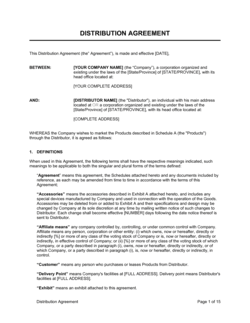
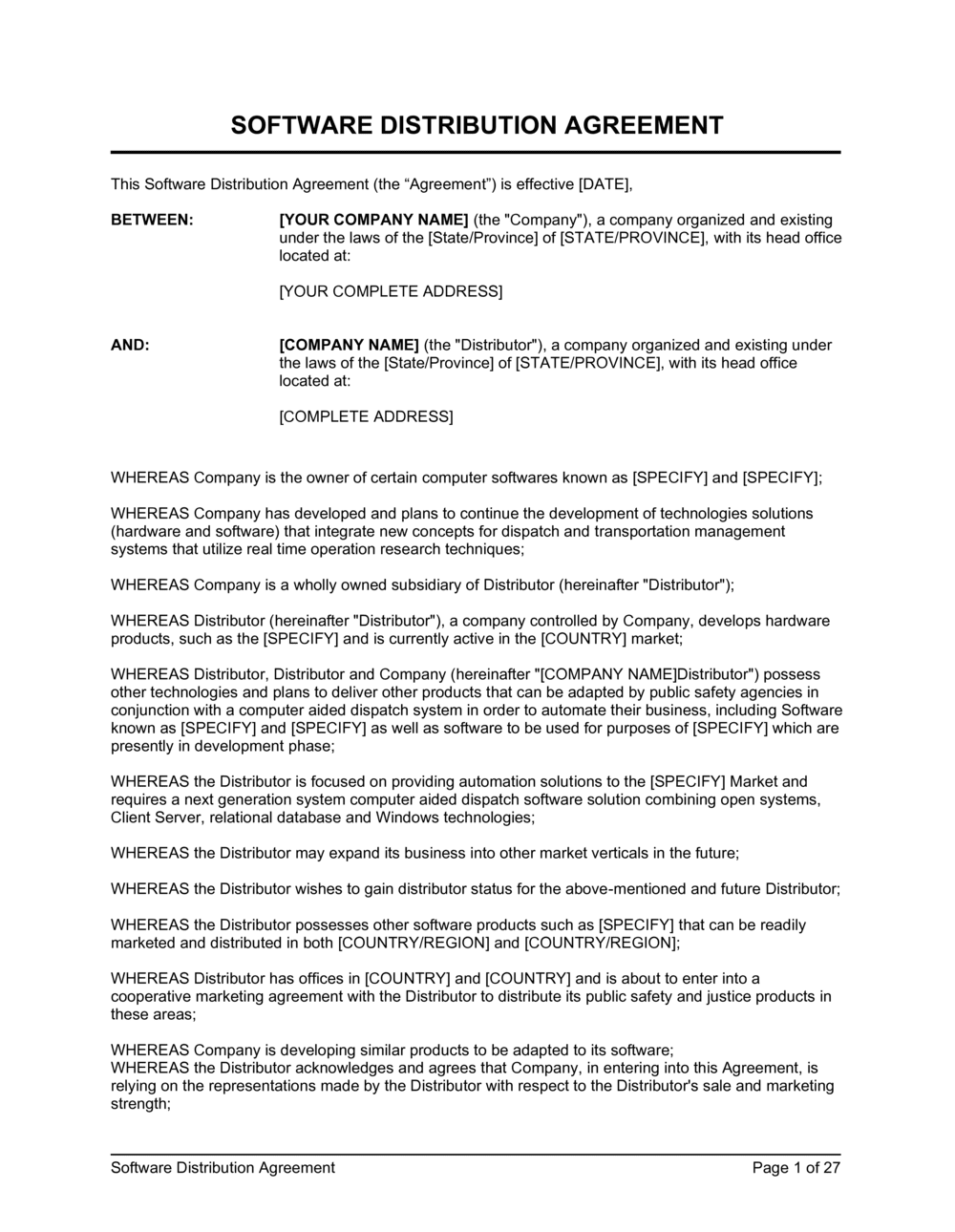
Software Distribution Agreement Long Form Template

Free Word download β€’ Edit online β€’ Save & share with Drive β€’ Export to PDF

27 pagesβ€’35–50 min to fillβ€’Difficulty: Complex
Learn more ↓
FreeSoftware Distribution Agreement  Long Form Template

At a glance

What it is
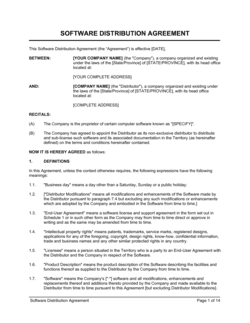
A Software Distribution Agreement Long Form is a structured commercial document that defines the terms under which a software vendor authorizes a third-party distributor or reseller to market, sell, and sublicense its software products. This free Word download covers license scope, territory, pricing, support obligations, IP ownership, and termination in a single document you can edit online and export as PDF.
When you need it
Use it when appointing a new channel partner, reseller, or regional distributor to sell or sublicense your software β€” or when accepting distribution rights from a software vendor as an authorized reseller.
What's inside
Vendor and distributor identification, grant of distribution rights, territory and exclusivity terms, pricing and payment structure, support and maintenance obligations, IP ownership and confidentiality, and termination conditions with post-termination obligations.

What is a Software Distribution Agreement Long Form?

A Software Distribution Agreement Long Form is a structured commercial document that authorizes a third-party distributor or reseller to market, sell, and sublicense a software vendor's products within a defined territory and under agreed commercial terms. It sets out the full scope of distribution rights β€” exclusive or non-exclusive β€” alongside pricing, minimum purchase commitments, support responsibilities, IP ownership, confidentiality obligations, and termination conditions. Unlike a short-form version, the long form includes detailed provisions covering audit rights, post-termination obligations for existing sublicenses, and SLA pass-through terms that protect both parties in a material channel relationship.

Why You Need This Document

Operating a software distribution relationship without a written agreement exposes both the vendor and the distributor to significant commercial and legal risk. A vendor who grants exclusivity without minimum commitments has no mechanism to replace an underperforming partner β€” or to add resellers in an underdeveloped territory. A distributor who begins reselling software without an explicit sublicense grant may be in breach of the vendor's end-user license terms the moment they issue their first customer contract. Support disputes, channel conflict, and IP misuse are all predictable consequences of informal arrangements. This template eliminates those gaps by establishing the full commercial relationship in a single enforceable document β€” from the first sublicense to the last support ticket after termination.

Which variant fits your situation?

If your situation is…Use this template
Short-form or single-product resale arrangementSoftware Distribution Agreement Short Form
Direct end-user licensing without a reseller in the chainSoftware License Agreement
SaaS subscription resale with usage-based billingSaaS Reseller Agreement
White-label software sold under the distributor's brandWhite Label Software Agreement
Software bundled with hardware products for distributionOEM Software Agreement
Open-source software with redistribution conditionsOpen Source License Agreement
Software affiliate referral program with no resale rightsAffiliate Agreement

Common mistakes to avoid

❌ Exclusive territory without minimum commitments

Why it matters: A distributor with unconditional exclusivity has no incentive to perform β€” and the vendor has no mechanism to replace them or add partners in the territory.

Fix: Tie exclusivity explicitly to quarterly or annual minimums, with automatic conversion to non-exclusive rights if two consecutive periods are missed.

❌ Vague support obligation language

Why it matters: If the agreement says only that the distributor 'shall provide support,' end users get promises neither party has committed to keeping β€” leading to customer churn and dispute.

Fix: Attach a support matrix exhibit defining first-, second-, and third-line responsibilities with specific SLA response times for each severity level.

❌ No post-termination clause for existing sublicenses

Why it matters: When the agreement ends, customers holding active sublicenses are left in limbo β€” no one is contractually responsible for their support or renewals.

Fix: Include a clause stating that existing end-user sublicenses survive termination for their original term, and assign support responsibility to the vendor after the wind-down date.

❌ Auto-renewal with no minimum notice period

Why it matters: Without a clear notice window, a distributor who misses the date is automatically locked into another full year β€” and disputes about when notice was sent are common.

Fix: Specify a minimum 60-day written notice period for non-renewal and require acknowledgment of receipt to start the notice clock.

The 10 key fields, explained

Vendor and distributor identification

Grant of distribution rights

Territory

Pricing, discounts, and payment terms

Minimum purchase commitments

Support and maintenance responsibilities

Intellectual property ownership and trademark use

Confidentiality

Term and termination

Post-termination obligations

How to fill it out

  1. 1

    Enter the legal names and entity details for both parties

    Fill in the full registered legal name, state of incorporation, and principal address for both the vendor and the distributor. Confirm entity names match corporate registry filings.

    πŸ’‘ Ask the distributor for a copy of their business registration certificate before executing β€” mismatched entity names are the most common cause of enforceability problems.

  2. 2

    Define the software products covered

    List every product, module, or SKU the distributor is authorized to sell in Schedule A. Specify version numbers or product lines explicitly so future releases are not automatically included.

    πŸ’‘ Use a product schedule rather than embedding product names in the body β€” updating a schedule is simpler than amending the main agreement each time the product lineup changes.

  3. 3

    Set territory and exclusivity

    Define the geographic territory precisely β€” name countries, regions, or named-account lists. Choose exclusive or non-exclusive and note any carve-outs for direct vendor sales.

    πŸ’‘ If granting exclusivity, tie it explicitly to meeting minimum purchase commitments β€” unconditional exclusivity removes your main lever to replace an underperforming partner.

  4. 4

    Agree on pricing, discounts, and payment terms

    Enter the distributor's discount percentage off SRP, the invoicing currency, and the payment due date. Reference the current price list and specify how much advance notice the vendor must give before changing it.

    πŸ’‘ A 60-day price-change notice period is a common negotiation point β€” it protects the distributor's margin on deals already in the sales pipeline.

  5. 5

    Set minimum purchase commitments and consequences

    Enter quarterly or annual minimums and specify the consequence of missing them β€” typically a conversion from exclusive to non-exclusive rights or the right to terminate.

    πŸ’‘ Use a ramp schedule for new distributors: lower minimums in the first two quarters rising to full commitment in Q3 and Q4. It reduces early churn and gives the partner time to build pipeline.

  6. 6

    Allocate support responsibilities and SLAs

    Specify whether the distributor handles first-line support or passes all tickets to the vendor. Define response-time SLAs for each severity level and the escalation path.

    πŸ’‘ Attach a support matrix as a separate exhibit so SLAs can be updated without amending the main agreement.

  7. 7

    Complete the term, renewal, and termination fields

    Enter the start date, initial term length, auto-renewal mechanism, and the notice period required for non-renewal or termination for cause.

    πŸ’‘ 60-day non-renewal notice is the practical minimum β€” shorter periods cause disputes when the renewal date falls during holidays or a busy quarter.

Frequently asked questions

What is a software distribution agreement?

A software distribution agreement is a commercial contract between a software vendor and a third-party distributor or reseller that defines the authorized scope of distribution, territory, pricing, support responsibilities, and IP ownership. It gives the distributor the legal right to resell or sublicense the software to end users while protecting the vendor's ownership and brand. The long-form version covers all material commercial and operational terms in a single document.

What is the difference between a software distribution agreement and a software license agreement?

A software license agreement governs the relationship between the vendor and the end user directly β€” it grants the end user the right to use the software. A distribution agreement sits one level up in the chain: it authorizes a distributor to resell or sublicense the software to end users. The distributor then issues end-user license agreements (EULAs) to each customer under the rights granted by the distribution agreement.

When should a software distribution agreement be exclusive?

Exclusivity makes sense when the distributor is investing significantly in market development β€” local sales teams, marketing spend, or integration work β€” and needs protection from the vendor appointing competing resellers in the same territory. It should always be tied to minimum purchase commitments. Without performance conditions, unconditional exclusivity removes the vendor's ability to replace an underperforming partner.

What happens to existing end-user sublicenses if the distribution agreement is terminated?

This depends on the termination clause. Best practice is to include a provision stating that valid sublicenses active at the time of termination survive for their original term, with the vendor assuming support obligations after the wind-down period. Without this clause, customers holding active licenses have no party contractually responsible for their support or renewals β€” a significant customer and reputational risk.

Does a software distribution agreement need to specify support obligations?

Yes. Leaving support obligations vague is one of the most common and costly mistakes in distribution agreements. The document should specify which party handles first-line (distributor), second-line, and third-line (vendor) support, response-time SLAs for each severity level, and the escalation process. Attaching a support matrix as a separate exhibit makes SLAs easy to update without amending the main agreement.

What pricing terms should a software distribution agreement include?

The agreement should state the distributor's discount percentage off the vendor's current suggested retail price, the invoicing currency, payment terms (e.g., Net 30), and the notice period the vendor must give before changing prices. A 60-day price-change notice period is common and gives the distributor time to protect deals already in their sales pipeline.

Can a distributor sublicense the software to end users under this agreement?

Only if the agreement explicitly grants sublicense rights. The grant of rights clause should state whether the distributor may resell, sublicense, or both. Without an explicit sublicense right, the distributor technically only holds a license for their own use and has no right to issue end-user licenses to customers.

What audit rights should a vendor include in a software distribution agreement?

The vendor should include the right to audit the distributor's sales records, sublicense logs, and customer lists to verify that reported license counts and revenue figures are accurate. Audits are typically permitted no more than once per year, with reasonable advance notice (10–30 days), and are conducted at the vendor's expense unless a material discrepancy is found.

How this compares to alternatives

vs Software License Agreement

A software license agreement governs the direct relationship between a vendor and an end user β€” granting usage rights with no resale chain involved. A distribution agreement sits above it, authorizing a third party to resell or sublicense to end users. Use a license agreement for direct-to-customer sales; use a distribution agreement when a reseller or partner is in the chain.

vs Software Distribution Agreement Short Form

The short form covers core rights, territory, and pricing in a condensed format suited to simple or low-value resale arrangements. The long form adds detailed support SLAs, audit rights, minimum commitments, post-termination obligations, and IP indemnification β€” necessary for material channel relationships with significant revenue or exclusivity at stake.

vs Affiliate Agreement

An affiliate agreement compensates a third party with a referral commission for driving leads or sales β€” the affiliate never holds distribution or sublicense rights. A distribution agreement grants actual resale and sublicense authority, making the distributor a contractual party in the sales chain with pricing, support, and minimum-commitment obligations.

vs OEM Agreement

An OEM agreement authorizes a manufacturer to bundle the vendor's software with hardware products sold under the manufacturer's brand. A distribution agreement authorizes resale of the software as a standalone product under the vendor's brand. The key difference is branding: OEM involves white-labeling or bundling; distribution preserves the vendor's product identity.

Industry-specific considerations

SaaS / Technology

Subscription-based sublicensing with usage reporting, automatic renewal terms tied to end-user contracts, and SLA pass-through obligations from vendor to distributor.

Cybersecurity

Export control compliance clauses, restricted-country territory carve-outs, and incident-notification obligations tied to data-security breaches affecting distributed software.

Healthcare / MedTech

HIPAA Business Associate Agreement requirements for software handling PHI, FDA software classification disclosures, and distributor credentialing obligations.

Manufacturing and Industrial Software

On-premise deployment terms, source code escrow arrangements for mission-critical systems, and field-service support obligations distinct from cloud-based software.

Template vs pro β€” what fits your needs?

PathBest forCostTime
Use the templateSoftware vendors and resellers establishing standard channel partner relationships with clear commercial termsFree30–60 minutes
Template + professional reviewExclusive territory grants, high-value channel relationships, or distribution into regulated industries such as healthcare or finance$300–$800 for a technology attorney review2–5 days
Custom draftedEnterprise channel programs, multi-tier distribution networks, or agreements with complex IP indemnification and export-control requirements$2,000–$6,000+2–4 weeks

Glossary

Distribution Rights
The vendor-granted authorization for a distributor to market, sell, and sublicense specified software products within a defined territory.
Exclusive Territory
A geographic or market segment in which the distributor is the sole authorized reseller and the vendor agrees not to appoint competing resellers.
Sublicense
A license granted by the distributor to an end user, flowing from the original license the vendor granted to the distributor.
Suggested Retail Price (SRP)
The vendor's recommended end-user price, used as the basis for calculating the distributor's wholesale discount or margin.
Minimum Purchase Commitment
A contractually required minimum number of licenses or revenue amount the distributor must achieve within a defined period to retain distribution rights.
Maintenance and Support Obligations
The defined responsibilities β€” whether assigned to the vendor, the distributor, or shared β€” for bug fixes, updates, and end-user technical assistance.
Intellectual Property (IP) Ownership
A clause confirming that the vendor retains all ownership of the software, source code, trademarks, and documentation regardless of distribution activities.
Termination for Convenience
A right allowing either party to end the agreement without cause by providing a specified notice period β€” typically 30 to 90 days.
Channel Conflict
A situation where the vendor's direct sales team or another reseller competes directly with the distributor for the same customer or deal.
Audit Rights
The vendor's contractual right to inspect the distributor's records to verify that sublicensed copies and reported sales are accurate and within the agreed scope.

Part of your Business Operating System

This document is one of 3,000+ business & legal templates included in Business in a Box.

  • Fill-in-the-blanks β€” ready in minutes
  • 100% customizable Word document
  • Compatible with all office suites
  • Export to PDF and share electronically

Create your document in 3 simple steps.

From template to signed document β€” all inside one Business Operating System.
1
Download or open template

Access over 3,000+ business and legal templates for any business task, project or initiative.

2
Edit and fill in the blanks with AI

Customize your ready-made business document template and save it in the cloud.

3
Save, Share, Send, Sign

Share your files and folders with your team. Create a space of seamless collaboration.

Save time, save money, and create top-quality documents.

β˜…β˜…β˜…β˜…β˜…

"Fantastic value! I'm not sure how I'd do without it. It's worth its weight in gold and paid back for itself many times."

Managing Director Β· Mall Farm
Robert Whalley
Managing Director, Mall Farm Proprietary Limited
β˜…β˜…β˜…β˜…β˜…

"I have been using Business in a Box for years. It has been the most useful source of templates I have encountered. I recommend it to anyone."

Business Owner Β· 4+ years
Dr Michael John Freestone
Business Owner
β˜…β˜…β˜…β˜…β˜…

"It has been a life saver so many times I have lost count. Business in a Box has saved me so much time and as you know, time is money."

Owner Β· Upstate Web
David G. Moore Jr.
Owner, Upstate Web

Run your business with a system β€” not scattered tools

Stop downloading documents. Start operating with clarity. Business in a Box gives you the Business Operating System used by over 250,000 companies worldwide to structure, run, and grow their business.

Start freeΒ Β·Β No credit card required