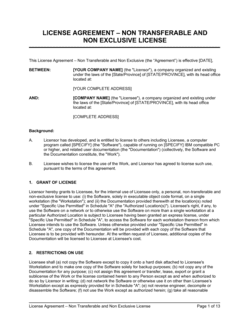
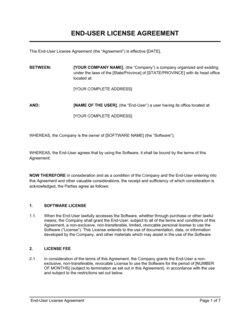
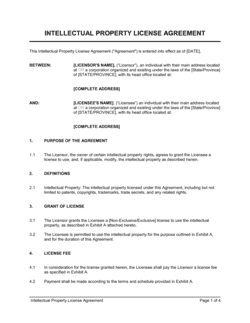
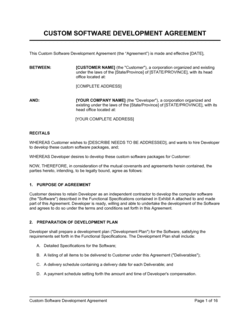
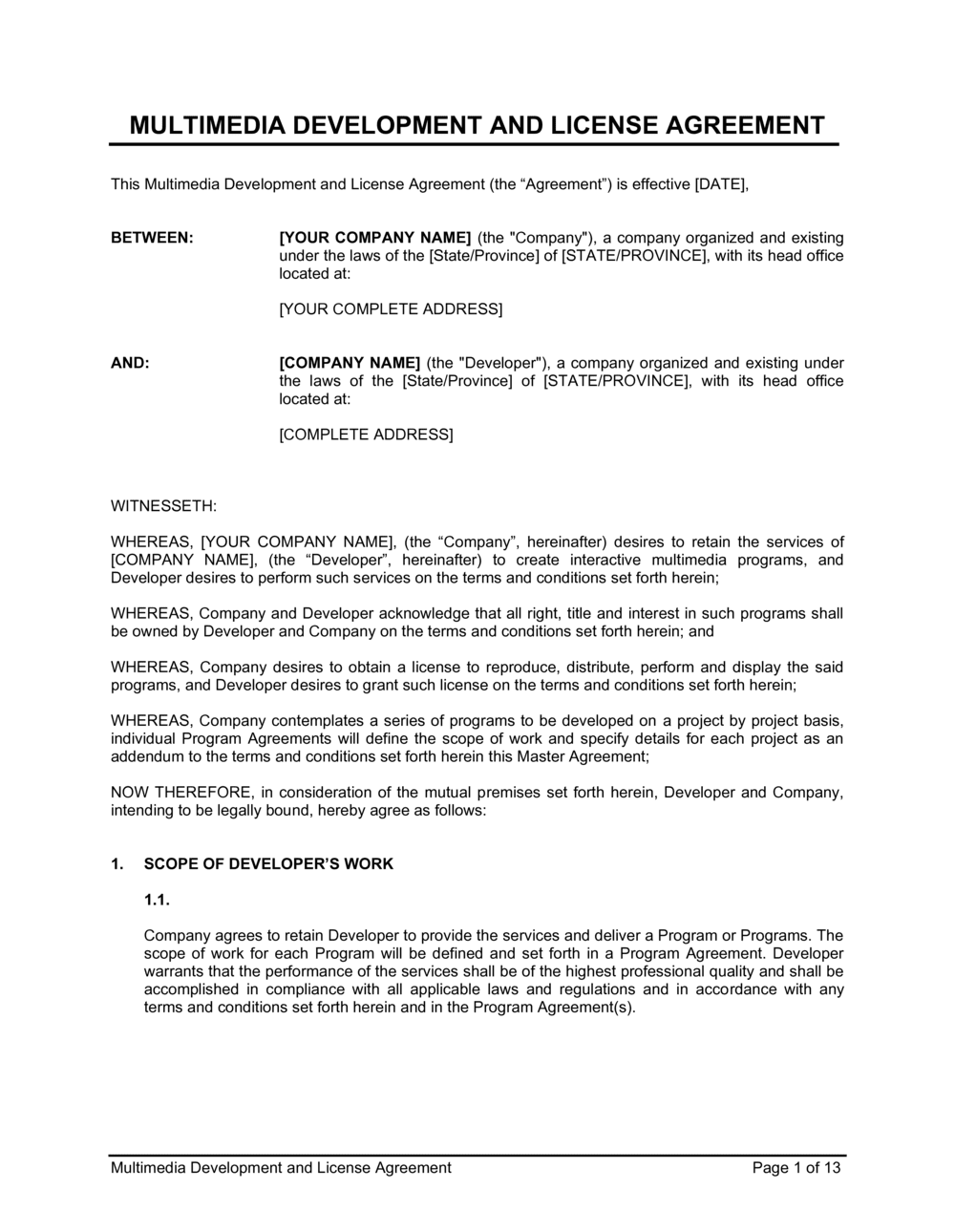
Multimedia Development and License Agreement Template

Free Word download • Edit online • Save & share with Drive • Export to PDF

12 pages30–40 min to fillDifficulty: ComplexSignature requiredLegal review recommended
Learn more ↓
FreeMultimedia Development and License Agreement Template

At a glance

What it is
A Multimedia Development and License Agreement is a legally binding contract between a developer or content creator and a client or licensee that governs the creation of multimedia works — including interactive applications, video, audio, animation, and digital graphics — and specifies the terms under which the finished work may be used. This free Word download covers deliverables, IP ownership, usage rights, royalties, and termination in a single document you can edit online and export as PDF.
When you need it
Use it whenever a business commissions a developer or creative studio to build a multimedia product — a training module, branded interactive experience, educational app, or digital marketing asset — and both parties need clarity on who owns the result, how it can be used, and what happens if the project changes or ends early.
What's inside
The agreement includes a project scope and deliverables schedule, a clear IP ownership and assignment clause, detailed license grant specifying permitted uses and restrictions, compensation and royalty terms, acceptance testing procedures, confidentiality obligations, and termination and post-termination rights covering both the developed work and any underlying third-party content.

What is a Multimedia Development and License Agreement?

A Multimedia Development and License Agreement is a legally binding contract that governs two related but legally distinct transactions in a single document: the obligation of a developer or creative studio to produce a multimedia work — combining video, audio, animation, interactive elements, or software — and the rights the commissioning party receives to use that finished work. Unlike a generic service agreement, it addresses the full lifecycle of a multimedia project: what gets built, who owns it, under what terms it can be used, how embedded third-party content is handled, and what happens when either party needs to exit. The agreement is typically executed between a digital agency, interactive media studio, or freelance developer on one side and a corporate client, publisher, or software company on the other.

Why You Need This Document

Without a multimedia development and license agreement, both parties are exposed to risks that generic contractor agreements do not address. A client who pays for a multimedia training module or branded interactive experience but lacks an explicit IP assignment may discover — after the project closes — that the developer still owns the copyright. A developer who delivers without a deemed-acceptance clause can be held to unlimited revisions by a client who never formally accepts the work. Third-party content embedded in deliverables — stock footage, licensed audio, commercial fonts — carries its own restrictions; without a disclosure schedule and warranty, the client can unknowingly deploy an infringing asset. For projects where the multimedia work has real commercial value or will be distributed to end users, this agreement closes the gaps that a handshake, an offer letter, or a statement of work alone cannot fill. Using this template ensures both parties start with a clear, enforceable framework that reflects how multimedia development actually works.

Which variant fits your situation?

If your situation is…Use this template
Commissioning a standalone software application with no content licensingSoftware Development Agreement
Licensing existing multimedia content without any development workContent License Agreement
Engaging a freelance designer for static graphic assets onlyGraphic Design Services Agreement
Producing a video or film with a separate production companyVideo Production Agreement
Commissioning music or audio for use in multimedia projectsMusic License Agreement
Hiring an independent contractor for part of the multimedia buildIndependent Contractor Agreement
Protecting confidential project details before discussions beginNon-Disclosure Agreement

Common mistakes to avoid

❌ No fallback IP assignment after work-made-for-hire language

Why it matters: Work-made-for-hire status depends on statutory criteria that vary by jurisdiction and work type. If the deliverable does not qualify by operation of law, the developer retains ownership and the client has no rights to enforce.

Fix: Add an explicit assignment clause immediately after the work-made-for-hire provision: 'To the extent the Deliverables do not qualify as works made for hire, Developer hereby irrevocably assigns all rights to Client upon full payment.'

❌ Vague or missing technical specifications in the deliverables schedule

Why it matters: Without defined formats, resolutions, interactivity standards, and platform requirements, every milestone review becomes a negotiation, and the developer can claim any output meets the contract.

Fix: Attach a Schedule B with format specifications, file types, platform compatibility requirements, and performance benchmarks before execution, and have both parties initial it.

❌ Omitting a deemed-acceptance clause in the acceptance testing section

Why it matters: A client who fails to respond to a delivered milestone can hold the project — and final payment — in indefinite limbo. Without a deemed-acceptance trigger, the developer has no legal basis to declare the work accepted.

Fix: Insert language stating that failure to provide written acceptance or a list of nonconformities within the stated review period (e.g., 10 business days) constitutes acceptance of that deliverable.

❌ Failing to list third-party content and its licensing terms

Why it matters: Stock footage, licensed audio, and third-party fonts embedded in deliverables carry their own usage restrictions. An undisclosed component can expose the client to an infringement claim that the developer's warranty does not cover.

Fix: Add a Schedule D listing all third-party content incorporated in the deliverables, the source, the applicable license type, and any use restrictions. Have the developer represent and warrant the schedule is complete.

❌ No survival clause identifying which obligations continue post-termination

Why it matters: Without a survival clause, confidentiality, indemnification, and IP ownership provisions may terminate with the contract, leaving both parties without the protections they negotiated.

Fix: Include a standard survival clause explicitly listing the sections that survive termination: IP ownership, confidentiality, indemnification, payment obligations for accepted work, and governing law.

❌ Granting broad license rights without specifying permitted platforms and use cases

Why it matters: A license to 'use the work' without platform or use restrictions can be read to permit deployment across channels, markets, or revenue models the developer never intended and did not price.

Fix: Enumerate permitted platforms (e.g., the client's internal LMS, a single public-facing website) and permitted uses (e.g., internal training only, not commercial resale) in the license grant clause and attach a list of restricted uses.

The 10 key clauses, explained

Parties, recitals, and project description

In plain language: Identifies the developer and the client by their full legal names, summarizes the business context, and provides a plain-English description of the multimedia project being commissioned.

Sample language
This Multimedia Development and License Agreement ('Agreement') is entered into as of [DATE] by and between [DEVELOPER LEGAL NAME], a [STATE/PROVINCE] [ENTITY TYPE] ('Developer'), and [CLIENT LEGAL NAME], a [STATE/PROVINCE] [ENTITY TYPE] ('Client'). Developer has agreed to create the multimedia work described in Schedule A ('Project') for Client.

Common mistake: Using trade names instead of registered legal entity names. If the contracting party doesn't match the entity that holds the IP or receives payment, enforcing rights or recovering fees becomes significantly harder.

Scope of work and deliverables schedule

In plain language: Defines exactly what the developer will produce, broken into milestones with specific formats, technical specifications, and delivery dates.

Sample language
Developer shall deliver the Deliverables set out in Schedule A by the dates specified therein. Each Deliverable shall conform to the technical specifications in Schedule B. Client acknowledges that changes to Deliverables after approval of a milestone may require an amended Statement of Work and additional fees.

Common mistake: Attaching a vague Statement of Work with no technical specifications. Without format, resolution, file-type, and interactivity requirements defined upfront, disputes over 'what was agreed' dominate every milestone review.

Compensation, payment schedule, and expenses

In plain language: States the total project fee, payment milestones tied to deliverable acceptance, the process for approving out-of-pocket expenses, and consequences for late payment.

Sample language
Client shall pay Developer a total fixed fee of $[AMOUNT], payable in installments as follows: [X]% upon execution ($[AMOUNT]), [X]% upon delivery of Milestone 1 ($[AMOUNT]), and [X]% upon final acceptance ($[AMOUNT]). Undisputed invoices unpaid after [30] days accrue interest at [1.5]% per month.

Common mistake: Tying the final payment milestone to 'final delivery' rather than 'final acceptance.' If acceptance is undefined, the client can withhold the last payment indefinitely by never formally accepting the work.

IP ownership and work-made-for-hire

In plain language: Determines who owns the finished multimedia work and any custom elements created for the project, distinguishing between newly created deliverables and the developer's pre-existing tools and frameworks.

Sample language
Subject to full payment, all Deliverables created specifically for Client under this Agreement shall be deemed works made for hire and shall be the sole property of Client. To the extent any Deliverable is not a work made for hire by operation of law, Developer hereby assigns all right, title, and interest therein to Client.

Common mistake: Omitting a fallback assignment clause after the work-made-for-hire language. In some jurisdictions, certain works do not qualify as works made for hire by statute — without a backup assignment, ownership reverts to the developer by default.

Developer's retained rights and underlying IP license

In plain language: Reserves the developer's ownership of pre-existing tools, code libraries, frameworks, and proprietary workflows, while granting the client a license to use those elements as embedded in the final deliverable.

Sample language
Developer retains all ownership of Developer's Pre-Existing IP listed in Schedule C. Developer grants Client a non-exclusive, perpetual, royalty-free license to use Developer's Pre-Existing IP solely as incorporated in the Deliverables for the purposes contemplated by this Agreement.

Common mistake: Failing to list pre-existing IP in a schedule before execution. Disputes about whether a tool or component was pre-existing or project-specific are almost impossible to resolve without a contemporaneous inventory.

License grant — scope, exclusivity, territory, and restrictions

In plain language: Specifies exactly what the client or licensee may do with the multimedia work — the permitted platforms, geographies, duration, and whether the license is exclusive — along with a list of prohibited uses.

Sample language
Developer grants Client a [exclusive / non-exclusive], perpetual, irrevocable, worldwide license to reproduce, distribute, display, perform, and create derivative works of the Deliverables for [PERMITTED PURPOSES]. Client may not sublicense, sell, or transfer the Deliverables without Developer's prior written consent.

Common mistake: Granting a broad license without listing prohibited uses. Clients routinely repurpose multimedia assets for platforms or markets not contemplated at signing — a restrictions list prevents scope creep from turning a narrow campaign asset into a global product.

Acceptance testing and change-order procedure

In plain language: Establishes how the client reviews each deliverable, the timeline for requesting revisions, when a deliverable is deemed accepted by inaction, and the process for requesting and pricing scope changes.

Sample language
Client shall have [10] business days after delivery of each Deliverable to provide written acceptance or a detailed list of nonconformities. Failure to respond within the review period constitutes acceptance. Any scope change requested by Client shall be documented in a written Change Order signed by both parties before implementation.

Common mistake: No deemed-acceptance clause. Without one, a client who goes silent after delivery can later claim the work was never accepted, justifying non-payment and demanding rework months after the project closed.

Confidentiality and non-disclosure

In plain language: Requires both parties to keep project details, technical specifications, business information, and pricing confidential during and after the project.

Sample language
Each party agrees to keep confidential all non-public information disclosed by the other party in connection with this Agreement ('Confidential Information') and not to disclose or use it except as necessary to perform under this Agreement. This obligation survives termination for a period of [3] years.

Common mistake: Using a mutual confidentiality clause when only one party is disclosing sensitive information. One-sided obligations give the disclosing party stronger contractual standing to seek injunctive relief if information leaks.

Representations, warranties, and indemnification

In plain language: Each party warrants that they have authority to enter the agreement; the developer additionally warrants that the deliverables are original, do not infringe third-party rights, and are free of undisclosed third-party licenses; and each party indemnifies the other against losses arising from their own breach.

Sample language
Developer warrants that the Deliverables are original works, do not infringe any third-party intellectual property rights, and do not incorporate any third-party materials except those disclosed in Schedule D. Developer shall indemnify Client against any third-party claims arising from a breach of this warranty.

Common mistake: A developer warranty that covers only the deliverables but not embedded third-party content. Stock footage, licensed fonts, and audio tracks carry their own license restrictions — an undisclosed third-party component can expose the client to an infringement claim the warranty does not cover.

Termination, post-termination rights, and effect of termination

In plain language: States the grounds for early termination by either party, what happens to deliverables and payment upon termination, and which clauses survive the agreement's end.

Sample language
Either party may terminate this Agreement for material breach upon [30] days' written notice if the breach is not cured within the notice period. Upon termination, Client shall pay for all Deliverables accepted and work in progress as of the termination date at the agreed milestone rate. Clauses covering IP ownership, confidentiality, indemnification, and governing law survive termination.

Common mistake: No survival clause listing which provisions continue after termination. Without it, confidentiality, indemnification, and IP ownership obligations may lapse the moment the contract ends, leaving both parties exposed.

How to fill it out

  1. 1

    Enter the legal entity names and effective date

    Insert the full registered names of the developer and client entities — not trade names or DBA names — and the date both parties execute the agreement. Confirm entity types (LLC, corporation, sole proprietor) match registration documents.

    💡 Cross-check the developer's name against their invoicing entity to avoid a mismatch that complicates tax reporting and payment processing.

  2. 2

    Complete Schedule A — project scope and deliverable milestones

    List every deliverable with a description, technical format, file specifications, interactivity requirements, and delivery date. Break large projects into at least three milestones to create natural payment and review checkpoints.

    💡 Include version numbers in deliverable names (e.g., 'Module 1 v1.0') — this prevents disputes about whether a revised version constitutes a new deliverable or a revision of an accepted one.

  3. 3

    Set the compensation structure and payment trigger

    Define the total fee, the percentage due at each milestone, and the exact trigger for each payment (execution, milestone delivery, milestone acceptance, or final acceptance). Add a late-payment interest rate in the payment clause.

    💡 Tie the largest single payment to formal acceptance of the penultimate milestone rather than final delivery — this avoids a scenario where the developer has no leverage to secure sign-off on final changes.

  4. 4

    Define IP ownership and populate Schedule C with pre-existing IP

    Confirm whether the deliverables are works made for hire, assigned, or licensed. List all developer tools, frameworks, and code libraries that will be incorporated but retained by the developer in Schedule C before execution.

    💡 If the developer cannot identify pre-existing IP at signing, insert a deadline (e.g., 10 days after execution) for delivering the Schedule C inventory — blank schedules invite disputes.

  5. 5

    Specify the license scope, exclusivity, and restrictions

    Fill in whether the license is exclusive or non-exclusive, the permitted territory (worldwide or named countries), the permitted platforms and uses, and any explicit restrictions on sublicensing, modification, or commercial resale.

    💡 If the client intends to monetize the multimedia work directly — selling it to end users or sublicensing it — the agreement must explicitly grant sublicense rights; they are not implied.

  6. 6

    Set acceptance testing timelines and the deemed-acceptance trigger

    Enter the number of business days the client has to review each deliverable, the maximum number of revision rounds included in the fee, and the inaction period after which a deliverable is deemed accepted.

    💡 10 business days is the standard review window for complex multimedia deliverables; 5 is reasonable for smaller assets. Shorter windows improve project velocity but require the client to have a dedicated reviewer available.

  7. 7

    Confirm governing law, dispute resolution, and signature blocks

    Select the governing jurisdiction — typically the developer's home state or province — and choose between arbitration, mediation, or court for dispute resolution. Both authorized signatories must sign before work begins.

    💡 If the parties are in different countries, specify the language of the agreement and the currency of all payments to eliminate ambiguity that arises from exchange-rate fluctuations.

  8. 8

    Attach and cross-reference all schedules

    Confirm that every schedule referenced in the body (A through D) is attached, complete, and initialed by both parties. Cross-reference each schedule by name in the relevant clause so the body and schedules are read together.

    💡 Have both parties initial each schedule page separately at signing — this prevents later claims that a schedule was substituted after execution.

Frequently asked questions

What is a multimedia development and license agreement?

A multimedia development and license agreement is a contract between a developer or creative studio and a client that covers two distinct legal relationships in a single document: the obligation to create a multimedia work (development) and the rights the client receives to use that work once delivered (license). It defines deliverables, payment, IP ownership, permitted uses, acceptance procedures, and termination — eliminating the ambiguity that arises when development and licensing are handled in separate, sometimes conflicting documents.

Who owns the multimedia work after the project is complete?

Ownership depends entirely on what the contract says. If the agreement includes a work-made-for-hire clause and a backup assignment, the client typically owns all custom deliverables upon full payment. The developer usually retains ownership of pre-existing tools, frameworks, and code libraries, which are licensed to the client as embedded in the final product. Without explicit ownership language, courts apply default copyright rules — which often favor the creator, not the commissioner.

What is the difference between an exclusive and a non-exclusive license?

An exclusive license prevents the developer from granting the same rights to anyone else in the defined scope — meaning the client is the only party that can use the work in that way, territory, or market. A non-exclusive license allows the developer to license the same work to multiple parties. Exclusive licenses typically command a higher fee or royalty and are essential when the multimedia work is central to a competitive product or brand identity.

Does this agreement cover third-party content embedded in the deliverables?

It should, and it is one of the most important things to verify before signing. Stock footage, licensed fonts, audio tracks, and third-party code libraries are all subject to their own separate licenses. A well-drafted agreement requires the developer to list all third-party content in a schedule, disclose the applicable license terms, and warrant that use within the deliverable does not exceed those license terms. Without this, the client can unknowingly receive a deliverable that infringes a third-party license.

What happens if the client wants to change the project scope after signing?

Changes to scope after execution should be handled through a written change order — a short document signed by both parties that describes the modification, the additional fee or adjusted timeline, and how it interacts with the existing deliverables schedule. A change-order procedure in the agreement prevents scope creep from becoming an uncompensated burden on the developer and protects the client from undocumented cost increases.

What is a deemed-acceptance clause and why does it matter?

A deemed-acceptance clause provides that if the client does not respond to a delivered milestone within a defined review window — typically 5 to 10 business days — the deliverable is legally accepted. Without it, a client who goes silent after delivery can later claim the work was never formally accepted, justifying non-payment or demands for unlimited revisions. It protects the developer's right to be paid for completed work.

Should I use a multimedia development agreement or a simple contractor agreement?

A standard independent contractor agreement does not address the specific legal issues that arise in multimedia development — IP ownership election between work-made-for-hire and assignment, underlying IP retention, license scope and restrictions, acceptance testing, and third-party content disclosure. For any project where the deliverable has commercial value or will be deployed to end users, a purpose-built multimedia development and license agreement provides substantially better protection for both parties.

Is this agreement enforceable internationally?

The agreement is generally enforceable in the jurisdiction specified in the governing-law clause, subject to local mandatory requirements. For cross-border projects, the governing law, currency, and language of the agreement should be explicitly stated. Copyright ownership rules, moral rights protections, and work-made-for-hire doctrines vary significantly between the US, Canada, the UK, and EU member states — consider local legal review when parties are in different countries.

What royalty structure is typical for multimedia license agreements?

Royalty structures vary by use case. For educational or training content licensed to an LMS provider, a per-seat or per-enrollment fee is common. For consumer-facing multimedia products, a percentage of net revenue ranging from 5% to 15% is typical. Flat perpetual license fees with no ongoing royalties are standard when the client owns the deliverables outright as works made for hire. The right structure depends on exclusivity, the commercial value of the work, and whether the developer retains any ongoing role in updates or maintenance.

Do I need a lawyer to use this template?

For straightforward domestic projects between established businesses, a well-completed template is usually a sound starting point. Legal review is strongly recommended when the project involves significant commercial value, cross-border parties, complex IP ownership structures, sublicensing rights, or exclusive licenses in competitive markets. An attorney review of a multimedia development agreement typically takes 2 to 4 hours and costs $400 to $1,000, which is modest relative to the risk of an unenforceable IP assignment or an undisclosed third-party content infringement claim.

How this compares to alternatives

vs Software Development Agreement

A software development agreement governs the creation of functional code and applications, focusing on technical specifications, testing, and defect remediation. A multimedia development and license agreement adds a dedicated licensing layer covering usage rights, exclusivity, royalties, and third-party content — essential when the deliverable combines code with video, audio, animation, or interactive media. Use the software agreement for pure code projects; use the multimedia agreement when content rights are as important as the technical build.

vs Independent Contractor Agreement

An independent contractor agreement establishes the working relationship and payment terms but does not include the IP ownership elections, license scope definitions, acceptance testing procedures, or third-party content disclosures that multimedia projects require. Relying on a generic contractor agreement for a multimedia project leaves both parties without enforceable rights over the finished work. The multimedia development and license agreement is the purpose-built alternative.

vs Non-Disclosure Agreement

An NDA protects confidential information shared during pre-contract discussions but creates no obligations regarding deliverables, payment, IP ownership, or license rights. It is a prerequisite to negotiations, not a substitute for a development contract. For multimedia projects, an NDA should be executed first, followed by the multimedia development and license agreement once scope and terms are agreed.

vs Service Agreement

A general service agreement covers the delivery of professional services for a fee but lacks the multimedia-specific provisions needed to manage IP ownership elections, license grant scope, royalties, and embedded third-party content. It is appropriate for ongoing retainer or consulting engagements with no significant IP deliverable. Any project where the primary output is a creative or technical multimedia work requires a dedicated development and license agreement.

Industry-specific considerations

E-learning and corporate training

Deliverables typically include SCORM-compliant modules; license scope must specify LMS platform, seat count or enrollment limits, and whether the client may modify content for internal updates.

Advertising and marketing agencies

Campaign multimedia assets often have time-limited licenses tied to the campaign flight period; rights for paid media, social, and out-of-home require separate platform-specific grants.

Gaming and interactive entertainment

Engine and middleware components carry third-party license obligations (Unreal, Unity) that must be disclosed; revenue-share royalty structures are common for independent studio development deals.

Healthcare and pharmaceutical

Patient-facing multimedia content may be subject to FDA or MHRA promotional material regulations; the agreement should include a regulatory compliance warranty and a review-cycle process for content updates.

Publishing and media

Digital publications combining text, video, and interactivity require clear derivative works rights and a plan for platform-specific format updates as device standards evolve.

SaaS and software products

UI/UX motion graphics, onboarding animations, and in-app multimedia are embedded in commercial software; the license must explicitly address whether the client can sublicense the work to end users through the SaaS product.

Jurisdictional notes

United States

US copyright law under 17 U.S.C. §101 defines specific categories of works eligible for work-made-for-hire status when created by an independent contractor — multimedia works do not automatically qualify, making a backup assignment clause essential. Moral rights under VARA are narrow and apply primarily to visual art, not multimedia. Non-compete clauses in service agreements are unenforceable in California and restricted in several other states.

Canada

The Copyright Act (Canada) recognizes work-made-for-hire for employees but is less clear for independent contractors, making explicit assignment language critical. Moral rights cannot be assigned but can be waived in writing — include a moral rights waiver. Quebec contractors may require French-language agreement versions for provincially regulated transactions.

United Kingdom

Under the Copyright, Designs and Patents Act 1988, works created by employees in the course of employment vest in the employer, but independent contractor work vests in the contractor by default — a written assignment is required to transfer ownership to the commissioning party. Moral rights apply to literary, dramatic, musical, and artistic works and must be expressly waived. Post-Brexit, EU copyright directives no longer apply directly, though UK law remains substantially aligned.

European Union

EU copyright law grants strong moral rights to creators in most member states, which cannot be assigned and in many jurisdictions cannot be waived — the developer's right of attribution and integrity typically survives the agreement. GDPR obligations apply when multimedia works incorporate personal data such as video footage of identifiable individuals. The EU Digital Single Market Directive (2019/790) imposes platform liability and content licensing obligations relevant to multimedia distribution.

Template vs lawyer — what fits your deal?

PathBest forCostTime
Use the templateDomestic projects between established businesses with a defined scope, a single deliverable owner, and no sublicensing or royalty complexityFree30–60 minutes
Template + legal reviewProjects involving exclusive licenses, revenue-share royalties, cross-border parties, or significant third-party content integration$400–$1,0002–5 days
Custom draftedHigh-value commercial multimedia products, multi-party co-development deals, international licensing with jurisdiction-specific IP obligations, or projects with material sublicensing or distribution rights$2,000–$8,000+1–3 weeks

Glossary

Multimedia Work
A work combining two or more media types — such as text, audio, video, animation, and interactive elements — delivered as a single integrated product.
License Grant
The contractual provision that specifies exactly what rights the licensee receives to use the multimedia work, including scope, territory, duration, and exclusivity.
Work Made for Hire
A legal doctrine under which creative work produced by an employee within the scope of employment, or by a contractor under a written agreement, is owned from inception by the commissioning party.
Underlying IP
Pre-existing intellectual property owned by the developer — tools, code libraries, design elements, or frameworks — incorporated into the deliverable but not transferred to the client.
Derivative Work
A new creative work based on or incorporating elements of an existing work; rights to create derivative works must be explicitly granted in the license.
Acceptance Testing
A contractually defined process by which the client reviews deliverables against agreed specifications and formally accepts or rejects them within a stated period.
Royalty
A recurring payment made by the licensee to the rights holder, typically calculated as a percentage of revenue or a fixed fee per unit, in exchange for the right to use the work.
Exclusivity
A license term preventing the licensor from granting the same rights to any other party within the defined scope, territory, or time period.
Moral Rights
Rights retained by creators in many jurisdictions to be identified as the author of a work and to object to modifications that harm their reputation, separate from economic IP rights.
Escrow (Source Code Escrow)
An arrangement under which the developer deposits source code with a neutral third party; the client gains access only upon defined trigger events such as insolvency or material breach.
Perpetual License
A license with no defined expiry date, allowing the licensee to use the work indefinitely subject to the other terms of the agreement.
Third-Party Content
Stock footage, licensed fonts, audio tracks, or other materials created by parties outside the agreement and incorporated into the deliverable, subject to separate licensing terms.

Part of your Business Operating System

This document is one of 3,000+ business & legal templates included in Business in a Box.

  • Fill-in-the-blanks — ready in minutes
  • 100% customizable Word document
  • Compatible with all office suites
  • Export to PDF and share electronically

Create your document in 3 simple steps.

From template to signed document — all inside one Business Operating System.
1
Download or open template

Access over 3,000+ business and legal templates for any business task, project or initiative.

2
Edit and fill in the blanks with AI

Customize your ready-made business document template and save it in the cloud.

3
Save, Share, Send, Sign

Share your files and folders with your team. Create a space of seamless collaboration.

Save time, save money, and create top-quality documents.

★★★★★

"Fantastic value! I'm not sure how I'd do without it. It's worth its weight in gold and paid back for itself many times."

Managing Director · Mall Farm
Robert Whalley
Managing Director, Mall Farm Proprietary Limited
★★★★★

"I have been using Business in a Box for years. It has been the most useful source of templates I have encountered. I recommend it to anyone."

Business Owner · 4+ years
Dr Michael John Freestone
Business Owner
★★★★★

"It has been a life saver so many times I have lost count. Business in a Box has saved me so much time and as you know, time is money."

Owner · Upstate Web
David G. Moore Jr.
Owner, Upstate Web

Run your business with a system — not scattered tools

Stop downloading documents. Start operating with clarity. Business in a Box gives you the Business Operating System used by over 250,000 companies worldwide to structure, run, and grow their business.

Start free · No credit card required