Domain Name Registration Agreement Template

Free Word download • Edit online • Save & share with Drive • Export to PDF

3 pages25–30 min to fillDifficulty: ComplexSignature requiredLegal review recommended
Learn more ↓
FreeDomain Name Registration Agreement Template

At a glance

What it is
A Domain Name Registration Agreement is a legally binding contract between a domain name registrar (or reseller) and a registrant that governs the registration, use, renewal, transfer, and termination of a specific domain name. This free Word download gives you a structured, enforceable starting point you can edit online and export as PDF to formalize control over your organization's online identity.
When you need it
Use it when a business registers a domain directly, when a web agency or reseller registers a domain on a client's behalf, or when domain ownership is being transferred between parties and a clear written record of rights and obligations is required.
What's inside
Registrant and registrar identification, domain name and registration term, acceptable use and prohibited content restrictions, ownership and transfer provisions, renewal and expiration terms, ICANN compliance obligations, dispute resolution (including UDRP), representations and warranties, limitation of liability, and governing law.

What is a Domain Name Registration Agreement?

A Domain Name Registration Agreement is a legally binding contract between a domain name registrar and a registrant that establishes who owns a specific domain name, how long the registration runs, what the domain may be used for, and what happens when it expires, is transferred, or becomes the subject of a dispute. It incorporates ICANN's mandatory policies — including the Uniform Domain-Name Dispute-Resolution Policy (UDRP) and WHOIS accuracy obligations — and governs the relationship between the registrar and the registrant for the full term of the registration. Beyond the commercial relationship, this agreement functions as the primary documentary evidence of domain ownership in trademark disputes, UDRP proceedings, and business asset transfers.

Why You Need This Document

Without a written domain name registration agreement, domain ownership becomes a matter of account access rather than documented legal right — and account access can change. Agencies that register domains in their own names, vendors who hold login credentials, and contractors who manage DNS settings without a formal agreement have all created costly disputes when relationships end. A properly executed registration agreement puts the registrant of record, the transfer process, the renewal obligations, and the ICANN policy incorporation in writing before any dispute arises. For businesses whose revenue depends on their domain — e-commerce operators, SaaS platforms, media publishers — this agreement is as foundational as a lease on a physical location: the absence of one doesn't stop operations immediately, but it creates significant legal exposure the moment anything goes wrong.

Which variant fits your situation?

If your situation is…Use this template
Registrar offering domain services directly to end-user registrantsDomain Name Registration Agreement (Registrar-to-Registrant)
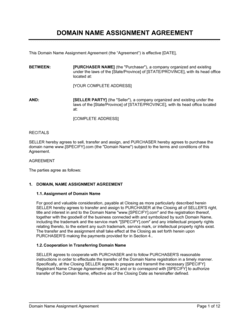
Agency registering a domain on behalf of a client who will own itDomain Name Assignment Agreement
Transferring an existing domain between two businessesDomain Name Transfer Agreement
Selling a premium or brandable domain for a lump-sum paymentDomain Name Purchase Agreement
Licensing use of a domain to a third party without transferring ownershipDomain Name License Agreement
Resolving a domain dispute through ICANN's UDRP processUDRP Complaint Template
Bundling domain registration with hosting and maintenance servicesWebsite Development and Hosting Agreement

Common mistakes to avoid

❌ Listing the agency or developer as registrant instead of the client

Why it matters: The registrant of record is the legal domain owner. An agency that registers a domain in its own name holds the client's online identity hostage — intentionally or not — and disputes over transfer can strand a business offline for weeks.

Fix: Always register the domain in the client's legal entity name from day one. If the agency manages the account, document this through a limited administrative access arrangement, not by substituting the agency as registrant.

❌ No renewal reminder process and relying solely on auto-renewal

Why it matters: Expired credit cards, closed bank accounts, and outdated billing email addresses cause unintended domain lapses every year. Recovery during the redemption period costs $80–$200 in added fees; after deletion, the domain may be gone permanently.

Fix: Set calendar-based renewal reminders at 90 and 30 days before expiration and confirm annually that the payment method and contact email on file are current.

❌ Omitting the EPP authorization code delivery obligation

Why it matters: Without a contractual obligation to provide the EPP auth code on request, a registrar or vendor has no documented timeline to release a domain transfer, creating leverage to delay handoff during disputes or contract terminations.

Fix: Include a clause requiring the registrar or managing party to deliver the EPP auth code to the registrant's verified email address within 5 business days of a valid written transfer request.

❌ Failing to incorporate ICANN policies by reference

Why it matters: ICANN's Registrar Accreditation Agreement requires all accredited registrars to flow down UDRP, WHOIS accuracy, and transfer policy obligations to registrants. An agreement that omits these references is technically non-compliant and may be unenforceable in an ICANN dispute.

Fix: Add a clause incorporating ICANN's current policies by URL reference and requiring the registrant to acknowledge and accept them as a condition of registration.

❌ No distinction between WHOIS privacy masking and legal ownership

Why it matters: Registrants who use privacy masking often assume the domain is anonymous from a legal standpoint. When a UDRP or trademark dispute arises, the registrant of record is still fully identifiable to ICANN and dispute resolution providers — the masking only affects public lookup.

Fix: Add a plain-English disclosure clause stating that WHOIS privacy masking hides contact details from public databases but does not alter the registrant's legal identity or obligations under ICANN policy.

❌ Choosing a governing law jurisdiction with no connection to either party

Why it matters: Courts in the EU, Canada, and several US states will apply consumer protection or data privacy statutes regardless of a contractual choice-of-law clause — making a distant governing law selection both unenforceable and misleading.

Fix: Select the governing law of the jurisdiction where the registrar operates or where the registrant is incorporated. For cross-border registrations, include a separate GDPR or PIPEDA compliance addendum rather than relying on choice-of-law alone.

The 10 key clauses, explained

Parties, domain name, and registration term

In plain language: Identifies the registrar and registrant as legal entities, specifies the exact domain name being registered, and sets the duration of the registration period (typically 1–10 years).

Sample language
This Domain Name Registration Agreement is entered into between [REGISTRAR LEGAL NAME] ('Registrar') and [REGISTRANT FULL LEGAL NAME / ENTITY NAME] ('Registrant') for the registration of the domain name [DOMAIN.TLD] for a term of [X] year(s) commencing [START DATE].

Common mistake: Listing only the brand name or trade name instead of the full registered legal entity as registrant. If the domain owner dissolves or rebrands, proving ownership continuity becomes difficult in UDRP or court proceedings.

Ownership, registrant of record, and WHOIS accuracy

In plain language: Establishes who the legal owner of the domain is, obligates the registrant to keep WHOIS contact details current, and states that providing false WHOIS data is grounds for cancellation.

Sample language
Registrant represents and warrants that all information submitted to the WHOIS database is accurate and complete. Registrant agrees to update contact information within [30] days of any change. Providing false or misleading WHOIS data is grounds for immediate cancellation of this registration without refund.

Common mistake: An agency or freelancer listing their own contact details as registrant instead of the client's. This is the single most common cause of domain ownership disputes between businesses and their web vendors.

Acceptable use and prohibited content

In plain language: Sets out what the domain may and may not be used for — prohibiting spam, phishing, malware distribution, illegal content, and intellectual property infringement.

Sample language
Registrant shall not use the domain name in connection with: (a) unsolicited bulk email or phishing schemes; (b) distribution of malware or unauthorized access tools; (c) content that infringes any third-party trademark, copyright, or other intellectual property right; or (d) any activity prohibited by applicable law.

Common mistake: Omitting acceptable-use terms entirely when a reseller registers domains for clients. Without them, the reseller bears full liability for client misuse under the registrar's upstream terms.

Renewal, expiration, and lapse

In plain language: States the renewal process, notice obligations, auto-renewal settings, grace period rights, and what happens to the domain if renewal payment fails.

Sample language
This registration will expire on [EXPIRATION DATE]. Registrar will send renewal notices to Registrant's email of record no less than [60] days before expiration. If renewal payment is not received by the expiration date, the domain enters a [X]-day grace period, after which Registrar may delete or re-offer the domain without further obligation to Registrant.

Common mistake: Relying solely on auto-renewal without confirming the payment method is current. Expired credit cards cause more unintended domain lapses than deliberate non-renewal, and recovery after the redemption period is not guaranteed.

Transfer restrictions and EPP authorization

In plain language: Governs when and how the domain may be transferred to another registrar or registrant, including the 60-day ICANN lock period, the EPP auth code process, and conditions under which the registrar may refuse a transfer.

Sample language
Registrant may initiate an outbound transfer to another ICANN-accredited registrar after the mandatory 60-day transfer lock period has elapsed. Registrar will provide the EPP Authorization Code to Registrant's verified email address within [5] business days of a valid transfer request. Registrar may refuse a transfer if the domain is subject to a pending dispute or legal hold.

Common mistake: Not documenting the EPP auth code delivery process. If a vendor holds a domain and goes out of business, an undocumented process can leave the client locked out for weeks during a critical business period.

Privacy and WHOIS data handling

In plain language: Explains how registrant contact data is handled, what WHOIS privacy masking services are offered, and how data is processed under applicable privacy law.

Sample language
Registrar offers optional WHOIS privacy masking, which replaces Registrant's personal contact details in public WHOIS records with proxy contact information. Registrant's underlying data is retained by Registrar and disclosed to third parties only as required by ICANN policy, court order, or applicable law. Data processing for EU residents is governed by [REGISTRAR PRIVACY POLICY / DPA], consistent with GDPR Article 6(1)(b).

Common mistake: Not distinguishing between WHOIS privacy masking and actual legal ownership. Privacy masking hides contact details from public lookup but does not change who the registrant of record is — a point that confuses clients who assume a masked domain is anonymous from a legal standpoint.

ICANN compliance and dispute resolution (UDRP)

In plain language: Incorporates ICANN's policies by reference, obligates the registrant to submit to UDRP arbitration for trademark disputes, and states which approved dispute resolution providers apply.

Sample language
Registrant acknowledges and agrees to be bound by ICANN's Uniform Domain-Name Dispute-Resolution Policy (UDRP) and Rules, as published at icann.org and amended from time to time. Registrant agrees that disputes brought by third parties alleging bad-faith registration or trademark infringement shall be submitted to [WIPO / NAF / ADNDRC] arbitration before any court action is commenced.

Common mistake: Failing to incorporate ICANN policies by reference. Without this clause, the agreement is technically non-compliant with ICANN's Registrar Accreditation Agreement requirements, which can expose an accredited registrar to accreditation penalties.

Representations, warranties, and indemnification

In plain language: The registrant warrants they have the right to register the domain, it does not infringe any third-party trademark, and they indemnify the registrar against any claims arising from their use of the domain.

Sample language
Registrant represents and warrants that: (a) the registration of the domain does not infringe any third-party trademark or intellectual property right; (b) Registrant has full authority to enter into this Agreement; and (c) the domain will not be used for any purpose prohibited by applicable law. Registrant shall indemnify, defend, and hold harmless Registrar from any claims, damages, or expenses arising from Registrant's use of the domain.

Common mistake: Omitting the indemnification clause or limiting it to direct damages only. Without indemnification, a registrar facing a UDRP complaint or third-party trademark claim has no contractual right to recover defense costs from the registrant who caused the dispute.

Limitation of liability and service interruptions

In plain language: Caps the registrar's liability for service outages, DNS resolution failures, or domain loss at a defined amount — typically the registration fees paid — and excludes consequential damages.

Sample language
Registrar's total liability to Registrant for any claim arising under this Agreement shall not exceed the total registration fees paid by Registrant for the domain in the 12 months preceding the claim. In no event shall Registrar be liable for indirect, consequential, or punitive damages, including lost revenue or business interruption resulting from DNS downtime or domain suspension.

Common mistake: No liability cap at all, or a cap that applies symmetrically to both parties. For high-traffic domains where a 1-hour outage can cost thousands in lost revenue, registrants should negotiate an uptime SLA addendum rather than relying on the default liability clause alone.

Governing law, jurisdiction, and entire agreement

In plain language: Specifies which jurisdiction's law governs the agreement, where disputes are litigated, and confirms this document supersedes all prior understandings between the parties.

Sample language
This Agreement is governed by the laws of [STATE / PROVINCE / COUNTRY], without regard to conflict-of-law rules. Any dispute not resolved under the UDRP shall be submitted to the exclusive jurisdiction of the courts of [CITY, STATE / COUNTRY]. This Agreement constitutes the entire agreement between the parties with respect to the domain name and supersedes all prior representations, negotiations, and understandings.

Common mistake: Choosing a governing law jurisdiction with no connection to either party's location or operation. Courts in several jurisdictions will apply local law regardless of the chosen forum, particularly where consumer protection statutes apply to the registrant.

How to fill it out

  1. 1

    Identify both parties with full legal names

    Enter the registrar's complete registered legal entity name and the registrant's full legal name — individual or incorporated entity — exactly as it appears on government records. Do not use trade names, brand names, or shortened versions.

    💡 For agency-to-client registrations, confirm the client's legal entity name in writing before completing this section — disputes almost always start with a mismatch between brand name and registered entity.

  2. 2

    Specify the exact domain name and registration term

    Enter the full domain name including the TLD (e.g., example.com, example.co.uk) and the registration period in years. ICANN-compliant registrations run from 1 to 10 years.

    💡 Register for 2–3 years minimum for a primary business domain — annual renewals increase the risk of lapse due to payment failure or contact detail changes.

  3. 3

    Set WHOIS accuracy obligations and update timelines

    Specify the number of days within which the registrant must update contact information after any change (30 days is the ICANN standard). Confirm that all WHOIS data submitted at signing is current and accurate.

    💡 Attach a completed WHOIS data sheet as an exhibit so there is a dated record of the contact details provided at the time of registration.

  4. 4

    Configure renewal and auto-renewal terms

    State the expiration date, the notice period for renewal reminders, whether auto-renewal is enabled by default, and the grace period duration. Confirm the payment method on file is valid through at least the next renewal date.

    💡 Set renewal reminders at 90, 60, and 30 days before expiration — not just the ICANN-minimum 60-day notice — to catch payment failures before they cause a lapse.

  5. 5

    Define transfer restrictions and EPP code process

    State the 60-day ICANN transfer lock period, the registrant's right to request an EPP auth code after the lock expires, and the timeline within which the registrar will deliver it. Note any conditions under which transfers may be suspended.

    💡 For agency-managed domains, include a clause obligating the agency to provide the EPP auth code to the client within 5 business days of project completion or contract termination.

  6. 6

    Incorporate ICANN policies and UDRP by reference

    Reference ICANN's current Registrar Accreditation Agreement, UDRP, and Uniform Rapid Suspension (URS) policies by citing the ICANN website URL and confirming the registrant agrees to be bound by them as amended.

    💡 Do not reproduce ICANN policy text verbatim — it changes, and a static copy in the agreement creates version conflicts. Reference by URL and amendment date instead.

  7. 7

    Complete the indemnification and liability sections

    Confirm the indemnification clause covers trademark disputes, UDRP proceedings, and third-party claims arising from domain use. Set the liability cap at the total registration fees paid in the preceding 12 months unless a higher cap is negotiated.

    💡 For premium domains or high-traffic sites where downtime costs are significant, add a separate uptime SLA addendum rather than expanding the main agreement's liability cap.

  8. 8

    Sign before the domain is registered or transferred

    Both parties must sign the agreement before the registration is processed or the transfer is initiated. Post-registration signatures raise enforceability questions in several jurisdictions, particularly for restrictive use and indemnification clauses.

    💡 Use a timestamped e-signature to create an auditable execution record — ICANN compliance audits and UDRP proceedings both benefit from a clear chain of dated documentation.

Frequently asked questions

What is a domain name registration agreement?

A domain name registration agreement is a legally binding contract between a registrar and a registrant that governs the registration, use, renewal, transfer, and termination of a specific domain name. It establishes who legally owns the domain, what the domain may be used for, what happens when it expires, and how disputes are resolved. ICANN requires all accredited registrars to enter into a registration agreement with every registrant as a condition of accreditation.

Who legally owns a domain name?

The registrant of record in the WHOIS database is the legal owner of a domain name. Ownership is not determined by who paid for the domain or who manages the hosting account — it is determined by whose legal entity name and contact details are listed as registrant. This is why agencies and developers should always register domains in the client's name, not their own, even if they manage the account operationally.

What happens if I don't renew my domain name?

After expiration, most domains enter a grace period of up to 45 days during which renewal is possible at the standard renewal fee. If not renewed, the domain enters a 30-day redemption period where recovery requires a higher redemption fee — typically $80–$200 depending on the registrar and TLD. After the redemption period, the domain enters pending deletion and is released to the public for re-registration by anyone. There is no guarantee of recovery once a domain reaches the deletion stage.

What is the UDRP and how does it affect my domain registration?

The Uniform Domain-Name Dispute-Resolution Policy (UDRP) is ICANN's mandatory arbitration process for resolving trademark disputes involving domain names. By agreeing to a domain name registration agreement, the registrant automatically consents to UDRP jurisdiction. A third party who believes a domain was registered in bad faith or infringes their trademark can file a UDRP complaint with an approved provider such as WIPO, and an arbitration panel can order transfer or cancellation of the domain — typically within 60 days and at much lower cost than litigation.

Does my domain registration agreement need to comply with GDPR?

If the registrant is an individual located in the EU or EEA, GDPR applies to the processing of their personal data in WHOIS records and registration databases. Registrars must provide a lawful basis for processing, limit public WHOIS exposure of personal data, and honor data subject rights including access and erasure requests. ICANN's Temporary Specification for gTLD Registration Data — adopted in 2018 in response to GDPR — limits public WHOIS disclosure and requires registrars to implement tiered access for legitimate third-party requests.

What is the difference between a domain registration agreement and a domain transfer agreement?

A domain registration agreement governs the initial registration of a domain name between a registrar and a registrant for a defined term. A domain transfer agreement governs the movement of an already-registered domain from one registrar to another, or the change of registrant from one party to another — sometimes called a change of ownership. Both documents establish rights and obligations, but a transfer agreement specifically addresses EPP auth codes, transfer timelines, payment for premium domains, and warranties about the domain's clean title.

Do I need a lawyer to draft a domain name registration agreement?

For a standard registrar-to-registrant agreement with no premium domain transaction or complex IP considerations, a well-structured template is typically sufficient. Engage a lawyer when the domain is a premium or brandable asset with significant monetary value, when the registration involves a disputed trademark, when a UDRP complaint has been filed or threatened, or when cross-border privacy law compliance (GDPR, PIPEDA) requires a tailored data processing addendum. A 1–2 hour attorney review typically costs $300–$600 and is worthwhile for any domain central to a brand's commercial identity.

What should I do if my domain was registered by a third party on my behalf?

Request an immediate WHOIS search to confirm the current registrant of record. If the domain is listed under a vendor, agency, or contractor's name rather than your legal entity name, request a change of registrant (also called a registrant transfer or push) in writing as soon as possible. Document the request with a timestamped email or a signed transfer agreement, and confirm the WHOIS update is reflected within 5 business days. If the vendor refuses, ICANN's registrar complaint process and UDRP are available remedies, provided you can demonstrate prior rights or an agreement that the domain was intended to be held on your behalf.

How this compares to alternatives

vs Domain Name Transfer Agreement

A domain name registration agreement governs the initial registration between registrar and registrant for a defined term. A transfer agreement governs the movement of an existing domain to a new registrar or registrant, covering EPP auth codes, transfer timelines, payment terms for premium domains, and clean-title warranties. Use a registration agreement when creating a new record; use a transfer agreement when changing ownership or registrar.

vs Website Development Agreement

A website development agreement covers the scope, deliverables, IP ownership, and payment terms for building or redesigning a website. It does not establish domain ownership or govern ICANN obligations. Many agencies use both documents together — the development agreement for the build, and the registration agreement to formally document who owns the domain that the site resolves to.

vs Trademark License Agreement

A trademark license agreement grants a licensee the right to use a trademark under defined conditions; it does not transfer control of a domain name. A domain registration agreement governs the domain itself. When a trademark holder licenses its brand to a third party who operates a corresponding domain, both documents are typically needed in parallel to cover brand use and domain administration separately.

vs Terms of Service Agreement

A terms of service agreement governs how end users may interact with a website or platform. A domain name registration agreement governs the registrant's rights and obligations with respect to the domain name itself — not the site's content or users. A business needs both: the registration agreement to protect domain ownership, and a terms of service to govern what visitors may do on the site.

Industry-specific considerations

Technology / SaaS

Multiple domain variants registered to prevent typosquatting, internationalized domain names (IDNs) for global markets, and strict WHOIS accuracy obligations tied to trademark portfolios.

E-commerce and retail

High-traffic domains where even a 1-hour DNS outage causes measurable revenue loss, requiring uptime SLA addenda and multi-registrar redundancy arrangements alongside the registration agreement.

Legal and professional services

Domain names that mirror firm or practitioner names require careful WHOIS accuracy and UDRP protections, as competitor or bad-faith registrations in this sector carry significant reputational risk.

Media and publishing

News and content platforms often register country-code TLDs (ccTLDs) in multiple jurisdictions, each governed by national registry rules that supplement or override the base ICANN registration agreement.

Financial services

Regulatory obligations in banking and securities require documented domain ownership as part of digital asset registers, and phishing domains mimicking financial brands make UDRP clauses particularly critical.

Healthcare

Patient-facing domains are frequent targets of typosquatting and phishing; healthcare operators commonly register defensive domain variants and require acceptable-use clauses that explicitly prohibit impersonation and fraudulent health claims.

Jurisdictional notes

United States

ICANN is headquartered in the US, and most gTLD registration agreements are governed by California or Delaware law. The Anti-Cybersquatting Consumer Protection Act (ACPA) provides a US federal cause of action for bad-faith domain registrations that infringe registered trademarks — separate from the UDRP process. State-level consumer protection statutes may apply to registrants who are individuals, particularly regarding auto-renewal disclosures.

Canada

The .ca ccTLD is governed by the Canadian Internet Registration Authority (CIRA), which operates its own registrant agreement and dispute resolution policy (CDRP) separate from ICANN's UDRP. CIRA requires registrants to be Canadian citizens, permanent residents, or incorporated Canadian entities. PIPEDA and provincial privacy statutes govern the processing of registrant personal data, and registrars serving Canadian registrants must provide meaningful WHOIS privacy options consistent with these obligations.

United Kingdom

The .uk ccTLD is administered by Nominet, which maintains its own registrant terms and dispute resolution service (DRS) independent of ICANN. Post-Brexit, UK GDPR applies to the processing of registrant personal data — mirroring EU GDPR obligations but enforced by the ICO. Nominet's registrant agreement limits registrant eligibility for .uk domains to UK-based individuals and entities, with verification requirements for certain second-level domains.

European Union

GDPR has materially changed how registrant data appears in public WHOIS records — personal data is masked by default, and access by third parties (including trademark holders and law enforcement) is gated through a tiered access framework. The .eu ccTLD is administered by EURid and is restricted to EU, EEA, and Swiss residents and entities; post-Brexit registrants from the UK had .eu domains revoked unless they established an EU presence. Member state courts vary in how they treat UDRP decisions, with some giving them significant weight and others treating them as persuasive but not binding.

Template vs lawyer — what fits your deal?

PathBest forCostTime
Use the templateRegistrars, resellers, and agencies formalizing standard domain registrations with clients using common gTLDsFree20–30 minutes
Template + legal reviewCross-border registrations, ccTLD portfolios, or agreements that need GDPR or PIPEDA data processing addenda$300–$6001–3 days
Custom draftedPremium domain acquisitions over $10,000, UDRP defense or enforcement, or registrar accreditation compliance programs$1,500–$5,000+1–3 weeks

Glossary

Registrant
The individual or organization that holds the registration rights to a specific domain name — the legal owner of record.
Registrar
An ICANN-accredited company authorized to register and manage domain names on behalf of registrants.
ICANN
The Internet Corporation for Assigned Names and Numbers — the non-profit body that coordinates global domain name policy and accredits registrars.
UDRP (Uniform Domain-Name Dispute-Resolution Policy)
ICANN's mandatory arbitration process for resolving disputes between domain registrants and parties who claim a domain was registered in bad faith or infringes a trademark.
WHOIS
A public database of domain registration records showing the registrant's name, contact information, and registration dates — subject to privacy masking under GDPR and similar laws.
Domain Lock
A security status applied by a registrar that prevents unauthorized transfer, deletion, or modification of a domain name.
Grace Period
A short window — typically 0 to 45 days after expiration — during which a registrant may renew a lapsed domain before it enters the redemption or deletion process.
Redemption Period
A 30-day window after expiration during which a registrant may reclaim a domain by paying a higher redemption fee; after this period the domain enters pending deletion.
EPP Authorization Code
A unique alphanumeric code, also called an auth code or transfer code, required to transfer a domain from one registrar to another.
Registrar-Lock (Transfer Prohibition)
A 60-day mandatory hold imposed by ICANN after a domain is newly registered or ownership details are updated, during which outbound transfers are blocked.
ccTLD
Country-code Top-Level Domain — a two-letter domain suffix assigned to a specific country or territory, such as .uk, .ca, or .de, often governed by national registry rules rather than ICANN policy alone.

Part of your Business Operating System

This document is one of 3,000+ business & legal templates included in Business in a Box.

  • Fill-in-the-blanks — ready in minutes
  • 100% customizable Word document
  • Compatible with all office suites
  • Export to PDF and share electronically

Create your document in 3 simple steps.

From template to signed document — all inside one Business Operating System.
1
Download or open template

Access over 3,000+ business and legal templates for any business task, project or initiative.

2
Edit and fill in the blanks with AI

Customize your ready-made business document template and save it in the cloud.

3
Save, Share, Send, Sign

Share your files and folders with your team. Create a space of seamless collaboration.

Save time, save money, and create top-quality documents.

★★★★★

"Fantastic value! I'm not sure how I'd do without it. It's worth its weight in gold and paid back for itself many times."

Managing Director · Mall Farm
Robert Whalley
Managing Director, Mall Farm Proprietary Limited
★★★★★

"I have been using Business in a Box for years. It has been the most useful source of templates I have encountered. I recommend it to anyone."

Business Owner · 4+ years
Dr Michael John Freestone
Business Owner
★★★★★

"It has been a life saver so many times I have lost count. Business in a Box has saved me so much time and as you know, time is money."

Owner · Upstate Web
David G. Moore Jr.
Owner, Upstate Web

Run your business with a system — not scattered tools

Stop downloading documents. Start operating with clarity. Business in a Box gives you the Business Operating System used by over 250,000 companies worldwide to structure, run, and grow their business.

Free Forever Plan · No credit card required