Customer Service VS Customer Experience Template

Free Word download • Edit online • Save & share with Drive • Export to PDF

3 pages25–30 min to fillDifficulty: ComplexSignature requiredLegal review recommended
Learn more ↓
FreeCustomer Service VS Customer Experience Template

At a glance

What it is
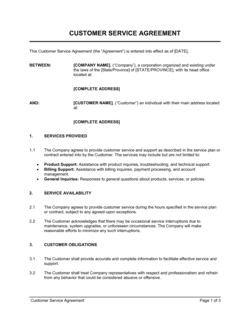
A Customer Service vs Customer Experience Policy Agreement is a binding internal and client-facing document that formally distinguishes reactive customer service obligations from the broader, proactive customer experience commitments a business makes across the full customer lifecycle. This free Word download lets you define service-level standards, escalation procedures, CX ownership roles, and measurement benchmarks in a single enforceable document you can edit online and export as PDF.
When you need it
Use it when onboarding a new client under a managed-services or retainer arrangement, when formalizing internal CX standards for customer-facing teams, or when a dispute arises over whether a service failure constitutes a breach of contracted service levels versus an unmet experience expectation.
What's inside
Definitions distinguishing customer service from customer experience, service-level commitments and response time guarantees, CX ownership and accountability clauses, escalation and remediation procedures, measurement and reporting obligations, and termination conditions tied to sustained service failure.

What is a Customer Service vs Customer Experience Policy Agreement?

A Customer Service vs Customer Experience Policy Agreement is a binding document that formally draws the operational and legal distinction between two related but fundamentally different business commitments: reactive customer service — the support a business provides when a customer encounters a specific problem — and customer experience, the cumulative perception a customer forms across every interaction with a business from first contact through renewal. By codifying both in a single signed agreement, the document assigns measurable standards, ownership accountability, escalation procedures, and remedies to each, eliminating the ambiguity that routinely turns unmet experience expectations into contested service breach claims. This free Word download covers SLA tiers, CX benchmarks, data confidentiality obligations, and termination triggers in a format you can edit online and export as PDF.

Why You Need This Document

Without a formal distinction between customer service and customer experience, a business is exposed to an unbounded category of claims: any negative customer perception — a slow onboarding, a confusing billing statement, an unreturned check-in call — can be framed as a failure to meet contracted service obligations. That ambiguity is costly in disputes, credibility-damaging in client reviews, and legally vulnerable under consumer protection frameworks in the US, Canada, the UK, and the EU. This agreement closes that gap by separating the remediable, metric-driven service commitments from the broader experience standards, each with their own benchmarks, accountability owners, and consequences for failure. For service providers managing enterprise CX programs, the data confidentiality and retention clauses address GDPR, PIPEDA, and CCPA obligations that attach the moment customer feedback data is collected. Using this template means you spend your next client conversation defining what excellent looks like — not defending what was never agreed.

Which variant fits your situation?

If your situation is…Use this template
Formalizing support response times and issue resolution commitments for a SaaS productService Level Agreement (SLA)
Documenting CX standards for a managed outsourced customer support teamCustomer Support Services Agreement
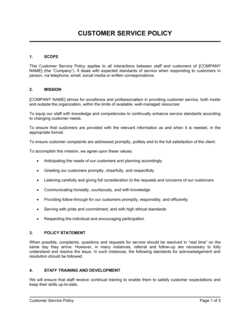
Setting internal performance standards for a customer service departmentCustomer Service Policy
Defining refund, return, and complaint resolution terms for retail customersCustomer Complaint Policy
Capturing the full scope of a consulting engagement to improve CXConsulting Services Agreement
Protecting proprietary customer data collected during CX programsNon-Disclosure Agreement (NDA)
Governing a long-term client relationship that includes both service delivery and experience managementMaster Services Agreement

Common mistakes to avoid

❌ Using identical definitions for customer service and customer experience

Why it matters: When the two terms are undefined or conflated, every negative customer perception becomes a potential breach of a measurable SLA, exposing the business to remediation claims on subjective outcomes it never contractually guaranteed.

Fix: Draft a separate, operationally specific definition for each term in the definitions clause. Run the definitions past a customer-facing manager to confirm they match how the team actually works.

❌ Setting CX benchmarks without linking them to a remedy

Why it matters: A clause that says 'Company shall maintain an NPS of 40 or above' but specifies no consequence for falling below 40 is unenforceable — it reads as aspirational, not contractual.

Fix: Pair every CX benchmark with an explicit remedy: a reporting obligation, a remediation plan deadline, a service credit, or a termination trigger after a defined cure period.

❌ No service credit cap

Why it matters: Without a ceiling, multiple SLA breaches in a single billing period can generate credits exceeding the full monthly contract value, creating a net-negative revenue position the company never intended.

Fix: Cap total monthly credits at 10–20% of the monthly fee. State that credits are the exclusive financial remedy for SLA failures — not a basis for consequential damages claims.

❌ Omitting data retention and destruction obligations

Why it matters: Without a defined retention period and a destruction obligation, the company holds customer data indefinitely after the contract ends — creating ongoing liability under GDPR, PIPEDA, CCPA, and equivalent statutes.

Fix: Set a specific retention period (e.g., 24 months post-termination) and require written confirmation of destruction or return within 30 days of the retention period ending.

❌ No cure period before termination for service failure

Why it matters: Immediate termination rights for any SLA miss — including minor ones — can be triggered by a single bad month, destroying an otherwise viable commercial relationship and creating revenue unpredictability.

Fix: Require a written notice identifying the specific failure, a cure period of at least 30 days, and a pattern of failure (e.g., three misses in two consecutive months) before termination rights activate.

❌ Signing after service delivery has already begun

Why it matters: SLA commitments and data handling obligations that were active before execution may be unenforceable for the pre-signature period, and customer data collected before signing may lack a lawful contractual basis under GDPR and PIPEDA.

Fix: Execute the agreement on or before the date the first customer interaction under its scope occurs. If execution is delayed, document the retroactive effective date explicitly and confirm both parties' consent to it.

The 10 key clauses, explained

Definitions and Scope

In plain language: Formally distinguishes customer service from customer experience within the context of this agreement and defines which products, services, channels, and customer segments fall within scope.

Sample language
For purposes of this Agreement, 'Customer Service' means reactive support provided in response to a Customer request or issue. 'Customer Experience' means the holistic perception of [COMPANY NAME] resulting from all interactions across [LIST OF CHANNELS] during the term of this Agreement.

Common mistake: Conflating customer service and customer experience in the definitions clause. If the two are not clearly separated, every unmet experience expectation becomes a potential breach of a measurable service obligation, exposing the company to remediation claims it never intended to guarantee.

Service-Level Commitments

In plain language: States the specific, measurable response and resolution time commitments for each support channel and issue severity tier.

Sample language
Company shall acknowledge all Tier 1 (Critical) support requests within [2] business hours and resolve or provide a documented remediation plan within [1] business day. Tier 2 (Standard) requests shall be acknowledged within [1] business day and resolved within [5] business days.

Common mistake: Setting SLA response times without defining business hours and holiday exclusions. Disputes routinely arise when a customer submits a critical request at 11:55 PM on a Friday and expects a 2-hour acknowledgment by 1:55 AM.

Customer Experience Standards

In plain language: Establishes the qualitative and quantitative benchmarks the company commits to maintaining across the customer lifecycle — including onboarding, ongoing engagement, and renewal touchpoints.

Sample language
Company shall maintain a Net Promoter Score of no less than [X] and a Customer Effort Score of no more than [Y] across all measured touchpoints, as reported quarterly. Company shall conduct a structured onboarding review no later than [30] days after service commencement.

Common mistake: Making CX benchmarks aspirational rather than measurable. Phrases like 'strive to deliver an excellent experience' create no obligation. If a benchmark matters enough to include, it should be tied to a specific metric and a remediation clause.

CX Ownership and Accountability

In plain language: Designates the individual or team responsible for monitoring CX performance, reporting results, and coordinating improvements — and their counterpart on the client side.

Sample language
Company shall designate a named Customer Experience Manager ([NAME / ROLE]) as the primary point of accountability for all CX obligations under this Agreement. Client shall designate a corresponding [TITLE] as its liaison. Both parties shall meet no less than [quarterly] to review performance data.

Common mistake: Omitting a client-side counterpart requirement. When the company has a designated CX owner but the client does not, feedback loops break down and disputes over experience failures become one-sided and unresolvable.

Escalation and Remediation Procedures

In plain language: Defines the step-by-step process for escalating unresolved service issues and the company's remediation obligations — including timelines, compensatory actions, and documentation requirements.

Sample language
If a Tier 1 issue remains unresolved beyond [2] business days, it shall automatically escalate to [TITLE / TEAM]. Company shall provide a written root-cause analysis within [5] business days of resolution and, where applicable, a service credit equal to [X]% of the monthly fee for the affected period.

Common mistake: Including service credits without a credit cap. Without a ceiling, a series of SLA breaches in a single month can generate credits that exceed the monthly contract value, creating a liability that exceeds the contract's revenue.

Measurement, Reporting, and Audit Rights

In plain language: Specifies how performance data is collected, what metrics are reported, how frequently reports are delivered, and the client's right to audit the methodology.

Sample language
Company shall deliver a monthly performance report no later than the [5th] business day of the following month, including CSAT scores, NPS results, SLA compliance rates, and open escalation summaries. Client may request an independent methodology audit no more than [once] per calendar year at its own expense.

Common mistake: Reporting only on metrics the company performed well on. A reporting clause should enumerate the specific metrics contractually required — not leave the content to the company's discretion — so that underperformance is documented, not omitted.

Intellectual Property in CX Deliverables

In plain language: Clarifies who owns the customer journey maps, VoC research, process documentation, and other CX deliverables created under the agreement.

Sample language
All CX deliverables created by Company specifically for Client under this Agreement, including journey maps, VoC reports, and process improvement documentation, shall be owned by [CLIENT / COMPANY] upon full payment of fees. Company retains rights to its proprietary methodologies and tools used to produce such deliverables.

Common mistake: Failing to distinguish between the deliverable and the methodology used to create it. Without this distinction, a client can claim ownership of the company's proprietary CX framework simply because it was used to produce a deliverable.

Confidentiality of Customer Data

In plain language: Restricts the use and disclosure of customer data — including survey responses, support interaction records, and behavioral analytics — collected during CX program delivery.

Sample language
Company shall not use, disclose, or transfer any Customer Data collected in the performance of this Agreement except as necessary to fulfill its obligations herein. Customer Data shall be retained for no longer than [24] months following termination and destroyed upon written request.

Common mistake: Omitting data retention and destruction timelines. Without them, the company faces indefinite obligations under GDPR, PIPEDA, and CCPA if the relationship ends and the client demands data deletion.

Termination for Sustained Service Failure

In plain language: Allows either party to terminate the agreement if measurable service or CX benchmarks are not met within a defined cure period, without triggering standard early-termination penalties.

Sample language
If Company fails to meet [three] or more SLA commitments in any [two] consecutive calendar months and fails to cure such failures within [30] days of written notice, Client may terminate this Agreement without payment of early-termination fees and shall receive a pro-rated refund of prepaid unused fees.

Common mistake: Granting termination rights without a cure period. Immediate termination for a single SLA miss — even a minor one — is disproportionate and creates commercial risk. A defined notice-and-cure window protects both parties.

Governing Law and Dispute Resolution

In plain language: Specifies the jurisdiction whose law governs the agreement and the process — mediation, arbitration, or litigation — for resolving disputes.

Sample language
This Agreement shall be governed by the laws of [STATE / PROVINCE / COUNTRY]. Any dispute arising from this Agreement shall first be submitted to non-binding mediation before a mutually agreed mediator in [CITY]. If mediation fails, disputes shall be resolved by binding arbitration under [AAA / JAMS / applicable institution] rules.

Common mistake: Choosing a governing law that differs from the jurisdiction where the customer-facing services are actually delivered. Regulators in the EU and certain Canadian provinces apply local consumer protection law regardless of the governing-law clause.

How to fill it out

  1. 1

    Define the parties and the scope of services

    Enter the full legal names of both parties, the specific services covered, and the customer channels in scope — email, phone, chat, in-store, app, or self-service portal.

    💡 Be explicit about what is excluded from scope. If social media DMs are not a supported service channel, say so — ambiguity becomes a service expectation.

  2. 2

    Draft distinct definitions for customer service and customer experience

    Write a one-paragraph definition for each term that makes the difference operationally clear — customer service is reactive and transactional; customer experience is cumulative and relationship-level.

    💡 Test your definitions against a real scenario: if a customer waits 10 minutes on hold, is that a service failure, an experience failure, or both? Your definitions should answer that question unambiguously.

  3. 3

    Set specific, measurable SLA commitments by tier

    Define at least two severity tiers (e.g., Critical and Standard), and assign acknowledgment and resolution time targets to each. Include the definition of business hours and the holiday calendar that applies.

    💡 Use absolute clock times — 'within 4 business hours of receipt' — rather than relative language like 'promptly' or 'as soon as possible.'

  4. 4

    Establish CX benchmarks with specific metrics

    Choose two to four measurable CX metrics — NPS, CSAT, CES, or first-contact resolution rate — and set a minimum threshold for each. Tie each metric to a specific reporting cadence.

    💡 Set thresholds you can realistically meet. A benchmark you miss in Month 1 immediately puts you in breach — start with achievable floors and negotiate improvements into the renewal.

  5. 5

    Name the CX owner and the escalation path

    Designate a named individual (or titled role) as CX owner on each side, define the escalation sequence, and set the time limits at each escalation level.

    💡 The escalation path should reach a decision-maker by no later than 48 hours — if it dead-ends at a junior role with no authority to offer remediation, it is not a real escalation path.

  6. 6

    Draft the service credit and remediation clause

    Define the credit formula, set a monthly credit cap (typically 10–20% of monthly fees), and specify the conditions under which a credit is forfeited — for example, if the client failed to report the issue within a defined window.

    💡 Credits should require a formal claim submission. Automatic credits for every missed SLA, without a claim requirement, create accounting complexity and invite disputes over what triggered the credit.

  7. 7

    Complete the data confidentiality and retention terms

    Specify which categories of customer data are covered, the permitted uses, the retention period, and the destruction or return obligation on termination. Align these terms with the governing jurisdiction's data protection law.

    💡 If the client is in the EU, the data handling clause must be GDPR-compliant regardless of what your governing-law clause says — include a GDPR addendum or data processing agreement if needed.

  8. 8

    Execute before service delivery begins

    Both parties must sign the agreement before the first customer interaction occurs under its terms. Post-commencement execution undermines the enforceability of SLA commitments and data handling obligations that were already active.

    💡 Use a timestamped eSignature platform to record the exact execution date and time — this becomes critical if an SLA breach is alleged to have occurred close to the contract start date.

Frequently asked questions

What is the difference between customer service and customer experience?

Customer service is the reactive support a business provides when a customer has a question, complaint, or problem — it is a single touchpoint interaction. Customer experience is the cumulative perception a customer forms across every interaction with a business, from first awareness through post-purchase. A company can have excellent customer service reps and still deliver a poor customer experience if onboarding, billing, and renewal touchpoints are frustrating. This document formalizes the distinction so that service-level obligations and experience commitments are governed by separate, appropriate standards.

Who should sign this agreement?

Both parties — the service provider and the client — should sign, typically through authorized representatives with authority to bind their respective organizations. For internal policy use, the document should be signed or acknowledged by department heads and the executive sponsor of the CX program. Unsigned policies are difficult to enforce when service disputes escalate to formal proceedings.

What metrics should be included in the CX standards clause?

The most commonly used and defensible CX metrics are Net Promoter Score (NPS), Customer Satisfaction Score (CSAT), Customer Effort Score (CES), and First Contact Resolution (FCR) rate. Choose two to four that align with your delivery model — NPS for relationship-level loyalty, CSAT for post-interaction quality, CES for ease of resolution, and FCR for support efficiency. Each metric should have a defined minimum threshold, a measurement methodology, and a reporting cadence written into the contract.

Is this agreement required by law?

No jurisdiction mandates a customer service versus customer experience policy agreement specifically. However, data protection laws in the EU (GDPR), Canada (PIPEDA), and several US states (CCPA, CPRA) require documented data handling procedures that overlap significantly with this agreement's confidentiality and retention clauses. In regulated industries — financial services, healthcare, telecoms — regulators often require documented service standards and complaint handling procedures that this agreement helps satisfy.

How does this document interact with a Service Level Agreement?

A Service Level Agreement (SLA) is a subset of what this document covers — it specifies technical performance metrics such as uptime, response time, and resolution time. This agreement encompasses the SLA commitments but adds the broader customer experience layer: CX benchmarks, ownership accountability, journey-level standards, and the distinction between reactive service and proactive experience management. In practice, you may embed SLA terms within this agreement or reference a standalone SLA as an attached schedule.

What happens if we miss a CX benchmark?

That depends on the remedy clause you negotiate. Typical consequences range from a written remediation plan obligation (lower stakes) to a service credit (moderate stakes) to a client termination right after a sustained failure period (highest stakes). The agreement should specify the exact remedy for each type of benchmark miss — SLA breaches and CX benchmark shortfalls are often governed by different remedy tiers because the former is more directly attributable to company action and the latter involves factors outside the company's sole control.

Do we need a lawyer to use this template?

For straightforward internal policy use or standard B2B service arrangements, a well-completed template is typically sufficient. Legal review is recommended when the contract governs a high-value or long-term client relationship, when customer data subject to GDPR or CCPA is involved, when service credits could represent significant financial exposure, or when the client is in a regulated industry with specific compliance requirements. A 1–2 hour review by a commercial contracts lawyer typically costs $300–$700 and is worthwhile for any engagement above $50K annually.

How often should this agreement be reviewed and updated?

Review it at each contract renewal, whenever a material change occurs in your service delivery model or technology stack, and after any significant service failure that reveals gaps in the current terms. Data protection obligations — particularly GDPR and CCPA requirements — are frequently updated by regulators; ensure your confidentiality and retention clauses remain compliant at least annually. If you update CX benchmarks based on improved capabilities, document the revision with a signed amendment rather than a side letter.

How this compares to alternatives

vs Service Level Agreement (SLA)

An SLA governs technical performance metrics — uptime, response time, resolution time — with defined service credits for breach. This agreement covers the SLA layer but adds the broader customer experience dimension: NPS benchmarks, CX ownership, journey-level standards, and the formal distinction between reactive service and proactive experience. Use an SLA when performance metrics alone are sufficient; use this agreement when the relationship involves a managed CX program or multi-touchpoint delivery commitment.

vs Customer Support Services Agreement

A customer support services agreement governs the operational delivery of a support function — staffing, tools, channels, and pricing. This agreement governs the standards those operations must meet from the customer's perspective, including experience benchmarks and accountability structures. The two documents are complementary: the support services agreement defines how the work is done; this agreement defines how well it must be done and what the customer should feel as a result.

vs Master Services Agreement

A master services agreement establishes the overarching commercial terms for an ongoing client relationship — liability, IP, payment, and general obligations. This agreement operates at a more granular level, specifying the service and experience standards that apply to a particular engagement or product line within that relationship. In practice, this document often attaches to an MSA as a schedule or statement of work.

vs Consulting Services Agreement

A consulting services agreement governs a defined engagement where a consultant delivers analysis or recommendations — payment, deliverables, and IP ownership are the core concerns. This agreement is appropriate when a business is committing to ongoing, measurable service and experience delivery rather than a one-time consultancy. If the CX work is advisory rather than operational, a consulting agreement is the more appropriate vehicle.

Industry-specific considerations

SaaS / Technology

Platform uptime SLAs coexist with onboarding experience commitments; the agreement must clearly separate technical availability metrics from customer success engagement standards to avoid conflating breach triggers.

Financial Services

Regulatory complaint-handling requirements under FCA, CFPB, and OSFI overlap with CX standards; the agreement must align with jurisdiction-specific response timelines and escalation documentation requirements.

Retail and E-commerce

High transaction volume means CSAT and CES metrics are collected at scale; the agreement should specify sampling methodology, minimum response rates for statistical validity, and how seasonal volume spikes affect SLA calculations.

Healthcare

Patient experience standards are subject to HIPAA data handling requirements and CMS guidelines; the confidentiality clause must reference applicable health data protection law and exclude patient data from standard VoC survey processes.

Jurisdictional notes

United States

No federal law mandates a customer service or CX policy, but the FTC Act's prohibition on unfair or deceptive practices means that published service commitments — including those in this agreement — can be enforced as binding representations. CCPA and CPRA in California impose specific data handling and deletion rights that must be reflected in the confidentiality and retention clauses. State consumer protection statutes vary significantly; check applicable state law before setting credit card or refund-related service commitments.

Canada

PIPEDA (federally) and provincial legislation such as Quebec's Law 25 govern the collection, use, and retention of customer data collected through CX programs. Law 25 requires that contracts with service providers handling Quebec residents' personal information include specific data protection provisions and designate a privacy officer. Telecoms, banking, and transportation sectors face additional CRTC and OSFI service standards that must be integrated into CX commitments.

United Kingdom

The UK GDPR and Data Protection Act 2018 govern customer data collected through CX programs, and the retention clause must align with documented lawful bases for processing. FCA-regulated firms must meet prescribed complaint-handling timelines — 8 weeks maximum for most financial services complaints — which function as mandatory SLA floors regardless of what the contract specifies. The Consumer Rights Act 2015 implies a service quality standard of reasonable care and skill into consumer-facing agreements.

European Union

GDPR requires a documented lawful basis for processing customer data through VoC surveys and CX analytics, and a Data Processing Agreement must be in place if a third-party CX vendor processes EU residents' personal data. The EU's General Product Safety Regulation and sector-specific directives (e.g., PSD2 for payments) impose mandatory complaint-response timelines in some industries. Post-employment non-competes and IP ownership clauses may require financial compensation to the affected party in certain member states if the CX program involves employed individuals.

Template vs lawyer — what fits your deal?

PathBest forCostTime
Use the templateB2B service providers establishing standard CX and service-level commitments with clients for engagements under $50K annuallyFree30–60 minutes
Template + legal reviewManaged-service arrangements with enterprise clients, multi-jurisdiction data handling, or service credits above $5K per month$300–$700 (1–2 hour commercial contracts review)2–5 days
Custom draftedHigh-value regulated-industry engagements, international CX programs subject to GDPR or CCPA, or arrangements where service failure exposure exceeds $100K$2,000–$6,000+2–4 weeks

Glossary

Customer Service
Reactive assistance provided to a customer at a specific touchpoint — typically in response to a question, complaint, or request — measured by resolution speed and accuracy.
Customer Experience (CX)
The cumulative perception a customer holds of a business across every interaction, from first awareness through post-purchase — encompassing emotion, ease, and consistency over time.
Service Level Agreement (SLA)
A contractual commitment specifying measurable performance standards — such as response time within 4 business hours and resolution within 2 business days — and the remedies for failing to meet them.
Customer Effort Score (CES)
A metric measuring how much effort a customer had to expend to get an issue resolved or a task completed — lower scores indicate a smoother experience.
Net Promoter Score (NPS)
A loyalty metric derived from asking customers how likely they are to recommend a company on a 0–10 scale, yielding a score between -100 and +100.
Escalation Path
A defined sequence of people or teams a customer issue is transferred to when it cannot be resolved at the first point of contact.
Touchpoint
Any interaction between a customer and a business — including website visits, support calls, invoices, packaging, and renewal notices — that contributes to the overall experience.
CX Ownership
The designated individual or team accountable for monitoring, improving, and reporting on the customer experience across all touchpoints.
Service Recovery
The actions a business takes to restore customer satisfaction after a service failure — including apology, remedy, and process improvement to prevent recurrence.
Voice of the Customer (VoC)
Structured feedback collected from customers through surveys, interviews, and support interactions, used to identify gaps between expected and delivered experience.
CSAT (Customer Satisfaction Score)
A post-interaction survey metric measuring customer satisfaction on a defined scale — typically 1–5 — immediately following a service event.

Part of your Business Operating System

This document is one of 3,000+ business & legal templates included in Business in a Box.

  • Fill-in-the-blanks — ready in minutes
  • 100% customizable Word document
  • Compatible with all office suites
  • Export to PDF and share electronically

Create your document in 3 simple steps.

From template to signed document — all inside one Business Operating System.
1
Download or open template

Access over 3,000+ business and legal templates for any business task, project or initiative.

2
Edit and fill in the blanks with AI

Customize your ready-made business document template and save it in the cloud.

3
Save, Share, Send, Sign

Share your files and folders with your team. Create a space of seamless collaboration.

Save time, save money, and create top-quality documents.

★★★★★

"Fantastic value! I'm not sure how I'd do without it. It's worth its weight in gold and paid back for itself many times."

Managing Director · Mall Farm
Robert Whalley
Managing Director, Mall Farm Proprietary Limited
★★★★★

"I have been using Business in a Box for years. It has been the most useful source of templates I have encountered. I recommend it to anyone."

Business Owner · 4+ years
Dr Michael John Freestone
Business Owner
★★★★★

"It has been a life saver so many times I have lost count. Business in a Box has saved me so much time and as you know, time is money."

Owner · Upstate Web
David G. Moore Jr.
Owner, Upstate Web

Run your business with a system — not scattered tools

Stop downloading documents. Start operating with clarity. Business in a Box gives you the Business Operating System used by over 250,000 companies worldwide to structure, run, and grow their business.

Start free · No credit card required