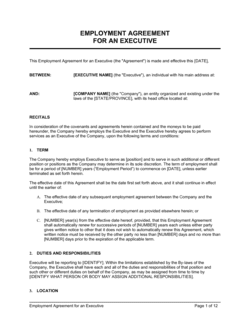
Copyright Assignment Confirmation Notification Template

Free Word download β€’ Edit online β€’ Save & share with Drive β€’ Export to PDF

4 pagesβ€’25–30 min to fillβ€’Difficulty: Standardβ€’Signature requiredβ€’Legal review recommended
Learn more ↓
FreeCopyright Assignment Confirmation Notification Template

At a glance

What it is
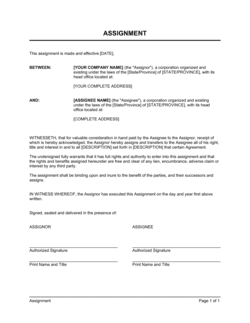
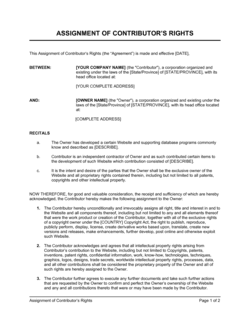
A Copyright Assignment Confirmation Notification is a legally binding document that formally records the transfer of copyright ownership from one party (the assignor) to another (the assignee). This free Word download lets you document the specific works being transferred, the consideration exchanged, any retained rights, and the effective date β€” creating an authoritative written record of the ownership change that both parties and third parties can rely on.
When you need it
Use it whenever a creator, freelancer, employee, or company formally transfers copyright in written works, software, designs, music, photographs, or other creative assets to a business or individual. It is particularly important after a prior informal assignment or verbal agreement, to confirm that ownership has passed and to establish a clear paper trail for licensing, registration, or future sale of the work.
What's inside
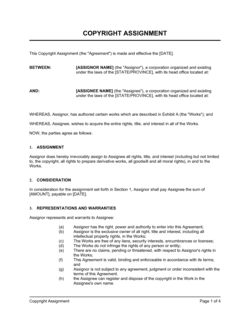
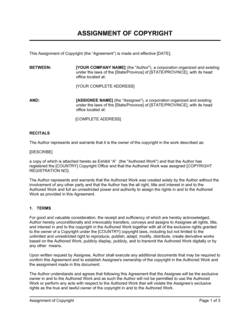
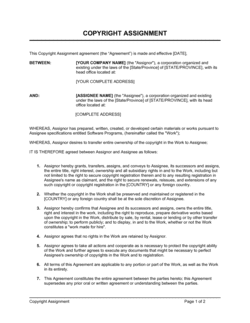
Identified parties and their roles, a precise description of the copyrighted works being assigned, the scope of rights transferred (including moral rights waiver where applicable), consideration paid, representations and warranties from the assignor, any retained or licensed-back rights, effective date, and governing law with signature blocks for both parties.

What is a Copyright Assignment Confirmation Notification?

A Copyright Assignment Confirmation Notification is a legally binding document that formally records the permanent transfer of copyright ownership from one party β€” the assignor β€” to another β€” the assignee. Copyright in any original work arises automatically upon creation, meaning a freelance designer, software developer, or writer owns their output by default unless they execute a written transfer. This document closes that gap by identifying the specific works being transferred, confirming the consideration exchanged, specifying any rights the assignor retains, and establishing an authoritative written record that both parties and third parties β€” including investors, licensees, and courts β€” can rely on to determine who owns the work.

Why You Need This Document

Without a signed copyright assignment, your business may be paying for creative work it does not legally own. Verbal agreements, purchase orders, and informal emails do not satisfy the written-signature requirement imposed by copyright law in the United States, Canada, the United Kingdom, and across the European Union. The consequences are concrete: a developer who built your core product may assert ownership during a funding round, triggering investor withdrawal; a designer who created your brand identity may prohibit you from modifying the logo after the relationship ends; a content creator may license the same work to a competitor after your payment. A properly executed copyright assignment confirmation notification eliminates each of these risks, establishes a clear chain of title for registration and enforcement, and gives your business the legal standing to exploit, adapt, and transfer the work without returning to the original creator for permission.

Which variant fits your situation?

If your situation is…Use this template
Assigning all copyright in a creative work outright with no retained rightsCopyright Assignment Confirmation Notification (Full Transfer)
Granting a limited license rather than full ownership transferCopyright License Agreement
Assigning IP created by an employee as part of their employmentEmployment Agreement with IP Assignment
Assigning IP created by an independent contractor during a projectIndependent Contractor Agreement with IP Assignment
Transferring copyright as part of a broader business or asset saleAsset Purchase Agreement
Registering the copyright transfer with a national copyright officeCopyright Registration Cover Letter
Confirming moral rights waiver separately in a jurisdiction that requires itMoral Rights Waiver

Common mistakes to avoid

❌ Vague or missing work description

Why it matters: An assignment that describes the work as 'all creative content' or 'website materials' without a specific list fails to clearly identify what was transferred. Courts have declined to enforce assignments where the subject matter was insufficiently certain.

Fix: Attach a numbered schedule listing each work by title, format, and creation date. For software, include repository and version identifiers. For images, include filenames and creation dates.

❌ Omitting the moral rights waiver for international assignments

Why it matters: In the UK, Canada, and most EU countries, moral rights exist independently of copyright ownership. Without a waiver, the original creator can object to modifications or demand attribution even after the assignment is executed.

Fix: Include a jurisdiction-appropriate moral rights waiver clause. For jurisdictions where waiver is prohibited (e.g., France), document attribution and integrity commitments in a separate agreement.

❌ No consideration recital

Why it matters: An assignment with no documented consideration may be treated as a gratuitous transfer or gift in common-law jurisdictions, potentially making it revocable or unenforceable against third parties.

Fix: Always state the consideration β€” even if nominal β€” and include an acknowledgment of receipt. 'For good and valuable consideration, receipt of which is hereby acknowledged' satisfies this requirement at minimum.

❌ Failure to authorize recordation with copyright offices

Why it matters: The US Copyright Office and equivalent bodies in Canada, the UK, and many EU countries allow β€” and in some cases require β€” recording of ownership transfers. Without authorization to record, the assignee cannot establish priority against a subsequent assignee or exclusive licensee.

Fix: Include a clause expressly authorizing the assignee to record or register the assignment with any applicable copyright office at their own expense and discretion.

❌ Not confirming prior licenses or encumbrances

Why it matters: If the assignor previously granted an exclusive license to a third party, the assignee may receive title to a copyright they cannot freely exploit. This creates immediate infringement risk and breach of warranty liability.

Fix: Add a disclosure schedule where the assignor lists all prior licenses, assignments, or encumbrances on each work. If none exist, the assignor warrants this fact explicitly.

❌ Executing the assignment after delivering the work without fresh consideration

Why it matters: In common-law jurisdictions, an assignment signed after the work was already delivered and paid for may lack fresh consideration, making restrictive covenants or broad warranty clauses potentially unenforceable.

Fix: Execute the assignment contemporaneously with delivery and payment, or provide documented additional consideration β€” a bonus, fee increment, or credit β€” at the time of delayed signature.

The 10 key clauses, explained

Parties identification

In plain language: Names and identifies the assignor (current copyright holder) and assignee (recipient) as legal entities, with addresses and any relevant registration numbers.

Sample language
This Copyright Assignment Confirmation Notification is entered into as of [EFFECTIVE DATE] by and between [ASSIGNOR FULL LEGAL NAME], a [ENTITY TYPE] with its principal place of business at [ADDRESS] ('Assignor'), and [ASSIGNEE FULL LEGAL NAME], a [ENTITY TYPE] with its principal place of business at [ADDRESS] ('Assignee').

Common mistake: Using a trading name or brand instead of the registered legal entity name. If the assignor's name on the document does not match their government-registered identity, the assignment may be challenged as executed by the wrong party.

Description of the copyrighted works

In plain language: Precisely identifies the works being assigned β€” by title, format, creation date, and any registration number β€” so there is no ambiguity about what is and is not covered.

Sample language
Assignor hereby assigns to Assignee all copyright in and to the following works: [TITLE OF WORK], [FORMAT β€” e.g., written article / software code / logo design], created on approximately [CREATION DATE], Copyright Registration No. [NUMBER] (if applicable) (collectively, the 'Works').

Common mistake: Describing works in vague terms like 'all creative materials' without listing them specifically. An overbroad description can inadvertently capture works outside the intended scope, while a vague description may leave the assignment unenforceable for lack of certainty.

Scope of rights assigned

In plain language: Confirms that all exclusive copyright rights are being transferred β€” worldwide, in all media, in perpetuity β€” including the right to reproduce, distribute, adapt, display, and sublicense the works.

Sample language
Assignor irrevocably assigns to Assignee all right, title, and interest in and to the Works, including all exclusive rights under applicable copyright law, throughout the world, in all languages and media, for the full term of copyright protection and any renewals or extensions thereof.

Common mistake: Omitting the phrase 'in perpetuity' or a specific duration. Without it, courts in some jurisdictions may construe the assignment as a license of indefinite term rather than an outright transfer.

Consideration

In plain language: States what the assignee is paying or providing in exchange for the copyright β€” a fixed sum, royalty, or nominal consideration β€” to make the contract legally binding.

Sample language
In consideration of the sum of [AMOUNT] (the 'Assignment Fee'), receipt of which is hereby acknowledged by Assignor, and other good and valuable consideration, Assignor agrees to the terms of this Assignment.

Common mistake: Stating no consideration or leaving the field blank. An assignment with no documented consideration may be treated as a gift or gratuitous transfer in some jurisdictions, creating ambiguity about whether it is immediately revocable.

Representations and warranties

In plain language: The assignor confirms they own the copyright, that the works are original, that they have not already assigned or licensed the rights to anyone else, and that the works do not infringe any third party's intellectual property.

Sample language
Assignor represents and warrants that: (a) Assignor is the sole legal and beneficial owner of the Works; (b) the Works are original and do not infringe any third party's rights; (c) Assignor has not assigned, licensed, or encumbered any rights in the Works to any third party; and (d) Assignor has full authority to execute this Assignment.

Common mistake: Omitting the warranty that rights have not already been licensed to a third party. If the assignor previously granted an exclusive license, the assignee may receive title to a copyright they cannot freely use without the prior licensee's consent.

Moral rights waiver

In plain language: Where recognized by law, the assignor waives any rights to attribution and work integrity that cannot be transferred, to the extent permitted in the applicable jurisdiction.

Sample language
To the fullest extent permitted by applicable law, Assignor hereby irrevocably waives all moral rights, including rights of attribution and integrity, in and to the Works in favor of Assignee and its successors and assigns.

Common mistake: Omitting the moral rights clause for international or multi-jurisdiction assignments. The UK, Canada, France, and most EU countries recognize moral rights β€” leaving them unaddressed creates a risk of the original creator later objecting to modifications or attributions.

Retained rights and license-back

In plain language: Specifies any rights the assignor keeps after the transfer β€” for example, a non-exclusive license to display the work in their portfolio β€” to prevent disputes over post-assignment use.

Sample language
Notwithstanding the foregoing, Assignor retains a non-exclusive, royalty-free, worldwide license to display the Works in Assignor's professional portfolio solely for the purpose of self-promotion, provided that Assignor credits Assignee as owner of the Works.

Common mistake: Failing to include a license-back when the assignor genuinely needs to continue using the work. Without it, the assignor's post-assignment use of their own work may constitute copyright infringement.

Indemnification

In plain language: Requires the assignor to compensate the assignee for any losses, claims, or damages arising from a breach of the assignor's representations and warranties.

Sample language
Assignor shall indemnify, defend, and hold harmless Assignee and its officers, directors, and assigns from and against any claims, damages, losses, and costs (including reasonable legal fees) arising out of or relating to any breach of Assignor's representations and warranties in this Assignment.

Common mistake: Omitting an indemnification clause or limiting it to direct damages only. If a third party later asserts infringement of the assigned work, the assignee needs a mechanism to recover losses from the assignor who warranted clear title.

Governing law and dispute resolution

In plain language: Specifies which jurisdiction's law governs the assignment and how disputes are resolved β€” through litigation, arbitration, or mediation β€” and in which forum.

Sample language
This Assignment shall be governed by the laws of [STATE / PROVINCE / COUNTRY], without regard to conflict-of-laws principles. Any dispute arising hereunder shall be resolved by [binding arbitration in [CITY] / the courts of [JURISDICTION]].

Common mistake: Selecting a governing law with no connection to either party or the work's creation. Courts in some jurisdictions will decline to apply a chosen law that bears no reasonable relationship to the transaction.

Entire agreement and recordation notice

In plain language: Confirms this document supersedes all prior informal agreements about the copyright and notifies the parties that the assignment may be recorded with the relevant copyright office.

Sample language
This Assignment constitutes the entire agreement between the parties regarding the subject matter hereof and supersedes all prior representations and understandings. Assignee is authorized to record this Assignment with applicable copyright offices at its discretion.

Common mistake: Forgetting to include authorization for the assignee to record the assignment. Without it, the assignee cannot register the transfer with the US Copyright Office or equivalent body, leaving the chain of title incomplete.

How to fill it out

  1. 1

    Identify both parties using full legal names

    Enter the assignor's and assignee's complete registered legal names, entity types, and addresses. Confirm these match the parties' corporate registration documents or government-issued ID.

    πŸ’‘ If the assignor is an individual rather than a company, include their full legal name as it appears on a government-issued ID to prevent identity disputes later.

  2. 2

    List each work being assigned with sufficient detail

    Describe every copyrighted work by title, medium, creation date, and any existing registration number. If assigning multiple works, use a numbered schedule attached to the document.

    πŸ’‘ For software, include the repository name, version number, and a hash or commit identifier if available β€” this prevents disputes about which code revision was assigned.

  3. 3

    Define the scope of rights and territory

    Confirm whether the assignment covers all exclusive rights worldwide and in perpetuity, or whether it is limited to specific territories, languages, or media. For a full transfer, use 'worldwide, in all media, for the full term of copyright.'

    πŸ’‘ Partial assignments β€” limited by territory or medium β€” are less common but valid. Clearly define the boundaries if you are not transferring everything.

  4. 4

    State the consideration and confirm receipt

    Enter the agreed payment amount or describe any non-monetary consideration. Include acknowledgment of receipt to satisfy the consideration requirement and prevent the assignor from later claiming they were not paid.

    πŸ’‘ Even a nominal payment of one dollar ($1.00) creates legally sufficient consideration in most common-law jurisdictions β€” what matters is that something of value changed hands.

  5. 5

    Complete the representations and warranties section

    Review each warranty statement to confirm it is accurate. If the assignor has previously granted any licenses in the works, disclose them here and attach copies as exhibits.

    πŸ’‘ Do not sign a warranty of non-encumbrance if any prior license exists β€” a breach of warranty triggers indemnification liability and can void the assignment in some jurisdictions.

  6. 6

    Add the moral rights waiver if applicable

    Include the moral rights waiver if either party operates in the UK, Canada, France, Germany, or any country that recognizes statutory moral rights. Confirm the jurisdiction's rules on whether waiver is permitted.

    πŸ’‘ France does not permit waiver of moral rights β€” in French-law assignments, remove the waiver language and instead document how attribution will be handled.

  7. 7

    Specify retained rights or portfolio license-back

    If the assignor needs any continuing right to display, reproduce, or reference the work β€” for example, in a design portfolio β€” document it explicitly in the retained-rights clause.

    πŸ’‘ A narrow, non-exclusive portfolio license-back adds two lines to the document and prevents a future infringement claim against the assignor who simply wants to show their work.

  8. 8

    Execute before or immediately after the triggering event

    Both parties must sign and date the document. For assignments triggered by project completion or final payment, execute on or before the payment date so ownership transfer and consideration are simultaneous.

    πŸ’‘ Use a timestamped e-signature platform to create an unambiguous execution record β€” particularly important if the assignor and assignee are in different countries.

Frequently asked questions

What is the difference between an assignment and a work-made-for-hire agreement?

Under US law, a work-made-for-hire arrangement means copyright vests directly in the employer or commissioning party from creation β€” there is no prior ownership by the creator to transfer. A copyright assignment, by contrast, starts with the creator owning the copyright and then formally transfers it to another party. For contractors and freelancers outside an employment relationship, work-made-for-hire applies only to specific categories of works under a written agreement; otherwise an explicit assignment is required.

How this compares to alternatives

vs Copyright License Agreement

A copyright license grants permission to use a work under defined conditions while the licensor retains ownership. A copyright assignment permanently transfers ownership to the assignee. Choose a license when the creator wants to retain rights and earn ongoing royalties; choose an assignment when the commissioning party needs full, permanent ownership to exploit, modify, or resell the work without restriction.

vs Independent Contractor Agreement

An independent contractor agreement governs the entire working relationship β€” scope, deliverables, payment, and confidentiality. It typically includes an IP assignment clause, but that clause alone may not satisfy the formal writing requirement for copyright transfer in all jurisdictions. A standalone copyright assignment confirmation notification supplements the contractor agreement with a dedicated, detailed ownership transfer record.

vs Non-Disclosure Agreement

An NDA protects confidential information shared between parties but does not transfer any intellectual property rights. A copyright assignment confirmation notification transfers ownership of specific works. Many transactions require both documents β€” the NDA during the creation phase and the assignment upon project completion.

vs IP Assignment Agreement

A general IP assignment agreement typically covers all forms of intellectual property β€” patents, trademarks, trade secrets, and copyright β€” in a single document. A copyright assignment confirmation notification is narrower, focused exclusively on copyright in identified works. Use the broader IP assignment for startup equity arrangements or employment contexts; use the copyright-specific document when only copyright ownership is at issue.

Industry-specific considerations

Technology / Software

Assignments cover source code, APIs, documentation, and training data sets; chain of title is scrutinized by investors during due diligence and must be complete before any funding round.

Media and Publishing

Publishers and content platforms require full copyright assignment from authors, photographers, and journalists before publication; prior license grants to other outlets must be disclosed and cleared.

Creative and Design Agencies

Agencies routinely assign copyright in logos, brand identities, and marketing materials to clients upon final payment; portfolio license-back provisions are standard to allow the agency to showcase work.

Entertainment and Music

Copyright assignments in music, film, and gaming must address performance rights, synchronization rights, and moral rights separately; registration with collecting societies may require recorded assignments.

Jurisdictional notes

United States

Under 17 U.S.C. Β§204, a copyright assignment must be in writing and signed by the assignor to be valid. Work-made-for-hire rules under Β§101 apply to employees and certain contractor categories β€” for all others, an explicit written assignment is required. Authors retain a statutory termination right under Β§203 beginning 35 years after execution, which cannot be contractually waived. Recording the assignment with the US Copyright Office establishes priority against subsequent conflicting transfers.

Canada

The Copyright Act of Canada (s. 13(4)) requires copyright assignments to be in writing and signed by the assignor. Moral rights under ss. 14.1–28.2 cannot be assigned but may be waived by written agreement. Quebec's civil-law tradition affects interpretation of assignment terms for provincially regulated matters β€” ensure French-language documentation if the assignor is a Quebec-domiciled individual or entity. Canada does not have a formal copyright assignment recordation system equivalent to the US Copyright Office.

United Kingdom

Under the Copyright, Designs and Patents Act 1988 (s. 90(3)), a copyright assignment must be in writing and signed by or on behalf of the assignor. Moral rights under ss. 77–89 are not assignable but may be waived by written instrument. Post-Brexit, UK copyright law operates independently of EU directives, though substantive rules remain largely aligned. The UK Intellectual Property Office does not maintain a public assignments register, making clear contractual documentation and chain-of-title records especially important.

European Union

Copyright assignment requirements vary by member state, but all EU countries recognize moral rights that are generally inalienable β€” France in particular prohibits full waiver. Germany requires assignments to specify each individual right being transferred; a blanket all-rights assignment without enumeration may be construed narrowly. The EU Copyright in the Digital Single Market Directive (2019/790) introduces additional author protections, including proportional remuneration rights that can limit the practical effect of an assignment in certain member states.

Template vs lawyer β€” what fits your deal?

PathBest forCostTime
Use the templateStandard assignments of freelance creative work, website content, logos, or software under $25,000 in value between domestic partiesFree15–30 minutes
Template + legal reviewAssignments involving prior licenses, multiple works, international parties, or works valued above $25,000$200–$500 (1-hour IP attorney review)1–3 days
Custom draftedHigh-value IP portfolios, publishing or entertainment deals, M&A-related IP transfers, or assignments in jurisdictions with complex moral rights regimes$1,000–$5,000+1–2 weeks

Glossary

Assignor
The person or entity that currently holds the copyright and is transferring ownership to another party.
Assignee
The person or entity receiving and taking ownership of the copyright through the assignment.
Copyright
A bundle of exclusive legal rights protecting original creative works β€” including reproduction, distribution, adaptation, and public display β€” that arises automatically upon creation in most jurisdictions.
Work Made for Hire
A US legal doctrine under which copyright in work created by an employee within the scope of employment, or by a contractor under a written agreement for certain categories of work, vests automatically in the employer or commissioning party.
Moral Rights
Rights recognized in many civil-law countries (and the UK) that protect an author's right to attribution and the integrity of their work, independent of economic copyright ownership β€” generally cannot be assigned but can be waived.
Consideration
Something of value exchanged between parties that makes a contract legally binding β€” in a copyright assignment this may be a cash payment, royalty, or the recital of nominal consideration such as one dollar.
Effective Date
The specific date on which the copyright ownership legally passes from assignor to assignee, which may differ from the document's execution date.
Representations and Warranties
Statements of fact made by the assignor confirming they own the copyright, the work is original, it does not infringe third-party rights, and they have the authority to transfer it.
Chain of Title
The documented history of ownership and transfers of a copyright from the original creator through all subsequent assignees β€” essential for licensing, financing, and enforcement.
Scope of Assignment
The specific rights being transferred β€” typically all exclusive rights under copyright law worldwide, in perpetuity β€” as distinct from a limited license for defined uses.
Indemnification
A contractual obligation by which the assignor agrees to compensate the assignee for losses arising from a breach of the assignor's representations and warranties.

Part of your Business Operating System

This document is one of 3,000+ business & legal templates included in Business in a Box.

  • Fill-in-the-blanks β€” ready in minutes
  • 100% customizable Word document
  • Compatible with all office suites
  • Export to PDF and share electronically

Create your document in 3 simple steps.

From template to signed document β€” all inside one Business Operating System.
1
Download or open template

Access over 3,000+ business and legal templates for any business task, project or initiative.

2
Edit and fill in the blanks with AI

Customize your ready-made business document template and save it in the cloud.

3
Save, Share, Send, Sign

Share your files and folders with your team. Create a space of seamless collaboration.

Save time, save money, and create top-quality documents.

β˜…β˜…β˜…β˜…β˜…

"Fantastic value! I'm not sure how I'd do without it. It's worth its weight in gold and paid back for itself many times."

Managing Director Β· Mall Farm
Robert Whalley
Managing Director, Mall Farm Proprietary Limited
β˜…β˜…β˜…β˜…β˜…

"I have been using Business in a Box for years. It has been the most useful source of templates I have encountered. I recommend it to anyone."

Business Owner Β· 4+ years
Dr Michael John Freestone
Business Owner
β˜…β˜…β˜…β˜…β˜…

"It has been a life saver so many times I have lost count. Business in a Box has saved me so much time and as you know, time is money."

Owner Β· Upstate Web
David G. Moore Jr.
Owner, Upstate Web

Run your business with a system β€” not scattered tools

Stop downloading documents. Start operating with clarity. Business in a Box gives you the Business Operating System used by over 250,000 companies worldwide to structure, run, and grow their business.

Start freeΒ Β·Β No credit card required