Christmas Season Thank You to Valued Customers Template

Free Word download β€’ Edit online β€’ Save & share with Drive β€’ Export to PDF

1 pageβ€’20–30 min to fillβ€’Difficulty: Standardβ€’Signature requiredβ€’Legal review recommended
Learn more ↓
FreeChristmas Season Thank You to Valued Customers Template

At a glance

What it is
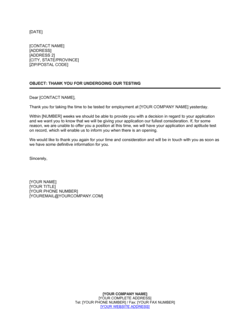
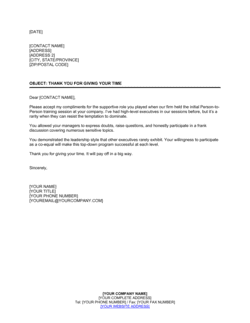
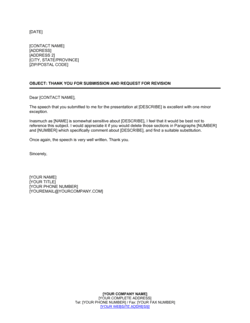
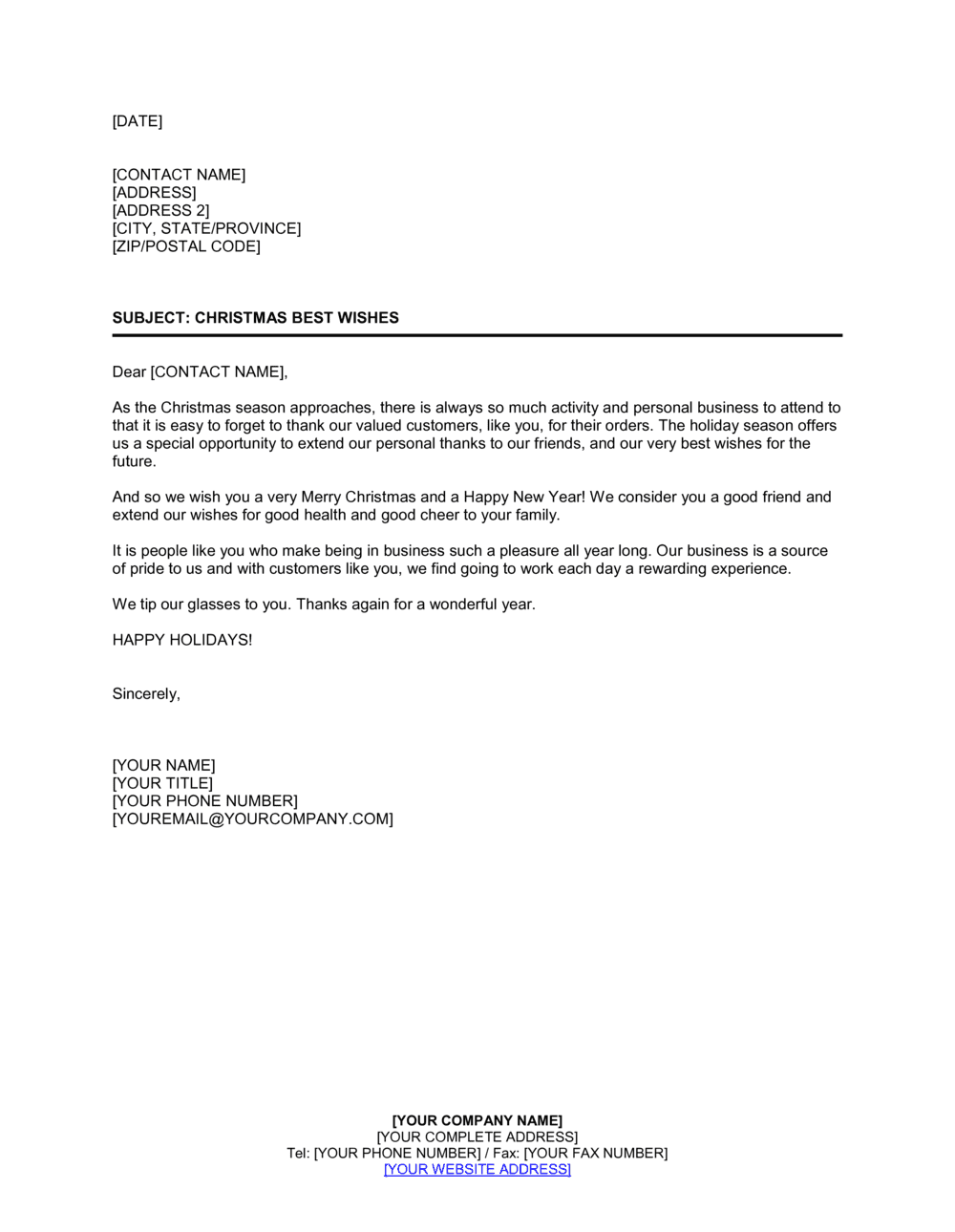
A Christmas Season Thank You to Valued Customers is a formal business letter sent during the holiday season to acknowledge the loyalty, trust, and continued support of clients and customers throughout the year. This free Word download gives you a professionally structured template you can personalize with your branding, recipient details, and specific acknowledgments, then export as PDF or send digitally.
When you need it
Send it in mid-to-late December to reinforce relationships with key clients or your broader customer base before the new year begins. It is especially valuable after a year of significant growth, a challenging operating period, or when you want to set a warm, professional tone ahead of renewed commercial activity in January.
What's inside
A formal salutation, a sincere expression of gratitude tied to specific value the customer has provided, a year-in-review acknowledgment, holiday wishes, a forward-looking statement about the upcoming year, and a professional closing with authorized signature.

What is a Christmas Season Thank You to Valued Customers?

A Christmas Season Thank You to Valued Customers is a formal business letter sent during the holiday period to express sincere gratitude for a customer's loyalty, trust, and continued patronage throughout the year. Unlike transactional correspondence, this letter is entirely relationship-driven β€” it acknowledges the customer's specific value to the business, reflects briefly on shared accomplishments from the year, extends warm holiday wishes, and signals the company's commitment to the relationship in the year ahead. The template is a free Word download you can personalize with your branding, recipient details, and specific acknowledgments, then export as PDF for digital delivery or high-quality print.

Why You Need This Document

The period between December 10 and December 22 is one of the highest-impact windows in the business calendar for relationship reinforcement β€” and one of the most consistently underused. Companies that send a thoughtful, personalized holiday letter to valued customers arrive in the new year with warmer relationships, stronger retention rates, and a meaningful competitive advantage over businesses that make contact only when they need something. Without a formal letter, customer relationships can drift during the quiet year-end period, creating an opening for competitors who are actively reaching out. A well-crafted Christmas thank-you letter closes that gap, acknowledges the customer as a named individual rather than an account number, and sets a tone of genuine partnership that carries forward into January renewal cycles, Q1 sales conversations, and ongoing loyalty. This template gives you a professionally structured starting point that takes 10 to 20 minutes to personalize β€” and delivers the kind of goodwill that a promotional email simply cannot replicate.

Which variant fits your situation?

If your situation is…Use this template
Sending a holiday letter to a single high-value client with personalized detailChristmas Season Thank You To Valued Customers (Individual)
Thanking customers at the end of the calendar year without religious referencesNew Year Thank You Letter to Customers
Expressing gratitude to business partners and vendors rather than customersHoliday Thank You Letter to Business Partners
Acknowledging employees for their contributions over the holiday seasonChristmas Appreciation Letter to Employees
Sending a mass holiday greeting to a large customer list with minimal personalizationHoliday Season Greeting Card Letter
Thanking customers after a specific purchase or service deliveryCustomer Thank You Letter (Post-Purchase)
Pairing a thank-you note with a formal loyalty discount or offerCustomer Appreciation Letter with Offer

Common mistakes to avoid

❌ Sending a completely generic letter with no personalization

Why it matters: A letter that could have been sent to any of 10,000 customers reads as automated outreach, not appreciation. Recipients recognize it immediately and the goodwill impact is near zero.

Fix: Replace at least two personalization tokens per letter with genuinely specific details β€” customer tenure, a named project, or a referral. Even one specific line transforms the perceived effort.

❌ Embedding a promotional offer in the body of the letter

Why it matters: A discount code or sales pitch in a thank-you letter shifts the reader's interpretation from 'they value me' to 'they want something from me,' which is the opposite of the intended effect.

Fix: If a promotion must accompany the letter, place it on a separate enclosure or in a P.S. clearly framed as a gift, not a campaign. Keep the letter body entirely free of commercial language.

❌ Sending too late β€” after December 23

Why it matters: Letters that arrive after December 23 are typically opened in the first week of January, when recipients are in work-mode and the seasonal warmth of the message is diluted.

Fix: Target delivery by December 20 for email and December 18 for physical mail. Build in a drafting and review window starting no later than December 1.

❌ Using the wrong signatory or no signature at all

Why it matters: A letter signed by a generic department name or with no signature looks like a bulk mail merge and signals that no individual at the company actually took time to acknowledge the customer.

Fix: Always sign from a named individual β€” ideally the most senior person with a real relationship to the customer β€” and use a scanned or digital signature, not a typed name alone.

❌ Mixing religious and secular language inconsistently

Why it matters: Using 'Merry Christmas' in the salutation and 'holiday season' in the body β€” or vice versa β€” signals a sloppy find-and-replace edit and can feel tone-deaf to customers with different backgrounds.

Fix: Decide upfront whether the letter is Christmas-specific or broadly seasonal, and apply that language consistently throughout. Segment your list if your customer base spans both preferences.

❌ No year-in-review or specific acknowledgment of the relationship

Why it matters: A letter that expresses gratitude in the abstract β€” without referencing anything specific about the customer β€” feels hollow. The reader knows you could not have written it with them in mind.

Fix: Include at least one sentence that references something real and specific about the customer's relationship with your business, even if it is just the number of years they have been a client.

The 9 key clauses, explained

Letterhead and date

In plain language: Your company's official name, address, logo reference, and the date the letter is issued β€” establishing it as a formal business document.

Sample language
[COMPANY NAME] | [STREET ADDRESS], [CITY], [STATE/PROVINCE] [ZIP/POSTAL CODE] | [PHONE] | [EMAIL] | Date: [MONTH DAY, YEAR]

Common mistake: Using an informal email header or omitting the date β€” without a date, the letter cannot be filed chronologically and loses its character as a formal business record.

Recipient name and address block

In plain language: The customer's full name, title, company name if applicable, and mailing or email address, placed below the date in standard business letter format.

Sample language
[CUSTOMER FULL NAME] | [TITLE] | [CUSTOMER COMPANY NAME] | [STREET ADDRESS], [CITY], [STATE/PROVINCE] [ZIP/POSTAL CODE]

Common mistake: Using a generic 'Valued Customer' salutation for a letter intended to feel personal β€” recipients notice the lack of their name and the relational impact is significantly reduced.

Formal salutation

In plain language: The opening greeting that addresses the recipient by name and establishes a warm, professional tone appropriate for holiday correspondence.

Sample language
Dear [CUSTOMER FIRST NAME / MR. / MS. LAST NAME],

Common mistake: Using 'To Whom It May Concern' in a personalized thank-you letter β€” this phrase signals mass correspondence and undermines the sincerity the letter is meant to convey.

Opening expression of gratitude

In plain language: The first substantive paragraph, which directly and sincerely thanks the customer for their business and loyalty during the year.

Sample language
As the Christmas season approaches, we want to take a moment to express our sincere gratitude for your continued trust and support of [COMPANY NAME] throughout [YEAR]. Your loyalty means more to us than we can adequately express.

Common mistake: Opening with a self-promotional statement about the company's achievements rather than leading with genuine thanks β€” this reads as a sales letter, not an appreciation note.

Value acknowledgment and year-in-review

In plain language: A specific paragraph acknowledging the customer's contributions β€” repeat purchases, referrals, or partnership milestones β€” and briefly reflecting on shared highlights from the year.

Sample language
This year, [SPECIFIC MILESTONE OR ACKNOWLEDGMENT β€” e.g., your partnership has enabled us to expand our services to X new clients / your continued orders have supported our team of Y employees]. We are proud of what we have accomplished together.

Common mistake: Writing a generic year-in-review about the company's own growth without connecting it back to the customer's role β€” the acknowledgment must feel specific to the recipient, not a corporate newsletter.

Holiday wishes

In plain language: A warm, inclusive seasonal greeting that wishes the customer and their family or team a joyful holiday period and restful year-end break.

Sample language
We wish you and everyone at [CUSTOMER COMPANY NAME / your family] a very Merry Christmas, joyful holidays, and a peaceful start to the New Year.

Common mistake: Combining holiday wishes with a discount offer or upsell in the same sentence β€” this immediately shifts the tone from sincere to transactional and diminishes the letter's goodwill impact.

Forward-looking commitment statement

In plain language: One or two sentences expressing the company's excitement and commitment to continuing the relationship and serving the customer even better in the upcoming year.

Sample language
As we look ahead to [NEW YEAR], we remain committed to providing you with [SPECIFIC VALUE PROPOSITION β€” e.g., the quality, responsiveness, and expertise] you deserve. We look forward to continuing to grow together.

Common mistake: Making vague promises like 'we will do even better next year' without any specificity β€” forward-looking statements are most credible when they reference a specific improvement, initiative, or shared goal.

Complimentary close and authorized signature

In plain language: The formal closing phrase followed by the handwritten or digital signature of the authorized signatory, their printed name, and their title.

Sample language
With warm appreciation and holiday wishes, [HANDWRITTEN OR DIGITAL SIGNATURE] [SIGNATORY FULL NAME] [TITLE], [COMPANY NAME]

Common mistake: Closing with a typed name only and no signature β€” for a letter intended to convey personal warmth, the absence of a signature (even a digital one) makes it feel like an automated message.

Optional postscript (P.S.)

In plain language: An optional one-sentence postscript that can reference a seasonal offer, an invitation to reconnect in January, or a personal note β€” postscripts receive high readership in direct correspondence.

Sample language
P.S. We would love to connect in the New Year to discuss how we can best support [CUSTOMER COMPANY NAME] in [YEAR]. Please feel free to reach out to [CONTACT NAME] at [EMAIL / PHONE] to schedule a call.

Common mistake: Burying a hard sales pitch in the P.S. of what is otherwise a genuine thank-you letter β€” if a P.S. is used, it should be an invitation, not a promotion with pricing or urgency language.

How to fill it out

  1. 1

    Add your company letterhead and the letter date

    Insert your company's official name, address, phone, email, and logo at the top of the template. Enter the date you plan to send the letter β€” typically between December 10 and December 22.

    πŸ’‘ If you are sending digitally, use a PDF with your letterhead embedded rather than a plain-text email β€” the visual formality increases perceived sincerity.

  2. 2

    Enter the recipient's name, title, and address

    Fill in the customer's full name, their title if applicable, and their mailing or billing address. For email delivery, confirm the correct recipient and CC the account manager if appropriate.

    πŸ’‘ For high-value accounts, use the decision-maker's name rather than a general company address β€” a letter addressed to a specific person is far more likely to be read.

  3. 3

    Write a personalized salutation

    Use the customer's first name for warm, established relationships ('Dear Sarah,') or their courtesy title and last name for more formal or newer relationships ('Dear Ms. Patel,').

    πŸ’‘ Consistency between salutation formality and the tone of the letter body matters β€” a 'Dear Sarah' opener followed by stiff corporate prose creates a jarring read.

  4. 4

    Customize the opening gratitude paragraph

    Replace the placeholder text with a genuine acknowledgment of the customer's specific value β€” number of years as a customer, a notable project, or a referral they made. One specific detail outperforms generic warmth.

    πŸ’‘ Pull from your CRM or account notes before drafting β€” a reference to their longest-running contract or a project completed this year shows you actually pay attention.

  5. 5

    Complete the year-in-review and value acknowledgment

    Reference one or two shared milestones from the year. This can be a project delivered, a challenge navigated together, or a growth metric you achieved partly because of their business.

    πŸ’‘ Keep this section to three to five sentences β€” brevity signals confidence and respect for the recipient's time.

  6. 6

    Add the holiday wishes and forward-looking statement

    Insert the seasonal greeting appropriate to your audience, then write one to two sentences about your commitment and enthusiasm for the relationship in the new year.

    πŸ’‘ If you serve a diverse customer base across faiths and cultures, use 'joyful holiday season' alongside 'Merry Christmas' β€” the template supports both without losing warmth.

  7. 7

    Sign the letter with an authorized signature

    Apply a handwritten signature (scanned), digital signature, or an eSign-generated signature above the printed name and title of the sender. For batches, a high-quality scanned signature image applied consistently is acceptable.

    πŸ’‘ Letters from the business owner or CEO carry more relational weight than those signed by a department. For top-tier accounts, have the most senior relationship owner sign personally.

  8. 8

    Proofread, export as PDF, and send before December 22

    Read the letter aloud to catch awkward phrasing, confirm all personalization tokens have been replaced, export as PDF, and send before December 22 to arrive before recipients begin their holiday break.

    πŸ’‘ For printed letters, use quality paper stock and hand-address the envelope for top accounts β€” physical mail open rates during the holiday season are significantly higher than email open rates.

Frequently asked questions

What is a Christmas season thank-you letter to valued customers?

A Christmas season thank-you letter to valued customers is a formal business letter sent during the holiday season to express sincere gratitude for a customer's loyalty, trust, and continued business over the past year. It typically includes a personalized acknowledgment of the relationship, holiday wishes, and a forward-looking statement about the upcoming year. It serves as a relationship-retention tool and a goodwill gesture outside of any transactional context.

When should I send a Christmas thank-you letter to customers?

Target delivery between December 10 and December 20 for most business contexts. For physical mail, post by December 15 to ensure arrival before recipients begin their holiday break. Email delivery is more flexible but should still land before December 22 to benefit from the seasonal mindset. Avoid sending in the final days before Christmas or after December 23, when the message loses much of its seasonal impact.

Should the letter be signed by the business owner or an account manager?

For high-value or long-tenure customers, a letter signed by the business owner or most senior executive carries significantly more weight and signals that the relationship matters at the highest level. For broader customer lists, account managers or department heads are appropriate signatories. The key rule is that the letter should be signed by a named individual β€” never by a department, brand name, or generic title alone.

Can I include a discount or promotional offer in the thank-you letter?

Including a promotion in the body of a thank-you letter typically undermines the sincerity of the message. If you want to pair goodwill with a commercial incentive, attach a separate enclosure or gift card, or add a brief P.S. framing the offer as a holiday gift rather than a promotion. Keep the letter body entirely focused on appreciation and relationship reinforcement.

Is a Christmas thank-you letter legally binding?

A Christmas season thank-you letter is not a contract and creates no legally binding obligations in itself. However, any forward-looking commitments written in the letter β€” such as promises of pricing, service levels, or specific deliverables in the new year β€” could potentially be interpreted as representations in certain jurisdictions if they are specific and reasonably relied upon by the recipient. Keep forward-looking statements aspirational and general to avoid unintended obligations.

How do I personalize a Christmas thank-you letter at scale?

Use mail-merge functionality in Word or Google Docs to populate personalization tokens β€” [CUSTOMER NAME], [COMPANY NAME], [SPECIFIC MILESTONE] β€” from a CRM export or spreadsheet. For your top 20 to 30 accounts, write each letter individually. For broader lists, use merge fields but add at least one segment-specific sentence that reflects customer type, tenure bracket, or industry rather than a single identical body for all recipients.

Should I use 'Merry Christmas' or 'Happy Holidays' in the letter?

The choice depends on your knowledge of your customer base and your brand voice. 'Merry Christmas' is appropriate when you know the recipient celebrates the holiday and your brand is comfortable with the religious reference. 'Happy Holidays' or 'joyful holiday season' is more inclusive for diverse customer lists. This template supports both β€” the key is to apply the chosen language consistently throughout the letter rather than mixing both in the same document.

What is the difference between a Christmas thank-you letter and a holiday greeting card?

A holiday greeting card is a brief, often printed seasonal message with a generic greeting and signature β€” minimal personalization and no substantive content. A Christmas thank-you letter is a full formal business letter that specifically acknowledges the customer's loyalty, reflects on the year's relationship, and expresses a commitment to the future. The letter carries substantially more relational weight and is appropriate for valued accounts; a card is suitable for casual or high-volume outreach.

Do I need to send a physical letter, or is email acceptable?

Both formats are professionally acceptable, but physical letters consistently outperform email for relationship impact with high-value customers β€” particularly in industries where formal correspondence is the norm, such as professional services, finance, and law. Email is appropriate for digital-native businesses or large customer lists where physical mailing is impractical. For your most important accounts, a printed letter on quality stock, hand-signed and personally addressed, delivers a noticeably stronger impression than an email, especially during a season when inboxes are crowded.

How this compares to alternatives

vs Holiday Greeting Card

A holiday greeting card is a brief, typically printed message with a seasonal greeting and signature β€” it conveys warmth but carries no substantive content about the relationship. A Christmas thank-you letter is a full formal business letter that acknowledges the customer's specific value and expresses a forward-looking commitment. Use a card for casual contacts; use the letter for accounts where retention and relationship depth matter.

vs Customer Appreciation Letter

A customer appreciation letter is a general-purpose document sent at any time of year to acknowledge loyalty or milestone events. A Christmas season thank-you letter is timed to the holiday period and incorporates seasonal language, holiday wishes, and a year-in-review tone that is specific to year-end relationship management. The seasonal context amplifies the emotional resonance of the message.

vs New Year Letter to Customers

A New Year letter to customers is forward-focused β€” it emphasizes upcoming initiatives, goals, and the company's plans for the year ahead. A Christmas thank-you letter is retrospective and relational β€” it looks back at the year's shared accomplishments and leads with gratitude rather than strategy. Both can be sent in sequence for maximum relationship impact.

vs Customer Thank You Letter (Post-Purchase)

A post-purchase thank-you letter is triggered by a specific transaction and is sent immediately after a purchase or service delivery. A Christmas season thank-you letter is relationship-driven, not transaction-triggered, and is sent annually regardless of recent purchase activity. The seasonal letter is specifically designed to reinforce long-term loyalty, not acknowledge a single event.

Industry-specific considerations

Professional Services

Law firms, accounting practices, and consultancies use year-end thank-you letters as a critical retention touchpoint before January renewal conversations begin.

Retail and E-commerce

Retailers segment their customer list by purchase frequency and lifetime value, sending personalized letters to top-tier loyalty members ahead of January sale periods.

Financial Services

Wealth managers, insurance brokers, and lenders use formal Christmas letters to reinforce trust with clients during a period when competitors are actively prospecting.

Construction and Trades

Contractors and tradespeople send year-end thank-you letters to general contractors and property managers to stay front-of-mind for project awards in the new year.

Healthcare and Wellness

Private clinics, dental practices, and wellness studios thank patients and members for their loyalty while maintaining a tone that is warm without making clinical promises.

Manufacturing and Wholesale

Manufacturers and distributors use formal holiday letters to acknowledge key wholesale accounts and reinforce partnership commitments ahead of Q1 order cycles.

Jurisdictional notes

United States

In the United States, a seasonal thank-you letter creates no contractual obligations provided it contains no specific pricing commitments, guarantees, or enforceable promises. However, any written representation that a customer reasonably relies upon β€” such as a stated discount or service-level commitment β€” could potentially be enforceable under promissory estoppel principles in some states. Keep forward-looking language aspirational and avoid specific commercial commitments in the letter body.

Canada

Canadian businesses sending holiday correspondence to customers should ensure any promotional language included complies with Canada's Anti-Spam Legislation (CASL) if the letter is sent electronically to commercial recipients who have not provided express consent. A purely relational thank-you letter with no commercial call to action is generally exempt from CASL, but adding offers or solicitations triggers full compliance requirements. Quebec recipients may appreciate a French-language version or bilingual format.

United Kingdom

UK businesses sending Christmas thank-you letters via email to customers should confirm they are operating within the UK GDPR and Privacy and Electronic Communications Regulations (PECR) framework. Relational correspondence to existing customers is generally permitted under the 'soft opt-in' exemption, but including promotional content activates stricter consent requirements. Letters sent by post are not subject to PECR but must still comply with UK GDPR data handling standards.

European Union

EU-based businesses must ensure that email delivery of holiday correspondence complies with GDPR and the ePrivacy Directive. Sending a Christmas thank-you letter to existing customers via email is typically permissible under legitimate interests grounds, provided no promotional content is included and an opt-out mechanism is available. Member states including Germany and France apply particularly strict interpretations of email marketing consent β€” businesses operating in these markets should confirm local requirements before batch sending.

Template vs lawyer β€” what fits your deal?

PathBest forCostTime
Use the templateSmall and mid-size businesses sending personalized holiday letters to their standard customer baseFree10–20 minutes per letter with personalization
Template + legal reviewBusinesses including forward-looking commitments, service-level references, or promotional offers that could be construed as representations$100–$300 for a brief legal or communications review1–2 business days
Custom draftedEnterprise accounts with regulated customer relationships, financial services firms, or situations where the letter accompanies a contract renewal or significant commercial announcement$300–$8002–5 business days

Glossary

Salutation
The opening greeting of a formal letter, typically addressing the recipient by name or title β€” e.g., 'Dear [CUSTOMER NAME]'.
Year-in-review statement
A brief acknowledgment of shared milestones, business highlights, or significant events from the past year included to personalize the letter.
Value acknowledgment
A specific sentence or paragraph identifying the tangible or relational value the customer has contributed β€” repeat business, referrals, or long tenure.
Forward-looking statement
A sentence or two that expresses enthusiasm or commitment for the relationship in the upcoming year, signaling continuity and investment in the partnership.
Complimentary close
The formal sign-off phrase before the signature β€” e.g., 'Warm regards,' 'Sincerely,' or 'With appreciation' β€” which sets the tone of the closing.
Authorized signatory
The named individual whose signature appears on the letter, typically a business owner, senior executive, or account relationship manager.
Personalization tokens
Placeholder fields such as [CUSTOMER NAME], [COMPANY NAME], or [SPECIFIC MILESTONE] that are replaced with recipient-specific information before sending.
Retention touchpoint
A deliberate communication designed to reinforce a customer relationship and reduce the likelihood of churn or disengagement.
Seasonal correspondence
Business communication sent at a predictable calendar moment β€” such as the holiday season β€” to maintain relationship continuity outside of transactional exchanges.
Call to action (optional)
An optional sentence inviting the customer to respond, book a meeting, or take advantage of a seasonal offer β€” used when the letter serves a dual commercial purpose.

Part of your Business Operating System

This document is one of 3,000+ business & legal templates included in Business in a Box.

  • Fill-in-the-blanks β€” ready in minutes
  • 100% customizable Word document
  • Compatible with all office suites
  • Export to PDF and share electronically

Create your document in 3 simple steps.

From template to signed document β€” all inside one Business Operating System.
1
Download or open template

Access over 3,000+ business and legal templates for any business task, project or initiative.

2
Edit and fill in the blanks with AI

Customize your ready-made business document template and save it in the cloud.

3
Save, Share, Send, Sign

Share your files and folders with your team. Create a space of seamless collaboration.

Save time, save money, and create top-quality documents.

β˜…β˜…β˜…β˜…β˜…

"Fantastic value! I'm not sure how I'd do without it. It's worth its weight in gold and paid back for itself many times."

Managing Director Β· Mall Farm
Robert Whalley
Managing Director, Mall Farm Proprietary Limited
β˜…β˜…β˜…β˜…β˜…

"I have been using Business in a Box for years. It has been the most useful source of templates I have encountered. I recommend it to anyone."

Business Owner Β· 4+ years
Dr Michael John Freestone
Business Owner
β˜…β˜…β˜…β˜…β˜…

"It has been a life saver so many times I have lost count. Business in a Box has saved me so much time and as you know, time is money."

Owner Β· Upstate Web
David G. Moore Jr.
Owner, Upstate Web

Run your business with a system β€” not scattered tools

Stop downloading documents. Start operating with clarity. Business in a Box gives you the Business Operating System used by over 250,000 companies worldwide to structure, run, and grow their business.

Free Forever PlanΒ Β·Β No credit card required