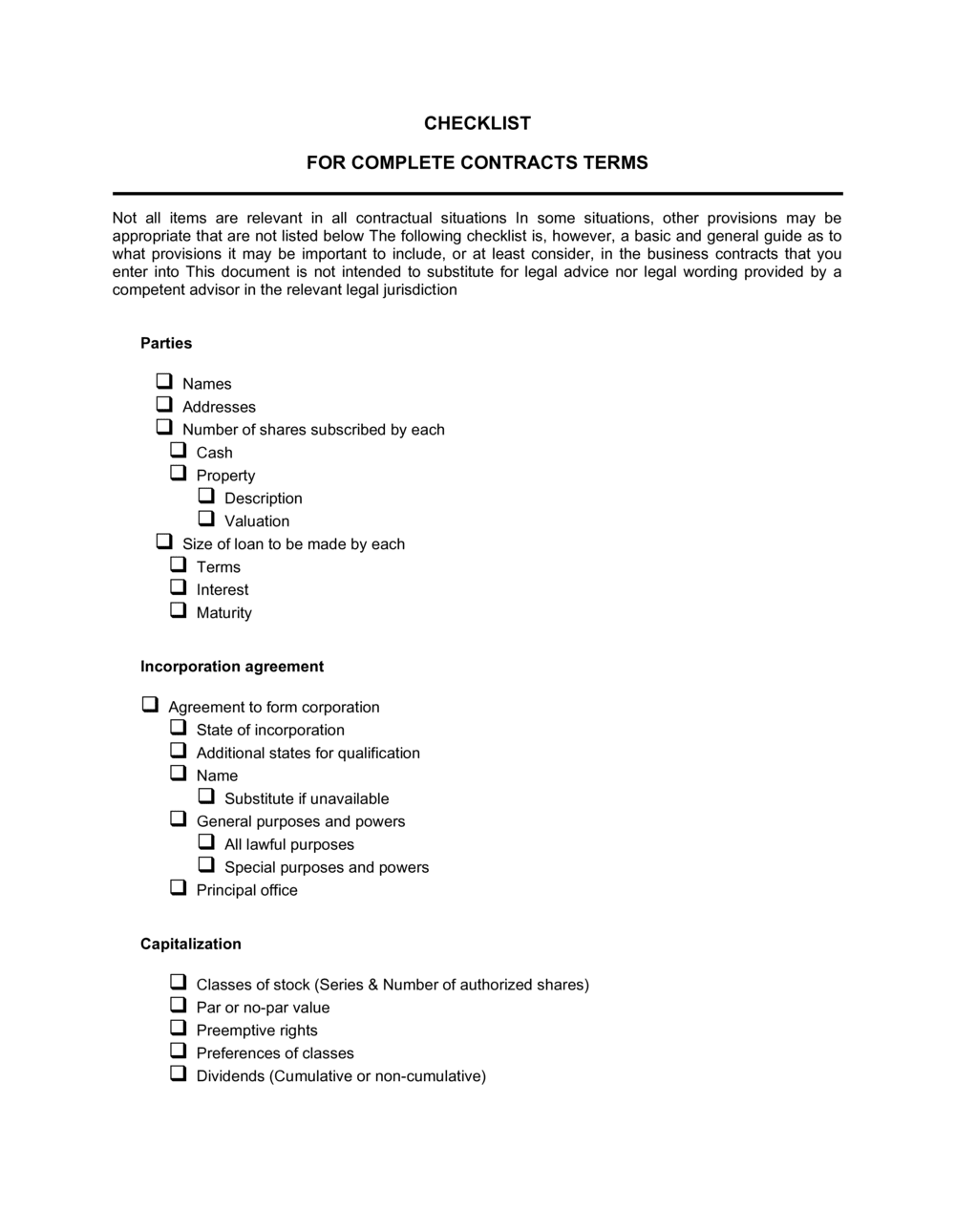
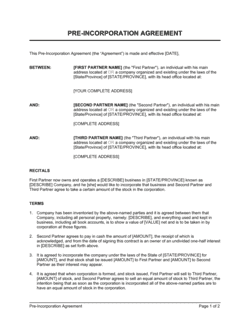
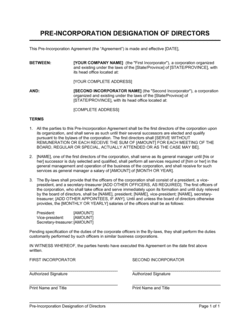
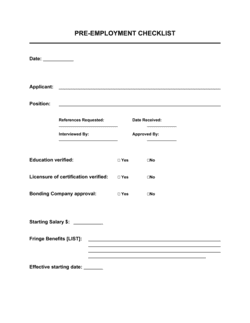
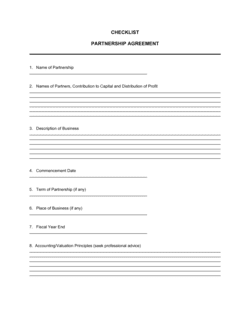
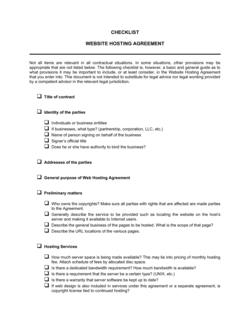
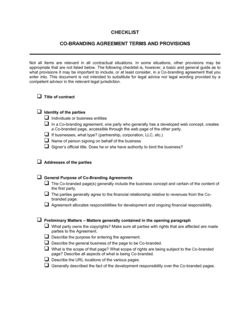
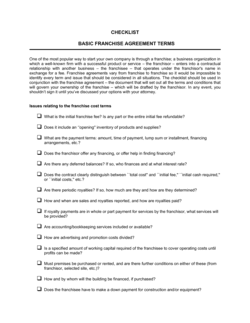
Checklist Pre-Incorporation Agreement

Free download β€’ Use as a template β€’ Print or share

3 pagesβ€’20–25 min to useβ€’Difficulty: Standard
Learn more ↓
FreeChecklist Pre-Incorporation Agreement Template

At a glance

What it is
A Checklist Pre Incorporation Agreement is a structured form that prompts co-founders and prospective shareholders to confirm, in writing, every key decision that must be resolved before filing articles of incorporation. This free Word download covers entity type, equity allocation, officer roles, IP assignment, and capital contributions β€” giving you a single reference sheet to hand off to your lawyer or accountant when the time comes.
When you need it
Use it the moment two or more founders agree to start a venture together, before any entity is formally registered. It captures the agreements made at the kitchen table before those agreements become disputes in a boardroom.
What's inside
Proposed entity type and jurisdiction, founder names and equity percentages, officer and director appointments, initial capital contributions, IP assignment confirmation, vesting schedule parameters, and a signature block for each founder acknowledging the agreed terms.

What is a Checklist Pre Incorporation Agreement?

A Checklist Pre Incorporation Agreement is a structured form that co-founders complete before filing any legal documents to formally create a business entity. It walks through every decision that must be settled at formation β€” entity type, jurisdiction, equity allocation, vesting schedule, capital contributions, officer appointments, IP assignment, and registered agent β€” and creates a written record that all founders have reviewed and agreed to the same terms. Rather than a binding legal contract, it functions as the organized brief that feeds directly into the articles of incorporation, shareholders agreement, or LLC operating agreement that a lawyer will draft next.

Why You Need This Document

Founders who skip this step and incorporate without written pre-formation alignment routinely discover their disagreements after the entity exists β€” when resolving them requires shareholder resolutions, legal amendments, and sometimes litigation. Equity splits recalled differently by two founders, IP that was never formally assigned to the company, and officer roles that were never clearly defined are the three most common triggers of early-stage co-founder disputes. A completed, signed checklist eliminates all three risks in a single 30-minute meeting. It also reduces the time and cost of the formal incorporation engagement by giving your lawyer a clear, complete brief rather than a series of back-and-forth emails collecting the same information piecemeal. This template gives you the structure to have that conversation completely, the first time.

Which variant fits your situation?

If your situation is…Use this template
Two or more founders splitting equity in a new corporationChecklist Pre Incorporation Agreement
Founders ready to formalize a binding founders agreementFounders Agreement
Incorporating as a limited liability company (LLC)LLC Operating Agreement
Documenting a shareholder structure post-incorporationShareholders Agreement
Assigning pre-existing IP to the new entityIP Assignment Agreement
Issuing shares with vesting after incorporationStock Vesting Agreement

Common mistakes to avoid

❌ Skipping the checklist entirely and filing directly

Why it matters: Founders who incorporate without aligning on equity, roles, and IP first frequently discover disagreements after the entity exists β€” when resolving them requires legal amendments and costs significantly more.

Fix: Complete the checklist in a single co-founder meeting before any filing is initiated. It takes under an hour and eliminates the most common sources of early-stage disputes.

❌ Leaving equity allocation vague or approximate

Why it matters: An entry like 'roughly equal split' creates ambiguity that compounds over time β€” especially when one founder contributes more than expected or leaves early.

Fix: Enter exact percentages and calculated share counts. If the split is truly equal, write '33.33%' β€” not 'equal thirds.'

❌ Omitting IP assignment details

Why it matters: If a founder built the core product before incorporation and the assignment is not documented, the IP may legally belong to that individual β€” not the company β€” which blocks fundraising and acquisition.

Fix: List every piece of pre-existing IP by description in the IP assignment field and execute a separate written IP Assignment Agreement at or before incorporation.

❌ Not applying vesting to all founders

Why it matters: Exempting a founder from vesting because they 'came up with the idea' means they can walk away on day two with a full equity stake, leaving the remaining team to rebuild.

Fix: Apply vesting to every founder without exception. Prior contributions can be recognized through a shorter cliff or accelerated schedule, not by waiving vesting entirely.

The 9 key fields, explained

Proposed entity type and state of incorporation

Founder names and contact details

Equity allocation and share counts

Vesting schedule parameters

Initial capital contributions

Officer and director appointments

IP assignment confirmation

Registered agent and principal address

Founder acknowledgment signatures

How to fill it out

  1. 1

    Agree on entity type before opening the form

    Decide with your co-founders whether you are forming a C-corp, S-corp, or LLC. The choice determines tax treatment, fundraising options, and required filings. Enter the result in the entity type field.

    πŸ’‘ If you plan to raise venture capital, a Delaware C-corp is the standard β€” most institutional investors will not fund other structures.

  2. 2

    Enter each founder's legal name and contact information

    Use full legal names exactly as they appear on government-issued ID. Include a personal email and mailing address for each founder.

    πŸ’‘ Cross-check names against passports or driver's licenses now β€” a discrepancy in legal name between the checklist and the articles of incorporation requires an amendment to fix.

  3. 3

    Record equity percentages and share counts

    Enter each founder's agreed ownership percentage and calculate the corresponding share count based on the total authorized share pool you have chosen.

    πŸ’‘ Authorize at least 10,000,000 shares at $0.0001 par value β€” this gives flexibility for option pools, future investors, and share splits without a costly amendment.

  4. 4

    Define vesting terms for every founder

    Fill in the vesting period, cliff date, and whether unvested shares are subject to company repurchase on departure. Apply vesting to all founders equally, regardless of contribution.

    πŸ’‘ A 4-year vesting schedule with a 1-year cliff is the investor-expected standard β€” deviating from it requires a documented rationale.

  5. 5

    List all capital contributions with delivery dates

    Record each founder's cash contribution, property, or IP assignment with a specific dollar value and the date by which it will be delivered to the company.

    πŸ’‘ Value non-cash contributions conservatively β€” an inflated IP valuation can create a taxable event for the contributing founder.

  6. 6

    Appoint officers and initial board members

    Name one person to each officer role and list the initial board of directors. Confirm each appointee has agreed to serve before entering their name.

    πŸ’‘ Keep the initial board to two or three founders β€” even numbers create tie votes. An odd-numbered board is easier to govern.

  7. 7

    Collect founder signatures

    Have every founder sign and date the acknowledgment block. Store the signed copy alongside the articles of incorporation once filed.

    πŸ’‘ Use Business in a Box eSign to capture dated digital signatures β€” a timestamped signed copy is stronger evidence than an unsigned printed form.

Frequently asked questions

What is a pre-incorporation agreement checklist?

A pre-incorporation agreement checklist is a structured form that co-founders complete before formally registering a business entity. It records every key decision β€” entity type, equity split, officer roles, capital contributions, IP assignment, and vesting terms β€” in a single document so that all founders are aligned before the articles of incorporation are filed. It is not a substitute for a full founders agreement or shareholders agreement, but it captures the intent that those documents will formalize.

Is this checklist legally binding?

On its own, a checklist is not a binding legal contract in most jurisdictions. Its value is evidentiary β€” a signed, dated checklist demonstrates that founders agreed on specific terms at a specific point in time. If a dispute arises before the formal agreements are executed, a signed checklist is typically admissible as evidence of the parties' intent. To create binding obligations, follow the checklist with a formal pre-incorporation agreement or shareholders agreement.

When should I complete this checklist?

Complete it before any entity filing is initiated β€” ideally in the same meeting where co-founders shake hands on the deal. At minimum, it should be signed before any founder contributes cash, transfers IP, or begins working on the venture in a formal capacity. Completing it after incorporation is possible but reduces its usefulness as an alignment tool.

What is the difference between a pre-incorporation agreement and a shareholders agreement?

A pre-incorporation agreement (or checklist) captures founder decisions before the entity exists. A shareholders agreement is a formal legal contract entered into after incorporation that governs how shares are transferred, how decisions are made, and what happens when a founder leaves. The checklist feeds into the shareholders agreement β€” the terms agreed on the checklist become the starting point for the lawyer drafting the formal document.

Does every co-founder need to sign this checklist?

Yes. The checklist only has practical and evidentiary value if every founder has reviewed and signed it. A checklist signed by only some founders does not establish consensus and may create confusion about whether the absent founders agreed to the recorded terms. Collect all signatures before any filing proceeds.

Do I need a lawyer to use this checklist?

No β€” the checklist is designed to be completed by founders without legal assistance. However, once the checklist is complete, sharing it with a startup lawyer before filing is worthwhile for complex situations involving significant IP, outside investors, or founders in multiple jurisdictions. The checklist gives the lawyer a clear brief and typically reduces the time β€” and cost β€” of the incorporation engagement.

What happens if founders disagree while filling out the checklist?

Any disagreement surfaced during the checklist process is a disagreement that would otherwise surface after incorporation β€” when it is far more expensive to resolve. Treat each unresolved field as a required decision, not an optional one. If co-founders cannot agree on equity splits or IP assignment before filing, that misalignment will not improve once money and legal structures are involved.

Should this checklist be updated after incorporation?

Once the entity is incorporated and formal agreements are executed, the checklist is superseded by those documents. Archive the signed checklist alongside the articles of incorporation and founders agreement as a historical record of the terms agreed at formation. It is not typically updated post-incorporation β€” changes to equity, roles, or IP after that point are handled through shareholder resolutions and amendments to the formal agreements.

How this compares to alternatives

vs Shareholders Agreement

A shareholders agreement is a binding post-incorporation contract governing share transfers, decision-making, and founder departure. This checklist captures the decisions that feed into that agreement. Complete the checklist first, then use it as the brief for drafting the shareholders agreement.

vs LLC Operating Agreement

An LLC operating agreement governs the internal operations of an LLC β€” member roles, profit distribution, and voting rights. This checklist is entity-agnostic and covers the pre-filing alignment step regardless of whether the entity will be a corporation or an LLC. Complete the checklist, then draft the operating agreement from its outputs.

vs Partnership Agreement

A partnership agreement is a binding document for general or limited partnerships. This checklist is a lighter pre-formation tool used to align founders before any entity is created. If the chosen entity is a partnership, the completed checklist informs the partnership agreement.

vs Business Plan

A business plan documents the market opportunity, strategy, and financial projections for a new venture. This checklist documents the legal and governance decisions that must be made before the entity can be formed. They serve different purposes and both should be completed before launch β€” the business plan does not substitute for the incorporation checklist.

Industry-specific considerations

Technology / SaaS

IP assignment is the most critical field β€” pre-existing code, algorithms, or data sets built before incorporation must be explicitly listed and assigned to the new entity.

Professional Services

Founding partner roles and equity often reflect different client contribution levels, making the capital contribution and equity allocation fields especially important to document precisely.

Retail / E-commerce

Initial capital contributions for inventory, website build-out, and brand assets should be itemized by founder to establish a clear record of who funded what at launch.

Manufacturing

Equipment and tooling contributed by founders as non-cash capital must be valued and recorded, as their transfer to the entity has direct tax and asset-register implications.

Template vs pro β€” what fits your needs?

PathBest forCostTime
Use the templateCo-founders aligning on entity structure, equity, and roles before any filingFree30–60 minutes
Template + professional reviewFounders with significant pre-existing IP, outside investors, or multi-jurisdiction formation$300–$800 for a one-hour startup lawyer review1–2 days
Custom draftedComplex multi-founder structures with negotiated vesting, convertible instruments, or international co-founders$1,000–$3,000 for a full incorporation package with a startup lawyer1–2 weeks

Glossary

Pre-Incorporation Agreement
A written record of decisions made by co-founders before a legal entity is formally registered, covering equity, roles, and capital contributions.
Articles of Incorporation
The legal filing submitted to a state or provincial authority to officially create a corporation.
Equity Split
The percentage of ownership each founder receives in the new entity, typically expressed as a share count or percentage.
Vesting Schedule
A timeline over which founders earn full ownership of their shares, typically 4 years with a 1-year cliff, to incentivize continued contribution.
IP Assignment
The transfer of any intellectual property β€” code, designs, patents, or trade secrets β€” created by founders before incorporation to the new entity.
Capital Contribution
Cash, property, or services each founder agrees to contribute to the company in exchange for their equity stake.
Registered Agent
A person or company designated to receive official legal and government correspondence on behalf of the corporation.
Par Value
The nominal minimum price assigned to each share of stock, often set at $0.0001 per share for early-stage corporations.
Authorized Shares
The maximum number of shares a corporation is permitted to issue, as stated in its articles of incorporation.
Cliff
The minimum period a founder must remain with the company before any vested shares are earned β€” typically 12 months in a standard vesting schedule.

Part of your Business Operating System

This document is one of 3,000+ business & legal templates included in Business in a Box.

  • Fill-in-the-blanks β€” ready in minutes
  • 100% customizable Word document
  • Compatible with all office suites
  • Export to PDF and share electronically

Create your document in 3 simple steps.

From template to signed document β€” all inside one Business Operating System.
1
Download or open template

Access over 3,000+ business and legal templates for any business task, project or initiative.

2
Edit and fill in the blanks with AI

Customize your ready-made business document template and save it in the cloud.

3
Save, Share, Send, Sign

Share your files and folders with your team. Create a space of seamless collaboration.

Save time, save money, and create top-quality documents.

β˜…β˜…β˜…β˜…β˜…

"Fantastic value! I'm not sure how I'd do without it. It's worth its weight in gold and paid back for itself many times."

Managing Director Β· Mall Farm
Robert Whalley
Managing Director, Mall Farm Proprietary Limited
β˜…β˜…β˜…β˜…β˜…

"I have been using Business in a Box for years. It has been the most useful source of templates I have encountered. I recommend it to anyone."

Business Owner Β· 4+ years
Dr Michael John Freestone
Business Owner
β˜…β˜…β˜…β˜…β˜…

"It has been a life saver so many times I have lost count. Business in a Box has saved me so much time and as you know, time is money."

Owner Β· Upstate Web
David G. Moore Jr.
Owner, Upstate Web

Run your business with a system β€” not scattered tools

Stop downloading documents. Start operating with clarity. Business in a Box gives you the Business Operating System used by over 250,000 companies worldwide to structure, run, and grow their business.

Free Forever PlanΒ Β·Β No credit card required