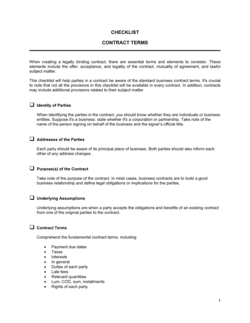
Checklist Basic Franchise Agreement Terms

Free download β€’ Use as a template β€’ Print or share

4 pagesβ€’20–30 min to useβ€’Difficulty: Standard
Learn more ↓
FreeChecklist Basic Franchise Agreement Terms Template

At a glance

What it is
A Checklist Basic Franchise Agreement Terms is a structured review form that walks a prospective franchisee or franchisor through every material provision of a franchise agreement before signing. This free Word download lets you tick off each key term β€” fees, territory, training, renewal, and termination β€” so nothing is overlooked during due diligence.
When you need it
Use it when evaluating a franchise disclosure document (FDD) or draft agreement, before entering negotiations, or as a pre-signing audit to confirm all critical terms are documented and understood.
What's inside
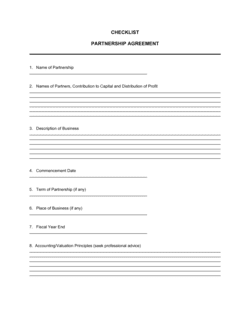
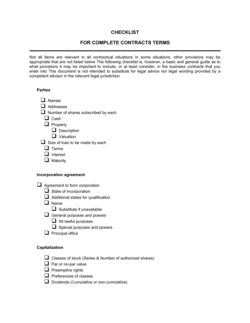
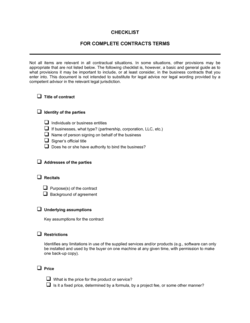
The checklist covers franchise fee and royalty structures, territory rights, training and support obligations, renewal and transfer conditions, termination triggers, and post-term restrictions β€” organized as a line-by-line review form with a status column and notes field for each item.

What is a Checklist Basic Franchise Agreement Terms?

A Checklist Basic Franchise Agreement Terms is a structured review form that walks a prospective franchisee, franchise attorney, or consultant through every material clause of a franchise agreement before it is signed. It organizes key provisions β€” initial fees, royalty structure, territory rights, training obligations, renewal conditions, termination triggers, and post-term restrictions β€” into a line-by-line format with a status column and notes field so each term can be confirmed, questioned, or flagged for negotiation. Rather than reading a 40-page agreement linearly and hoping nothing is missed, users work through a defined sequence of high-stakes items that determine the financial and operational reality of the franchise relationship.

Why You Need This Document

Signing a franchise agreement without a structured review is one of the most expensive due-diligence shortcuts a business buyer can make. A royalty rate that looks modest at 6% can cost significantly more when the definition of gross sales includes catering revenue, delivery fees, and gift card redemptions. A territory that appears exclusive may contain carve-outs for online sales or existing units that effectively undercut it. Renewal options that seem straightforward may require signing a then-current franchise agreement with materially higher fees decades after the original signing. None of these risks appear in the headline numbers β€” they are buried in definitions, exhibits, and cross-references that a checklist surfaces before they become binding obligations. This template gives franchisees, attorneys, and consultants a consistent, repeatable process for confirming that every critical term is present, understood, and acceptable before any money or signature is committed.

Which variant fits your situation?

If your situation is…Use this template
Full pre-signing due diligence on a new franchise opportunityChecklist Basic Franchise Agreement Terms
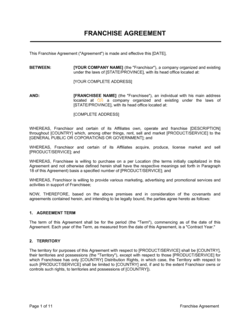
Drafting the underlying franchise agreement from scratchFranchise Agreement
Reviewing disclosure obligations under FTC Franchise RuleFranchise Disclosure Document (FDD) Checklist
Adding a new unit or territory for an existing franchiseeFranchise Amendment Agreement
Transferring a franchise to a new ownerFranchise Transfer Agreement
Evaluating the operations manual obligations referenced in the agreementOperations Manual Outline
Recording a territorial exclusivity grant with supporting mapTerritory Addendum

Common mistakes to avoid

❌ Skipping the FDD and reviewing only the agreement

Why it matters: The FDD contains audited financials, litigation history, franchisee contact lists, and Item 19 earnings claims that materially change how agreement terms should be evaluated.

Fix: Complete the checklist with both the FDD and the draft agreement open. Cross-reference Items 5, 6, 7, 11, and 12 against the corresponding agreement clauses.
❌ Recording royalty rate without defining the gross sales base

Why it matters: A 6% royalty on a broad gross sales definition (including catering, delivery, and online orders) can cost 30% more than the same rate on a narrow in-store-only definition.

Fix: Locate and record the exact definition of 'gross sales' or 'net sales' from the agreement and note any exclusions in the checklist notes field.

❌ Accepting territory descriptions without a map exhibit

Why it matters: Boundaries defined by neighborhood names, street intersections, or county lines without a map are routinely disputed when a second unit opens nearby.

Fix: Request a signed map exhibit before signing. If the franchisor refuses, note the refusal in the checklist and escalate before execution.

❌ Not checking renewal terms against current franchise agreement requirements

Why it matters: If renewal requires signing the then-current franchise agreement, the franchisee may inherit materially higher fees, shorter terms, or new restrictions at renewal β€” decades after the original signing.

Fix: Record this condition explicitly in the renewal row and request a copy of the current standard franchise agreement to compare against the one being signed today.

The 9 key fields, explained

Franchise fee and royalty structure

Territory rights and exclusivity

Term and renewal conditions

Training and support obligations

Operations and system standards compliance

Termination triggers and cure periods

Transfer and assignment rights

Post-term non-compete and non-solicitation

Marketing fund contributions and obligations

How to fill it out

  1. 1

    Obtain the FDD and draft franchise agreement

    Request the current FDD at least 14 days before signing. Locate the draft franchise agreement, which is typically Item 22 of the FDD. Use both documents side-by-side when completing the checklist.

    πŸ’‘ Download the FDD receipt page and record the exact date you received it β€” the 14-day waiting period is a federal requirement under the FTC Franchise Rule.

  2. 2

    Enter the fee and royalty details

    Record the initial franchise fee, ongoing royalty rate, marketing fund contribution, and any technology or software fees in the corresponding checklist fields.

    πŸ’‘ Add all recurring percentage fees together β€” royalty plus marketing fund plus technology fee β€” to calculate the true total percentage of gross sales leaving the business each period.

  3. 3

    Confirm and map the territory

    Identify the territorial boundaries in the agreement and confirm whether exclusivity is granted. Note any carve-outs such as online sales, airports, or existing units. Attach any referenced map as an exhibit.

    πŸ’‘ If no map exhibit exists, request one before signing β€” a written description alone is rarely sufficient to resolve future boundary disputes.

  4. 4

    Record term, renewal, and transfer conditions

    Enter the initial term length, the number and length of renewal options, all conditions required to renew, and the transfer fee and approval process for a future sale.

    πŸ’‘ Check whether renewal requires signing the then-current franchise agreement β€” this is one of the highest-impact terms to understand before committing to a long-term investment.

  5. 5

    Document training, support, and compliance obligations

    List the initial training program details, who bears the cost, and the ongoing support or training the franchisor is contractually required to provide. Note inspection frequency and audit rights.

    πŸ’‘ Compare the training described in Item 11 of the FDD against what is actually written into the agreement β€” the agreement controls if there is a conflict.

  6. 6

    Review termination and post-term restrictions

    Identify every non-curable default trigger and every curable default with its cure period. Record the duration and geographic scope of any post-term non-compete and non-solicitation clauses.

    πŸ’‘ Flag non-curable defaults for discussion with a franchise attorney before signing β€” these are the terms most likely to result in loss of the entire investment without recourse.

Frequently asked questions

What is a franchise agreement terms checklist?

A franchise agreement terms checklist is a structured review form that lists every material clause in a franchise agreement β€” fees, territory, training, renewal, termination, and post-term restrictions β€” and gives the reviewer a place to record the specific terms, confirm they are present, and flag items for follow-up. It is used during due diligence before signing a franchise agreement to ensure nothing is overlooked.

When should I use a franchise agreement checklist?

Use it as soon as you receive a draft franchise agreement or FDD, before entering any negotiations, and again as a final pre-signing audit. The FTC Franchise Rule requires a 14-day waiting period between receiving the FDD and signing β€” that window is the ideal time to complete a thorough checklist review.

Does completing this checklist replace a franchise attorney review?

No. The checklist organizes your review and surfaces questions, but it does not replace legal advice on enforceability, jurisdiction-specific risks, or negotiation strategy. For any franchise investment, a one- to two-hour review with a franchise attorney typically costs $500–$1,500 and is worthwhile given the capital commitment involved.

What is the difference between a franchise agreement and a franchise disclosure document?

The franchise disclosure document (FDD) is a federally mandated disclosure package the franchisor provides before signing β€” it contains 23 items including audited financials, litigation history, fees, and territory information. The franchise agreement is the binding contract that governs the actual relationship. The FDD discloses; the agreement binds. Always review both together.

What franchise terms are most commonly missed during review?

The four most frequently overlooked terms are: the definition of gross sales used to calculate royalties, the requirement to sign a then-current agreement at renewal, non-curable default triggers that allow immediate termination, and post-term non-compete scope. Each of these can have major financial consequences that are not apparent from the headline fee numbers alone.

Can a franchise agreement be negotiated?

Some terms β€” territory boundaries, personal guarantee scope, development schedule milestones, and transfer fees β€” are frequently negotiable, particularly for multi-unit operators or experienced franchisees. Core brand standards, royalty rates, and marketing fund contributions are rarely negotiable. A checklist helps identify which terms are material enough to raise in negotiation.

How long does it take to complete this checklist?

A thorough review of a standard franchise agreement using this checklist takes 2–4 hours for a first-time buyer working from the FDD and draft agreement. Experienced franchise attorneys or consultants familiar with the specific system can complete it in under an hour. Budget extra time for franchise agreements longer than 40 pages or those covering multiple unit formats.

What is an exclusive territory and how does the checklist capture it?

An exclusive territory is a defined geographic area within which the franchisor agrees not to grant another franchisee or operate a competing unit. The checklist records the boundary description, any carve-outs such as online channels or existing units, whether a map exhibit is attached, and any encroachment provisions that define what counts as a competing outlet.

How this compares to alternatives

vs Franchise Agreement

A franchise agreement is the binding contract that governs the franchisee-franchisor relationship. This checklist is a review and due-diligence tool used before signing that agreement. Use the checklist to audit the agreement; use the agreement itself to establish legal obligations.

vs Franchise Disclosure Document Checklist

An FDD checklist reviews the 23 mandatory disclosure items in the franchise disclosure document. This checklist focuses on the franchise agreement's binding legal terms. Both should be used together during due diligence β€” the FDD provides context; the agreement creates obligations.

vs Due Diligence Checklist

A general due diligence checklist covers financial, legal, and operational factors across any business acquisition. This checklist is specific to franchise agreement terms and maps directly to clauses in the contract. Use the franchise-specific version when the acquisition involves a franchise system.

vs Letter of Intent (Franchise)

A letter of intent records preliminary agreed terms before the franchise agreement is drafted. This checklist is used after the draft agreement is received to verify that the LOI terms made it into the final document and that no unfavorable clauses were added.

Industry-specific considerations

Food and Beverage

High-volume franchise systems with complex royalty structures, marketing co-ops, and required supplier purchase programs that must each be captured in the checklist.

Retail

Territory exclusivity is critical in retail franchising given proximity sensitivity; the checklist captures radius restrictions, mall vs. street format distinctions, and e-commerce carve-outs.

Professional Services

Service-based franchises often have performance quotas and client non-solicitation obligations that are easy to miss without a structured review form.

Healthcare and Wellness

Licensing and certification prerequisites are often embedded as conditions of the franchise agreement β€” the checklist surfaces these as non-negotiable pre-opening obligations.

Template vs pro β€” what fits your needs?

PathBest forCostTime
Use the templateProspective franchisees conducting an initial self-review of a standard franchise agreementFree2–4 hours
Template + professional reviewFirst-time franchise buyers or anyone investing more than $50K in franchise fees$500–$1,500 (franchise attorney review)3–5 days
Custom draftedMulti-unit developers, private equity buyers, or franchisors auditing their own agreement portfolio$2,000–$5,000 (franchise counsel engagement)1–2 weeks

Glossary

Franchise Disclosure Document (FDD)
A federally mandated disclosure document a franchisor must provide to prospective franchisees at least 14 calendar days before signing any agreement or accepting money.
Initial Franchise Fee
A one-time upfront payment made to the franchisor in exchange for the right to operate under the franchise system.
Royalty Fee
An ongoing periodic payment β€” typically a percentage of gross sales β€” paid by the franchisee to the franchisor for continued use of the brand and system.
Exclusive Territory
A defined geographic area within which the franchisor agrees not to grant another franchisee or operate a competing unit.
Area Development Agreement
A contract granting a franchisee the right to open multiple units within a territory according to a development schedule.
Transfer Fee
A charge paid to the franchisor when a franchisee sells or assigns its franchise to a third party.
Post-Term Non-Compete
A clause restricting a former franchisee from operating a competing business within a defined area for a set period after the franchise ends.
System Standards
The franchisor's documented operational requirements β€” covering products, services, signage, uniforms, and procedures β€” that franchisees must follow.
Renewal Term
The additional period of franchise operation a franchisee may elect after the initial term expires, typically subject to meeting performance and fee conditions.
Encroachment
The placement by a franchisor of a new unit, alternative channel, or competing outlet that draws customers away from an existing franchisee's territory.

Part of your Business Operating System

This document is one of 3,000+ business & legal templates included in Business in a Box.

  • Fill-in-the-blanks β€” ready in minutes
  • 100% customizable Word document
  • Compatible with all office suites
  • Export to PDF and share electronically

Create your document in 3 simple steps.

From template to signed document β€” all inside one Business Operating System.
1
Download or open template

Access over 3,000+ business and legal templates for any business task, project or initiative.

2
Edit and fill in the blanks with AI

Customize your ready-made business document template and save it in the cloud.

3
Save, Share, Send, Sign

Share your files and folders with your team. Create a space of seamless collaboration.

Save time, save money, and create top-quality documents.

β˜…β˜…β˜…β˜…β˜…

"Fantastic value! I'm not sure how I'd do without it. It's worth its weight in gold and paid back for itself many times."

Managing Director Β· Mall Farm
Robert Whalley
Managing Director, Mall Farm Proprietary Limited
β˜…β˜…β˜…β˜…β˜…

"I have been using Business in a Box for years. It has been the most useful source of templates I have encountered. I recommend it to anyone."

Business Owner Β· 4+ years
Dr Michael John Freestone
Business Owner
β˜…β˜…β˜…β˜…β˜…

"It has been a life saver so many times I have lost count. Business in a Box has saved me so much time and as you know, time is money."

Owner Β· Upstate Web
David G. Moore Jr.
Owner, Upstate Web

Run your business with a system β€” not scattered tools

Stop downloading documents. Start operating with clarity. Business in a Box gives you the Business Operating System used by over 250,000 companies worldwide to structure, run, and grow their business.

Start freeΒ Β·Β No credit card required