1
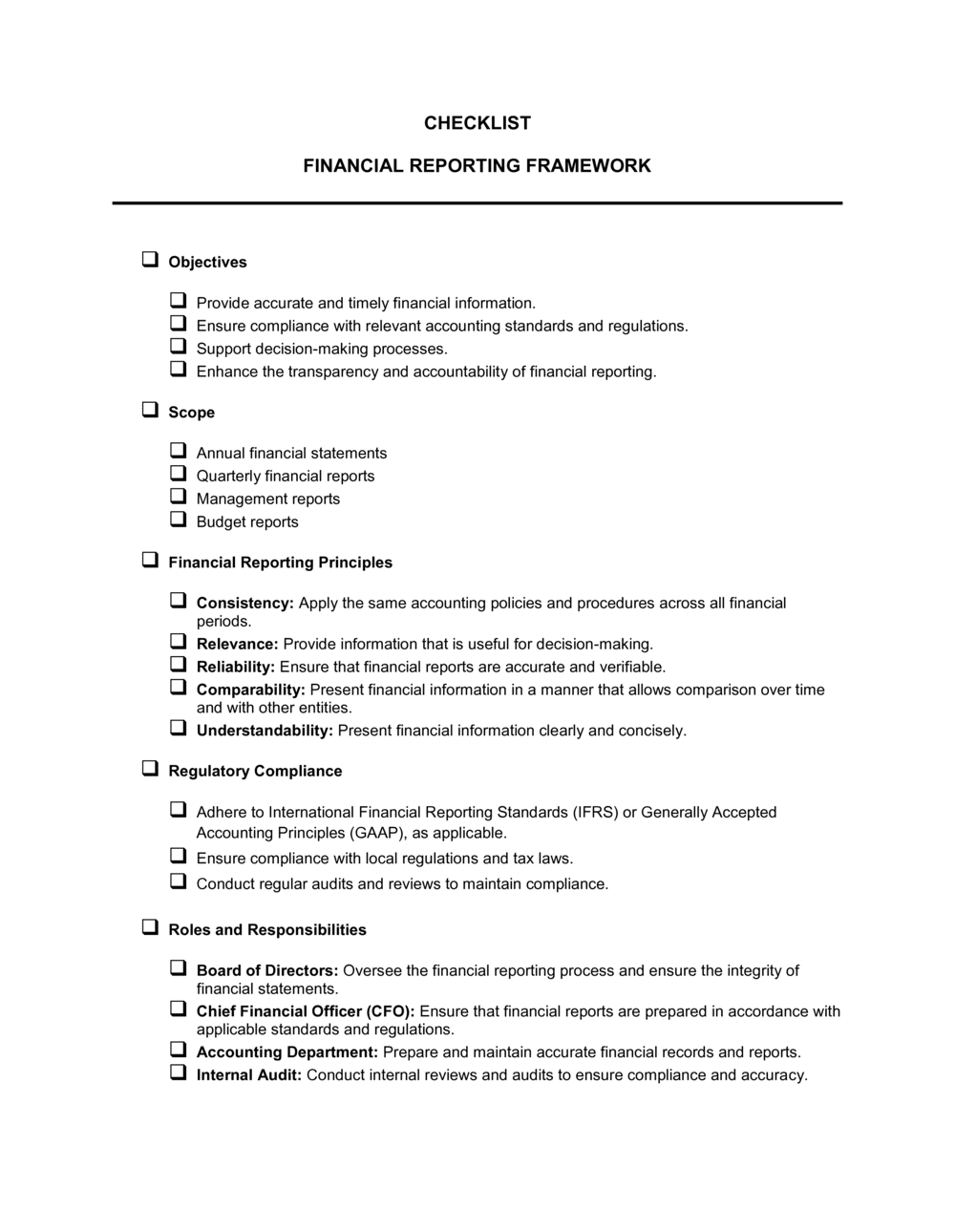
Define the scope, entities, and reporting standard
Enter the legal entity names, the accounting standard in use (GAAP or IFRS), the reporting currency, and whether the framework applies to a monthly, quarterly, or annual close cycle.
💡 If you consolidate multiple entities, note which intercompany eliminations are required — this determines whether an intercompany reconciliation step belongs in the checklist.
2
Map every pre-close task to a named owner and deadline
List each data-gathering task — payroll import, expense report cutoff, accounts payable batch — assign it to a specific person or role, and set a deadline expressed as business days before the close date.
💡 Express deadlines as relative days (Day -5, Day -3) rather than fixed calendar dates so the checklist works for every period without editing.
3
Set journal entry authorization and cut-off rules
Define the dollar threshold above which a second reviewer must approve journal entries, name the approver, and state the hard cut-off date and time for the period.
💡 Post the cut-off time in your accounting system as a locked period so entries cannot be posted accidentally after the deadline.
4
List every account requiring reconciliation
Add a row for each account that must be reconciled — cash, AR, AP, fixed assets, prepaids, accrued liabilities, intercompany — and identify the reconciling source document for each.
💡 Sort accounts by dollar balance descending so the highest-risk reconciliations appear at the top and receive attention first.
5
Define the materiality threshold for flux review
Set the dollar amount or percentage change that triggers a required written explanation in the flux analysis section. Apply it consistently across all accounts each period.
💡 A threshold of the greater of $[X] or 5% of the account balance is common for small and mid-size businesses — adjust based on total revenue or asset size.
6
Complete the disclosure and notes checklist
Work through each disclosure item — policy changes, contingencies, related-party transactions, subsequent events — and confirm each is identified, drafted, and reviewed before statements are finalized.
💡 Review the prior-period notes as a starting point; any item carried forward must be updated for current-period facts, not copied verbatim.
7
Execute the sign-off sequence in order
Have each approver sign and date the checklist in sequence — preparer, reviewer, controller, CFO — before statements are distributed or filed.
💡 Lock the period in your accounting system as the final step in the sign-off sequence, not before — locking early prevents late adjustments that auditors will otherwise request through a separate post-period entry.
8
File, distribute, and log the completed checklist
Send finalized statements to the distribution list by the stated deadline, file the completed checklist and supporting workpapers in the designated location, and log the close date for performance tracking.
💡 Track close completion dates over time — if your average close takes 8 business days and the target is 5, the gap identifies which checklist steps are the bottleneck.