Internal Control Framework Template

Free Word download β€’ Edit online β€’ Save & share with Drive β€’ Export to PDF

10 pagesβ€’25–30 min to fillβ€’Difficulty: Complex
Learn more ↓
FreeInternal Control Framework Template

At a glance

What it is
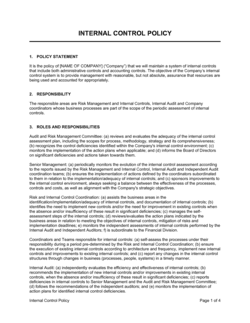
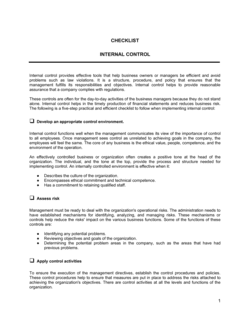
An Internal Control Framework is a structured policy document that defines how an organization identifies financial and operational risks, assigns control responsibilities, and monitors compliance with its own procedures. This free Word download gives you a ready-to-edit template organized around the five components of the COSO model β€” control environment, risk assessment, control activities, information and communication, and monitoring β€” that you can customize for your business and export as PDF for board or auditor review.
When you need it
Use it when preparing for an external audit, establishing formal governance procedures for the first time, responding to a compliance gap identified by an auditor, or scaling operations to the point where informal controls are no longer sufficient to prevent errors and fraud.
What's inside
A scope and objective statement, control environment principles, risk assessment methodology, documented control activities by process area, information and communication protocols, monitoring procedures, roles and responsibilities matrix, and a deficiency escalation process.

What is an Internal Control Framework?

An Internal Control Framework is a structured policy document that defines how an organization identifies its financial and operational risks, assigns specific control responsibilities to named owners, and monitors whether those controls are operating effectively over time. Most frameworks are built around the five components of the COSO Integrated Framework β€” control environment, risk assessment, control activities, information and communication, and monitoring β€” which is the model external auditors and regulators expect to see referenced. The document translates abstract governance commitments into concrete, testable controls assigned to specific roles with defined frequencies and evidence requirements.

Why You Need This Document

Without a documented internal control framework, your organization cannot demonstrate to auditors, lenders, or investors that financial data is reliable and that errors or fraud would be caught before they become material. External auditors who find no formal control documentation must reconstruct controls from scratch β€” a process that lengthens the audit, increases fees, and almost always produces findings that a documented framework would have prevented. For companies preparing for equity investment, bank financing, or regulated industry certification, the absence of documented controls is frequently the single issue that stalls or kills the process. This template gives you a COSO-aligned starting point that establishes the right structure from day one β€” one that scales with your business as headcount, systems, and regulatory exposure grow.

Which variant fits your situation?

If your situation is…Use this template
Publicly traded company needing SOX-compliant internal controls over financial reportingSOX Compliance Framework
Small or mid-size business establishing basic financial controls for the first timeInternal Control Framework
Organization seeking ISO 9001 or ISO 27001 certificationQuality Management System Policy
Finance team documenting segregation of duties for payroll and AP processesSegregation of Duties Matrix
Company responding to an audit finding with a formal remediation planCorrective Action Plan
Board or audit committee requesting a risk and controls summaryRisk Management Plan
IT department documenting access controls and system change proceduresIT General Controls Policy

Common mistakes to avoid

❌ Copying a big-company framework without scaling it down

Why it matters: A 200-control Fortune 500 framework applied to a 30-person company creates compliance theater β€” controls that exist on paper but cannot be resourced or tested, which is worse than no documented framework.

Fix: Start with the 15–20 controls that address your highest-risk processes. Expand the inventory as headcount and system complexity grow.

❌ Writing vague control descriptions that cannot be tested

Why it matters: A control described as 'management reviews financial reports' cannot be tested by an auditor because there is no specified reviewer, frequency, scope, or evidence requirement.

Fix: Every control description must answer: who, what, when, and what evidence proves it happened. If any of the four are missing, rewrite the control.

❌ Building a segregation matrix without compensating controls for small teams

Why it matters: Most small businesses cannot fully segregate all incompatible duties β€” acknowledging the gap without a compensating control leaves the risk unmitigated and the auditor unsatisfied.

Fix: For each unavoidable conflict, document a specific compensating control β€” typically an owner or senior manager review of all transactions processed by the conflicted individual.

❌ Treating the framework as a one-time document rather than a living policy

Why it matters: A framework last updated three years ago does not reflect new systems, acquired businesses, or changed regulations β€” auditors will identify the gap and may question the entire control environment.

Fix: Schedule an annual review with a named owner and a calendar reminder. Trigger an off-cycle update any time a new system, business unit, or regulation materially changes the risk landscape.

❌ Omitting IT general controls from the framework

Why it matters: Financial data integrity depends on the systems that produce it β€” access controls, change management, and backup procedures are prerequisites for the accuracy of every financial control.

Fix: Include a dedicated IT General Controls section covering user access provisioning and deprovisioning, system change approvals, and data backup and recovery procedures.

❌ No formal deficiency escalation path

Why it matters: Without a defined escalation process, control failures are handled inconsistently β€” some are fixed quietly, others are never reported to leadership, and material weaknesses can go undetected until an external audit.

Fix: Define a three-tier classification and a named escalation contact for each tier. Set maximum response timelines (e.g., material weaknesses reported to the Audit Committee within 5 business days).

The 10 key sections, explained

Scope and objectives

Control environment

Risk assessment methodology

Control activities by process area

Segregation of duties matrix

Information and communication

Monitoring activities

Deficiency identification and escalation

Roles and responsibilities

Document control and review schedule

How to fill it out

  1. 1

    Define the scope and select a control framework

    Decide which business units and processes the document will cover and choose an authoritative framework (COSO for most businesses, COBIT for IT-focused organizations) to reference. Write the scope statement before touching any other section.

    πŸ’‘ Narrower is better on first implementation β€” a focused 15-control framework that is fully tested beats a 60-control inventory maintained on paper only.

  2. 2

    Document the control environment

    List the actual governance policies and structures in place β€” board composition, audit committee charter, code of conduct, and ethics certification process. Link or attach the referenced documents rather than summarizing them.

    πŸ’‘ If a referenced policy does not yet exist, flag it as a gap and add it to the remediation plan before sharing the framework with auditors.

  3. 3

    Conduct the risk assessment

    For each in-scope process, identify the events that could prevent accurate, complete financial reporting or operational effectiveness. Score each risk on a likelihood-impact matrix and set a residual risk target.

    πŸ’‘ Include both internal risks (process errors, staff turnover) and external risks (vendor failure, regulatory change) β€” auditors expect both dimensions.

  4. 4

    Document control activities for each process

    Write a specific control description for each risk: what the control does, who performs it, how often, what evidence it produces, and where that evidence is stored. Use the AP-01 naming convention to make controls traceable.

    πŸ’‘ Test each control description by asking: could a new employee perform this control with no additional explanation? If not, add detail.

  5. 5

    Build the segregation of duties matrix

    Map all finance and operations roles against the functions they perform, then identify any single person who handles both sides of a transaction. Document compensating controls for any unavoidable conflicts in small teams.

    πŸ’‘ For organizations with fewer than five finance staff, compensating controls such as monthly management review of transactions processed by a single individual are generally acceptable to auditors.

  6. 6

    Set up the monitoring schedule

    Assign a specific owner, frequency, and evidence requirement to each monitoring activity. Calendar quarterly self-assessments and the annual internal audit cycle before finalizing the document.

    πŸ’‘ Build monitoring deadlines into the same calendar system your finance team already uses for close and reporting β€” standalone schedules are routinely missed.

  7. 7

    Define the deficiency escalation process

    Write out the three-tier classification (deficiency, significant deficiency, material weakness), the escalation path for each tier, and the required remediation timeline. Name the Audit Committee contact explicitly.

    πŸ’‘ Include a one-page escalation flowchart in the appendix β€” visual aids help control owners make the right call quickly under time pressure.

  8. 8

    Obtain management sign-off and communicate to control owners

    Have the CFO or CEO approve the final document, assign version number 1.0, and distribute it with a brief training session or written briefing for every named control owner.

    πŸ’‘ Send a confirmation email to each control owner asking them to acknowledge receipt and confirm they understand their responsibilities β€” retain those responses for the audit file.

Frequently asked questions

What is an internal control framework?

An internal control framework is a structured policy document that defines how an organization identifies financial and operational risks, assigns control responsibilities, and monitors compliance with its own procedures. Most frameworks are organized around the five components of the COSO model β€” control environment, risk assessment, control activities, information and communication, and monitoring. The document gives auditors, investors, and regulators a clear picture of how the organization prevents errors and fraud.

Who needs an internal control framework?

Any organization that handles significant financial transactions, employs multiple people with access to financial systems, or is subject to external audit should have a documented internal control framework. It is essential for publicly traded companies (required under SOX), but private companies preparing for investor due diligence, bank financing, or regulatory inspection benefit equally from having one in place.

What is the COSO framework and should I follow it?

COSO (Committee of Sponsoring Organizations of the Treadway Commission) is the most widely recognized internal control model globally. Its 2013 Integrated Framework organizes controls across five components and 17 principles. For most businesses, using COSO as the reference model ensures your framework aligns with what external auditors expect to see. Highly IT-dependent organizations may also reference COBIT for technology controls.

What is the difference between an internal control framework and an internal audit?

An internal control framework is the policy document that defines which controls exist and who is responsible for them. An internal audit is the independent testing process that evaluates whether those controls are actually operating as designed. The framework comes first β€” you cannot meaningfully audit controls that have not been documented and assigned.

How many controls should a small business document?

For a business with 10–50 employees, 15–25 controls covering the highest-risk processes β€” typically accounts payable, accounts receivable, payroll, cash management, and IT access β€” is a realistic and defensible starting point. A smaller set of controls that are fully tested and consistently operated provides more assurance than a large inventory that exists only on paper.

How often should an internal control framework be updated?

At a minimum, conduct a full annual review aligned to your fiscal year end or external audit cycle. Trigger an off-cycle update any time you implement a new accounting or ERP system, acquire another business, enter a new market, hire significantly, or face a new regulatory requirement. A framework that does not reflect the current business is effectively useless in an audit.

What is a material weakness and how does it differ from a control deficiency?

A control deficiency is any gap in the design or operation of a control that reduces its effectiveness. A material weakness is a deficiency β€” or combination of deficiencies β€” that creates a reasonable possibility that a material misstatement of the financial statements will not be prevented or detected in time. Material weaknesses require immediate escalation to leadership and a formal written remediation plan.

Can a small business use this template without a dedicated compliance team?

Yes. This template is designed to work for organizations without a dedicated internal audit or compliance function. The CFO or finance manager typically owns the framework, with individual process owners responsible for operating and evidencing specific controls. For organizations without an internal audit function, annual testing by an external accountant or consultant is a cost-effective alternative.

Does an internal control framework replace an audit?

No. A documented framework is the starting point that makes an audit possible and efficient. External auditors use the framework to identify which controls to test, assess design adequacy, and identify gaps. An organization with no documented framework forces auditors to reconstruct controls from scratch β€” significantly increasing audit time, cost, and the likelihood of findings.

How this compares to alternatives

vs Risk Management Plan

A risk management plan identifies and prioritizes risks at a strategic level and defines the organization's overall response strategy. An internal control framework translates those risks into specific, assigned control activities at the process level. You typically need both β€” the risk plan to identify what matters most, and the control framework to document how each risk is mitigated day-to-day.

vs Standard Operating Procedure (SOP)

An SOP documents the step-by-step process for completing a specific task. An internal control framework sits above individual SOPs β€” it defines which risks exist in a process and specifies the control points within it. SOPs are how the work is done; the control framework defines the checkpoints that ensure the work is done correctly and completely.

vs Audit Report

An audit report is the output of a testing process β€” it records findings, deficiencies, and recommendations based on evidence gathered. An internal control framework is the input β€” the document that defines what controls exist so they can be tested. The framework precedes the audit; the report evaluates whether the framework is operating as designed.

vs Compliance Checklist

A compliance checklist is a point-in-time tool for verifying that specific requirements have been met β€” useful for periodic reviews but not a substitute for a living control framework. An internal control framework assigns ongoing ownership, monitoring frequency, and escalation paths that a checklist does not capture. Use checklists as one monitoring tool within a broader framework.

Industry-specific considerations

Financial services

Regulatory capital requirements, AML transaction monitoring controls, and segregation of duties between trading, settlement, and reconciliation functions.

Healthcare

HIPAA access controls over patient data, billing compliance controls to prevent upcoding, and pharmacy inventory reconciliation procedures.

Manufacturing

Inventory cycle count controls, purchase order authorization thresholds, and physical access controls over warehouse and production assets.

SaaS / Technology

IT general controls over cloud infrastructure, user access provisioning and deprovisioning workflows, and software change management approval gates.

Retail and e-commerce

Cash handling reconciliation at point of sale, vendor payment authorization limits, and inventory shrinkage monitoring controls.

Professional services

Time and billing accuracy controls, expense reimbursement approval workflows, and client trust account segregation requirements.

Template vs pro β€” what fits your needs?

PathBest forCostTime
Use the templatePrivate companies under 100 employees establishing formal controls for the first time or preparing for a bank loanFree1–2 weeks (10–20 hours)
Template + professional reviewCompanies preparing for a first external audit, investor due diligence, or a regulated industry certification$500–$2,500 for an external accountant or risk consultant review2–4 weeks
Custom draftedSOX-regulated public companies, highly regulated industries (banking, insurance, healthcare), or post-acquisition control integration$5,000–$25,000+ for a Big 4 or specialized advisory engagement6–16 weeks

Glossary

COSO Framework
A widely adopted model from the Committee of Sponsoring Organizations that defines internal control across five components: control environment, risk assessment, control activities, information and communication, and monitoring.
Control Environment
The organizational culture, tone at the top, and governance structures that set the foundation for all other internal controls.
Risk Assessment
The process of identifying events that could prevent an organization from achieving its objectives and evaluating their likelihood and potential impact.
Control Activity
A specific policy or procedure designed to prevent or detect a particular risk β€” such as an approval threshold, reconciliation, or system access restriction.
Segregation of Duties
Dividing a transaction process across two or more people so that no single individual can both execute and authorize the same transaction, reducing fraud risk.
Deficiency
A gap in the design or operation of a control that reduces the likelihood of preventing or detecting a material misstatement or operational error.
Material Weakness
A significant control deficiency β€” or combination of deficiencies β€” that creates a reasonable possibility that a material misstatement will not be prevented or detected in time.
IT General Controls (ITGCs)
Controls over the IT environment that affect the reliability of data produced by financial systems β€” including access management, change management, and backup and recovery.
Monitoring Activities
Ongoing and periodic evaluations that assess whether internal controls are present and operating effectively over time.
Tone at the Top
The ethical culture, commitment to integrity, and control consciousness demonstrated by senior leadership that influences how employees throughout the organization behave.
Inherent Risk
The level of risk in a process or account before any controls are applied.
Residual Risk
The risk remaining after controls have been applied β€” the target is for residual risk to fall within the organization's defined risk tolerance.

Part of your Business Operating System

This document is one of 3,000+ business & legal templates included in Business in a Box.

  • Fill-in-the-blanks β€” ready in minutes
  • 100% customizable Word document
  • Compatible with all office suites
  • Export to PDF and share electronically

Create your document in 3 simple steps.

From template to signed document β€” all inside one Business Operating System.
1
Download or open template

Access over 3,000+ business and legal templates for any business task, project or initiative.

2
Edit and fill in the blanks with AI

Customize your ready-made business document template and save it in the cloud.

3
Save, Share, Send, Sign

Share your files and folders with your team. Create a space of seamless collaboration.

Save time, save money, and create top-quality documents.

β˜…β˜…β˜…β˜…β˜…

"Fantastic value! I'm not sure how I'd do without it. It's worth its weight in gold and paid back for itself many times."

Managing Director Β· Mall Farm
Robert Whalley
Managing Director, Mall Farm Proprietary Limited
β˜…β˜…β˜…β˜…β˜…

"I have been using Business in a Box for years. It has been the most useful source of templates I have encountered. I recommend it to anyone."

Business Owner Β· 4+ years
Dr Michael John Freestone
Business Owner
β˜…β˜…β˜…β˜…β˜…

"It has been a life saver so many times I have lost count. Business in a Box has saved me so much time and as you know, time is money."

Owner Β· Upstate Web
David G. Moore Jr.
Owner, Upstate Web

Run your business with a system β€” not scattered tools

Stop downloading documents. Start operating with clarity. Business in a Box gives you the Business Operating System used by over 250,000 companies worldwide to structure, run, and grow their business.

Start freeΒ Β·Β No credit card required