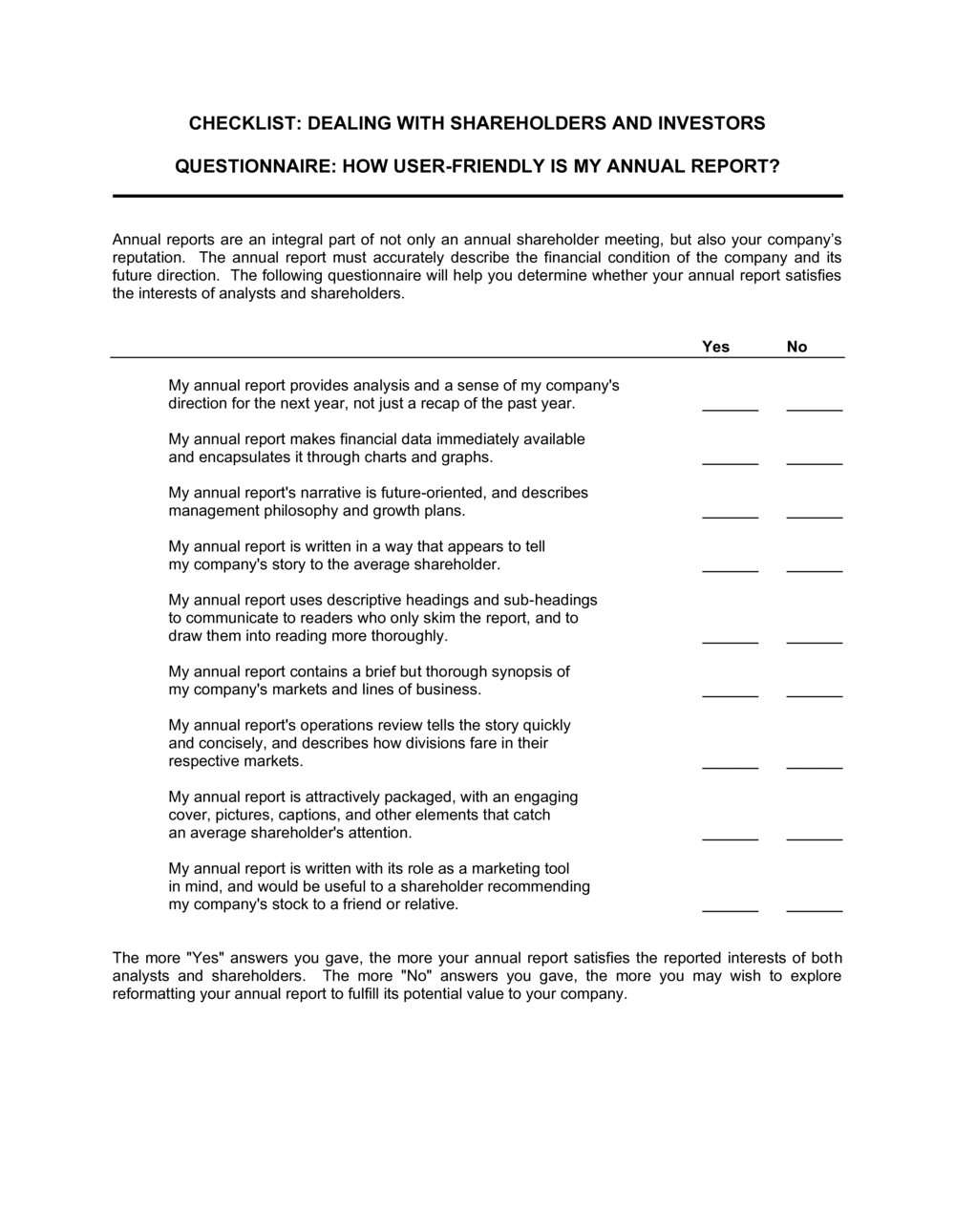
Checklist Dealing with Shareholders and Investors

Free download β€’ Use as a template β€’ Print or share

1 pageβ€’20–25 min to useβ€’Difficulty: Standard
Learn more ↓
FreeChecklist Dealing with Shareholders and Investors Template

At a glance

What it is
A Checklist Dealing With Shareholders And Investors is a structured reference document that organizes every recurring obligation, disclosure, and communication task a company must complete when managing its shareholder and investor relationships. This free Word download gives you an editable, printable checklist you can tailor to your company's reporting calendar and investor base.
When you need it
Use it before an annual general meeting, ahead of a new funding round, or whenever you need to confirm that all statutory disclosures and investor communications are current and accounted for.
What's inside
The checklist covers shareholder register maintenance, financial reporting deadlines, meeting notice requirements, dividend and distribution records, investor update schedules, and compliance sign-off items β€” all organized into clearly labeled rows you can check off as tasks are completed.

What is a Checklist Dealing With Shareholders And Investors?

A Checklist Dealing With Shareholders And Investors is a structured operational form that organizes every recurring obligation a company must meet toward its shareholders and investors β€” covering shareholder register maintenance, financial reporting deadlines, meeting notice requirements, dividend resolutions, investor update schedules, compliance filings, and open action-item tracking. It gives the responsible person β€” typically a founder, CFO, or corporate secretary β€” a single, auditable reference that confirms each obligation has been completed, by whom, and on time. Unlike a legal agreement that creates obligations, this checklist is the tool that proves those obligations were honored.

Why You Need This Document

Investor and shareholder obligations repeat every quarter, every annual meeting, and every funding round β€” and a missed filing, late financial statement, or unanswered investor commitment erodes trust faster than any poor performance metric. Without a structured checklist, obligations tracked informally across email threads and calendar reminders fall through the cracks: notice is sent too late, audited accounts are distributed after the contractual deadline, or a shareholder's open information request goes unanswered for weeks. During due diligence for a new round or acquisition, investors and lawyers ask for evidence that these obligations were met β€” a complete archive of signed-off checklists answers that question in minutes rather than days. This template gives you a consistent, repeatable process that scales from a two-shareholder startup to a pre-Series B company managing a complex investor base.

Which variant fits your situation?

If your situation is…Use this template
Preparing for an annual general meeting with registered shareholdersAGM Checklist
Onboarding a new institutional investor after a funding closeInvestor Onboarding Checklist
Tracking ongoing board meeting preparation tasksBoard Meeting Checklist
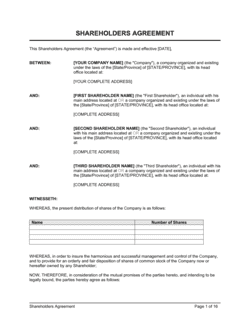
Managing a shareholder register and equity cap tableShareholders Agreement
Documenting investor rights and information obligationsInvestor Rights Agreement
Preparing quarterly or annual financial updates for investorsInvestor Update Template
Tracking due diligence items during a new funding roundDue Diligence Checklist

Common mistakes to avoid

❌ No named owner for each checklist item

Why it matters: Shared responsibility means no responsibility β€” tasks without an owner consistently slip past deadlines, and by the time the gap is discovered, a statutory filing may already be late.

Fix: Assign a specific name or role to every section before the review period begins, and confirm ownership has not changed since the last cycle.

❌ Skipping investor updates during poor-performance periods

Why it matters: Silence signals a loss of control. Investors who do not hear from a company during a difficult quarter typically assume the worst and begin preparing for the worst-case outcome.

Fix: Send a candid update with context, root-cause analysis, and a specific corrective plan β€” investors fund teams that communicate problems clearly, not teams that hide them.

❌ Treating the checklist as a one-time document

Why it matters: Investor obligations recur every quarter, every annual meeting, and every funding round. A checklist used once and discarded provides no historical record and saves no time on the next cycle.

Fix: Archive each completed checklist by period and use the prior version as the starting point for the next cycle, updating owners and deadlines rather than rebuilding from scratch.

❌ Distributing financial statements without checking investor-rights entitlements

Why it matters: Sending management accounts when an investor is contractually entitled to audited statements is a breach of the investor rights agreement β€” even if it is an honest oversight.

Fix: Review the investor rights agreement at the start of each reporting cycle and annotate the checklist with the exact document type and deadline owed to each investor class.

The 10 key fields, explained

Company and meeting details

Shareholder register review

Meeting notice and agenda distribution

Financial reporting package

Investor update communications

Dividend and distribution record

Compliance and filing obligations

Outstanding investor action items

Quorum and voting record

Sign-off and archiving

How to fill it out

  1. 1

    Enter company and period details at the top

    Fill in the company legal name, the date of the review, and the specific event or reporting period this checklist covers. Assign a named individual as the responsible owner for each section.

    πŸ’‘ Create a separate completed checklist for each period or event rather than overwriting a prior one β€” the archive becomes your paper trail.

  2. 2

    Verify and update the shareholder register

    Cross-reference the register against all share transfers, new issuances, and option exercises since the last review. Confirm contact details are current for every listed shareholder.

    πŸ’‘ Match the register against your cap table at the same time β€” catching discrepancies now is far cheaper than resolving them during a funding round.

  3. 3

    Confirm notice and agenda requirements

    Check your company's constitution and applicable corporate law for the minimum notice period. Record the date notice was sent, the method, and confirm every required enclosure (agenda, proxy form, accounts) was included.

    πŸ’‘ Store the sent-notice email or postal confirmation alongside the completed checklist row β€” it is your evidence of compliance if a shareholder later disputes receipt.

  4. 4

    Prepare and distribute financial reports

    Confirm whether the period requires audited accounts, management accounts, or both under your investor agreements. Record the preparation date, who reviewed them, and the distribution date.

    πŸ’‘ Review your investor rights agreement before each period to confirm exactly which financial statements are owed and within how many days of period close.

  5. 5

    Draft and send the investor update

    Write the investor update covering financial performance, key metrics, strategic highlights, and any material risks or changes. Have the CEO or CFO review before sending.

    πŸ’‘ A consistent format from update to update makes year-over-year comparisons easy for investors and signals operational discipline.

  6. 6

    Log open investor action items

    Review notes from the last board or investor meeting and list every open commitment with an owner and due date. Mark items completed and add any new commitments arising from this period's communications.

    πŸ’‘ Review this log at the start of every investor call β€” clearing open items before they are raised by investors builds credibility faster than any financial metric.

  7. 7

    Complete the sign-off row and archive

    Have the responsible party confirm all items are resolved or formally escalated, record the sign-off date, and save the completed checklist to the designated secure folder.

    πŸ’‘ Name the archived file with the company name, period, and date (e.g., AcmeCo_InvestorChecklist_Q2-2026) so any team member can locate it instantly during diligence.

Frequently asked questions

What is a shareholder and investor checklist?

A shareholder and investor checklist is a structured form that lists every recurring obligation a company must fulfill toward its shareholders and investors β€” notice periods, financial disclosures, meeting preparation, compliance filings, and communication schedules. It ensures nothing is missed across reporting cycles and creates an auditable record of completed obligations.

Who should complete this checklist?

Typically the corporate secretary, CFO, or a founder wearing the investor-relations hat. For smaller companies without dedicated IR staff, assigning ownership to a single named person β€” even if they delegate individual tasks β€” prevents items from falling through the cracks. For larger companies, each section may have a different owner who signs off independently.

How often should this checklist be used?

At minimum, once per quarter and before every shareholder meeting or AGM. Companies with monthly investor update obligations should run a lighter version monthly and the full version quarterly. Any trigger event β€” new funding close, director change, or dividend declaration β€” also warrants a checklist review to confirm all related filings and communications are completed on time.

Does this checklist replace a shareholders agreement?

No. A shareholders agreement is a legally binding contract that defines shareholder rights, transfer restrictions, drag-along and tag-along provisions, and governance rules. This checklist is an operational tool for tracking compliance with the obligations created by that agreement and by corporate law. Both documents serve different purposes and are used together.

What investor obligations are most commonly missed?

The four most frequently missed items are: periodic investor updates (skipped during difficult quarters), timely distribution of audited accounts (delayed past the contractually required deadline), shareholder notice periods for meetings (sent too late or to stale contact details), and open action-item follow-through from prior investor meetings. This checklist addresses all four explicitly.

Is this checklist suitable for a company with only a few shareholders?

Yes β€” in fact, small shareholder bases benefit most from a checklist because there is rarely a dedicated IR team to catch missed obligations informally. Even a two-shareholder company has notice, reporting, and resolution-documentation requirements. The checklist scales down easily: leave irrelevant rows blank rather than deleting them, so the structure remains consistent across cycles.

Can I customize this checklist for my specific investor agreements?

Yes, and you should. Every company's investor rights agreement specifies different reporting deadlines, financial statement types, and notice requirements. Download the Word template, annotate each row with the specific obligation from your agreement, and add any bespoke items your investors have requested. The template provides the structure; your agreements determine the content.

What should I do with completed checklists?

Archive every completed checklist in a secure, named folder β€” organized by company name, event type, and date. During due diligence for a new funding round or acquisition, investors and lawyers routinely request evidence that shareholder obligations were met. A complete archive of signed-off checklists is faster and more credible than reconstructing records from email threads.

How this compares to alternatives

vs Shareholders Agreement

A shareholders agreement is a legally binding contract that creates the obligations β€” voting rights, transfer restrictions, information rights, and governance rules. This checklist is the operational tool used to track compliance with those obligations. The agreement tells you what you owe; the checklist confirms you have delivered it.

vs Board Meeting Agenda

A board meeting agenda structures the discussion for a single meeting. This checklist covers a broader recurring cycle of investor and shareholder obligations β€” many of which occur outside board meetings entirely, such as periodic investor updates and statutory filings. The two documents complement each other rather than overlap.

vs Due Diligence Checklist

A due diligence checklist is used once β€” during a transaction β€” to verify a company's legal, financial, and operational records. This shareholder and investor checklist is used repeatedly to keep those records current. A well-maintained shareholder checklist archive makes due diligence substantially faster and less painful.

vs Investor Update Template

An investor update template structures the content of a single periodic communication to investors. This checklist tracks whether that update β€” and every other investor obligation β€” was completed on time and by whom. The update is one item on the checklist, not a substitute for it.

Industry-specific considerations

Technology / SaaS

Monthly investor updates are standard post-seed; the checklist tracks MRR, churn, and runway disclosures alongside standard corporate reporting obligations.

Professional Services

Partnership structures with equity-holding partners require regular capital account statements and profit-distribution resolutions tracked alongside standard shareholder items.

Manufacturing

Capital-intensive businesses with asset-backed lending often have additional lender-reporting covenants that run in parallel with shareholder obligations and must be coordinated in the same review cycle.

Retail / E-commerce

Multi-location retail groups with silent investors use the checklist to synchronize quarterly performance reporting with dividend and distribution decisions.

Template vs pro β€” what fits your needs?

PathBest forCostTime
Use the templateFounders, corporate secretaries, and small business owners managing investor relations without a dedicated IR teamFree15–30 minutes per review cycle
Template + professional reviewCompanies with complex investor rights agreements or multiple share classes requiring custom obligation mapping$200–$600 (corporate lawyer or governance consultant check)2–4 hours
Custom draftedPublic companies, pre-IPO businesses, or companies with institutional investors requiring bespoke compliance tracking$1,000–$3,000+ (governance advisor or corporate counsel)1–2 weeks

Glossary

Shareholder Register
The official record of all current shareholders, their contact details, share class, and number of shares held.
Annual General Meeting (AGM)
A mandatory yearly meeting at which shareholders receive financial reports, vote on resolutions, and elect or ratify directors.
Investor Update
A periodic communication β€” typically monthly or quarterly β€” summarizing financial performance, key metrics, and strategic progress for investors.
Disclosure Obligation
A legal or contractual requirement to share specific financial or operational information with shareholders or regulators within a defined timeframe.
Cap Table
A spreadsheet listing all equity holders, their share class, ownership percentage, and the effect of any dilution from new issuances or conversions.
Dividend Resolution
A formal board decision approving the payment of a dividend, specifying the amount per share, record date, and payment date.
Information Rights
Contractual entitlements β€” typically granted to lead investors β€” to receive financial statements, budgets, and board materials on a defined schedule.
Proxy
Written authorization allowing one person to vote on behalf of a shareholder at a general meeting.
Quorum
The minimum number or percentage of shareholders who must be present or represented at a meeting for its resolutions to be valid.
Notice Period
The minimum number of days before a shareholder meeting that written notice must be sent to all eligible shareholders, as required by law or the company's constitution.

Part of your Business Operating System

This document is one of 3,000+ business & legal templates included in Business in a Box.

  • Fill-in-the-blanks β€” ready in minutes
  • 100% customizable Word document
  • Compatible with all office suites
  • Export to PDF and share electronically

Create your document in 3 simple steps.

From template to signed document β€” all inside one Business Operating System.
1
Download or open template

Access over 3,000+ business and legal templates for any business task, project or initiative.

2
Edit and fill in the blanks with AI

Customize your ready-made business document template and save it in the cloud.

3
Save, Share, Send, Sign

Share your files and folders with your team. Create a space of seamless collaboration.

Save time, save money, and create top-quality documents.

β˜…β˜…β˜…β˜…β˜…

"Fantastic value! I'm not sure how I'd do without it. It's worth its weight in gold and paid back for itself many times."

Managing Director Β· Mall Farm
Robert Whalley
Managing Director, Mall Farm Proprietary Limited
β˜…β˜…β˜…β˜…β˜…

"I have been using Business in a Box for years. It has been the most useful source of templates I have encountered. I recommend it to anyone."

Business Owner Β· 4+ years
Dr Michael John Freestone
Business Owner
β˜…β˜…β˜…β˜…β˜…

"It has been a life saver so many times I have lost count. Business in a Box has saved me so much time and as you know, time is money."

Owner Β· Upstate Web
David G. Moore Jr.
Owner, Upstate Web

Run your business with a system β€” not scattered tools

Stop downloading documents. Start operating with clarity. Business in a Box gives you the Business Operating System used by over 250,000 companies worldwide to structure, run, and grow their business.

Free Forever PlanΒ Β·Β No credit card required