Shareholders Resolution Approving Voluntary Dissolution of the Company Template

Free Word download • Edit online • Save & share with Drive • Export to PDF

2 pages20–30 min to fillDifficulty: StandardSignature requiredLegal review recommended
Learn more ↓
FreeShareholders Resolution Approving Voluntary Dissolution of the Company Template

At a glance

What it is
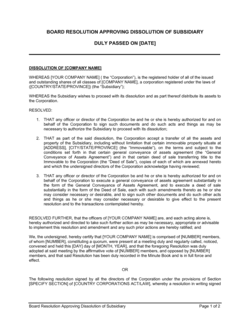
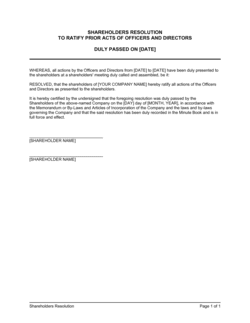
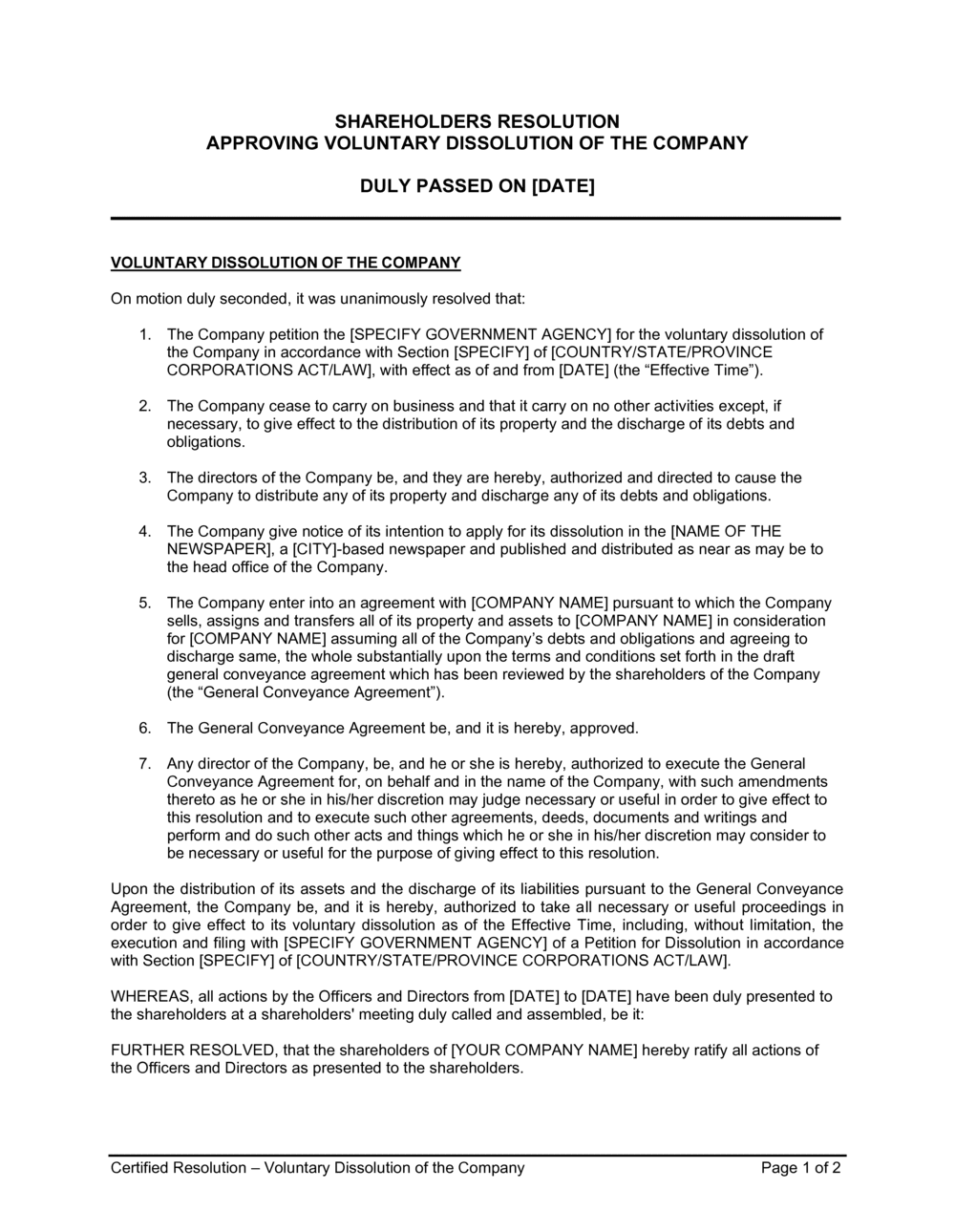
A Shareholders Resolution Approving Voluntary Dissolution of the Company is a formal corporate document in which the shareholders of a company vote to authorize and approve the winding up and dissolution of the business. This free Word download gives you a legally structured starting point you can edit online and export as PDF — covering the meeting record, voting outcome, appointment of a liquidator, and authority to complete all dissolution formalities.
When you need it
Use it when the shareholders of a corporation have agreed to close the business voluntarily — whether due to the completion of the company's purpose, retirement of founders, strategic wind-down, or inability to continue profitably. It is required before the directors and officers can take any formal winding-up steps recognized by regulators and creditors.
What's inside
The resolution records the meeting details, shareholder attendance and quorum, the specific resolution text approving dissolution, the vote count and threshold confirmation, appointment of a liquidator or winding-up agent, and authorization for officers to file dissolution documents with the relevant government authority.

What is a Shareholders Resolution Approving Voluntary Dissolution of the Company?

A Shareholders Resolution Approving Voluntary Dissolution of the Company is a formal binding corporate document in which a company's shareholders meet, vote, and formally authorize the voluntary winding up and legal termination of the corporation's existence. It records the meeting details, confirms that the required quorum and vote threshold were met, appoints a liquidator to settle liabilities and distribute remaining assets, and grants officers the authority to file Articles of Dissolution with the applicable government registry. Without this resolution, directors and officers have no recognized legal mandate to begin the winding-up process — and any dissolution steps taken without it are procedurally invalid in most jurisdictions.

Why You Need This Document

Attempting to wind down a company without a properly executed shareholders resolution creates serious legal and financial exposure. Government registries in every major jurisdiction require evidence of shareholder authority before they will accept a dissolution filing — a missing or defective resolution is the single most common reason Articles of Dissolution are rejected. Beyond the filing requirement, the resolution creates the paper trail that protects directors and shareholders from personal liability: it documents that creditors were properly notified, that assets were distributed only after liabilities were settled, and that the correct vote threshold was met. A dissolution that skips or shortcuts the resolution process can leave the corporation technically alive — accruing annual fees, tax obligations, and compliance penalties — long after the owners believed it was closed. This template gives you a professionally structured starting point that covers every required element, from quorum confirmation to liquidator appointment, so you can close the company cleanly and move forward with confidence.

Which variant fits your situation?

If your situation is…Use this template
Sole shareholder dissolving a wholly owned corporationSole Shareholder Written Resolution — Dissolution
Board of directors initiating dissolution before shareholder voteBoard Resolution to Dissolve Corporation
Involuntary dissolution ordered by a court or regulatorCourt-Ordered Dissolution Notice
Dissolving a limited liability company (LLC) rather than a corporationLLC Member Resolution to Dissolve
Shareholders approving a merger instead of dissolutionShareholders Resolution Approving Merger
Winding up a nonprofit or charitable organizationMembers Resolution to Dissolve Nonprofit
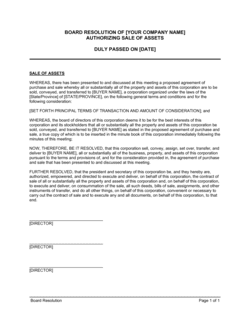
Shareholders authorizing sale of all assets instead of formal dissolutionShareholders Resolution Approving Sale of Assets

Common mistakes to avoid

❌ Using the wrong vote threshold

Why it matters: If the resolution passes with a simple majority but the statute or bylaws require a two-thirds special resolution, the dissolution is procedurally void and any subsequent filings are invalid.

Fix: Verify the required threshold in both the applicable corporate statute and the company's own bylaws before calling the meeting — the higher of the two requirements governs.

❌ Distributing assets before settling all creditor claims

Why it matters: In most jurisdictions, distributing assets to shareholders ahead of creditors makes shareholders personally liable to return those assets to satisfy unpaid debts — up to the amount each shareholder received.

Fix: Include and follow the creditor payment clause in the resolution, and require the liquidator to confirm in writing that all known liabilities are discharged before any shareholder distribution is made.

❌ Omitting the statutory citation in the dissolution clause

Why it matters: Corporate registries in the US, Canada, UK, and EU require the resolution to cite the specific statute under which dissolution is being effected. Without it, Articles of Dissolution are routinely rejected.

Fix: Identify the applicable statute (e.g., Delaware General Corporation Law §275, CBCA s.210, Companies Act 2006 s.84) and insert the citation into the operative resolution clause.

❌ Failing to give proper notice to creditors within the statutory window

Why it matters: Late or missing creditor notice can invalidate the entire winding-up process, expose the liquidator to personal liability, and prevent the company from being struck from the register.

Fix: Set a calendar reminder the day the resolution is signed, prepare the creditor notice letters immediately, and send them within the first week — well ahead of any statutory deadline.

The 10 key clauses, explained

Meeting details and notice

In plain language: Records the date, time, location (or virtual platform), and confirmation that proper notice was given to all shareholders in accordance with the bylaws and applicable law.

Sample language
A [special / general] meeting of the shareholders of [COMPANY LEGAL NAME] (the 'Company') was duly convened and held on [DATE] at [TIME] at [LOCATION / via [PLATFORM]], notice of which having been given to all shareholders in accordance with the Company's bylaws and the laws of [JURISDICTION].

Common mistake: Failing to document that proper notice was given and to whom. If a shareholder later claims they were not notified, the entire resolution can be challenged as invalid.

Shareholder attendance and quorum confirmation

In plain language: Lists attending shareholders (or their proxies), the total shares represented, and confirms that quorum required to pass a valid resolution was present.

Sample language
The following shareholders, holding in aggregate [X] shares representing [Y]% of the total issued and outstanding shares, were present in person or by proxy: [LIST]. A quorum being present, the meeting was called to order.

Common mistake: Stating quorum was met without specifying the share count and percentage. Courts and registries may require proof that the statutory or bylaw-mandated threshold was actually reached.

Statement of purpose and intent to dissolve

In plain language: Sets out the shareholders' intention to voluntarily wind up and dissolve the company, and states the reason or background in plain terms.

Sample language
WHEREAS the shareholders of the Company have determined that it is in the best interests of the Company to voluntarily wind up and dissolve its operations and legal existence pursuant to [APPLICABLE STATUTE].

Common mistake: Omitting the statutory reference. Without citing the applicable corporate statute, the resolution may not be accepted by the corporate registry when filing Articles of Dissolution.

Resolution to dissolve — voting record

In plain language: The operative clause recording the resolution text, the vote count in favor and against, and confirmation that the required majority threshold was met.

Sample language
IT IS HEREBY RESOLVED that the Company be voluntarily wound up and dissolved. Votes in favor: [X] ([Y]% of votes cast). Votes against: [X]. Abstentions: [X]. The resolution was [PASSED / DEFEATED] having received [MORE THAN / AT LEAST] the required [MAJORITY / TWO-THIRDS] of votes.

Common mistake: Recording only a voice vote or a simple 'unanimous' without documenting the actual share count. A challenged dissolution requires a precise voting record to withstand scrutiny.

Appointment of liquidator or winding-up agent

In plain language: Formally appoints a named individual or firm as liquidator with authority to collect assets, pay creditors, and distribute the surplus to shareholders.

Sample language
IT IS FURTHER RESOLVED that [LIQUIDATOR NAME / FIRM], of [ADDRESS], be and is hereby appointed as Liquidator of the Company for the purposes of winding up its affairs, with full authority to collect and realize assets, discharge liabilities, and distribute any surplus to shareholders.

Common mistake: Appointing a liquidator who is a current creditor of the company. In most jurisdictions this creates a disqualifying conflict of interest that voids the appointment.

Authority to pay creditors and discharge liabilities

In plain language: Authorizes the liquidator or officers to settle all outstanding debts, taxes, and obligations from company assets before any distribution to shareholders.

Sample language
The Liquidator is authorized and directed to pay or make adequate provision for the payment of all debts, taxes, obligations, and liabilities of the Company from its assets before making any distribution to shareholders.

Common mistake: Skipping this clause and proceeding directly to shareholder distribution. Distributing assets before creditors are paid exposes shareholders to personal liability for the company's unpaid debts in many jurisdictions.

Distribution of surplus assets to shareholders

In plain language: Authorizes distribution of any assets remaining after all liabilities are settled, on a pro rata basis according to each shareholder's shareholding.

Sample language
After payment of all liabilities, the remaining assets of the Company shall be distributed to the shareholders of record on a pro rata basis in proportion to their respective shareholdings as at [DATE], or as otherwise required by the Company's articles.

Common mistake: Not specifying the record date for the distribution. Without a fixed date, disputes arise over which share transfers before dissolution closing are recognized for distribution purposes.

Authorization to file dissolution documents

In plain language: Grants authority to named officers or the liquidator to execute and file Articles of Dissolution and all related documents with the applicable government registry.

Sample language
The officers of the Company and the Liquidator are hereby authorized and directed to execute, deliver, and file Articles of Dissolution and all other documents required by [JURISDICTION] law to effect the dissolution, and to take all further actions necessary to complete the winding up.

Common mistake: Authorizing only one named officer who then becomes unavailable. Including a 'or any officer of the Company' fallback ensures the filing can proceed even if the named person is unreachable.

Notice to creditors and public notice

In plain language: Directs the liquidator or officers to notify all known creditors and, where required by law, to publish a public notice of dissolution within the required timeframe.

Sample language
The Liquidator is directed to give written notice of the Company's dissolution to all known creditors within [X] days of this resolution and, where required by applicable law, to publish a notice of dissolution in [PUBLICATION / GAZETTE].

Common mistake: Treating notice to creditors as optional. Failure to give proper notice within the statutory window can invalidate the dissolution process and expose the liquidator to personal liability for unknown creditor claims.

Certification and signatures

In plain language: Confirms the resolution was duly passed, records the date, and provides signature blocks for the chairperson of the meeting and the corporate secretary.

Sample language
This resolution was duly passed at the meeting of shareholders of [COMPANY LEGAL NAME] held on [DATE]. _________________________ [CHAIRPERSON NAME], Chairperson | _________________________ [SECRETARY NAME], Secretary

Common mistake: Having only one signatory when the bylaws or jurisdiction require both chair and secretary signatures. A singly-signed resolution may be rejected by the corporate registry as incomplete.

How to fill it out

  1. 1

    Confirm the required vote threshold before the meeting

    Check your corporation's bylaws and the applicable corporate statute to determine whether dissolution requires an ordinary majority (50%+1) or a special resolution (typically 66.7% or 75%). Enter the correct threshold in the voting clause.

    💡 If your articles are silent on the threshold, default to the statutory minimum in your jurisdiction — which is commonly two-thirds of votes cast for voluntary dissolution.

  2. 2

    Enter the company's full legal name and jurisdiction

    Use the exact registered name as it appears on your certificate of incorporation — not a trade name or abbreviation. Include the governing jurisdiction to anchor the statutory references throughout the document.

    💡 Cross-check the name against your most recent annual corporate filing; name discrepancies are one of the most common reasons dissolution filings get rejected.

  3. 3

    Record meeting logistics and notice confirmation

    Fill in the meeting date, time, and location. Confirm the method and date on which notice was delivered to all shareholders (registered mail, email per bylaws, or written waiver of notice).

    💡 Attach copies of the notice letters or waiver-of-notice forms as an exhibit to the resolution for a complete corporate record.

  4. 4

    Document shareholder attendance and vote count

    List every shareholder present or by proxy, the number of shares each holds, and the aggregate percentage of total shares represented. Record the exact vote: shares in favor, shares against, and abstentions.

    💡 If any shareholder participates by proxy, attach the signed proxy form to the resolution — registries increasingly require these as supporting documentation.

  5. 5

    Appoint the liquidator by full name and address

    Name the individual or firm who will act as liquidator, confirm they are not a creditor or otherwise disqualified, and enter their address. If no separate liquidator is appointed, name the officer authorized to perform liquidation duties.

    💡 In smaller companies, a director who holds no outstanding loans from the company can serve as liquidator — but confirm this is permitted under the applicable corporate statute.

  6. 6

    Authorize officers to file dissolution documents

    Name at least two officers (or the liquidator plus one officer) and include the 'or any officer of the Company' fallback to ensure the filing authority survives personnel changes.

    💡 Research the specific Articles of Dissolution form required by your state, province, or country before this step — some registries require the form to reference the authorizing resolution by date.

  7. 7

    Set the creditor notice timeline

    Enter the number of days within which creditor notice must be sent after the resolution is passed. Check your jurisdiction's statutory minimum — typically 30 to 90 days — and set a calendar reminder immediately.

    💡 Publish public notice simultaneously if required (most US states and Canadian provinces mandate a gazette or newspaper notice); the clock on the claims period often runs from publication, not from the private creditor letter.

  8. 8

    Execute with required signatories before filing

    Have both the meeting chairperson and corporate secretary (or equivalent officers per your bylaws) sign and date the resolution. Make certified copies for your minute book, the corporate registry, and each major creditor.

    💡 File the executed resolution with the registry within the statutory window — most jurisdictions require Articles of Dissolution to be filed within 90 to 180 days of the authorizing resolution.

Frequently asked questions

What is a shareholders resolution approving voluntary dissolution?

It is the formal corporate record in which a company's shareholders vote to authorize the voluntary winding up and legal termination of the corporation. The resolution documents the meeting, the vote count, the appointment of a liquidator, and the authority given to officers to file Articles of Dissolution with the relevant government registry. Without this resolution, directors and officers typically have no legal authority to begin the formal dissolution process.

What vote percentage is required to pass a dissolution resolution?

The required threshold depends on the jurisdiction and the company's own governing documents. In most US states, voluntary dissolution requires approval by a majority of shares entitled to vote, though some states require two-thirds. In Canada under the CBCA, a special resolution (two-thirds of votes cast) is required. In the UK, a special resolution (75% of votes cast) is needed for a members' voluntary winding up. Always check both the applicable statute and your bylaws — the higher threshold governs.

Who can act as liquidator in a voluntary dissolution?

In most jurisdictions, any competent individual or licensed insolvency practitioner who is not a creditor of the company and not otherwise disqualified can act as liquidator. For small, solvent companies, a director or shareholder commonly serves. In the UK, a members' voluntary liquidation requires a licensed insolvency practitioner. Appointing someone with a financial conflict of interest — such as an outstanding loan to the company — can void the appointment.

Does a voluntary dissolution resolution need to be notarized?

Notarization is not typically required for the resolution itself in most US states, Canadian provinces, or the UK. However, the Articles of Dissolution filed with the registry may require notarized or certified signatures in some jurisdictions. Some states also require the resolution to be included as an exhibit to the Articles filing. Check the specific requirements of your state, provincial, or national registry before execution.

What happens to company debts when a company is voluntarily dissolved?

All known creditors must be paid — or adequate provision made for their payment — from company assets before any distribution to shareholders. The liquidator is responsible for notifying creditors, settling claims in priority order (secured creditors first, then unsecured, then shareholders), and ensuring the company is solvent at the time of dissolution. Distributing assets to shareholders before creditors are paid can make shareholders personally liable to return those funds.

Can shareholders dissolve a company without a meeting?

In many jurisdictions, yes — shareholders can pass a resolution in writing without holding a formal meeting, provided all shareholders (or the required majority, depending on the statute) sign a written resolution. This approach is common for sole-shareholder or closely held companies. The same vote threshold requirements apply to written resolutions as to meeting-based votes.

What is the difference between voluntary dissolution and administrative dissolution?

Voluntary dissolution is initiated by the shareholders themselves — typically when the business has fulfilled its purpose, is no longer viable, or the owners choose to retire or restructure. Administrative dissolution is imposed by the government registry — usually for failure to file annual reports, pay state fees, or maintain a registered agent. Voluntary dissolution follows a structured winding-up process with creditor notice and asset distribution; administrative dissolution can happen abruptly and may leave debts and compliance obligations unresolved.

How long does the voluntary dissolution process take?

Timeline varies significantly by jurisdiction. In most US states, the process from passing the resolution to receiving a certificate of dissolution takes 2 to 6 months — accounting for creditor notice periods (typically 30 to 90 days), tax clearance requirements, and registry processing times. Canada and the UK have similar timelines. Jurisdictions that require a tax clearance certificate before dissolution can add 3 to 12 months if the company has outstanding tax filings or assessments.

Do we need a lawyer to complete a voluntary dissolution?

For straightforward dissolutions of small, solvent companies with few creditors, a well-drafted template combined with a legal review is usually sufficient. Engage a corporate lawyer when the company has significant outstanding liabilities, pending litigation, complex asset structures, minority shareholders who may object, or operations in multiple jurisdictions. A dissolution handled without proper advice can leave directors and shareholders personally exposed to creditor claims.

How this compares to alternatives

vs Directors Resolution Approving Voluntary Dissolution

A directors resolution records the board's internal decision to recommend dissolution to shareholders — it does not itself authorize the winding up. The shareholders resolution is the operative document that legally authorizes the dissolution. In most jurisdictions, both documents are required: directors recommend, shareholders approve, and both are filed with the registry.

vs Articles of Dissolution

Articles of Dissolution is the government-prescribed form filed with the corporate registry to formally terminate the corporation's legal existence. The shareholders resolution is the internal corporate authority that empowers the officers to execute and file the Articles. The resolution comes first; the Articles are the external filing that gives the resolution legal effect.

vs Shareholders Resolution Approving Sale of All Assets

A resolution approving the sale of all assets authorizes the disposition of the company's property — often as a precursor to dissolution or as an alternative to it. Selling all assets does not itself dissolve the corporation; a separate dissolution resolution and filing are still required if the intent is to terminate the legal entity entirely.

vs Shareholders Resolution Approving a Merger

A merger resolution authorizes combining the company with another entity — the corporation's legal existence may continue in the surviving entity rather than terminating. A voluntary dissolution resolution is used when the intent is to end the corporation entirely with no successor entity. Dissolution is a terminal event; merger typically continues operations under a new or surviving corporate structure.

Industry-specific considerations

Technology / SaaS

IP ownership transfer to acquirer or founders must be documented before dissolution; subscription liability wind-down and data deletion obligations under privacy laws require careful sequencing.

Professional Services

Client file transfer or destruction protocols, professional indemnity run-off coverage, and regulatory deregistration must be completed before the dissolution filing.

Retail / E-commerce

Outstanding customer orders, gift cards, and return obligations must be settled or explicitly transferred before the dissolution becomes effective to avoid consumer protection violations.

Manufacturing

Environmental liability clearance, equipment disposal under applicable regulations, and union notification requirements add significant time and cost to the winding-up process.

Financial Services

Regulatory license surrender to FINRA, SEC, FCA, or equivalent must precede or accompany the dissolution filing; client account transfers require regulator approval timelines.

Real Estate

Title transfer for any company-owned properties must close before the corporation is struck from the register; outstanding lease obligations require novation or assignment to a continuing party.

Jurisdictional notes

United States

Dissolution requirements are governed by state law and vary significantly. Most states require a majority or two-thirds shareholder vote, filing of Articles of Dissolution with the Secretary of State, and tax clearance from the state revenue authority. Delaware requires approval by a majority of shares entitled to vote (DGCL §275) and allows dissolution by written consent. Some states — including California — require a tax clearance certificate before the Articles are accepted, which can add several months to the process.

Canada

Under the Canada Business Corporations Act (CBCA s.210), voluntary dissolution requires a special resolution passed by two-thirds of votes cast at a shareholder meeting. Each province has equivalent legislation (e.g., Ontario's OBCA, BC's BCA) with similar thresholds. A certificate of dissolution is issued by Corporations Canada or the provincial registry only after all known liabilities are discharged or provided for. Tax clearance from the CRA is required before final distribution to shareholders.

United Kingdom

Under the Insolvency Act 1986, a members' voluntary liquidation (MVL) requires a special resolution (75% of votes cast) and a Declaration of Solvency signed by a majority of directors confirming the company can pay its debts within 12 months. A licensed insolvency practitioner must be appointed as liquidator. For solvent companies with assets under £25,000, voluntary strike-off under Companies Act 2006 s.1004 is a simpler alternative that does not require a formal resolution or liquidator.

European Union

Dissolution requirements vary by member state. In Germany, a GmbH requires a three-quarters majority shareholder vote and appointment of a Liquidator (Abwickler) registered with the commercial court. In France, an extraordinary general meeting resolution is required followed by publication in a legal gazette and filing with the greffe du tribunal de commerce. Most EU member states impose a creditor notice period of 30 to 90 days and require tax and social contribution clearances before the dissolution is finalized.

Template vs lawyer — what fits your deal?

PathBest forCostTime
Use the templateSmall, solvent companies with a single class of shares, few creditors, and no pending litigationFree1–2 days to draft and execute; 2–6 months for full process completion
Template + legal reviewCompanies with multiple share classes, minority shareholders, outstanding tax obligations, or operations in more than one jurisdiction$500–$1,500 for a corporate lawyer review and filing guidance3–5 days to finalize; 3–9 months for full process
Custom draftedCompanies with significant creditor exposure, pending litigation, regulated industry licenses, or complex asset structures requiring court supervision$2,000–$10,000+ depending on complexity and jurisdiction1–4 weeks to draft; 6–18 months for full winding-up process

Glossary

Voluntary Dissolution
A shareholder-initiated process to legally wind up and terminate a corporation's existence, as distinct from court-ordered or administrative dissolution.
Quorum
The minimum percentage or number of shares that must be represented at a meeting for any vote to be legally valid — typically defined in the articles or bylaws.
Special Resolution
A resolution requiring a higher approval threshold — typically 66.7% or 75% of votes cast — used for fundamental corporate changes such as dissolution.
Ordinary Resolution
A resolution passed by a simple majority (more than 50%) of votes cast, used for routine corporate matters.
Liquidator
A person or firm appointed to collect the company's assets, pay creditors in priority order, and distribute any surplus to shareholders before the company is struck off the register.
Winding Up
The process of settling a company's affairs — realizing assets, discharging liabilities, and distributing remaining funds — prior to formal dissolution.
Articles of Dissolution
The formal document filed with the state, provincial, or national corporate registry to legally terminate the corporation's existence.
Surplus Assets
Assets remaining after all creditors have been paid in full during a winding up, which are then distributed to shareholders in proportion to their shareholdings.
Notice to Creditors
A formal communication sent to all known creditors — and often published publicly — informing them of the dissolution and providing a deadline to submit claims.
Certificate of Dissolution
The official government-issued document confirming that a corporation has been legally dissolved and removed from the corporate register.
Pro Rata Distribution
Distribution of surplus assets to shareholders in proportion to each shareholder's percentage ownership of the total shares outstanding.

Part of your Business Operating System

This document is one of 3,000+ business & legal templates included in Business in a Box.

  • Fill-in-the-blanks — ready in minutes
  • 100% customizable Word document
  • Compatible with all office suites
  • Export to PDF and share electronically

Create your document in 3 simple steps.

From template to signed document — all inside one Business Operating System.
1
Download or open template

Access over 3,000+ business and legal templates for any business task, project or initiative.

2
Edit and fill in the blanks with AI

Customize your ready-made business document template and save it in the cloud.

3
Save, Share, Send, Sign

Share your files and folders with your team. Create a space of seamless collaboration.

Save time, save money, and create top-quality documents.

★★★★★

"Fantastic value! I'm not sure how I'd do without it. It's worth its weight in gold and paid back for itself many times."

Managing Director · Mall Farm
Robert Whalley
Managing Director, Mall Farm Proprietary Limited
★★★★★

"I have been using Business in a Box for years. It has been the most useful source of templates I have encountered. I recommend it to anyone."

Business Owner · 4+ years
Dr Michael John Freestone
Business Owner
★★★★★

"It has been a life saver so many times I have lost count. Business in a Box has saved me so much time and as you know, time is money."

Owner · Upstate Web
David G. Moore Jr.
Owner, Upstate Web

Run your business with a system — not scattered tools

Stop downloading documents. Start operating with clarity. Business in a Box gives you the Business Operating System used by over 250,000 companies worldwide to structure, run, and grow their business.

Start free · No credit card required