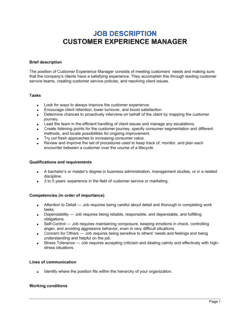
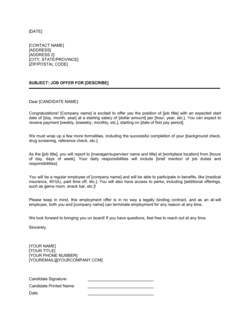
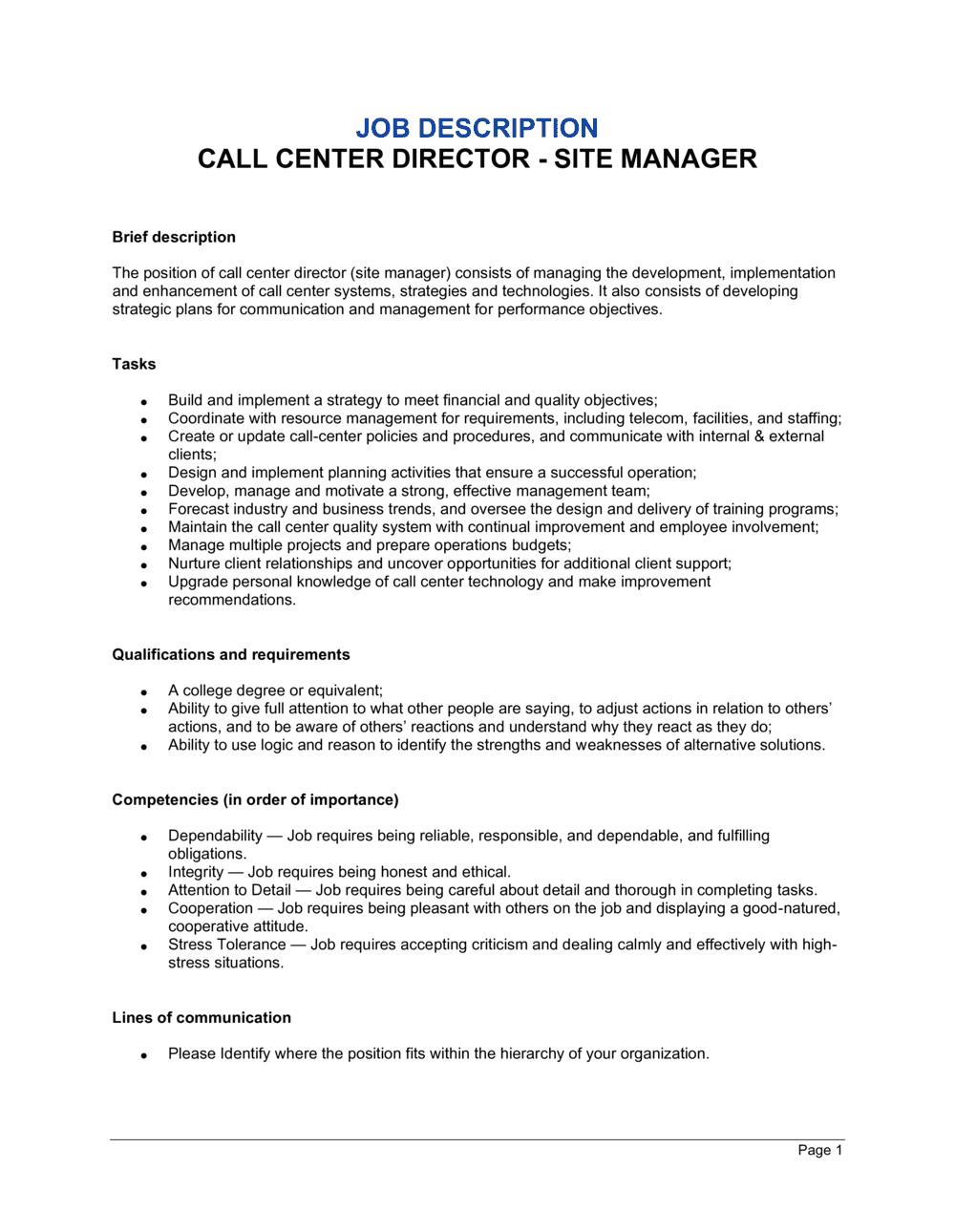
Call Center Director_Site Manager Job Description Template

Free Word download • Edit online • Save & share with Drive • Export to PDF

2 pages20–30 min to fillDifficulty: StandardSignature requiredLegal review recommended
Learn more ↓
FreeCall Center Director_Site Manager Job Description Template

At a glance

What it is
A Call Center Director / Site Manager Job Description is a formal binding document that defines the scope of authority, core responsibilities, performance expectations, reporting structure, and minimum qualifications for a senior operations leader overseeing a call center or contact center site. This free Word download gives you a structured, legally grounded starting point you can edit online and export as PDF for use in hiring packages, employment contracts, and performance management frameworks.
When you need it
Use it when hiring, onboarding, or reclassifying a director-level leader responsible for call center operations — whether opening a new site, replacing a departing executive, or formalizing an incumbent role that has grown beyond its original scope. It is also used when attaching a formal role definition to an employment contract or offer letter.
What's inside
Role summary and reporting structure, key duties spanning workforce management, quality assurance, technology oversight, and financial accountability, required and preferred qualifications, defined KPIs and performance metrics, compensation band, and signature block for employer and employee acknowledgment.

What is a Call Center Director / Site Manager Job Description?

A Call Center Director / Site Manager Job Description is a formal binding document that defines the full scope of authority, core duties, performance metrics, qualifications, compensation classification, and reporting structure for a senior operations leader responsible for running a call center or contact center site. Unlike a generic position summary, this document is structured to serve both as a hiring tool and as a legally significant record — it establishes the pre-agreed KPIs and role boundaries that govern performance management, compensation decisions, and, if necessary, termination. This free Word download is designed to be edited online, exported as PDF, and attached directly to an employment contract or offer letter as a formal schedule.

Why You Need This Document

Hiring a call center director without a complete, signed job description creates four overlapping risks. First, without documented KPI targets, any performance improvement process can be challenged as arbitrary or retaliatory — courts and labor boards routinely request the job description as the baseline for what was agreed at hire. Second, without an explicit FLSA or provincial classification statement, the role is vulnerable to retroactive overtime claims during audits. Third, vague duty language prevents the director from understanding what success looks like, which increases early-tenure attrition in a role that is expensive to fill. Fourth, without a signature block, the employer loses the documented acknowledgment that is its primary defense in misclassification and wrongful termination disputes. This template closes all four gaps in under an hour, and pairs directly with the employment contract and offer letter templates in Business in a Box to give you a complete, consistent hiring package for your most operationally critical leadership hire.

Which variant fits your situation?

If your situation is…Use this template
Hiring for a large multi-site contact center enterpriseVP of Contact Center Operations Job Description
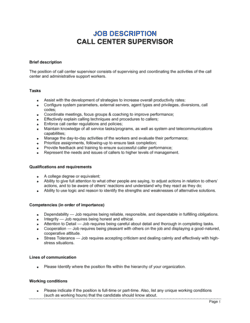
Posting a call center team lead or supervisor role below director levelCall Center Supervisor Job Description
Defining a customer service manager role in a non-call-center environmentCustomer Service Manager Job Description
Engaging a call center director as a fractional or project-based contractorIndependent Contractor Agreement
Attaching a role definition to a formal employment agreementEmployment Contract
Documenting performance standards and KPIs for an existing directorEmployee Performance Review Template
Hiring a temporary or interim site manager for a fixed project periodFixed-Term Employment Contract

Common mistakes to avoid

❌ Omitting numeric KPI targets

Why it matters: Without pre-agreed performance metrics, a director can claim any performance standard applied after the fact is arbitrary — significantly weakening a performance improvement plan or termination for cause.

Fix: Insert specific numeric thresholds for AHT, FCR, CSAT, attrition, and service level before the employee signs. These numbers should mirror the site's SLA commitments.

❌ Using vague duty language like 'manages operations'

Why it matters: Duties that cannot be measured cannot be evaluated. Vague descriptions expose the employer to claims that termination was pretextual rather than performance-based.

Fix: Rewrite each duty with an action verb and a quantifiable scope: 'Oversees scheduling for 250 agents to maintain 80% service level within 20 seconds.'

❌ Skipping the FLSA classification line

Why it matters: Failing to document exempt classification at the time of hire leaves the company exposed to retroactive overtime claims if the director is later reclassified or files a wage complaint.

Fix: Include the classification explicitly — 'Exempt under FLSA Section 13(a)(1) administrative/executive exemption' — and confirm the salary meets the current minimum threshold ($684/week as of 2024).

❌ No signature block or unsigned at hiring

Why it matters: An unacknowledged job description has limited evidentiary value in a dispute. Courts and labor boards give significantly more weight to signed, dated documents as evidence of mutual agreement.

Fix: Add a signature block and collect signatures from both parties before or on the employee's first day — the same day the employment contract is signed.

❌ Setting education requirements that exceed actual job needs

Why it matters: Requiring a degree for a role where operational experience is the real determinant can constitute disparate impact discrimination under Title VII if the requirement screens out a protected class at a higher rate.

Fix: Replace rigid degree requirements with experience equivalencies: 'Bachelor's degree or equivalent combination of 8+ years of progressive call center operations experience.'

❌ Copying a generic job description without tailoring KPIs and scope to the actual site

Why it matters: A director hired against a generic description may legitimately argue that site-specific targets — volume, budget, team size — were never part of the agreed role, complicating accountability and performance management.

Fix: Update the headcount, budget, volume, and KPI fields to reflect the actual site before posting or presenting to the candidate.

The 10 key clauses, explained

Role title, reporting structure, and effective date

In plain language: States the official job title, the executive this role reports to, and the date the description takes effect or was last revised.

Sample language
Position Title: Call Center Director / Site Manager. Reports To: [VP OF OPERATIONS / CHIEF OPERATING OFFICER]. Effective Date: [DATE]. Location: [SITE ADDRESS / REMOTE].

Common mistake: Listing a generic reporting line like 'senior management' instead of a specific title — making the chain of authority ambiguous and creating accountability gaps during performance reviews.

Role summary and purpose

In plain language: A three-to-five sentence summary of why the role exists, what the director is ultimately accountable for, and the scope of the site or function they oversee.

Sample language
The Call Center Director / Site Manager is responsible for leading all operational, workforce, and quality functions at the [SITE NAME] contact center, overseeing a team of [NUMBER] agents and [NUMBER] supervisors. The Director ensures the site meets or exceeds SLA commitments, financial targets, and customer satisfaction benchmarks established by [COMPANY NAME].

Common mistake: Writing a purpose statement so broad ('responsible for all customer service activities') that it cannot support a defensible performance improvement plan or termination for cause.

Core duties and responsibilities

In plain language: An enumerated list of the director's primary day-to-day and strategic obligations — workforce management, quality oversight, P&L ownership, vendor management, and escalation handling.

Sample language
Key responsibilities include: (a) managing site-level P&L with a budget of $[AMOUNT]; (b) overseeing workforce scheduling to maintain a service level of [X]% of calls answered within [Y] seconds; (c) leading QA calibration sessions with team leaders; (d) managing relationships with technology vendors including [PLATFORM NAME].

Common mistake: Listing duties at a level of abstraction too high to be measurable — 'manages operations' provides no basis for evaluating whether the director is succeeding or failing.

Performance metrics and KPIs

In plain language: Specifies the measurable targets the director is held to — AHT, FCR, CSAT, NPS, attrition rate, and SLA adherence — with target ranges where applicable.

Sample language
The Director is accountable for the following site KPIs: Average Handle Time ≤ [X] minutes; First Call Resolution ≥ [X]%; CSAT ≥ [X]/10; Agent Attrition ≤ [X]% annually; Service Level [X]% of calls answered within [Y] seconds.

Common mistake: Omitting KPI targets from the job description entirely, then attempting to establish them for the first time in a performance improvement plan — making the metrics feel retaliatory rather than pre-agreed.

Direct reports and organizational authority

In plain language: Defines how many and which roles report directly to the director, the scope of their hiring and termination authority, and any matrix reporting relationships.

Sample language
Direct reports: [NUMBER] Team Leaders / Supervisors, [NUMBER] Workforce Management Analysts, [NUMBER] Quality Assurance Specialists. The Director has full hiring and disciplinary authority over direct reports, subject to HR policy. Dotted-line authority over [FUNCTION] teams embedded at the site.

Common mistake: Omitting the scope of hiring and firing authority, which later creates confusion about whether the director can onboard or remove personnel without executive approval — slowing operational decisions.

Required qualifications and experience

In plain language: Minimum education, years of experience, industry background, and any required certifications that a candidate must possess to be considered for the role.

Sample language
Required: Bachelor's degree in Business Administration, Operations, or a related field; minimum [X] years of call center management experience, including at least [X] years in a director-level or multi-team leadership role; demonstrated experience managing teams of [X]+ agents; proficiency with [WFM PLATFORM] and [CRM PLATFORM].

Common mistake: Setting education requirements that exceed what the role actually requires — requiring an MBA for a role where proven operational experience matters more — which can narrow the candidate pool and expose the employer to disparate-impact claims.

Preferred qualifications and certifications

In plain language: Differentiating credentials, skills, or experience that are valued but not required — used to rank candidates without excluding otherwise qualified applicants.

Sample language
Preferred: Six Sigma Green Belt or Black Belt certification; experience with omnichannel platforms including [PLATFORM NAME]; bilingual English/[LANGUAGE]; prior experience in [INDUSTRY VERTICAL, e.g., financial services, healthcare, telecommunications].

Common mistake: Listing preferred qualifications that are identical to required qualifications — making the two sections redundant and signaling a poorly thought-out hiring process to candidates.

Compensation, classification, and benefits

In plain language: States the salary band or range, FLSA classification (exempt or non-exempt), bonus eligibility, and a reference to benefits enrollment.

Sample language
Base Salary: $[MINIMUM] – $[MAXIMUM] annually, depending on experience. Classification: Exempt under the FLSA. Bonus Eligible: Yes — up to [X]% of base salary based on site KPI performance. Benefits: Eligible for the Company's standard benefits program as in effect from time to time.

Common mistake: Omitting the FLSA classification — which leaves the company exposed to misclassification claims if the director later disputes overtime eligibility or is reclassified during an audit.

Physical requirements and work environment

In plain language: Documents any physical demands of the role (extended screen time, occasional site travel, standing on a call center floor) and the primary work environment — on-site, hybrid, or remote.

Sample language
This role is primarily office-based at [SITE LOCATION] with [X]% travel to other company sites or client locations. The Director must be able to remain stationary for extended periods and operate standard computer equipment. Occasional evening or weekend availability is required during peak operational periods.

Common mistake: Skipping this clause entirely for roles that involve any physical or schedule demands — creating a mismatch between candidate expectations and actual requirements that surfaces after the offer is accepted.

Acknowledgment and signature block

In plain language: A signature section where both the employer representative and the employee confirm they have reviewed, understood, and agreed to the job description as a formal record.

Sample language
I acknowledge receipt of this Job Description and confirm that I have read and understood its contents. Employee Signature: ________________________ Date: ________ | HR / Manager Signature: ________________________ Date: ________

Common mistake: Omitting the signature block entirely, leaving the employer without documented acknowledgment — which weakens the company's position in a wrongful termination or misclassification dispute.

How to fill it out

  1. 1

    Enter the role title, reporting line, and effective date

    Fill in the exact job title as it will appear in payroll and the ATS, the specific title of the role this position reports to, and the date the description takes effect.

    💡 Match the job title exactly to the title in your HRIS and any posted job ads — inconsistencies create confusion during background checks and offer-letter reviews.

  2. 2

    Write a focused role summary

    Draft three to five sentences that state what the director is ultimately accountable for, the size of the site (agent headcount, call volume), and the primary business outcome this role drives.

    💡 Lead with the accountability, not the activity. 'Accountable for a 300-seat site generating $4M in annual revenue' is more useful than 'manages a large call center team.'

  3. 3

    Enumerate core duties with measurable language

    List eight to twelve specific responsibilities using action verbs. Where possible, attach a quantitative scope — team size, budget, or volume threshold — to each duty.

    💡 Avoid the word 'assists.' Every item in a director-level job description should reflect ownership, not support.

  4. 4

    Define KPIs with explicit targets

    Insert actual numeric targets for AHT, FCR, CSAT, attrition, and service level. These should reflect the site's current baseline or the targets in the client SLA.

    💡 Align KPI targets in the job description with those in the director's employment contract and any client SLA — inconsistency between documents is a liability in performance disputes.

  5. 5

    Set required and preferred qualifications separately

    List minimum qualifications that every candidate must meet in the 'required' section. Move differentiating credentials — certifications, industry-specific experience, language skills — to a separate 'preferred' section.

    💡 Review your required qualifications against EEOC guidance to confirm they are job-related and consistent with business necessity — particularly education requirements.

  6. 6

    State the compensation range and FLSA classification

    Enter the salary band, confirm exempt or non-exempt classification under the FLSA (or applicable provincial/national law), and reference bonus eligibility and benefits.

    💡 In jurisdictions that mandate pay transparency — California, Colorado, New York, and others — including the salary range in the job description is legally required for posted positions.

  7. 7

    Add physical requirements and work environment details

    Describe the on-site, hybrid, or remote nature of the role, any travel expectations, and any physical demands relevant to the position.

    💡 Be specific about schedule flexibility requirements — 'occasional weekend availability' is better than 'flexible schedule' so candidates can self-screen before applying.

  8. 8

    Obtain signatures before the first day

    Have both the hiring manager or HR representative and the incoming director sign and date the completed job description before the employee's start date.

    💡 Store the signed copy in the employee file alongside the employment contract — it is your primary defense in a misclassification audit or wrongful termination claim.

Frequently asked questions

What does a Call Center Director / Site Manager do?

A Call Center Director or Site Manager is the senior operational leader accountable for all functions at a contact center site — including workforce scheduling, quality assurance, technology performance, agent development, budget management, and SLA compliance. They typically oversee a team of supervisors and team leaders and report to a VP of Operations or COO. At BPO organizations, they may also serve as the primary client relationship owner for one or more dedicated accounts.

What is the difference between a Call Center Director and a Site Manager?

The titles are often used interchangeably for the same senior operational role, but in larger organizations there can be a distinction. A Site Manager typically focuses on day-to-day operations at a single physical location. A Call Center Director may carry broader strategic accountability — budget ownership, technology roadmap input, and cross-site consistency — and may oversee multiple site managers. This template covers both interpretations and should be tailored to reflect the actual scope of the role being filled.

Is a job description a legally binding document?

A job description is generally not a standalone employment contract, but it becomes a legally significant document when signed by both parties and incorporated by reference into an employment contract. It establishes the agreed scope of duties, the basis for performance evaluation, and the authority structure. In wrongful termination, misclassification, and discrimination claims, courts and labor tribunals routinely examine job descriptions as evidence of what was mutually agreed at the time of hire.

What KPIs should a Call Center Director be held to?

The most commonly used KPIs for a call center director include Average Handle Time (AHT), First Call Resolution (FCR), Customer Satisfaction Score (CSAT), Net Promoter Score (NPS), service level (percentage of calls answered within a target number of seconds), agent attrition rate, and occupancy rate. Financial accountability KPIs include cost per contact and site P&L performance against budget. Targets should be set based on the site's current baseline, the client SLA, and industry benchmarks for the specific vertical.

Does a call center director qualify as an exempt employee under the FLSA?

In most cases, yes. Call center directors typically qualify for the executive or administrative exemption under the FLSA because they earn above the salary threshold (currently $684/week as of 2024, subject to change), their primary duty is management or directly related to general business operations, and they exercise independent judgment on significant matters. However, FLSA exemptions are fact-specific — confirm the classification with an employment attorney, particularly if the director's duties overlap significantly with those of a non-exempt supervisor.

What qualifications should I require for a call center director?

Minimum qualifications typically include a bachelor's degree or equivalent experience, five to ten years of call center management experience with at least two to three years in a director-level role, demonstrated experience managing teams of 100 or more agents, and proficiency with at least one major WFM and CRM platform. Preferred qualifications often include Six Sigma or COPC certification, omnichannel platform experience, and industry-specific background (financial services, healthcare, or telecommunications).

Do I need to include a salary range in the job description?

In several US states — including California, Colorado, New York, and Washington — pay transparency laws require employers to include a salary range in any publicly posted job description. Even where not legally required, including a range improves application quality and reduces time spent screening candidates whose salary expectations don't align. For internal role documents, the range is best practice for equity and defensibility in compensation reviews.

How does this job description differ from a performance review?

A job description defines the scope of the role, qualifications, and pre-agreed KPI targets at the time of hire. A performance review evaluates actual performance against those targets over a defined period. The job description is the foundational document; the performance review cannot be fair or legally defensible if the targets it measures were never formally agreed. Both documents should be kept in the employee file and reviewed together during any performance management process.

Should a job description be updated after the employee is hired?

Yes. When the role's responsibilities change materially — due to a reorganization, site expansion, or shift in reporting structure — the job description should be revised, shared with the employee, and re-signed by both parties. Operating with a stale job description creates a gap between the agreed role and actual duties that can complicate performance management and weaken the employer's position in a constructive dismissal claim.

How this compares to alternatives

vs Call Center Supervisor Job Description

A supervisor job description covers front-line team leadership for 10–20 agents, focusing on daily coaching, schedule adherence, and escalation handling. The director-level document addresses site-wide P&L, multi-team oversight, strategic workforce planning, and executive reporting. Use the supervisor template for team leads; use this template for the leader who the supervisors report to.

vs Customer Service Manager Job Description

A customer service manager description is suited to non-call-center environments — retail floors, service desks, or small support teams — where the manager handles escalations and service standards but not high-volume telephony operations. The call center director template adds WFM, AHT, FCR, and SLA accountability that is specific to volume-driven contact center environments.

vs Employment Contract

An employment contract governs the full legal relationship — compensation, benefits, IP, confidentiality, non-compete, termination, and severance. A job description defines the operational scope of the role and is typically attached to the employment contract as a schedule. The two documents work together: the contract establishes legal obligations; the job description establishes performance obligations.

vs Independent Contractor Agreement

An independent contractor agreement engages a self-employed individual for project-based call center consulting or interim site management without creating an employment relationship. The job description template assumes an employment relationship with full FLSA and benefits implications. Using a contractor agreement for someone performing a director role with day-to-day operational control is a common misclassification risk.

Industry-specific considerations

Business Process Outsourcing (BPO)

BPO directors manage multiple client-dedicated teams under separate SLAs, requiring the job description to explicitly address client relationship accountability alongside internal operational KPIs.

Financial Services

Regulatory compliance obligations — CFPB, PCI-DSS, SOC 2 — must be reflected in the director's duty list, and QA clauses should reference compliance monitoring frequency and audit readiness.

Healthcare

HIPAA training requirements and patient data handling obligations should appear as explicit duties, and the qualifications section should reference any required HIPAA compliance certification.

Retail and E-commerce

Seasonal volume spikes require the director to have demonstrable WFM expertise for rapid headcount scaling, and KPIs should include peak-period CSAT and FCR benchmarks specific to promotional campaigns.

Jurisdictional notes

United States

The director role typically qualifies for the FLSA executive or administrative exemption, but the salary threshold ($684/week as of 2024, subject to regulatory updates) must be met and primary duties must be managerial. Several states — including California, Colorado, New York, and Washington — require a salary range to be included in any publicly posted job description. Non-compete language referenced in the job description must comply with state-specific enforceability rules, which vary significantly.

Canada

Each province's Employment Standards Act governs minimum notice, overtime, and classification requirements — the job description should be reviewed against the applicable provincial statute before use. In Quebec, all job documentation presented to employees must be available in French under the Charter of the French Language (Bill 96). The concept of 'at-will' employment does not apply; termination obligations are governed by common law and statute regardless of job description language.

United Kingdom

Under the Employment Rights Act 1996, employers must provide a written statement of employment particulars — including a description of duties — on or before the first day of employment. The job description should be reviewed to ensure KPIs and duties do not inadvertently create indirect discrimination exposure under the Equality Act 2010. Working Time Regulations 1998 limits on weekly hours should be reflected in any language about extended or flexible availability.

European Union

The EU Transparent and Predictable Working Conditions Directive requires written terms describing duties and working arrangements to be provided within seven days of hire in most member states. GDPR implications arise when the director handles customer or employee personal data — data processing responsibilities should be explicitly listed as a duty. Works council consultation may be required in Germany, France, and the Netherlands before a new director role is formally created or significantly modified.

Template vs lawyer — what fits your deal?

PathBest forCostTime
Use the templateStandard domestic full-time hires at a single-site call center where the director reports to an internal executiveFree30–60 minutes
Template + legal reviewMulti-site or BPO directors with complex SLA accountability, equity components, or cross-jurisdictional roles$200–$500 for an HR consultant or employment attorney review1–3 days
Custom draftedExecutive-level contact center leaders with P&L ownership exceeding $5M, regulated industries, or international sites requiring jurisdiction-specific compliance language$800–$2,5001–2 weeks

Glossary

Average Handle Time (AHT)
The average duration of a customer interaction from greeting to wrap-up, including hold time and after-call work — a primary call center efficiency metric.
Service Level Agreement (SLA)
A contractual commitment between a call center and its client or internal stakeholder specifying minimum response time, quality, and availability thresholds.
FLSA Exempt Classification
A US designation under the Fair Labor Standards Act indicating that an employee meets salary and duties tests to be excluded from overtime pay requirements — applicable to most director-level roles.
Workforce Management (WFM)
The process of forecasting call volume, scheduling agents, and managing intra-day staffing to meet service level targets at minimum cost.
First Call Resolution (FCR)
The percentage of customer issues resolved on the first contact without a follow-up call or escalation — a primary quality metric for call center operations.
Customer Satisfaction Score (CSAT)
A survey-based metric measuring customer satisfaction with a specific interaction, typically scored on a 1–5 or 1–10 scale.
Attrition Rate
The percentage of agents who leave the call center in a given period, calculated as departures divided by average headcount — a key indicator of workforce stability.
Net Promoter Score (NPS)
A loyalty metric derived from asking customers how likely they are to recommend the company, scored from -100 to +100.
Escalation Management
The process by which calls or cases beyond a front-line agent's authority are routed to a supervisor or director for resolution.
Quality Assurance (QA) Calibration
A structured process where call center evaluators score the same interaction to align scoring standards, ensuring consistent quality measurement across the team.
Omnichannel Operations
A contact center model supporting customer interactions across voice, chat, email, social media, and SMS within a unified routing and reporting platform.

Part of your Business Operating System

This document is one of 3,000+ business & legal templates included in Business in a Box.

  • Fill-in-the-blanks — ready in minutes
  • 100% customizable Word document
  • Compatible with all office suites
  • Export to PDF and share electronically

Create your document in 3 simple steps.

From template to signed document — all inside one Business Operating System.
1
Download or open template

Access over 3,000+ business and legal templates for any business task, project or initiative.

2
Edit and fill in the blanks with AI

Customize your ready-made business document template and save it in the cloud.

3
Save, Share, Send, Sign

Share your files and folders with your team. Create a space of seamless collaboration.

Save time, save money, and create top-quality documents.

★★★★★

"Fantastic value! I'm not sure how I'd do without it. It's worth its weight in gold and paid back for itself many times."

Managing Director · Mall Farm
Robert Whalley
Managing Director, Mall Farm Proprietary Limited
★★★★★

"I have been using Business in a Box for years. It has been the most useful source of templates I have encountered. I recommend it to anyone."

Business Owner · 4+ years
Dr Michael John Freestone
Business Owner
★★★★★

"It has been a life saver so many times I have lost count. Business in a Box has saved me so much time and as you know, time is money."

Owner · Upstate Web
David G. Moore Jr.
Owner, Upstate Web

Run your business with a system — not scattered tools

Stop downloading documents. Start operating with clarity. Business in a Box gives you the Business Operating System used by over 250,000 companies worldwide to structure, run, and grow their business.

Free Forever Plan · No credit card required