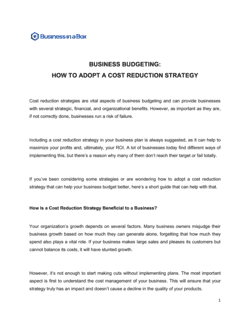
Business Budgeting How To Reduce Expenses

Free Word download • Edit online • Save & share with Drive • Export to PDF

3 pages25–30 min to fillDifficulty: StandardSignature requiredLegal review recommended
Learn more ↓
FreeBusiness Budgeting How To Reduce Expenses Template

At a glance

What it is
A Business Budgeting: How to Reduce Expenses document is a formal, binding internal policy and action plan that codifies a company's commitment to systematic cost reduction — establishing spending limits, approval hierarchies, variance tracking obligations, and accountability measures across departments. This free Word download gives you a structured, board-ready template you can edit online and distribute to finance leads, department heads, and executive stakeholders as a binding operating agreement.
When you need it
Use it when your business faces margin pressure, is preparing for a funding round, is entering a restructuring period, or needs to formalize informal cost-control practices into an enforceable, organization-wide policy. It is equally appropriate for annual budget cycles where leadership needs a documented framework to govern discretionary spending.
What's inside
The template covers the scope of the cost-reduction mandate, baseline expense audit requirements, category-by-category spending limits, approval thresholds for discretionary purchases, employee obligations and accountabilities, variance reporting schedules, and consequences for non-compliance — all in a single document signed by authorized officers.

What is a Business Budgeting: How to Reduce Expenses document?

A Business Budgeting: How to Reduce Expenses document is a formal, signed internal policy that transforms a company's cost-reduction intentions into binding organizational commitments. It establishes a structured framework — covering baseline expense audits, category-specific reduction targets, tiered approval thresholds, employee spending obligations, and variance reporting schedules — that holds departments and individuals accountable to measurable financial outcomes. Unlike an informal memo or a spreadsheet of aspirational cuts, a properly executed cost reduction policy creates enforceable obligations that connect to employment agreements, procurement processes, and governance structures across the organization.

Why You Need This Document

Operating without a written, signed expense reduction policy means cost-control efforts rely entirely on management persuasion rather than documented obligation — and persuasion erodes quickly under deadline and competitive pressure. Without defined approval thresholds, employees make purchasing commitments the company cannot afford; without variance reporting triggers, overspend accumulates for quarters before anyone is required to respond. Lenders, investors, and boards increasingly require evidence of documented financial controls before extending capital or approving budgets, and an undocumented cost-reduction effort provides no audit trail when questioned. A signed policy with specific targets and escalation requirements converts a budget conversation into an enforceable standard — one that protects the organization legally, satisfies external stakeholders, and gives finance leadership the authority to act when spending discipline breaks down. This template gives you the structure to implement that framework in hours, not weeks.

Which variant fits your situation?

If your situation is…Use this template
Company-wide cost reduction affecting all departmentsBusiness Budgeting: How to Reduce Expenses
Department-level budget planning for a single fiscal yearAnnual Department Budget Plan
Startup extending cash runway with a documented burn-rate policyOperating Budget Template
Expense reimbursement policy for employee purchasesEmployee Expense Reimbursement Policy
Tracking actual vs. budgeted spend month by monthBudget vs. Actual Variance Report
Vendor contract review as part of a cost-reduction initiativeVendor Agreement Review Checklist
Board-level approval of a restructuring or cost-reduction resolutionBoard Resolution Template

Common mistakes to avoid

❌ Setting a single blended reduction target across all categories

Why it matters: Departments protect high-spend areas and cut token amounts in low-spend categories, producing compliance on paper but minimal actual savings.

Fix: Assign a specific reduction percentage or dollar amount to each major expense category in the authorization matrix, with a measurement period and a named accountable owner.

❌ Using aspirational language instead of mandatory obligations

Why it matters: 'Employees should seek approval' is not enforceable. When a policy is litigated or audited, aspirational language is treated as guidance rather than a binding obligation.

Fix: Replace 'should,' 'encouraged to,' and 'may wish to' with 'shall,' 'must,' and 'is required to' throughout every obligation clause.

❌ No escalation trigger for budget variances

Why it matters: Distributing a variance report with no required response allows chronic overspend to continue for quarters without any accountability mechanism.

Fix: Add an explicit clause: any cost center exceeding its budget by more than X% must submit a written corrective action plan within a defined number of business days.

❌ Omitting multi-year contract commitments from approval thresholds

Why it matters: A 3-year SaaS contract at $900 per month creates $32,400 in total exposure but passes a $1,000 single-transaction approval threshold — making the threshold meaningless.

Fix: Add a separate threshold row for multi-year or recurring commitments calculated on total contract value, not the periodic payment amount.

❌ Failing to conduct a baseline audit before setting targets

Why it matters: Reduction targets set without verified baseline data are guesses. Departments either hit them trivially or dispute them, and neither outcome improves financial discipline.

Fix: Require each cost-center owner to complete a documented baseline audit using 12 months of actuals before the policy is signed, and attach the audits as a schedule.

❌ No governing law clause in a multi-jurisdiction policy

Why it matters: A policy applied across multiple states or countries without a governing law clause can be interpreted differently by courts in each jurisdiction, undermining consistent enforcement.

Fix: Include an explicit governing law and dispute resolution clause naming the jurisdiction and the resolution mechanism — arbitration, mediation, or courts — before executing.

The 10 key clauses, explained

Recitals and Purpose

In plain language: States the business reason for adopting the cost-reduction policy — financial pressure, strategic realignment, or board mandate — and establishes the policy's authority and effective date.

Sample language
WHEREAS [COMPANY NAME] seeks to improve operating margin by [X]% by [DATE]; NOW THEREFORE, the parties agree to implement the following expense reduction framework effective [EFFECTIVE DATE].

Common mistake: Omitting a clear recital of purpose. Without it, employees and managers have no context for why the policy applies and are less likely to treat it as binding rather than advisory.

Scope and Applicability

In plain language: Defines which entities, departments, employees, and expense categories are subject to the policy, including any subsidiaries or contractors.

Sample language
This Policy applies to all employees, officers, contractors, and agents of [COMPANY NAME] and its subsidiaries incurring expenses charged to any [COMPANY NAME] cost center, effective [DATE].

Common mistake: Excluding contractors or agency staff from scope. Vendors and contractors can account for a significant share of discretionary spend — omitting them creates an easy workaround.

Baseline Expense Audit Requirements

In plain language: Obligates each cost-center owner to complete a documented audit of current spending within a specified number of days, using a standardized format.

Sample language
Each Cost Center Owner shall deliver a Baseline Expense Audit to the CFO within [30] days of the Effective Date, covering all recurring and discretionary expenditures in the format set out in Schedule A.

Common mistake: Setting no deadline for the audit submission. Without a hard date, audits are perpetually deferred and the entire cost-reduction timeline slips.

Reduction Targets by Category

In plain language: Sets specific percentage or dollar reduction targets for defined expense categories — travel, software, marketing, facilities, professional services — with a measurement period.

Sample language
The parties agree to the following reduction targets for the period [START DATE] to [END DATE]: Travel & Entertainment: [X]% reduction from baseline; SaaS subscriptions: [X]% reduction; External contractors: [X]% reduction.

Common mistake: Using a single blended target across all categories. Undifferentiated targets allow departments to protect their highest-spend areas while cutting token amounts elsewhere.

Approval Thresholds and Authorization Matrix

In plain language: Establishes the dollar limits at which purchases require escalating levels of approval — direct manager, department head, CFO, or CEO — and prohibits commitments above certain thresholds without written pre-approval.

Sample language
Purchases up to $[500] require Manager approval. Purchases of $[500]–$[2,500] require Director approval. Purchases above $[2,500] require CFO written pre-approval. No multi-year commitment above $[10,000] may be entered without CEO and Board sign-off.

Common mistake: Failing to address multi-year commitments separately from single-period purchases. A 3-year software contract signed at $800/month bypasses a $10,000 single-transaction threshold but creates $28,800 in total exposure.

Employee Obligations and Spending Conduct

In plain language: States each employee's personal obligation to comply with spending controls, report suspected policy violations, and avoid commitments on behalf of the company without proper authorization.

Sample language
Each Employee agrees to: (a) obtain required approvals before incurring any expense subject to this Policy; (b) submit expenses with supporting receipts within [10] business days; (c) promptly report any suspected circumvention of this Policy to [CONTACT / HOTLINE].

Common mistake: Making compliance obligations aspirational rather than mandatory. Language like 'employees should seek approval' is unenforceable — use 'shall' or 'must' throughout.

Variance Reporting and Monitoring

In plain language: Requires periodic comparison of actual spending against budget targets, with escalation requirements when variances exceed defined thresholds.

Sample language
The CFO shall circulate a monthly Variance Report within [10] business days following each month-end. Any cost center exceeding its budget by more than [10]% in any month shall submit a written explanation and corrective action plan within [5] business days.

Common mistake: No escalation trigger for variances. A report distributed without any required response allows chronic overspend to persist indefinitely without accountability.

Consequences for Non-Compliance

In plain language: Describes the disciplinary, financial, and operational consequences for employees or managers who violate spending controls — including personal liability for unauthorized commitments.

Sample language
Employees who incur expenses in violation of this Policy may be required to personally reimburse the Company for unauthorized expenditures. Repeated violations may result in disciplinary action up to and including termination for cause, in accordance with [COMPANY NAME]'s HR policies.

Common mistake: Including consequences language without connecting it to the employment agreement or HR policy. Standalone consequence clauses that contradict the employment contract can be legally ineffective or create inconsistency problems.

Review and Amendment

In plain language: Specifies how often the policy is reviewed, who has authority to amend it, and the notice required before changes take effect.

Sample language
This Policy shall be reviewed no less than annually. Amendments require written approval from the CFO and CEO and take effect [30] days after written notice to all affected employees, except in cases of financial emergency where immediate effect may be declared.

Common mistake: No review schedule at all. A cost-reduction policy written during a downturn will have the wrong targets and thresholds 18 months later — and no trigger to update them.

Governing Law and Dispute Resolution

In plain language: States which jurisdiction's law governs any dispute arising from the policy and how disagreements between the company and employees or contractors are resolved.

Sample language
This Policy is governed by the laws of [STATE / PROVINCE / COUNTRY]. Any dispute arising hereunder shall be resolved first through good-faith negotiation, and if unresolved within [30] days, by binding arbitration in [CITY] under the rules of [AAA / JAMS / applicable body].

Common mistake: Omitting a governing law clause in a policy that applies across multiple states or countries. Without it, courts in different jurisdictions may reach different conclusions on the same enforcement question.

How to fill it out

  1. 1

    Identify the triggering event and set the effective date

    Record why the cost-reduction policy is being adopted — margin pressure, board resolution, loan covenant, or a restructuring event — and enter a specific effective date in the recitals. This context gives the policy legal and organizational weight.

    💡 If the policy is being adopted in response to a board resolution, attach the resolution as Schedule B to make the authority chain explicit.

  2. 2

    Define scope and list all covered entities

    Specify every legal entity, department, employee class, and contractor category covered. If subsidiaries are included, list them by legal name. If contractors are excluded, state that explicitly so there is no ambiguity.

    💡 Run the scope clause past your HR and legal leads before finalizing — misclassification of workers or inadvertent exclusions create enforcement gaps immediately.

  3. 3

    Complete the baseline expense audit for each cost center

    Require each department head to submit a line-by-line expense list using the Schedule A format before the policy is signed. These audit outputs become the baseline from which reduction targets are measured.

    💡 Use the last 12 months of actuals, not budget figures, as the baseline — budget figures often already reflect aspirational reductions that never materialized.

  4. 4

    Set category-specific reduction targets

    Enter a specific percentage or dollar reduction target for each major expense category. Typical starting points: 20–30% on travel and entertainment, 15–25% on SaaS subscriptions, 10–20% on professional services and external contractors.

    💡 Build in a 'floor' for each category — a minimum spend level below which cuts would impair operations. This prevents managers from cutting to zero in a category just to hit a number.

  5. 5

    Populate the approval threshold matrix

    Enter the dollar amounts for each approval tier: direct manager, department head, CFO, and CEO. Add a separate row for multi-year or recurring commitments, which should carry a lower threshold than one-time purchases of the same value.

    💡 Index your thresholds to company size — a $2,500 CFO threshold is appropriate for a 20-person startup; a $25,000 threshold may be more practical for a 200-person operation.

  6. 6

    Define the variance reporting schedule and escalation triggers

    Enter the reporting frequency (monthly is standard), the deadline after month-end (10 business days is typical), and the variance percentage that triggers a mandatory corrective action plan.

    💡 Set a tighter escalation threshold — 5% rather than 10% — for the first two quarters after the policy takes effect, while spending patterns are being reset.

  7. 7

    Link consequence language to existing HR and employment agreements

    Review your employment contracts and HR handbook before finalizing the consequences clause. The policy's disciplinary language should mirror, not contradict, the termination provisions in signed employment agreements.

    💡 Have HR countersign the policy alongside the CFO — this confirms the consequence provisions are consistent with the company's existing employment framework.

  8. 8

    Execute and distribute before the new budget period begins

    Obtain signatures from the CEO and CFO, and distribute the signed policy to all covered employees before the new budget period starts. Late distribution undermines the effective date and creates enforceability questions.

    💡 Use a signed acknowledgment form — or an e-signature receipt — for each employee to confirm they received and read the policy before the effective date.

Frequently asked questions

What is a business budgeting expense reduction plan?

A business budgeting expense reduction plan is a formal document that commits a company to specific, measurable cost-reduction actions across defined expense categories. It establishes who is responsible for cutting costs, by how much, within what timeframe, and what approval controls and reporting obligations govern spending going forward. When signed by authorized officers, it functions as a binding internal policy that can be enforced through employment agreements and corporate governance frameworks.

Why does a cost reduction plan need to be a signed document?

An unsigned cost-reduction plan is an aspiration. A signed document creates accountability: department heads who commit in writing to specific targets have fewer grounds to claim ambiguity when targets are missed. It also satisfies lender, investor, and board requirements for documented financial controls — many loan covenants and investor side letters specifically require evidence of an adopted expense management policy. In regulated industries, a signed document provides the audit trail required by financial regulators.

What expense categories should a cost reduction plan address?

The most impactful categories to target are typically travel and entertainment, SaaS and software subscriptions, external contractors and professional services, marketing and advertising, facilities and utilities, and non-essential administrative costs. Each category should carry its own reduction target and measurement period. Payroll is often the largest cost but requires separate HR and legal treatment and should not be bundled into a general expense policy.

How specific should the reduction targets be?

Targets should be expressed as a specific percentage or dollar amount per category, not a blended total. A target of '15% reduction in SaaS subscriptions by June 30' is enforceable and measurable. A target of '10% reduction in total operating expenses' allows departments to protect their largest costs while cutting minor ones, producing compliance on paper with minimal financial impact. Include a baseline figure alongside each target so there is no dispute about what the reduction is measured against.

What approval thresholds are typical for a small business?

For businesses with 10–50 employees, typical thresholds run: up to $500 at direct manager level, $500–$2,500 at department head level, and above $2,500 at CFO level. For multi-year contracts, apply the total contract value, not the monthly payment, to determine the threshold. These figures should be indexed to the company's revenue and cash position — a startup burning $200K per month needs tighter controls than a profitable business at the same revenue level.

Does this policy apply to independent contractors?

It depends on how the scope clause is drafted. Contractors who incur expenses on behalf of the company — such as consultants billing for travel or software on company projects — should typically be included. Contractors who manage their own costs independently need not be. Explicitly address contractors in the scope clause either way; ambiguity creates both enforcement gaps and classification risk in jurisdictions that scrutinize employer-contractor relationships closely.

How often should a cost reduction policy be updated?

Review the policy at least annually, aligned to the fiscal year-end budget cycle. Also trigger an off-cycle review when the business changes materially — headcount grows or contracts by more than 20%, a new product line is launched, the company enters a new jurisdiction, or a lender or investor requires updated financial controls. A policy with targets set during a 2022 cost crisis will have the wrong thresholds and baselines in 2025 without an update.

Can this document be used alongside an existing employee expense policy?

Yes — and it typically should be. An employee expense reimbursement policy governs how individual employees submit and get paid back for out-of-pocket costs. A business budgeting expense reduction plan governs how the company sets targets, monitors departmental spend, and enforces accountability at the cost-center level. The two documents should cross-reference each other and use consistent approval thresholds; conflicting dollar limits between the two create loopholes employees will exploit unintentionally or otherwise.

What happens if a department head does not comply with the policy?

The consequences clause should address this directly. At minimum, non-compliant managers should be required to submit a written corrective action plan within a defined period after a variance is flagged. Repeated violations should trigger the disciplinary provisions of the employment agreement, which may include formal warnings, performance improvement plans, or termination for cause. Personal liability for unauthorized expenditures is legally enforceable in most jurisdictions when the obligation is clearly stated in both the policy and the employment contract.

How this compares to alternatives

vs Annual Operating Budget

An annual operating budget sets the total spending plan for the year across all categories. A cost reduction plan is an intervention document — it is used when actual or projected spending is diverging from budget and specific, binding corrective action is required. The two documents work together: the budget sets the target; the cost reduction plan enforces a return to it.

vs Employee Expense Reimbursement Policy

An expense reimbursement policy governs how individual employees submit and receive payment for out-of-pocket business costs. A cost reduction plan operates at the organizational level — setting departmental targets, approval hierarchies, and variance reporting obligations. The reimbursement policy controls individual behavior; the cost reduction plan controls aggregate spending and accountability.

vs Financial Projections Template

Financial projections model future revenue and expenses to forecast outcomes. A cost reduction plan creates binding obligations to achieve specific spending outcomes. Projections inform strategy; the cost reduction plan creates the enforceable commitment that drives the numbers in the projection. Both are typically presented together to lenders and investors.

vs Vendor Contract Agreement

A vendor contract governs the terms of a specific supplier relationship. A cost reduction plan governs the internal process for reviewing, renegotiating, and approving all vendor relationships as part of a broader expense discipline. The cost reduction plan will typically require periodic vendor contract reviews as one of its key action items.

Industry-specific considerations

Technology / SaaS

SaaS subscription audits typically yield 20–35% savings; the policy should mandate a quarterly software-license reconciliation against active users.

Professional Services

Travel, client entertainment, and subcontractor costs are the dominant discretionary categories; tiered approval by engagement value is standard.

Retail / E-commerce

Procurement policy and vendor renegotiation clauses are critical given high COGS variability; the policy should require competitive re-quoting above defined thresholds.

Manufacturing

Materials sourcing, energy costs, and maintenance contracts are primary targets; the policy should integrate with existing supplier agreement review cycles.

Healthcare

Supply chain and medical equipment maintenance are largest controllable costs; compliance language must account for regulatory procurement requirements.

Financial Services

Regulatory and compliance spend is often fixed; discretionary targets should focus on technology, data subscriptions, and third-party advisory costs.

Jurisdictional notes

United States

US employment law is largely at-will, but cost reduction policies that include personal liability or termination consequences must align with applicable state wage-and-hour laws and wrongful termination standards. California, New York, and Illinois impose additional employee protections that can limit an employer's ability to recoup unauthorized expenses through payroll deduction. Ensure the policy cross-references the signed employment agreement to avoid creating standalone contractual obligations.

Canada

Provincial employment standards legislation governs what employers may require employees to repay or bear as personal liability for unauthorized expenses. Ontario and BC impose strict limits on deductions from wages. In Quebec, the policy must be available in French for provincially regulated employers. Constructive dismissal risk arises if the policy materially changes an employee's working conditions without adequate notice and consideration.

United Kingdom

The Employment Rights Act 1996 restricts unauthorized deductions from wages, which affects any personal liability clause for unauthorized expenses. HMRC has specific rules on what constitutes a deductible business expense for tax purposes, and a cost reduction policy should align with these to avoid inadvertently disqualifying legitimate expense claims. Policies affecting terms and conditions of employment may require consultation with employee representatives or unions under existing agreements.

European Union

EU member states generally require works council or employee representative consultation before implementing policies that materially affect working conditions, which may include mandatory expense approval processes. GDPR considerations apply if the policy involves monitoring employee spending behavior through company systems. France and Germany impose particularly strong protections against unilateral policy changes — legal review is strongly recommended before rollout in these jurisdictions.

Template vs lawyer — what fits your deal?

PathBest forCostTime
Use the templateSMBs and startups adopting a standard internal cost-reduction policy for a single domestic jurisdictionFree2–4 hours
Template + legal reviewMulti-entity businesses, lender-required policies, or any policy with personal liability or termination-for-cause consequences$300–$8002–5 business days
Custom draftedMultinational operations, regulated industries, or restructuring engagements requiring board-level governance documentation$1,500–$5,000+1–3 weeks

Glossary

Baseline Expense Audit
A line-by-line review of all current operating expenditures used to identify reduction targets before the new budget period begins.
Discretionary Expense
A cost that is not essential to core operations and can be reduced, deferred, or eliminated without immediately impairing revenue generation.
Approval Threshold
A dollar limit above which a purchase or commitment requires sign-off from a designated authority — typically a manager, director, or CFO.
Variance Reporting
A periodic comparison of actual spending against budgeted amounts, expressed in dollars and percentages, used to identify overspend in real time.
Zero-Based Budgeting
A budgeting method that requires each expense to be justified from zero every period, rather than incrementing the prior year's figures.
Cost Center
An organizational unit — department, team, or project — whose expenses are tracked separately for accountability and budget purposes.
Run Rate
Annualized current spending, calculated by multiplying a recent monthly or quarterly expense figure by 12 or 4, used to project future cost trajectory.
Fixed vs. Variable Costs
Fixed costs remain constant regardless of output (rent, salaries); variable costs scale with activity (materials, transaction fees) and are the primary target of short-term reduction efforts.
Procurement Policy
Rules governing how employees request, approve, and pay for goods and services — a key mechanism for enforcing spending limits.
Cost Avoidance
Actions that prevent a future expense from occurring, as distinct from cost reduction, which cuts an expense already incurred.
Spending Freeze
A temporary suspension of non-essential purchases, typically declared by executive leadership during a budget crisis or restructuring.

Part of your Business Operating System

This document is one of 3,000+ business & legal templates included in Business in a Box.

  • Fill-in-the-blanks — ready in minutes
  • 100% customizable Word document
  • Compatible with all office suites
  • Export to PDF and share electronically

Create your document in 3 simple steps.

From template to signed document — all inside one Business Operating System.
1
Download or open template

Access over 3,000+ business and legal templates for any business task, project or initiative.

2
Edit and fill in the blanks with AI

Customize your ready-made business document template and save it in the cloud.

3
Save, Share, Send, Sign

Share your files and folders with your team. Create a space of seamless collaboration.

Save time, save money, and create top-quality documents.

★★★★★

"Fantastic value! I'm not sure how I'd do without it. It's worth its weight in gold and paid back for itself many times."

Managing Director · Mall Farm
Robert Whalley
Managing Director, Mall Farm Proprietary Limited
★★★★★

"I have been using Business in a Box for years. It has been the most useful source of templates I have encountered. I recommend it to anyone."

Business Owner · 4+ years
Dr Michael John Freestone
Business Owner
★★★★★

"It has been a life saver so many times I have lost count. Business in a Box has saved me so much time and as you know, time is money."

Owner · Upstate Web
David G. Moore Jr.
Owner, Upstate Web

Run your business with a system — not scattered tools

Stop downloading documents. Start operating with clarity. Business in a Box gives you the Business Operating System used by over 250,000 companies worldwide to structure, run, and grow their business.

Start free · No credit card required