Business Budgeting How To Adopt A Cost Reduction Strategy

Free Word download β€’ Edit online β€’ Save & share with Drive β€’ Export to PDF

3 pagesβ€’20–25 min to fillβ€’Difficulty: Standard
Learn more ↓
FreeBusiness Budgeting How To Adopt A Cost Reduction Strategy Template

At a glance

What it is
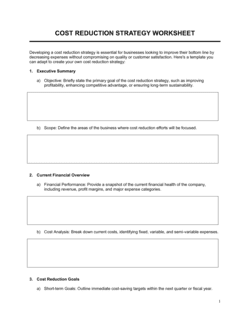
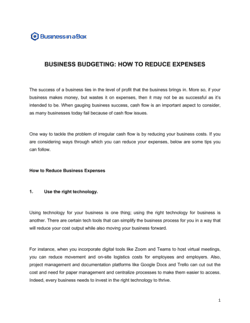
A Business Budgeting: How to Adopt a Cost Reduction Strategy is a structured operational document that guides a business through analyzing its current expenditure, identifying savings opportunities, setting measurable reduction targets, and implementing a prioritized action plan. This free Word download gives you a ready-to-edit framework you can customize for your company's cost structure and export as PDF to share with finance leadership or the board.
When you need it
Use it when margins are compressing, when leadership needs to demonstrate financial discipline to investors or lenders, or when an annual budgeting cycle calls for a formal review of discretionary and fixed costs. It is also the right tool after a merger, acquisition, or rapid headcount change that has left cost structures misaligned with current revenue.
What's inside
An expense baseline analysis, cost categorization framework, savings target matrix, departmental reduction assignments, implementation timeline, risk assessment, and a tracking mechanism for measuring realized savings against plan. Each section includes instructional guidance and editable placeholders so any finance team member can complete it without starting from scratch.

What is a Business Budgeting: How to Adopt a Cost Reduction Strategy?

A Business Budgeting: How to Adopt a Cost Reduction Strategy is a structured operational document that guides a business through the full process of analyzing its current expenditure, classifying costs by type and strategic importance, setting quantified savings targets by department, and building a phased action plan to achieve those targets. Unlike a standard budget β€” which plans future spending β€” this document is specifically oriented toward reducing what the business currently spends, with named owners, initiative-level tracking, and a formal savings validation process. It functions as both a decision-making tool for finance leadership and a governance document that holds department heads accountable for delivering their share of the savings.

Why You Need This Document

Without a structured cost reduction plan, cost-cutting efforts tend to be reactive, inconsistent, and impossible to track β€” resulting in savings that were announced but never confirmed in the financial statements. Department heads cut the wrong things, initiatives stall without clear owners, and leadership cannot tell investors or lenders how much has actually been saved versus how much was targeted. The financial consequence is compounded: unvalidated savings inflate reported progress, delay corrective action, and erode credibility precisely when it matters most. This template forces the discipline that separates a cost program that delivers measurable EBITDA improvement from one that produces a slide deck and no lasting change β€” giving any finance team a repeatable, board-ready framework they can deploy in days rather than weeks.

Which variant fits your situation?

If your situation is…Use this template
Planning a full annual operating budget from scratchAnnual Business Budget
Tracking actual spend against budget month by monthBudget vs. Actual Report
Reducing headcount costs specificallyWorkforce Reduction Plan
Renegotiating vendor and supplier contractsVendor Evaluation and Selection Template
Quick departmental cost snapshot for a single periodDepartmental Budget Template
Presenting financial performance to investors or boardFinancial Report Template
Modeling the financial impact of reduction scenariosFinancial Projections Template

Common mistakes to avoid

❌ Using budget figures instead of actual spend as the baseline

Why it matters: Savings calculated against a budget that was never actually spent produce fictional results. Leadership and the board will see no corresponding improvement in the financial statements.

Fix: Always build the baseline from 12 months of audited or system-confirmed actuals, reconciled to the P&L before any analysis begins.

❌ Applying uniform percentage cuts across all departments

Why it matters: A 10% cut applied equally to R&D and facilities treats strategically critical spend the same as pure overhead, often damaging revenue-generating or compliance functions disproportionately.

Fix: Differentiate targets by cost type, strategic importance, and department spend mix. High-value functions should face smaller percentage cuts or be ring-fenced entirely.

❌ Counting identified savings as realized savings

Why it matters: A vendor negotiation that is 'in progress' or a headcount change that has been 'approved' has not yet produced cash. Reporting it as realized overstates progress and misleads decision-makers.

Fix: Establish a formal validation gate: savings are only counted as realized when the reduced cost appears in two consecutive months of actual financial statements.

❌ No risk assessment or mitigation plan

Why it matters: Cost reduction programs routinely encounter vendor resistance, service gaps, and employee attrition that eliminate a significant portion of targeted savings. Without pre-identified mitigations, recovery is slow and reactive.

Fix: Complete the risk section before launching any initiative. Assign a named owner and a specific contingency action to every risk rated medium or higher.

❌ Setting targets without departmental input

Why it matters: Finance-imposed targets that ignore operational constraints β€” active contracts, minimum service levels, regulatory requirements β€” consistently fail to be achieved and damage trust between finance and operating teams.

Fix: Run a structured input session with each department head before finalizing targets. Allow them to propose alternative paths to the same dollar savings.

❌ Skipping the implementation cost calculation for each initiative

Why it matters: Initiatives that cost more to implement than they save in the first 18 months reduce net cash flow rather than improving it, even if they appear on the savings total.

Fix: Calculate and document the net benefit and payback period for every initiative. Flag any with a payback period longer than 12 months for separate executive approval.

The 8 key sections, explained

Executive Summary

Current Cost Baseline

Cost Categorization and Prioritization

Savings Targets by Department

Cost Reduction Initiatives

Implementation Timeline

Risk Assessment

Savings Tracking and Reporting

How to fill it out

  1. 1

    Pull 12 months of actual expenditure data

    Export all cost data from your accounting system for the most recent full fiscal year, broken down by department and account code. Do not use budget figures β€” actuals are the only reliable baseline.

    πŸ’‘ Reconcile the export total to your audited P&L before building any analysis. A gap of more than 2% signals missing data that will skew every downstream savings estimate.

  2. 2

    Categorize every cost as fixed, variable, or discretionary

    Go line by line and label each cost. Fixed costs are contractually or structurally locked for at least 12 months. Variable costs move with volume. Discretionary costs are neither contractually required nor operationally critical.

    πŸ’‘ Discretionary spend is where most quick wins live β€” identify it first so you can show early momentum while longer-cycle vendor negotiations are underway.

  3. 3

    Score each category by savings potential and implementation difficulty

    Assign an estimated savings range (in dollars) and a difficulty rating (low, medium, high) to each category. Prioritize high-savings, low-difficulty items for Phase 1 of the plan.

    πŸ’‘ A 2Γ—2 matrix plotting savings potential against implementation difficulty makes the prioritization visible and defensible to skeptical stakeholders.

  4. 4

    Set department-level targets with named owners

    Assign a specific dollar reduction target and deadline to each department head. Targets should be differentiated β€” do not apply a uniform percentage cut across all functions.

    πŸ’‘ Share draft targets with department heads before finalizing them. Targets set without operational input consistently underestimate implementation barriers.

  5. 5

    Define each initiative in specific, actionable terms

    Write each initiative as a discrete action with a vendor name, contract value, estimated saving, implementation cost, and owner. Vague initiatives like 'reduce travel' cannot be tracked or owned.

    πŸ’‘ For any initiative with an implementation cost, calculate the payback period explicitly. Drop initiatives with payback periods longer than 18 months unless strategically essential.

  6. 6

    Build a phased implementation timeline

    Sequence initiatives into phases based on dependencies and lead times. Quick wins (contract cancellations, policy changes) go in Phase 1. Complex vendor renegotiations and process redesigns go in Phase 2 or 3.

    πŸ’‘ Map each initiative's start date against your reporting calendar so savings appear in the right fiscal period for board and investor reporting.

  7. 7

    Document risks and mitigation actions

    For each of the top five to seven risks, write a one-sentence description, a likelihood rating, an estimated financial impact, and a specific mitigation action with an owner.

    πŸ’‘ If a single risk could eliminate more than 20% of targeted savings, escalate it to the executive summary and flag it explicitly in leadership communications.

  8. 8

    Define the tracking and reporting cadence before you launch

    Agree on how savings will be validated β€” by whom, using which data source, and on what schedule β€” before initiating any initiative. Establish this before kickoff, not after the first review cycle.

    πŸ’‘ Use the same cost categories in the tracking report as in the baseline analysis so that variance is unambiguous and cannot be reinterpreted between periods.

Frequently asked questions

What is a cost reduction strategy in business budgeting?

A cost reduction strategy is a structured plan that identifies where a business is spending money, determines which costs can be reduced or eliminated without harming operations or revenue, sets quantified savings targets, and defines the specific actions and owners needed to achieve those targets. It differs from a general budget in that it is specifically oriented toward reducing the existing cost base rather than planning future spending from scratch.

When should a business adopt a cost reduction strategy?

The most common triggers are compressing margins, a cash flow shortfall, a funding round that requires demonstrating financial discipline, or an annual budgeting cycle that reveals costs growing faster than revenue. It is also appropriate after a merger or acquisition where overlapping functions and vendor contracts need to be rationalized. Proactive cost reviews in healthy periods are more effective than reactive cuts made under financial pressure.

What is the difference between cost reduction and cost avoidance?

Cost reduction eliminates or lowers expenses that are currently being incurred β€” for example, renegotiating a software contract from $80,000 to $60,000 per year saves $20,000 that was actually being spent. Cost avoidance prevents a future expense from occurring β€” for example, standardizing on an existing tool rather than purchasing a new one. Both are valuable, but cost avoidance does not appear as savings in current financial statements and should be tracked separately.

How do you set realistic cost reduction targets?

Start from 12 months of actual expenditure, categorize every cost as fixed, variable, or discretionary, and assess savings potential for each category based on market benchmarks, contractual flexibility, and operational dependency. Targets should be differentiated by department based on spend mix. Most first-cycle programs achieve 5–15% of the total cost base; targets above 20% in a single year typically require structural changes such as headcount reductions or facility consolidations.

How is savings realization tracked and validated?

Savings are validated only when the reduced cost appears in actual financial statements for two or more consecutive months, compared against the documented baseline. Tracking against a budget or forecast is insufficient β€” savings must be visible in the P&L or cash flow statement to be counted as realized. A monthly review cycle with a named finance owner for each initiative is the standard governance structure.

What is zero-based budgeting and when should it be used?

Zero-based budgeting (ZBB) requires every line item to be justified from zero each budget cycle rather than starting from prior-year actuals. It is more time-intensive than incremental budgeting but is effective for identifying costs that have accumulated without scrutiny over several years. ZBB is most commonly applied to discretionary categories β€” travel, consulting, software subscriptions, and marketing β€” rather than to the entire cost base simultaneously.

How long does a cost reduction program typically take to deliver results?

Quick wins β€” contract cancellations, discretionary spend freezes, and policy changes β€” typically produce savings within 30 to 60 days. Vendor renegotiations take 60 to 120 days depending on contract terms. Process redesigns and technology consolidations generally take 3 to 6 months. A well-structured program should target 30–40% of savings from initiatives completing in the first 90 days to maintain momentum and demonstrate early progress to leadership.

Can cost reduction hurt revenue or customer satisfaction?

Yes, if implemented without a risk assessment. Cuts to customer-facing functions, product development, or quality assurance can reduce service levels in ways that increase churn or damage brand reputation β€” generating losses that exceed the savings. The risk section of the strategy should explicitly model the potential revenue impact of each initiative and require sign-off from sales or customer success leadership on any reduction that touches the customer experience.

Who should own the cost reduction strategy in an organization?

The CFO or finance director typically owns the overall program and consolidated reporting. Individual department heads own the savings targets assigned to their functions. A program management office (PMO) or dedicated project manager is advisable for programs targeting more than $500,000 in annualized savings, as cross-functional coordination and initiative tracking at that scale typically exceed the capacity of a part-time finance resource.

How this compares to alternatives

vs Annual Business Budget

An annual budget plans total spending for the upcoming period across all categories. A cost reduction strategy specifically analyzes the existing cost base to identify what can be cut, renegotiated, or eliminated. The two documents are complementary β€” the reduction strategy informs the targets that feed into the annual budget, but they serve different purposes and are completed at different points in the planning cycle.

vs Financial Projections Template

Financial projections model future revenue, expenses, and cash flow under a set of assumptions. A cost reduction strategy is an action plan for changing those expense assumptions β€” it is the operational document that makes the projected cost line credible. Projections show where you want to go; the cost reduction strategy shows how you will get there.

vs Strategic Plan

A strategic plan sets the 3–5 year direction of the business including growth initiatives, market positioning, and capability investments. A cost reduction strategy is focused narrowly on reducing the current cost base to improve margins or extend runway. The two should be aligned β€” cost cuts that undermine strategic priorities are counterproductive β€” but they are distinct documents with different owners and time horizons.

vs Financial Report

A financial report documents historical performance β€” what was spent, earned, and generated in cash over a prior period. A cost reduction strategy is a forward-looking action plan built from that historical data. The financial report provides the baseline; the cost reduction strategy defines what changes will be made to improve the next period's results.

Industry-specific considerations

SaaS / Technology

Cloud infrastructure rightsizing, software license consolidation, and headcount efficiency ratios (revenue per employee) are the primary levers, with particular attention to avoiding cuts that slow product velocity.

Manufacturing

Materials procurement renegotiation, energy cost reduction, production yield improvement, and overhead absorption rate optimization are the highest-impact levers for reducing cost of goods sold.

Professional Services

Billable utilization rate improvement, subcontractor cost management, and back-office automation are the primary focus areas, given that personnel costs typically represent 60–75% of the total cost base.

Retail / E-commerce

Inventory carrying cost reduction, fulfillment cost per order, returns processing efficiency, and marketing spend ROI are the key cost levers alongside supplier payment term renegotiations.

Healthcare

Supply chain standardization, administrative process automation, and group purchasing organization (GPO) membership for procurement leverage are common strategies, constrained by patient safety and regulatory compliance requirements.

Food and Beverage

Food cost as a percentage of revenue (target 28–35%), portion control standardization, waste reduction, and energy cost management in production and retail locations are the primary cost reduction opportunities.

Template vs pro β€” what fits your needs?

PathBest forCostTime
Use the templateSmall business owners, finance managers, and operators running a first-cycle cost review targeting under $500,000 in savingsFree1–2 weeks (20–40 hours depending on cost base complexity)
Template + professional reviewMid-market companies targeting $500K–$5M in savings where external benchmarking or procurement expertise adds credibility$2,000–$10,000 for a finance consultant or fractional CFO review3–5 weeks
Custom draftedEnterprise cost transformation programs, post-merger integrations, or turnaround situations requiring a dedicated PMO and third-party validation$20,000–$150,000+ for a management consulting engagement8–16 weeks

Glossary

Cost Baseline
A documented snapshot of total current expenditure across all categories, used as the reference point against which savings are measured.
Fixed Costs
Expenses that remain constant regardless of production or revenue volume, such as rent, salaries, and insurance premiums.
Variable Costs
Expenses that fluctuate in proportion to output or sales volume, such as raw materials, shipping, and sales commissions.
Discretionary Spend
Expenditure that is not essential to day-to-day operations and can be reduced or eliminated without immediately affecting core business functions.
Run Rate
The annualized cost projection based on current-period spending β€” calculated by multiplying a monthly or quarterly figure by 12 or 4.
Cost Avoidance
Actions taken to prevent future costs from being incurred, as distinct from reducing costs that are already being spent.
Savings Realization Rate
The percentage of targeted cost reductions that have been confirmed in the financial statements, not just identified on paper.
Zero-Based Budgeting (ZBB)
A budgeting method in which every line item must be justified from zero each period, rather than based on the prior year's figure.
Procurement Leverage
The negotiating advantage a buyer gains by consolidating purchasing volume with fewer vendors or committing to longer-term contracts.
EBITDA Margin
Earnings Before Interest, Taxes, Depreciation, and Amortization expressed as a percentage of revenue β€” a standard measure of operating efficiency.

Part of your Business Operating System

This document is one of 3,000+ business & legal templates included in Business in a Box.

  • Fill-in-the-blanks β€” ready in minutes
  • 100% customizable Word document
  • Compatible with all office suites
  • Export to PDF and share electronically

Create your document in 3 simple steps.

From template to signed document β€” all inside one Business Operating System.
1
Download or open template

Access over 3,000+ business and legal templates for any business task, project or initiative.

2
Edit and fill in the blanks with AI

Customize your ready-made business document template and save it in the cloud.

3
Save, Share, Send, Sign

Share your files and folders with your team. Create a space of seamless collaboration.

Save time, save money, and create top-quality documents.

β˜…β˜…β˜…β˜…β˜…

"Fantastic value! I'm not sure how I'd do without it. It's worth its weight in gold and paid back for itself many times."

Managing Director Β· Mall Farm
Robert Whalley
Managing Director, Mall Farm Proprietary Limited
β˜…β˜…β˜…β˜…β˜…

"I have been using Business in a Box for years. It has been the most useful source of templates I have encountered. I recommend it to anyone."

Business Owner Β· 4+ years
Dr Michael John Freestone
Business Owner
β˜…β˜…β˜…β˜…β˜…

"It has been a life saver so many times I have lost count. Business in a Box has saved me so much time and as you know, time is money."

Owner Β· Upstate Web
David G. Moore Jr.
Owner, Upstate Web

Run your business with a system β€” not scattered tools

Stop downloading documents. Start operating with clarity. Business in a Box gives you the Business Operating System used by over 250,000 companies worldwide to structure, run, and grow their business.

Start freeΒ Β·Β No credit card required