Budgeting Policy Template

Free Word download β€’ Edit online β€’ Save & share with Drive β€’ Export to PDF

12 pagesβ€’25–35 min to fillβ€’Difficulty: Complex
Learn more ↓
FreeBudgeting Policy Template

At a glance

What it is
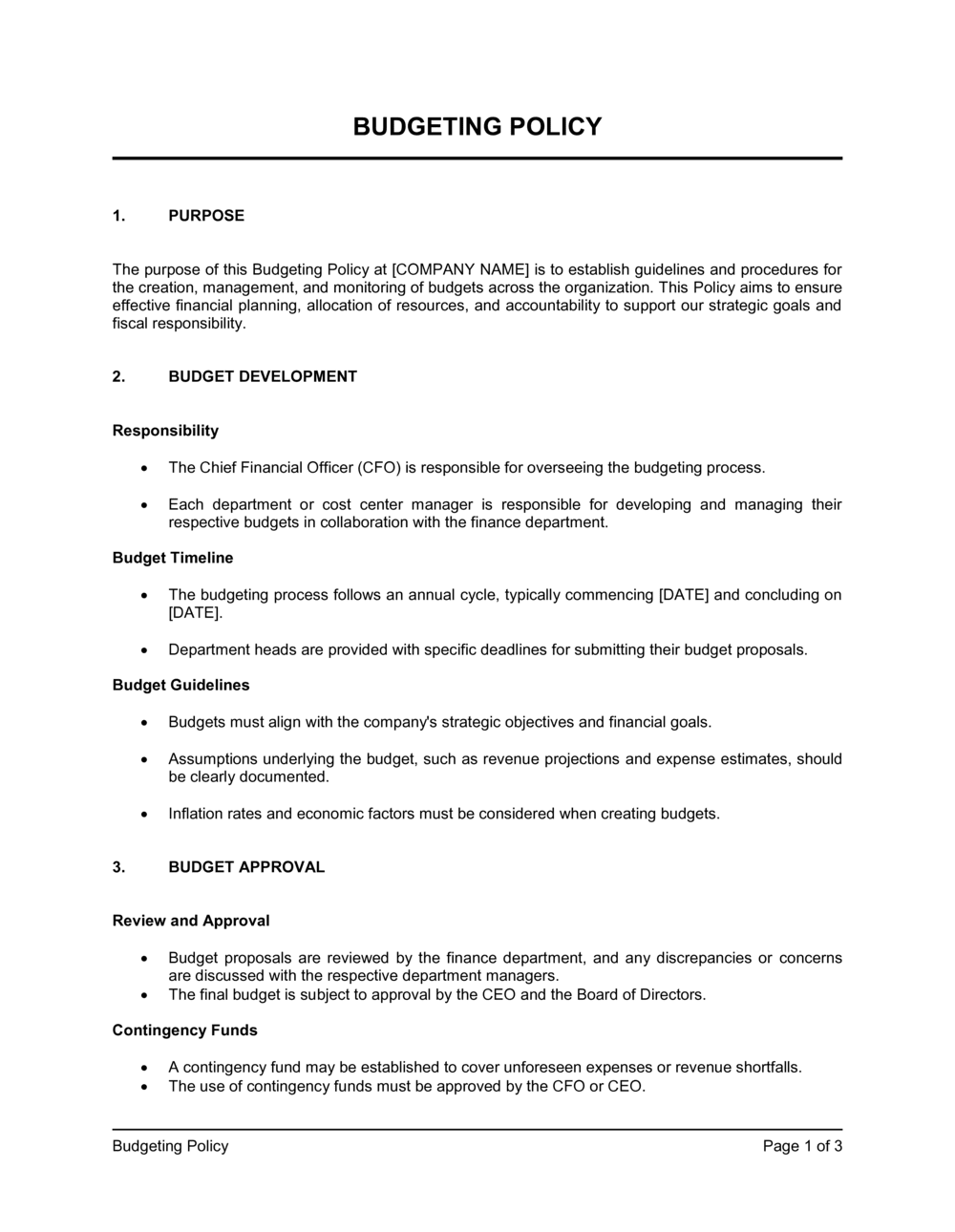
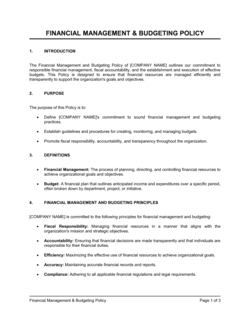
A Budgeting Policy is an internal governance document that formalizes how an organization plans, approves, monitors, and adjusts its financial budgets across departments and periods. This free Word download gives you a ready-to-edit framework you can tailor to your organization's fiscal calendar, approval hierarchy, and reporting requirements, then export as PDF and distribute to all budget owners.
When you need it
Use it when formalizing your annual planning cycle, onboarding new department heads, or responding to audit findings that reveal inconsistent budget practices across the organization.
What's inside
Policy scope and objectives, budget preparation timeline, roles and approval authority, budget categories and classification rules, variance monitoring thresholds, amendment and reforecast procedures, and non-compliance consequences.

What is a Budgeting Policy?

A Budgeting Policy is an internal governance document that defines how an organization prepares, approves, monitors, and amends its financial budgets across departments and fiscal periods. It establishes who owns each step of the planning cycle, sets the dollar thresholds that trigger each level of approval, specifies the variance limits that require a formal management response, and states the consequences of spending outside the approved envelope. Unlike the annual budget itself β€” which contains specific revenue and expenditure figures β€” the budgeting policy is the standing rulebook that governs how every budget is built and controlled, year after year.

Why You Need This Document

Without a formal budgeting policy, financial planning defaults to informal practices that vary by department: some managers submit granular line-item budgets while others provide a single total, approvals happen via email threads with no audit trail, and mid-year reallocations go undocumented. The result is a year-end reconciliation that finance teams cannot close cleanly, and an audit finding that the organization lacks adequate internal controls over financial planning. A documented budgeting policy gives every budget owner a consistent framework to follow, gives auditors and board members evidence that controls are operating as designed, and gives the CFO the authority structure needed to hold departments accountable when spending exceeds approved limits. This template gives you that framework in a ready-to-customize Word format β€” complete with a calendar, approval matrix, and variance thresholds β€” so you can formalize your budget process in hours rather than weeks.

Which variant fits your situation?

If your situation is…Use this template
Setting financial targets for the full organization over a 12-month periodAnnual Budget Plan
Documenting department-level spending limits and categoriesDepartmental Budget Template
Tracking actual spend against the approved budget month by monthBudget Variance Report
Projecting monthly cash position given current budget and receivablesCash Flow Forecast
Requesting additional funds outside the approved annual budgetBudget Amendment Request
Presenting a multi-year financial outlook to investors or a boardFinancial Projections (3-Year)
Governing general financial controls beyond budgetingFinancial Policy and Procedures Manual

Common mistakes to avoid

❌ Omitting enforcement consequences

Why it matters: A policy with no stated consequences for non-compliance is treated as optional guidance. Budget owners who overspend without approval face no formal risk, so violations recur.

Fix: Add a non-compliance section with explicit escalation steps and disciplinary outcomes, and reference it in the onboarding materials for every new budget owner.

❌ Using informal spending category names

Why it matters: When budget categories don't map directly to account codes in the accounting system, finance teams manually reclassify every month β€” adding hours to close and introducing reclassification errors.

Fix: Build the budget category list directly from your chart of accounts and include the account code next to each category name in the policy.

❌ Setting identical approval thresholds for budgeted and unbudgeted spend

Why it matters: Unbudgeted expenditures carry higher risk because they weren't reviewed during the planning cycle. Treating them the same as approved budget lines removes a key control.

Fix: Set the unbudgeted approval threshold at one level tighter β€” for example, if $25,000 budgeted requires CFO approval, set $10,000 unbudgeted at the same level.

❌ Publishing the policy without a review or expiry date

Why it matters: Undated policies accumulate β€” teams don't know which version is current, approval thresholds become outdated, and auditors flag the absence of a review cycle as a control gap.

Fix: Include a version number, effective date, and scheduled next review date on the cover page, and assign a named owner responsible for the annual review.

❌ Skipping the budget calendar section

Why it matters: Without a published calendar, budget submissions arrive at different times from different departments, making consolidation impossible and pushing board approval past the fiscal year start.

Fix: Publish a calendar with specific dates for kickoff, submissions, consolidation, executive review, and board approval β€” and distribute it to all budget owners at the start of each planning cycle.

❌ Allowing mid-year reallocations via informal email approval

Why it matters: Undocumented transfers make year-end reconciliation impossible. Auditors cannot verify that total spend matched the approved budget if reallocations were never formally recorded.

Fix: Require a completed Budget Amendment Form for all reallocations, regardless of size, and maintain a numbered log of all amendments approved during the fiscal year.

The 10 key sections, explained

Purpose and scope

Policy objectives

Roles and responsibilities

Budget calendar and preparation timeline

Budget categories and classification rules

Approval authority matrix

Variance monitoring and reporting

Budget amendments and reforecasts

Non-compliance and consequences

Policy review and maintenance

How to fill it out

  1. 1

    Confirm organizational scope

    Identify every entity, subsidiary, and department the policy will cover. If certain business units follow different fiscal calendars or governance structures, note the exceptions explicitly in the scope section.

    πŸ’‘ List entity names exactly as they appear in your corporate registry β€” informal names cause confusion when the policy is referenced in audit reports.

  2. 2

    Define roles with specific titles, not department names

    Replace generic labels like 'management' or 'finance' with exact job titles β€” CFO, VP Finance, Department Head β€” so accountability is unambiguous. Add an escalation path for when the primary approver is unavailable.

    πŸ’‘ Cross-reference the roles here with your HR org chart to catch any title mismatches before the policy is distributed.

  3. 3

    Set the budget calendar with buffer dates

    Work backward from your board approval meeting to set department submission deadlines. Build in at least five business days between the submission deadline and the finance consolidation deadline to absorb late submissions.

    πŸ’‘ Align your budget kickoff date with the close of the prior fiscal year's Q3 actuals so department heads have current data when building their submissions.

  4. 4

    Map budget categories to your chart of accounts

    Use your accounting software's account codes as the basis for budget line items. Define the CapEx threshold β€” typically a useful life of 12 months and a unit cost above a specific dollar amount β€” and apply it consistently.

    πŸ’‘ Share a completed mapping table with department heads before kickoff. Category confusion is the single biggest cause of reclassification work at month-end close.

  5. 5

    Build the approval authority matrix

    Set dollar thresholds for each approval level covering both budgeted and unbudgeted spend. Use tighter thresholds for unbudgeted items. Include CapEx as a separate row with its own approval requirements.

    πŸ’‘ Benchmark your thresholds against industry norms β€” most mid-sized companies set CFO authority at $25,000–$75,000 and board authority above $100,000 for unbudgeted CapEx.

  6. 6

    Set variance thresholds using both dollar and percentage triggers

    Define the variance levels that require a written management response β€” for example, any line exceeding 10% or $10,000, whichever is lower. Specify who receives the report and the response timeline.

    πŸ’‘ Use the lower of the two triggers to avoid missing significant variances on large budget lines where a small percentage equals a large dollar amount.

  7. 7

    Draft the amendment and reforecast procedure

    Distinguish between a reallocation within an approved envelope (requiring CFO sign-off) and a request for additional budget above the approved envelope (requiring executive committee or board approval). Create a named form for each.

    πŸ’‘ Numbering amendment requests sequentially β€” BA-2026-001 β€” makes it easy to track how many times a department has exceeded its approved budget in a single year.

  8. 8

    Add a version number, effective date, and next review date

    Enter the policy version (e.g., v1.0), the date it takes effect, and the scheduled next review date β€” typically 12 months from the effective date. Include the name and title of the approving authority.

    πŸ’‘ Store the prior version in a version history table at the back of the document so auditors can see what changed and when.

Frequently asked questions

What is a budgeting policy?

A budgeting policy is an internal governance document that formalizes how an organization prepares, approves, monitors, and adjusts its financial budgets. It defines who is responsible for each step of the budget cycle, sets approval authority thresholds, establishes variance monitoring requirements, and specifies the consequences of non-compliance. It differs from a budget itself β€” the policy governs the process; the budget contains the actual numbers.

Why does a company need a formal budgeting policy?

Without a documented policy, budget practices vary by department β€” some managers submit detailed line-item budgets while others provide a single total, and approvals happen informally via email chains that leave no audit trail. A formal policy creates a consistent, auditable process, reduces unauthorized spending, and gives auditors and board members confidence that financial controls are operating as intended.

What is the difference between a budgeting policy and a budget?

A budget is a financial plan β€” specific revenue targets, expense line items, and dollar amounts for a defined period. A budgeting policy is the governance document that defines how the budget is created, who approves it, how variances are monitored, and what happens when spending exceeds the approved amount. The policy remains relatively stable year to year; the budget changes with every planning cycle.

Who should approve the budgeting policy?

Approval authority depends on the organization's governance structure. In most companies, the CFO owns the policy and the CEO or executive committee approves it. Organizations with a board of directors β€” including nonprofits β€” typically route policy approval through the finance committee or the full board. The approving authority should be named explicitly in the policy header.

How often should a budgeting policy be reviewed?

An annual review aligned to the fiscal year-end is standard practice. Trigger an off-cycle review immediately after a significant organizational change β€” merger, acquisition, major restructuring β€” or following an audit finding that reveals a gap in the existing controls. Every reviewed version should carry a new version number and effective date.

What dollar thresholds should the approval authority matrix include?

Thresholds vary by organization size, but a common structure for mid-sized companies is: department head up to $10,000 for budgeted OpEx; CFO up to $50,000; executive committee above $50,000; and board approval for any unbudgeted CapEx above $100,000. Set unbudgeted spend thresholds one level tighter than budgeted amounts at the same dollar value to reflect the higher risk of unplanned expenditures.

What is the difference between a budget reforecast and a budget amendment?

A reforecast updates the expected outcome for the remainder of the year based on current performance β€” it revises the projection without changing the approved spending authority. A budget amendment formally requests additional funds above the approved envelope and requires executive or board approval to take effect. Both should be documented, but they follow different approval paths.

Does a budgeting policy apply to capital expenditures?

Yes β€” in fact, CapEx typically requires a separate section in the budgeting policy because it involves larger amounts, multi-year commitments, and different accounting treatment than OpEx. The policy should define the CapEx threshold (minimum useful life and unit cost), specify the approval authority for CapEx items at each dollar level, and reference the organization's capitalization policy for consistent treatment.

Can a small business benefit from a budgeting policy?

Yes. Even a business with five employees benefits from documenting who can approve spending and up to what amount. A simple one-page policy that sets spending authority, defines budget categories, and requires a monthly review of actuals against plan is sufficient for most small businesses β€” and provides the foundation needed to scale controls as headcount and complexity grow.

How this compares to alternatives

vs Annual Budget Plan

An annual budget plan contains the actual financial figures β€” revenue targets, expense line items, and capital allocations β€” for a specific fiscal year. A budgeting policy governs the process by which that plan is built and approved. You need both: the policy defines the rules; the annual budget applies them.

vs Financial Policy and Procedures Manual

A financial policy and procedures manual covers the full range of financial controls β€” expense reimbursement, procurement, payroll, and treasury management. A budgeting policy focuses specifically on the planning, approval, and monitoring cycle. The budgeting policy is typically incorporated by reference into the broader manual.

vs Cash Flow Forecast

A cash flow forecast projects the timing and amount of cash inflows and outflows over a future period. A budgeting policy is the governance document that defines how spending limits are set and monitored. The forecast is an output of the budget process; the policy is the framework that produces it.

vs Budget Variance Report

A budget variance report is a recurring operational document that compares actual spending to the approved budget for a given period. A budgeting policy defines how often that report is produced, who reviews it, and what variance thresholds trigger a formal response. The report implements a specific requirement of the policy.

Industry-specific considerations

Professional Services

Billable utilization targets drive department budgets; reforecast cycles align with project pipeline changes and partner compensation reviews.

Nonprofit Organizations

Funder reporting requirements and grant restrictions make documented budget controls a condition of compliance; board-level approval is typically mandatory.

Manufacturing

CapEx planning for equipment cycles and production capacity is central; variance monitoring covers material costs, labor, and overhead separately.

Retail / E-commerce

Seasonal demand cycles require mid-year reforecasts; marketing and inventory budgets are closely linked and often need rapid reallocation authority.

Healthcare

Regulatory and accreditation bodies expect documented financial controls; staffing and supply budgets are subject to strict compliance review.

SaaS / Technology

Headcount and cloud infrastructure costs dominate the budget; rapid growth makes quarterly reforecasts standard rather than annual.

Template vs pro β€” what fits your needs?

PathBest forCostTime
Use the templateSmall to mid-sized businesses formalizing their budget process for the first timeFree2–4 hours to customize and distribute
Template + professional reviewOrganizations preparing for an external audit, board governance review, or ISO certification$300–$800 for a controller or CPA review1–3 days
Custom draftedLarge enterprises, regulated industries, or organizations with complex multi-entity structures requiring bespoke controls$2,000–$6,000 for a financial controls consultant2–4 weeks

Glossary

Budget Owner
The individual β€” typically a department head or cost center manager β€” accountable for preparing, monitoring, and reporting on a specific portion of the budget.
Cost Center
An organizational unit that incurs costs but does not directly generate revenue, such as HR, IT, or finance.
Budget Envelope
The total approved spending limit allocated to a department or project for a defined period.
Variance
The difference between a budgeted amount and the actual amount spent or earned, expressed in dollars and as a percentage.
Reforecast
A mid-period revision to the original budget based on actual performance and updated assumptions, without changing the approved baseline.
Commitment Accounting
Recording a budget obligation at the point a purchase order or contract is signed, before the invoice is received or paid.
Zero-Based Budgeting
A budgeting method that requires every expense to be justified from zero each period, rather than incrementally adjusting the prior year's figures.
Capital Expenditure (CapEx)
Spending on long-term assets β€” equipment, property, or software β€” that is capitalized on the balance sheet rather than expensed immediately.
Operating Expenditure (OpEx)
Day-to-day spending on goods and services consumed within the current period, expensed directly in the income statement.
Approval Authority Matrix
A table specifying which individual or committee must approve expenditures at each dollar threshold β€” for example, department head up to $10,000, CFO up to $50,000, and board above $50,000.

Part of your Business Operating System

This document is one of 3,000+ business & legal templates included in Business in a Box.

  • Fill-in-the-blanks β€” ready in minutes
  • 100% customizable Word document
  • Compatible with all office suites
  • Export to PDF and share electronically

Create your document in 3 simple steps.

From template to signed document β€” all inside one Business Operating System.
1
Download or open template

Access over 3,000+ business and legal templates for any business task, project or initiative.

2
Edit and fill in the blanks with AI

Customize your ready-made business document template and save it in the cloud.

3
Save, Share, Send, Sign

Share your files and folders with your team. Create a space of seamless collaboration.

Save time, save money, and create top-quality documents.

β˜…β˜…β˜…β˜…β˜…

"Fantastic value! I'm not sure how I'd do without it. It's worth its weight in gold and paid back for itself many times."

Managing Director Β· Mall Farm
Robert Whalley
Managing Director, Mall Farm Proprietary Limited
β˜…β˜…β˜…β˜…β˜…

"I have been using Business in a Box for years. It has been the most useful source of templates I have encountered. I recommend it to anyone."

Business Owner Β· 4+ years
Dr Michael John Freestone
Business Owner
β˜…β˜…β˜…β˜…β˜…

"It has been a life saver so many times I have lost count. Business in a Box has saved me so much time and as you know, time is money."

Owner Β· Upstate Web
David G. Moore Jr.
Owner, Upstate Web

Run your business with a system β€” not scattered tools

Stop downloading documents. Start operating with clarity. Business in a Box gives you the Business Operating System used by over 250,000 companies worldwide to structure, run, and grow their business.

Free Forever PlanΒ Β·Β No credit card required