Board Resolution Authorizing the Issue of Corporate Credit Cards Template

Free Word download • Edit online • Save & share with Drive • Export to PDF

1 page20–30 min to fillDifficulty: StandardSignature requiredLegal review recommended
Learn more ↓
FreeBoard Resolution Authorizing the Issue of Corporate Credit Cards Template

At a glance

What it is
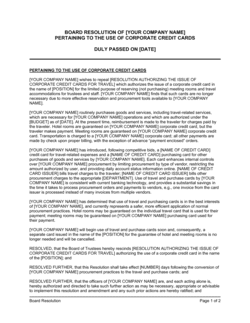
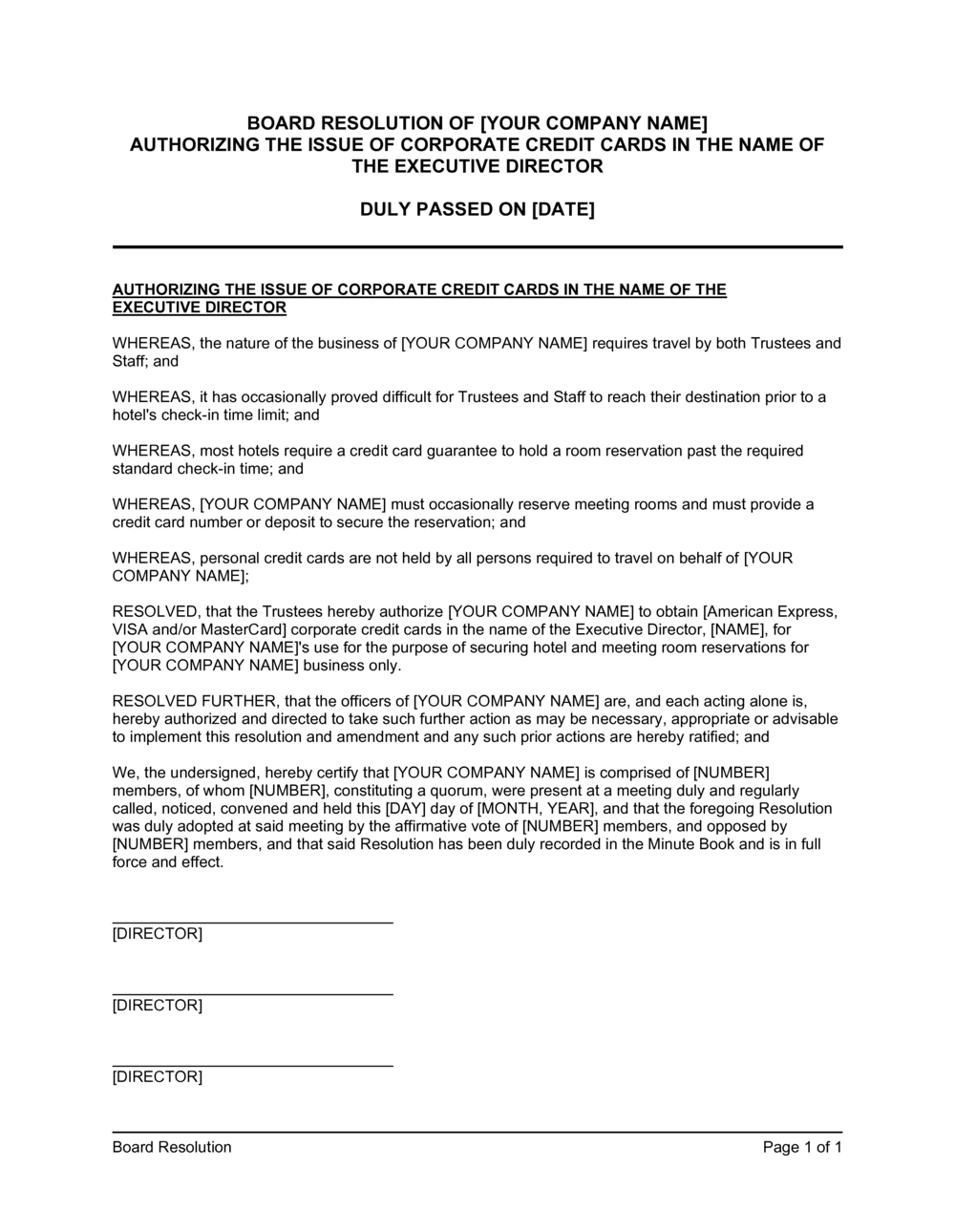
A Board Resolution Authorizing the Issue of Corporate Credit Cards is a formal corporate governance document in which the board of directors officially approves the opening of one or more company credit card accounts, designates authorized cardholders and spending limits, and delegates signing authority to named officers. This free Word download gives you a ready-to-edit template you can adapt to your corporate structure and export as PDF for filing with your card issuer, auditors, or corporate secretary.
When you need it
Use it when your company first applies for a corporate credit card program, adds new cardholders to an existing program, or when a financial institution requires documented board approval before issuing cards. Banks and card issuers routinely require a certified resolution before opening a commercial credit account in the company's name.
What's inside
The template covers the meeting header and quorum confirmation, recitals establishing the business purpose, the authorizing operative clauses naming cardholders and spending limits, delegation of authority to specific officers, ratification of prior acts, and signature and certification blocks for the corporate secretary.

What is a Board Resolution Authorizing the Issue of Corporate Credit Cards?

A Board Resolution Authorizing the Issue of Corporate Credit Cards is a formal corporate governance document in which a company's board of directors officially approves the establishment of a corporate credit card program, identifies the financial institution, designates authorized cardholders, sets spending limits, and delegates authority to a named officer to execute the card agreement on the company's behalf. As a legal instrument, it sits in the company's minute book as the documented basis for the credit obligation and satisfies the know-your-customer and account-opening requirements that banks impose before issuing commercial credit in a company's name. This free Word download gives you a ready-to-edit template that follows standard corporate governance conventions and can be certified by your corporate secretary and submitted directly to your card issuer.

Why You Need This Document

Without a properly adopted and certified board resolution, most financial institutions will not open a corporate credit card account — full stop. Even when a bank informally issues a card, the absence of a resolution leaves the company without documented authority for the credit obligation, creating serious exposure: auditors will flag the gap as a material internal-control weakness, the officer who signed the application may have acted without board authority, and any dispute with the issuer over unauthorized charges becomes significantly harder to resolve in the company's favor. Beyond satisfying the bank, the resolution creates the governance foundation for your entire card program — it establishes who is authorized, to what limit, and under what policy, giving you an enforceable basis to recover personal or unauthorized charges from employees. A signed, certified resolution completed before the application is submitted costs under 30 minutes and closes every one of these risks.

Which variant fits your situation?

If your situation is…Use this template
Opening an initial corporate credit card account for the first timeBoard Resolution Authorizing the Issue of Corporate Credit Cards
Authorizing officers to open a bank account rather than a credit lineBoard Resolution to Open a Bank Account
Approving a company loan or line of creditBoard Resolution Authorizing a Bank Loan
Delegating signing authority to a specific officer for all financial instrumentsBoard Resolution Authorizing Signing Authority
Adopting or updating a formal corporate credit card expense policyCorporate Credit Card Policy
Documenting a unanimous written consent instead of a formal meetingUnanimous Written Consent of the Board of Directors
Authorizing a purchase of equipment or capital asset by creditBoard Resolution Authorizing Purchase of Capital Assets

Common mistakes to avoid

❌ Signing the resolution after submitting the card application

Why it matters: Banks require a certified resolution as a condition of account opening. A resolution backdated to pre-date the application raises fraud concerns during bank due diligence and can result in account closure.

Fix: Pass and certify the resolution before submitting any card application to the issuer. Keep the date sequence consistent across all submitted documents.

❌ Listing individual employee names instead of delegating to a role

Why it matters: Every time a named cardholder is added, removed, or changes title, the resolution is technically outdated. Auditors and issuers may flag a resolution that doesn't reflect current cardholders.

Fix: Authorize a specific officer (e.g., the CFO) to add and remove cardholders within board-set limits, so day-to-day changes don't require a new board vote.

❌ Omitting spending limits from the resolution

Why it matters: Without documented limits, the company has no contractual basis to dispute unauthorized charges with employees, and auditors will flag the absence of documented financial controls.

Fix: State at minimum a per-cardholder monthly maximum in the resolution and reference a separate policy for transaction-level and category-level controls.

❌ Using a generic 'any officer' authorization instead of a named title

Why it matters: Card issuers require a specific named individual or title to process the application. Vague authority causes the application to be rejected or delayed, and can create ambiguity about who is personally on the hook.

Fix: Name a specific title (e.g., 'Chief Financial Officer') and the current holder's full legal name in the delegation clause. Update the resolution if the officer changes before the account opens.

❌ Failing to file the certified resolution in the minute book

Why it matters: A resolution that exists only as a scanned PDF sent to the bank has no proper corporate record. In litigation or an audit, the absence of a minute-book entry can be treated as evidence that no valid resolution exists.

Fix: File the executed original in the corporate minute book and retain a certified copy for the bank's file. Note the resolution in the board meeting minutes by reference.

❌ Embedding expense policy details directly in the resolution

Why it matters: Every change to eligible categories, receipt thresholds, or reimbursement timelines technically requires an amendment to the resolution, which requires another board vote.

Fix: Reference a separately maintained and dated Credit Card Use Policy for all operational details. The resolution only needs to authorize the program and set top-level limits.

The 9 key clauses, explained

Meeting header and quorum confirmation

In plain language: Establishes when and where the board met (or that written consent was used), who was present, and that a quorum existed to make the resolution valid.

Sample language
A duly called meeting of the Board of Directors of [COMPANY LEGAL NAME] ('Corporation') was held on [DATE] at [TIME] at [LOCATION / via [PLATFORM]]. The following directors were present: [LIST OF NAMES], constituting a quorum of the Board.

Common mistake: Failing to confirm quorum in writing. If the resolution is ever challenged, the absence of a quorum record can void the authorization and expose the company to liability with the card issuer.

Recitals (WHEREAS clauses)

In plain language: Sets out the business purpose for issuing corporate credit cards — typically to facilitate employee travel, procurement, and operating expenses — and confirms the board has reviewed the relevant terms.

Sample language
WHEREAS, the Corporation wishes to establish a corporate credit card program with [BANK/ISSUER NAME] to facilitate authorized business expenditures by designated employees and officers; and WHEREAS, the Board has reviewed the proposed card agreement terms and finds them to be in the best interests of the Corporation;

Common mistake: Omitting the recitals entirely to save space. Recitals establish the documented business purpose, which is important evidence if the program is later scrutinized by auditors or in litigation.

Authorization to open the credit card account

In plain language: The primary operative clause formally resolving that the corporation is authorized to enter into a credit card agreement with a named financial institution.

Sample language
RESOLVED THAT the Corporation is hereby authorized to enter into a corporate credit card agreement with [BANK/ISSUER NAME] and to open one or more corporate credit card accounts in the name of the Corporation on terms and conditions approved by the [CEO / CFO / PRESIDENT].

Common mistake: Naming a specific card product or account number in this clause. Product names and account numbers change — tie the authorization to the institution and purpose, not a specific product.

Designation of authorized cardholders

In plain language: Lists the specific officers, employees, or roles approved to hold and use a corporate card, or delegates authority to a named officer to designate cardholders within a defined scope.

Sample language
FURTHER RESOLVED THAT the following individuals are hereby authorized to hold and use a corporate credit card on behalf of the Corporation: [NAME / TITLE], [NAME / TITLE]; and that the [CFO] is authorized to add or remove cardholders from time to time, subject to the Corporation's credit card policy.

Common mistake: Listing individual employee names rather than delegating to an officer. Employee turnover forces a new resolution every time a cardholder changes — delegation to a role (e.g., CFO) is more durable.

Spending limits and use restrictions

In plain language: Sets per-cardholder or per-transaction spending limits and restricts use to authorized business purposes, referencing the corporate credit card policy for detail.

Sample language
FURTHER RESOLVED THAT each authorized cardholder shall be subject to a monthly spending limit of $[AMOUNT] per card, and that all charges shall be limited to bona fide business expenses in accordance with the Corporation's Credit Card Use Policy dated [DATE], as amended from time to time.

Common mistake: Embedding granular expense categories in the resolution rather than referencing a separate policy. The resolution becomes unwieldy, and every policy update requires a new board vote.

Delegation of authority to execute agreements

In plain language: Authorizes a specific officer — typically the CEO or CFO — to sign the card application, cardholder agreements, and any related documents with the issuing bank.

Sample language
FURTHER RESOLVED THAT the [CEO / CFO / PRESIDENT] of the Corporation, [NAME], is hereby authorized and directed to execute and deliver, on behalf of the Corporation, any and all applications, agreements, and other documents required by [BANK/ISSUER NAME] in connection with the corporate credit card program.

Common mistake: Authorizing 'any officer' to sign without naming a specific title or individual. Card issuers typically require a named officer on the resolution; vague authority can cause the application to be rejected.

Personal liability and indemnification acknowledgment

In plain language: Clarifies whether cardholders bear personal liability for unauthorized charges and states the corporation's indemnification position for charges made within policy.

Sample language
FURTHER RESOLVED THAT cardholders shall be personally liable for any charges that are not approved business expenses under the Corporation's Credit Card Use Policy, and that the Corporation shall reimburse authorized charges submitted with supporting receipts within [30] days of submission.

Common mistake: Omitting personal liability language entirely. Without it, recovering unauthorized or personal charges from employees is legally ambiguous and difficult to enforce.

Ratification of prior acts

In plain language: Retroactively approves any steps already taken by officers in connection with the credit card program before the resolution was formally adopted.

Sample language
FURTHER RESOLVED THAT any and all actions previously taken by any officer or director of the Corporation in connection with the establishment of the corporate credit card program are hereby ratified, confirmed, and approved as acts of the Corporation.

Common mistake: Including a ratification clause when no prior acts have occurred. While harmless, a boilerplate ratification when nothing was done in advance can create confusion during due diligence about what acts are being ratified.

Certification by corporate secretary

In plain language: The corporate secretary's signed attestation that the resolution was duly adopted, that it is a true and accurate extract from the minute book, and that it remains in full force.

Sample language
I, [SECRETARY NAME], Secretary of [COMPANY LEGAL NAME], hereby certify that the foregoing is a true and correct copy of a resolution duly adopted by the Board of Directors at a meeting held on [DATE], at which a quorum was present and acting throughout, and that such resolution has not been amended or rescinded and remains in full force and effect.

Common mistake: Having a director (other than the secretary) sign the certification. Banks require the corporate secretary's signature specifically — a director's signature alone will typically not satisfy the issuer's requirements.

How to fill it out

  1. 1

    Insert the corporation's legal name and state of incorporation

    Use the full registered legal name exactly as it appears on your certificate of incorporation or articles of organization. Include the state or province of formation.

    💡 Cross-reference your corporate registry filing before completing this field — a name mismatch between the resolution and the card application is the most common reason issuers reject submissions.

  2. 2

    Record the meeting date, time, location, and attending directors

    List every director present by full name. If the resolution is adopted by unanimous written consent instead of a meeting, substitute the consent execution date and note the written consent procedure.

    💡 For distributed or remote boards, state the video-conferencing platform and confirm in the recitals that all participants could hear and be heard — some jurisdictions require this for a valid meeting.

  3. 3

    Confirm quorum and identify the presiding officer

    State the total number of directors currently serving and the number present, confirming that the quorum threshold in your bylaws was met. Name the chair of the meeting.

    💡 Check your bylaws for the exact quorum definition — some companies require a majority of the entire board, others only a majority of those in office.

  4. 4

    Name the financial institution and credit program

    Enter the full legal name of the bank or card issuer. Reference the credit program by type (e.g., commercial Visa, Mastercard corporate card) but avoid embedding account numbers that may change.

    💡 Ask your bank relationship manager for the exact entity name they require on corporate resolutions — it sometimes differs from the consumer-facing brand name.

  5. 5

    Complete the authorized cardholders and spending limits

    Either list specific individuals by name and title or delegate authority to a named officer (typically the CFO) to designate cardholders within the limits stated in the resolution.

    💡 Delegating to a role rather than listing individuals by name will save you from needing a new resolution every time an employee leaves or is promoted.

  6. 6

    Reference your corporate credit card policy

    Link the resolution to a separately maintained credit card use policy that governs eligible expense categories, receipt requirements, and reimbursement timelines. State the policy date.

    💡 If you do not yet have a formal policy, adopt one at the same board meeting and reference it in the resolution — many issuers and auditors expect both documents together.

  7. 7

    Have the authorized officer sign the application section

    Ensure the officer named in the delegation clause (typically CEO or CFO) signs any bank application documents. Their title in the resolution must match what appears on the application.

    💡 Some issuers require a personal guarantee from the principal officer on small-business corporate cards — confirm this requirement before the meeting so the right person is present.

  8. 8

    Have the corporate secretary certify and date the resolution

    The corporate secretary signs the certification block, attesting that the resolution was duly adopted, reflects accurate meeting details, and has not been revoked. File the original in the minute book.

    💡 Provide the bank with a certified copy — not the original. Keep the original in the minute book and prepare a copy bearing the secretary's 'certified true copy' stamp or notation.

Frequently asked questions

What is a board resolution authorizing corporate credit cards?

A board resolution authorizing corporate credit cards is a formal decision recorded in writing by a company's board of directors that approves the opening of a corporate credit card account, designates who may hold cards, sets spending limits, and delegates authority to a named officer to execute the card agreement with a financial institution. Banks and card issuers typically require this document before they will open a commercial credit account in the company's name.

Why do banks require a board resolution for a corporate credit card?

Financial institutions require a board resolution because a corporation can only act through its authorized agents, and banks need documented proof that the board — not just a single employee — has approved the creation of the credit obligation. The resolution also identifies who is authorized to sign the application, making it a key part of the issuer's know-your-customer and account-opening compliance process. Without it, the bank has no assurance that the officer signing the application had authority to bind the company.

Who signs a board resolution authorizing corporate credit cards?

The resolution itself is adopted by the board of directors at a duly called meeting (or by unanimous written consent) and does not require individual director signatures on the resolution document in most jurisdictions — though some companies include a director signature block for clarity. The certification block at the bottom must be signed by the corporate secretary, who attests that the resolution was properly adopted. The bank application is then signed by the officer named in the delegation clause, typically the CEO or CFO.

Can an LLC use a board resolution to authorize corporate credit cards?

LLCs do not have boards of directors; they have members or managers. The equivalent document for an LLC is a Manager's Resolution or a Member Consent authorizing the credit card program. The substance is identical — it identifies the institution, designates authorized cardholders, sets limits, and delegates signing authority — but the governance terminology reflects the LLC structure rather than a corporate one. Most card issuers accept either format provided it is properly executed.

Does the resolution need to be notarized?

Notarization is not required for a corporate credit card resolution in most jurisdictions. The corporate secretary's certification is generally sufficient for bank purposes. Some international issuers or government-related accounts may request a notarized certification or an apostille, but this is the exception rather than the rule for domestic commercial card programs.

How often does a board resolution for corporate credit cards need to be updated?

The resolution does not need to be updated for routine day-to-day changes if it delegates cardholder management authority to a named officer. You should pass a new or amended resolution when the authorized financial institution changes, the credit limit or program type changes materially, the delegated officer changes, or the company undergoes a structural change such as a merger, reincorporation, or name change. Many companies review their banking and financial resolutions annually as part of the board's organizational meeting.

What is the difference between a board resolution and a corporate credit card policy?

A board resolution is a governance document that creates the legal authority for the corporation to enter into the credit card agreement and designates who may act on its behalf. A corporate credit card policy is an operational document that governs how cardholders use the cards day-to-day — eligible expense categories, receipt requirements, approval workflows, and reimbursement timelines. Both are needed: the resolution opens the account; the policy controls how it is used. The resolution should reference the policy by name and date rather than duplicating its contents.

What happens if a company issues corporate credit cards without a board resolution?

Without a board resolution, the officer who signed the card application may have done so without documented authority, potentially exposing both the officer and the company to claims of unauthorized action. Auditors will flag the absence of documented board approval as a material control weakness, and some card issuers may suspend the account if the oversight is discovered during a later compliance review. In the event of a dispute with the issuer or an unauthorized-charges claim, the absence of a resolution complicates the company's legal position.

How this compares to alternatives

vs Board Resolution to Open a Bank Account

A bank account resolution authorizes the company to open a deposit account and designates who may sign checks and initiate transfers — a debit authorization. A corporate credit card resolution authorizes the company to take on a revolving credit obligation. Both are required by financial institutions, but they cover different types of accounts and are typically submitted as separate documents to the bank.

vs Corporate Credit Card Policy

A corporate credit card policy is an operational document governing day-to-day card use — eligible expenses, receipt submission, approval chains, and consequences for misuse. The board resolution creates the legal authority to have the cards at all. The resolution should reference the policy by name; the policy should not replace the resolution as a governance document.

vs Unanimous Written Consent of the Board

A unanimous written consent is the procedural vehicle used when the board wants to adopt a resolution without holding a formal meeting. The corporate credit card resolution is the substantive decision being made. You can use a unanimous written consent form to adopt the credit card resolution, but they are not interchangeable — one is the procedure, the other is the content.

vs Employee Expense Reimbursement Policy

An expense reimbursement policy governs the process by which employees submit personal out-of-pocket expenses for repayment. A corporate credit card resolution governs the issuance of company-liability cards that charge directly to the corporation. Some companies use both in parallel — cards for frequent travelers, reimbursement for occasional expenses — and each requires its own governance documentation.

Industry-specific considerations

Professional Services

Firms issue cards to client-facing professionals for travel, client entertainment, and software subscriptions, requiring tight per-employee limits and an expense reconciliation workflow tied to client billing.

Construction and Trades

Cards are used for materials, equipment rentals, and fuel; resolutions typically delegate cardholder authority to a project manager tier and require job-code allocation on every charge.

Retail and E-commerce

Cards are issued to buyers and store managers for inventory purchases and vendor payments, with category-level merchant restrictions and daily limits built into the policy referenced by the resolution.

Technology / SaaS

Engineering and marketing teams use cards for cloud infrastructure, software licenses, and advertising spend; boards often authorize virtual card programs with per-vendor limits rather than physical cards.

Healthcare

Strict controls are needed to separate clinical supply purchases from administrative expenses; the resolution typically requires dual approval above a per-transaction threshold to satisfy compliance requirements.

Nonprofit Organizations

Grant funders and auditors require documented board approval of any credit instrument; resolutions must align with the organization's conflict-of-interest policy and prohibit personal charges with particular care.

Jurisdictional notes

United States

Corporate resolutions are governed by state corporation law and the company's bylaws. Most US states (following the Model Business Corporation Act) permit board action by unanimous written consent without a meeting. Delaware corporations should ensure the resolution language aligns with DGCL §141(f) for written consents. Some card issuers have their own required resolution format — confirm with your bank before using a custom template.

Canada

Under the Canada Business Corporations Act and provincial equivalents, directors may pass resolutions by unanimous written consent. The resolution should identify the corporation by its registered name under the CBCA or provincial act. Quebec corporations operating under the Business Corporations Act (Quebec) should ensure French-language compliance if the resolution is to be used in a provincially regulated context. Canadian banks typically accept a certified resolution in either official language.

United Kingdom

Under the Companies Act 2006, private companies may pass board resolutions by written consent of all directors without a board meeting (s. 248). The resolution should be filed in the company's statutory books and signed by a director or the company secretary. UK card issuers may require a Companies House registration number on the resolution. Public companies (PLCs) must pass resolutions at a properly convened board meeting.

European Union

EU member states each have their own company law requirements for board resolutions. France, Germany, and Spain all permit written board resolutions for routine corporate acts, but the formality requirements — notarial involvement, specific wording, filing with the commercial registry — vary by country. For companies operating across multiple EU jurisdictions, the resolution language should be reviewed against each applicable national law. GDPR considerations arise if cardholder names and data are shared with the issuing bank across borders.

Template vs lawyer — what fits your deal?

PathBest forCostTime
Use the templateSmall and mid-sized companies opening a standard commercial credit card account with a domestic bankFree15–30 minutes
Template + legal reviewCompanies with complex governance structures, multiple authorized signers, or issuers requiring custom resolution language$150–$400 for a one-hour attorney or corporate secretary review1–2 days
Custom draftedPublic companies, heavily regulated industries, or cross-border card programs requiring jurisdiction-specific authority language$500–$2,000+3–7 days

Glossary

Board Resolution
A formal written record of a decision made by a corporation's board of directors, adopted either at a duly called meeting or by unanimous written consent.
Quorum
The minimum number of directors who must be present or represented at a meeting for the board to validly conduct business and pass resolutions.
Operative Clause
The portion of a resolution that states what the board has actually decided or authorized — introduced by words such as 'RESOLVED THAT' or 'BE IT FURTHER RESOLVED.'
Recital
A preliminary 'WHEREAS' clause that explains the background, purpose, or business reason behind the resolution without itself constituting the decision.
Certified Resolution
A copy of a board resolution signed by the corporate secretary attesting that it was duly adopted and is a true extract from the minute book.
Signing Authority
The delegated power granted by the board to a named officer or employee to execute agreements, open accounts, or otherwise bind the corporation.
Corporate Credit Card
A credit card issued in the company's name and liability, provided to employees or officers for authorized business expenditures.
Spending Limit
A maximum dollar amount per transaction, per month, or per cardholder that the board or policy caps to control corporate credit exposure.
Ratification
Formal board approval of actions already taken by an officer or agent before the resolution was passed, giving those acts retrospective legal authority.
Corporate Secretary
The officer responsible for maintaining corporate records, preparing minutes, certifying resolutions, and ensuring compliance with governance obligations.
Unanimous Written Consent
A procedure allowing a board to adopt a resolution without holding a formal meeting, provided all directors sign the written consent document.

Part of your Business Operating System

This document is one of 3,000+ business & legal templates included in Business in a Box.

  • Fill-in-the-blanks — ready in minutes
  • 100% customizable Word document
  • Compatible with all office suites
  • Export to PDF and share electronically

Create your document in 3 simple steps.

From template to signed document — all inside one Business Operating System.
1
Download or open template

Access over 3,000+ business and legal templates for any business task, project or initiative.

2
Edit and fill in the blanks with AI

Customize your ready-made business document template and save it in the cloud.

3
Save, Share, Send, Sign

Share your files and folders with your team. Create a space of seamless collaboration.

Save time, save money, and create top-quality documents.

★★★★★

"Fantastic value! I'm not sure how I'd do without it. It's worth its weight in gold and paid back for itself many times."

Managing Director · Mall Farm
Robert Whalley
Managing Director, Mall Farm Proprietary Limited
★★★★★

"I have been using Business in a Box for years. It has been the most useful source of templates I have encountered. I recommend it to anyone."

Business Owner · 4+ years
Dr Michael John Freestone
Business Owner
★★★★★

"It has been a life saver so many times I have lost count. Business in a Box has saved me so much time and as you know, time is money."

Owner · Upstate Web
David G. Moore Jr.
Owner, Upstate Web

Run your business with a system — not scattered tools

Stop downloading documents. Start operating with clarity. Business in a Box gives you the Business Operating System used by over 250,000 companies worldwide to structure, run, and grow their business.

Free Forever Plan · No credit card required