Board Resolution Authorizing the President to Renew Employment Agreements Template

Free Word download • Edit online • Save & share with Drive • Export to PDF

1 page20–30 min to fillDifficulty: StandardSignature requiredLegal review recommended
Learn more ↓
FreeBoard Resolution Authorizing the President to Renew Employment Agreements Template

At a glance

What it is
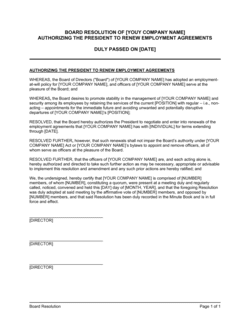
A Board Resolution Authorizing the President to Renew Employment Agreements is a formal corporate governance document in which a company's board of directors officially delegates authority to the president (or equivalent officer) to execute renewal agreements with existing employees. This free Word download provides a ready-to-use resolution you can edit online and export as PDF for inclusion in corporate minute books and HR records.
When you need it
Use it when employment agreements with key personnel are approaching their expiration date and the board wishes to formally authorize the president to negotiate and sign renewal contracts on the corporation's behalf without requiring a separate board vote for each individual agreement.
What's inside
Recitals identifying the corporation and the renewal context, a formal delegation clause granting the president signing authority, scope limitations defining which agreements and terms are covered, a ratification clause for acts already taken, and certification language for the corporate secretary.

What is a Board Resolution Authorizing the President to Renew Employment Agreements?

A Board Resolution Authorizing the President to Renew Employment Agreements is a formal corporate governance document through which a company's board of directors officially delegates signing authority to the president — or equivalent chief officer — to negotiate and execute renewed employment contracts on the corporation's behalf. Rather than requiring the full board to convene and vote each time an individual employment agreement comes up for renewal, this resolution consolidates that authority in a single instrument, defining the scope of permitted terms and setting a sunset date on the delegation. It becomes part of the corporation's permanent minute book and provides the paper trail that third parties — employees, auditors, lenders, and investors — rely on to confirm that the president had proper authority to act.

Why You Need This Document

Without a board resolution on file, a president who signs employment renewal agreements may technically be acting outside their documented authority — making those agreements voidable and exposing both the officer and the corporation to legal risk. Employment agreements create long-term obligations around compensation, benefits, intellectual property, and severance; the board has a governance responsibility to authorize them before they are executed, not after. Lenders and institutional investors routinely review corporate minute books during due diligence, and gaps in the authority chain for employment actions are among the most common findings that delay or derail financing. A properly drafted resolution, adopted before renewal negotiations begin and filed in the minute book immediately after execution, closes this exposure in under 30 minutes — and this template gives you the exact language to do it correctly the first time.

Which variant fits your situation?

If your situation is…Use this template
Authorizing the president to sign brand-new employment agreements, not renewalsBoard Resolution Authorizing the President to Enter Into Employment Agreements
Authorizing a specific officer other than the president to sign contractsBoard Resolution Authorizing an Officer to Sign Contracts
Approving a specific executive's compensation package at the board levelBoard Resolution Approving Executive Compensation
Recording a board decision on a different corporate matter entirelyGeneral Board Resolution
Documenting unanimous written consent in lieu of a formal board meetingUnanimous Written Consent of the Board of Directors
Authorizing the president to execute independent contractor agreements insteadBoard Resolution Authorizing Independent Contractor Agreements
Renewing a specific C-suite executive agreement with equity and severance termsExecutive Employment Agreement

Common mistakes to avoid

❌ Authorizing the president by name rather than title

Why it matters: If the named individual vacates the president role before all renewals are signed, the authority technically lapses — creating a gap the successor cannot fill without a new resolution.

Fix: Always reference 'the President of the Corporation' as a title, with the current holder's name included parenthetically for context only: 'the President (currently [NAME]).'
❌ Granting unlimited delegation with no scope restrictions

Why it matters: An unconstrained resolution could allow the president to renew agreements at any salary level, with any benefits package, or for any duration — committing the corporation far beyond what the board intended.

Fix: Include specific parameter limits in a Schedule A or in the body of the resolution — salary increase cap, agreement duration, and a list of terms that trigger a separate board vote.

❌ Omitting an expiration date on the delegation

Why it matters: Without a sunset clause, the authorization remains technically valid indefinitely, exposing the company to renewals executed months or years later under circumstances the board never anticipated.

Fix: Always include a specific calendar date — typically 90 to 180 days from adoption — after which the authority automatically lapses.

❌ Skipping the corporate secretary's certification

Why it matters: Banks, counterparties, and government agencies that need evidence of signing authority routinely require a secretary's certificate. A resolution without one may be rejected as insufficient proof of authority.

Fix: Complete the certification block at the time of adoption and have the secretary sign it immediately. Keep certified copies available for any counterparty that requests evidence of authority.

❌ Adopting the resolution after the employment agreements have already been renewed

Why it matters: Retroactive authorization is more legally fragile than pre-authorization. Some jurisdictions and counterparties do not recognize ratification of acts that were ultra vires at the time they were taken.

Fix: Adopt the resolution before the president begins substantive renewal negotiations. If timing is tight, call an emergency board meeting or circulate a unanimous written consent before any agreements are signed.

❌ Filing the resolution without attaching the referenced Schedule A

Why it matters: A resolution that references a schedule but does not attach it leaves the scope of authority ambiguous — creating disputes about which employees and terms were actually covered.

Fix: Finalize and attach Schedule A before the resolution is executed. Initial each page of the schedule to confirm it was reviewed and incorporated at the time of adoption.

The 9 key clauses, explained

Caption and preamble

In plain language: Identifies the corporation by full legal name, the type of meeting or consent action, the date, and confirms that a quorum of directors was present or that all directors consented in writing.

Sample language
BOARD RESOLUTION OF [CORPORATION LEGAL NAME] (the 'Corporation'), a [STATE/PROVINCE] [ENTITY TYPE], adopted at a duly convened meeting of the Board of Directors held on [DATE], at which a quorum was present and acting throughout.

Common mistake: Using a trade name or brand name instead of the exact registered legal entity name — if they differ, third parties and courts may question whether the resolution covers the contracting entity.

Recitals (whereas clauses)

In plain language: Explains why the board is acting — that existing employment agreements are approaching expiration, that renewal is in the corporation's interest, and that the board has reviewed the matter.

Sample language
WHEREAS, the Corporation is party to employment agreements with certain key employees, which agreements are scheduled to expire on or about [DATE]; and WHEREAS, the Board has determined that renewal of such agreements on substantially similar or improved terms is in the best interest of the Corporation;

Common mistake: Omitting recitals entirely to save space. Recitals provide the factual record that justifies the resolution and are critical if the authority is ever challenged.

Delegation of authority clause

In plain language: The operative heart of the resolution — formally grants the president (by title, not name alone) the authority to negotiate, finalize, and execute employment renewal agreements on the corporation's behalf.

Sample language
RESOLVED, that the President of the Corporation is hereby authorized and directed to negotiate, finalize, and execute, on behalf of the Corporation, renewal agreements with those employees whose existing employment agreements expire on or about [DATE], on terms consistent with the parameters set out in Schedule A attached hereto.

Common mistake: Authorizing the president by personal name only, without also referencing the title. If the named individual leaves the role, the authority lapses and the successor must obtain a new resolution.

Scope and parameter limitations

In plain language: Defines the boundaries of the delegated authority — which employees are covered, any maximum salary increase percentage, and whether new benefits or equity grants require separate board approval.

Sample language
The foregoing authority extends to renewal agreements with employees listed in Schedule A. Any renewal that includes a base salary increase exceeding [X]% of the current rate, a new equity grant, or a change in severance entitlement shall require prior approval by the Board.

Common mistake: Granting unlimited authority with no parameters. An unconstrained delegation exposes the corporation to salary commitments or severance terms the board never intended to approve.

Term of authority

In plain language: Sets a sunset date on the delegation so the authorization does not remain open indefinitely — typically 90 to 180 days from the date of the resolution.

Sample language
The authority granted herein shall expire on [DATE, NOT MORE THAN 180 DAYS FROM RESOLUTION DATE], unless earlier revoked or extended by further action of the Board.

Common mistake: Omitting any expiration date, leaving the authorization open permanently. This can expose the corporation to renewals executed years later under changed circumstances the board never contemplated.

Ratification of prior acts

In plain language: Confirms board approval of any preliminary negotiations or representations the president may have already made in anticipation of this resolution — preventing a gap between action and authority.

Sample language
FURTHER RESOLVED, that any actions heretofore taken by the President in connection with the renewal of the employment agreements described herein are hereby ratified, confirmed, and approved in all respects.

Common mistake: Using a ratification clause to retroactively cover acts that materially exceeded what the board would have authorized — courts may decline to enforce ratification of fundamentally unauthorized acts.

Counterparts and electronic execution

In plain language: Confirms that the resolution may be signed in counterparts and that electronic or digital signatures are valid, allowing directors to sign without gathering in person.

Sample language
This Resolution may be executed in one or more counterparts, each of which shall be deemed an original. Electronic signatures transmitted by email or executed through a recognized electronic signature platform shall be deemed valid and binding.

Common mistake: Omitting this clause and then attempting to collect e-signatures — in some jurisdictions, electronic execution of corporate records is only valid if the document explicitly permits it.

Certification by corporate secretary

In plain language: A certification block at the foot of the resolution in which the corporate secretary attests that the resolution was duly adopted, a quorum was present, and this is a true and accurate copy of the resolution on file.

Sample language
I, [SECRETARY NAME], Secretary of [CORPORATION NAME], hereby certify that the foregoing is a true and correct copy of a resolution duly adopted by the Board of Directors of the Corporation at a meeting duly called and held on [DATE], and that said resolution is in full force and effect as of the date hereof.

Common mistake: Signing the resolution without a separate certification block. Banks, counterparties, and government agencies routinely require a secretary's certificate as evidence of authority — without it, third parties may refuse to rely on the resolution.

Governing law

In plain language: States which jurisdiction's corporate law governs the resolution and the authority it grants, typically the state or province of incorporation.

Sample language
This Resolution shall be governed by and construed in accordance with the laws of the State/Province of [JURISDICTION], without regard to its conflict of law principles.

Common mistake: Defaulting to the state where the company operates rather than where it is incorporated — these can differ, and the law of the state of incorporation governs internal corporate authority questions.

How to fill it out

  1. 1

    Enter the corporation's full legal name and incorporation details

    In the caption and preamble, use the exact registered legal name — not a trade name or abbreviation. Include the state or province of incorporation and the entity type (e.g., Delaware corporation, Ontario limited company).

    💡 Cross-reference the name against your certificate of incorporation or articles of organization before execution — a mismatch can invalidate the document in the eyes of third parties.

  2. 2

    Confirm quorum or prepare written consent signatures

    If adopting the resolution at a meeting, confirm in the preamble that a quorum was present. If using unanimous written consent in lieu of a meeting, ensure every director signs and that the consent mechanism is permitted under your jurisdiction's corporate statute and your bylaws.

    💡 Check your bylaws for the quorum requirement — some boards require more than a simple majority for resolutions delegating authority to officers.

  3. 3

    Complete the recitals with specific renewal dates

    Fill in the expiration date(s) of the existing employment agreements being renewed. If multiple agreement dates are staggered, list them explicitly or reference a Schedule A with the full employee roster and dates.

    💡 Attach a Schedule A listing each employee, their current agreement expiration date, and the proposed renewal term — this becomes part of the corporate record and limits disputes about which renewals were authorized.

  4. 4

    Define the scope and parameter limitations

    Set a maximum salary increase percentage, confirm whether equity grants or severance changes require separate approval, and list any other material terms outside the president's authority. These limits protect the corporation and clarify expectations for all parties.

    💡 A salary increase cap of 5–15% is common for routine renewals; anything outside that band typically warrants a full board discussion rather than delegated authority.

  5. 5

    Set the expiration date for the delegation

    Enter a specific sunset date — typically 90 to 180 days from adoption. Align this date with the expected completion of all renewal negotiations so the authority does not lapse mid-process.

    💡 Add a calendar reminder 30 days before the expiration date so you can request a board extension if renewals are still in progress.

  6. 6

    Review and include the ratification clause if needed

    If the president has already begun preliminary renewal discussions or sent draft terms to employees, include the ratification clause to cover those prior acts. If no prior acts have occurred, the clause is still best practice as a prophylactic measure.

    💡 Do not use the ratification clause to approve binding commitments already made that exceed the intended scope — seek specific board approval for those acts separately.

  7. 7

    Obtain director signatures and have the secretary certify

    Collect signatures from the required number of directors — either at the meeting or via counterpart pages. Then have the corporate secretary complete and sign the certification block and file the executed resolution in the corporate minute book.

    💡 Store a certified copy in both the minute book and the relevant employee HR files so the authority chain is traceable from the employment agreement back to the board action.

Frequently asked questions

What is a board resolution authorizing the president to renew employment agreements?

It is a formal corporate governance document in which the board of directors officially delegates authority to the company's president to negotiate and execute employment agreement renewals on the corporation's behalf. It creates a documented chain of authority connecting the board's decision to the president's actions, satisfying corporate law requirements and providing evidence of signing authority to employees, counterparties, and auditors.

Why does a board resolution need to authorize employment agreement renewals?

Under corporate law in most jurisdictions, binding contracts can only be executed by individuals who have been granted authority to act on the corporation's behalf — either through the corporate bylaws, a board resolution, or both. Without documented board authorization, a president who signs renewal agreements may be acting outside their actual authority, which can make those agreements voidable or create personal liability for the officer who signed.

Can the president renew employment agreements without a board resolution?

It depends on the corporation's bylaws and the jurisdiction of incorporation. Some bylaws grant the president broad authority to execute contracts below a certain dollar threshold without a separate resolution. However, for employment agreements — which create ongoing obligations around compensation, benefits, IP, and severance — most corporate governance best practices and many lender or investor agreements require explicit board authorization. When in doubt, adopting a resolution is the safer course.

What should the board resolution include to be legally effective?

At minimum: the corporation's full legal name and jurisdiction of incorporation, confirmation of quorum or unanimous consent, recitals explaining the renewal context, a clear delegation clause naming the president by title, scope and parameter limits on the authority granted, an expiration date for the delegation, and certification by the corporate secretary. Missing any of these elements can create gaps that are difficult to cure retroactively.

Does this resolution need to be notarized?

Notarization is generally not required for a board resolution to be legally effective in most US states, Canadian provinces, or UK companies. The corporate secretary's certification is the standard authentication mechanism. However, some foreign counterparties, government registries, and real estate transactions may require a notarized or apostilled copy — check the specific requirements of each transaction before assuming certification alone is sufficient.

Can a board resolution be adopted without holding a formal meeting?

Yes, in most jurisdictions. The most common alternative is unanimous written consent, where all directors sign the resolution without convening a meeting. Most US state statutes, Canadian corporate legislation, and UK company law permit this mechanism. Check your articles of incorporation, bylaws, and the applicable corporate statute to confirm it is available and that the consent must be unanimous or merely a majority.

How long should the delegated authority last?

A typical sunset period is 90 to 180 days from the date of adoption, which provides sufficient time to complete renewal negotiations without leaving an open-ended authorization on the books. If renewals are not completed before the expiration date, the board can pass a short extension resolution. Permanent or multi-year delegations of this type of authority are generally not advisable without a corresponding review mechanism.

Where should the executed resolution be stored?

The original executed resolution should be filed in the corporation's minute book — the official record of all board actions. Certified copies should be kept in the HR files of each employee whose agreement was renewed under the authority, and a copy should be provided to any counterparty that requests evidence of signing authority. Electronic copies should be stored in a secure, access-controlled system with a clear version history.

Do I need a lawyer to prepare this board resolution?

For a straightforward renewal involving standard employment terms and a single domestic jurisdiction, a high-quality template is typically sufficient. Consider engaging a lawyer when the renewals involve executive-level compensation with equity or enhanced severance, when the corporation has operations in multiple jurisdictions with differing corporate law requirements, or when lenders, investors, or regulators have imposed specific governance requirements on board authority.

How this compares to alternatives

vs General Board Resolution

A general board resolution records any board decision — approving a contract, appointing an officer, authorizing a bank account. This template is a purpose-built variant specifically scoped to delegating renewal authority to the president for employment agreements. Use the general resolution for all other corporate decisions; use this one when employment contract renewals specifically require documented president authorization.

vs Employment Contract

An employment contract is the agreement between employer and employee setting out compensation, duties, and terms. This board resolution is the corporate governance document that authorizes the president to sign that contract on the corporation's behalf. You need both — the resolution proves the president had authority; the contract records the agreed terms.

vs Executive Employment Agreement

An executive employment agreement is the substantive contract between a corporation and a C-suite officer covering equity, severance, and change-of-control protections. This board resolution is not a contract at all — it is the internal authorization instrument that precedes and enables the president's signature on any employment agreement, executive or otherwise.

vs Unanimous Written Consent of the Board

A unanimous written consent is the procedural mechanism that allows directors to adopt a resolution without holding a formal meeting. This board resolution template can be adopted either at a meeting or by unanimous written consent — the consent form is the vehicle; this resolution is the decision being recorded. Both documents are needed when forgoing a formal meeting.

Industry-specific considerations

Technology / SaaS

Investor and lender agreements frequently require clean corporate governance records, making formal board authorization of employment renewals a standard diligence item before funding rounds.

Professional Services

Firms renewing agreements with senior partners or fee-earners use this resolution to document board oversight of compensation changes that directly affect client-billing capacity.

Manufacturing

Unionized or regulated environments require documented management authority chains for employment actions, and board resolutions provide the paper trail that supports labor compliance audits.

Healthcare

Hospitals and medical groups renewing credentialed physician or executive agreements rely on board resolutions to satisfy accreditation bodies and regulatory authorities that require documented governance of employment decisions.

Jurisdictional notes

United States

Corporate authority to execute contracts is governed by the law of the state of incorporation, not the state of operations. Most state statutes permit unanimous written consent in lieu of a meeting. Delaware and most other states require the resolution to be consistent with the corporation's certificate of incorporation and bylaws. Non-compete and IP provisions in any renewed agreements remain subject to state-specific enforceability rules — particularly in California, Minnesota, and Oklahoma.

Canada

Federal corporations under the Canada Business Corporations Act and provincial corporations under equivalent statutes can adopt resolutions by unanimous written consent of all directors. Quebec civil law may impose additional formalities for certain employment arrangements. Board resolutions should confirm consistency with the corporation's articles and by-laws, and any renewed employment agreements must meet provincial Employment Standards Act minimums regardless of what the resolution authorizes.

United Kingdom

Board resolutions of UK private limited companies are typically passed at a board meeting or by written resolution of the requisite majority under the Companies Act 2006. The company's articles of association govern the quorum and voting thresholds. Any renewed employment agreements must comply with the Employment Rights Act 1996 and provide a written statement of particulars. Directors acting outside their authorized scope may face personal liability under UK company law.

European Union

Corporate authority rules vary by member state — German GmbH and AG structures, French SAS and SA structures, and Dutch BV structures each have distinct formality requirements for board-level authorizations. Renewed employment agreements must comply with applicable national employment law, including mandatory notice periods and the EU Transparent and Predictable Working Conditions Directive. In many member states, works council consultation obligations may apply before employment terms are formally renewed.

Template vs lawyer — what fits your deal?

PathBest forCostTime
Use the templateCorporations renewing standard employment agreements with non-executive employees in a single domestic jurisdictionFree15–30 minutes
Template + legal reviewCorporations renewing senior management agreements involving salary increases above 15%, changes to equity or severance, or operations in more than one jurisdiction$300–$700 for a corporate lawyer review1–3 days
Custom draftedPublic companies, portfolio companies with investor board seats, or corporations where lender covenants or regulatory requirements impose specific governance standards on employment decisions$1,000–$3,000+1–2 weeks

Glossary

Board Resolution
A formal written record of a decision made by a company's board of directors, which becomes part of the official corporate record.
Delegation of Authority
A provision in a resolution or policy that grants a named officer or employee the legal power to act on the corporation's behalf for a defined purpose.
Recitals
The introductory 'whereas' clauses in a resolution that provide context and factual background for the board's decision, without themselves creating binding obligations.
Corporate Secretary
The officer responsible for maintaining corporate records, issuing certified copies of resolutions, and ensuring governance formalities are met.
Ratification
Formal board approval of an act already taken by an officer — confirming its validity and binding the corporation as if the board had pre-authorized it.
Signing Authority
The legal authorization for a specific individual to execute documents that create binding obligations for the corporation.
Quorum
The minimum number of board members who must be present or represented for a board vote to be legally valid — typically a majority of seated directors.
Minute Book
The official corporate record containing executed resolutions, meeting minutes, share registers, and other governance documents required by corporate law.
Unanimous Written Consent
A mechanism allowing all board members to approve a resolution in writing without convening a formal meeting, valid in most jurisdictions when all directors sign.
Ultra Vires
An act taken by an officer or corporation that exceeds the powers granted by the corporate charter or applicable law — potentially rendering the act void or voidable.

Part of your Business Operating System

This document is one of 3,000+ business & legal templates included in Business in a Box.

  • Fill-in-the-blanks — ready in minutes
  • 100% customizable Word document
  • Compatible with all office suites
  • Export to PDF and share electronically

Create your document in 3 simple steps.

From template to signed document — all inside one Business Operating System.
1
Download or open template

Access over 3,000+ business and legal templates for any business task, project or initiative.

2
Edit and fill in the blanks with AI

Customize your ready-made business document template and save it in the cloud.

3
Save, Share, Send, Sign

Share your files and folders with your team. Create a space of seamless collaboration.

Save time, save money, and create top-quality documents.

★★★★★

"Fantastic value! I'm not sure how I'd do without it. It's worth its weight in gold and paid back for itself many times."

Managing Director · Mall Farm
Robert Whalley
Managing Director, Mall Farm Proprietary Limited
★★★★★

"I have been using Business in a Box for years. It has been the most useful source of templates I have encountered. I recommend it to anyone."

Business Owner · 4+ years
Dr Michael John Freestone
Business Owner
★★★★★

"It has been a life saver so many times I have lost count. Business in a Box has saved me so much time and as you know, time is money."

Owner · Upstate Web
David G. Moore Jr.
Owner, Upstate Web

Run your business with a system — not scattered tools

Stop downloading documents. Start operating with clarity. Business in a Box gives you the Business Operating System used by over 250,000 companies worldwide to structure, run, and grow their business.

Start free · No credit card required