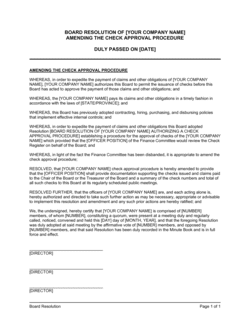
Board Resolution Authorizing a Check Approval Procedure

Free Word download β€’ Edit online β€’ Save & share with Drive β€’ Export to PDF

1 pageβ€’15–20 min to fillβ€’Difficulty: Standard
Learn more ↓
FreeBoard Resolution Authorizing a Check Approval Procedure Template

At a glance

What it is
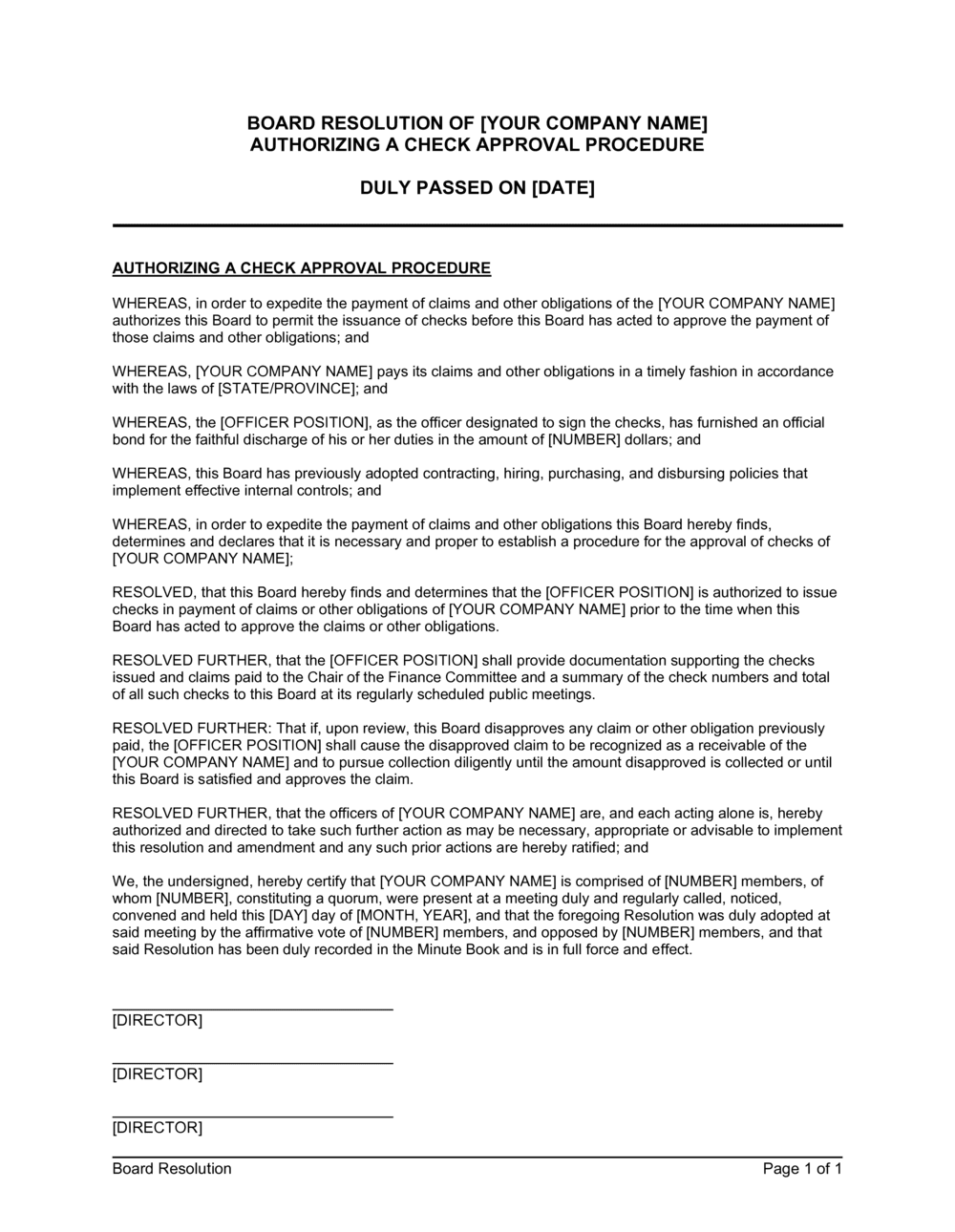
A Board Resolution Authorizing a Check Approval Procedure is a formal corporate document in which a company's board of directors officially establishes the rules governing who can sign checks, at what dollar thresholds, and under what conditions. This free Word download gives you a ready-to-edit template you can tailor to your organization's signatory structure and export as PDF for your bank, auditors, or corporate records.
When you need it
Use it when your organization opens a new bank account, adds or removes authorized signatories, raises check-signing thresholds, or implements dual-signature controls for the first time. Banks and auditors typically require a current certified copy before processing any signatory change.
What's inside
Recitals establishing the board's authority, a defined check approval policy with dollar-amount tiers, named authorized signatories and their individual limits, dual-signature requirements above specified thresholds, and a certification block for the corporate secretary.

What is a Board Resolution Authorizing a Check Approval Procedure?

A Board Resolution Authorizing a Check Approval Procedure is a formal governance document in which a company's board of directors officially establishes the rules for signing checks on behalf of the organization. It names specific authorized signatories, assigns each a maximum per-check dollar limit, defines the threshold above which two signatures are required, and prohibits practices β€” such as pre-signed or blank checks β€” that create fraud exposure. Once adopted, the resolution is filed in the corporate minute book and a certified copy is provided to each bank where the company holds accounts. It is a standard operational policy template available as a free Word download that can be edited online and exported as PDF.

Why You Need This Document

Without a board-adopted check approval procedure, your organization has no enforceable framework governing who can move money, in what amounts, and with what oversight. The practical consequences are significant: banks may refuse to update signatory records without a current resolution on file; auditors will flag the absence of documented disbursement controls as a material weakness; and grant funders β€” particularly government and foundation grantors β€” frequently withhold payments to nonprofits that cannot produce evidence of dual-signature controls. When a departing employee has never been formally revoked as an authorized signatory, they retain the legal ability to sign checks against your accounts. A properly structured resolution closes each of these gaps in under 30 minutes, creating a documented, board-level authorization trail that satisfies banks, auditors, and funders in a single document.

Which variant fits your situation?

If your situation is…Use this template
Authorizing a specific individual to sign checks up to a dollar limitBoard Resolution Authorizing a Check Approval Procedure
Opening a new corporate bank account and naming initial signatoriesBoard Resolution to Open a Bank Account
Removing or replacing an existing check signatoryBoard Resolution to Change Bank Signatories
Authorizing wire transfers and electronic payments in addition to checksBoard Resolution Authorizing Electronic Fund Transfers
Establishing a full accounts-payable policy beyond check signingAccounts Payable Policy
Documenting any other board-level financial authorizationGeneral Board Resolution

Common mistakes to avoid

❌ Using a trade name instead of the registered legal entity name

Why it matters: The bank will reject the resolution if the name does not match the account registration. A mismatch also creates enforceability questions if the authorization is ever challenged.

Fix: Pull the exact legal name from your state or provincial corporate registry filing and use it verbatim in the resolution header and body.

❌ Failing to revoke prior signatory authorizations

Why it matters: Former employees or departed officers remain valid signatories on the bank's records until formally revoked, giving them the ability to sign checks against company accounts.

Fix: Include an explicit revocation clause with an effective date and follow up directly with the bank to confirm removal from their signatory records.

❌ Setting the dual-signature threshold too high for the organization's actual transaction profile

Why it matters: A $250,000 threshold at a company whose largest routine check is $15,000 provides no fraud deterrent β€” every real disbursement falls below the control.

Fix: Review 12 months of actual check data and set the threshold at a level that captures the top 10–15% of disbursements by value.

❌ Listing signatories by title only without naming individuals

Why it matters: When the titleholder changes, the bank cannot determine whether the new person is authorized without a new resolution β€” creating a gap where either no one or the wrong person is authorized.

Fix: Always name individuals by full legal name alongside their title. Update the resolution promptly whenever a named signatory leaves or changes roles.

The 8 key sections, explained

Header and meeting details

Recitals (Whereas clauses)

Designation of authorized signatories

Dollar-threshold tiers and dual-signature requirement

Scope of accounts covered

Prohibition on pre-signed checks

Revocation of prior authorizations

Officer certification and attestation

How to fill it out

  1. 1

    Insert the company's full legal name and meeting details

    Enter the exact registered corporate name β€” not a trade name β€” along with the meeting date, location, and whether it was a regular meeting, special meeting, or action by written consent.

    πŸ’‘ Cross-reference your Articles of Incorporation or Certificate of Formation to confirm the exact legal name before finalizing.

  2. 2

    Draft the recitals to reflect your specific situation

    Customize the whereas clauses to describe the actual reason for adopting the procedure β€” opening a new account, replacing a departing signatory, or responding to an audit recommendation.

    πŸ’‘ One or two specific recitals are more useful than a generic list. Auditors read the recitals to understand context.

  3. 3

    Name each authorized signatory with their title and individual limit

    List every individual by full legal name and current title. Set a per-check dollar limit for each person based on their role and the company's disbursement patterns.

    πŸ’‘ Align individual limits with your accounts-payable workflow β€” a bookkeeper who processes vendor invoices under $2,500 should have a limit calibrated to that range, not $50,000.

  4. 4

    Set the dual-signature threshold

    Choose a dollar amount above which two signatures are required. Review your last 12 months of check disbursements to find a threshold that catches the top 10–15% of transactions by value.

    πŸ’‘ A threshold at roughly 5–10% of monthly operating expenses is a practical starting point for most small and mid-size organizations.

  5. 5

    List the specific bank accounts covered

    Enter the name of each financial institution and the last four digits of each account number this resolution governs. If you have multiple operating or payroll accounts, list them separately.

    πŸ’‘ Send the completed resolution to each bank's business banking team β€” some institutions require their own resolution form in addition to yours.

  6. 6

    Add the prohibition on pre-signed checks

    Confirm the pre-signed check prohibition language is present and clearly worded. If your organization uses check stock with a pre-printed signature for low-value items (e.g., petty cash), document that exception explicitly.

    πŸ’‘ Consider adding a parallel prohibition on checks payable to 'Cash' above a stated amount β€” this closes a separate fraud vector.

  7. 7

    Revoke all prior authorizations by date

    Enter the effective date of revocation and confirm you have a list of all current signatories at each bank so you can verify the bank updates its records after the resolution is submitted.

    πŸ’‘ Follow up with the bank in writing 5–7 business days after submission to confirm the old signatories have been removed from their system.

  8. 8

    Have the corporate secretary certify and file the resolution

    The certifying officer signs and dates the certification block, then files the original in the minute book and provides certified copies to each bank and the company's auditor.

    πŸ’‘ Keep a certified copy in the finance department's working files so it is immediately available during an audit without having to retrieve the minute book.

Frequently asked questions

What is a board resolution authorizing a check approval procedure?

A board resolution authorizing a check approval procedure is a formal governance document in which a company's board of directors establishes who may sign checks, at what dollar amounts, and under what conditions. It creates the official corporate authority for check-signing, names specific individuals and their limits, and typically establishes a dual-signature requirement above a defined threshold. Banks, auditors, and grant funders use it to verify that disbursement controls are board-approved.

Do all companies need a formal check approval procedure?

Any organization that issues checks from a corporate bank account benefits from a formal procedure, but it is most critical for nonprofits (where grant funders and bylaws frequently require it), companies with multiple signatories, and any business that has experienced or wants to prevent payment fraud. Sole proprietorships with a single owner-operator rarely need a formal resolution, but as soon as a second person has access to accounts, documenting authorization is prudent.

What is a dual-signature requirement and why does it matter?

A dual-signature requirement means that checks above a specified dollar amount must be signed by two separate authorized individuals before they are valid. It is a core internal control because it prevents any single employee β€” including senior finance staff β€” from unilaterally approving large disbursements. Most auditing standards and many grant agreements recommend dual signatures for checks above a threshold proportionate to the organization's operating budget.

How often should a board resolution for check signing be updated?

The resolution should be updated any time a named signatory is added, removed, or changes role; when dollar thresholds are revised; when a new bank account is opened; or when the board wants to change the procedure itself. Best practice is also to review the current resolution annually as part of a broader internal controls review to confirm all named signatories are still active employees or officers.

Does the bank require a copy of this resolution?

Yes β€” virtually every commercial bank requires a current certified copy of the board resolution before it will add or remove signatories from an account or honor a change in signing authority. Some banks also have their own resolution forms they prefer, so check with your relationship manager whether you need to complete both their form and file your own resolution in the minute book.

Who should certify the resolution?

The corporate secretary (or the officer designated as secretary for the meeting) certifies the resolution. The certifying officer should not be one of the individuals named as an authorized signatory in the same resolution β€” maintaining that separation preserves the independence of the governance record and is a standard internal control expectation.

What happens if the company issues a check signed by someone not listed in the resolution?

A check signed by an unauthorized person is technically not a valid corporate disbursement and may expose the company to fraud liability, particularly if the check is later disputed. Banks may also dishonor checks signed by individuals not on their authorization records. In the event of a dispute, an unauthorized signature creates personal liability risk for the signer and governance liability for the organization.

Is this the same as a corporate banking resolution?

These terms overlap but are not identical. A corporate banking resolution typically authorizes the opening of a bank account and names initial signatories β€” it is bank-facing and often uses the bank's own form. A check approval procedure resolution is an internal governance document that sets the detailed policy (thresholds, dual-signature requirements, prohibitions on pre-signed checks) and is maintained in the minute book. Both are often adopted together when a new account is opened.

How this compares to alternatives

vs Board Resolution to Open a Bank Account

A resolution to open a bank account authorizes the creation of the account and names initial signatories β€” it is primarily a bank-facing document. A check approval procedure resolution sets the internal policy governing how checks are signed, at what thresholds, and with what controls. The two are complementary and are typically adopted together when a new account is opened, but they serve distinct purposes.

vs Accounts Payable Policy

An accounts payable policy covers the full vendor payment lifecycle β€” invoice receipt, coding, approval workflows, and payment methods including checks, ACH, and wire. A check approval procedure resolution is narrower: it is a board-level governance document focused solely on who can sign checks and under what conditions. The AP policy operationalizes the day-to-day process; the resolution provides the board-level authorization that underlies it.

vs General Board Resolution

A general board resolution is a blank-format document for any board action. A check approval procedure resolution is a purpose-built template with pre-structured sections for signatories, dollar tiers, dual-signature requirements, and prohibitions β€” significantly reducing drafting time and the risk of missing a critical control element.

vs Corporate Signing Authority Policy

A corporate signing authority policy covers the full range of instruments an employee or officer may execute on the company's behalf β€” contracts, leases, and financial instruments. A check approval procedure resolution is specific to check disbursements and is the document the bank and auditors actually require on file. Both are needed for a complete internal controls framework.

Industry-specific considerations

Nonprofit Organizations

Grant funders and state regulators frequently require dual-signature controls and a current certified resolution as a condition of funding disbursement.

Professional Services

Law firms, accounting firms, and consultancies use tiered signatory authority to align check-signing limits with partner, manager, and staff seniority levels.

Construction

High-value subcontractor and supplier payments make dual-signature thresholds critical; the resolution also provides documentation for bonding and surety requirements.

Healthcare

Medical practices and healthcare organizations require clear disbursement controls to satisfy HIPAA-adjacent financial controls and accreditation body requirements.

Template vs pro β€” what fits your needs?

PathBest forCostTime
Use the templateSmall businesses, nonprofits, and growing companies establishing or updating check-signing controls without complex multi-entity structuresFree20–30 minutes
Template + professional reviewOrganizations subject to grant compliance requirements, external audits, or state regulatory oversight$150–$400 for a one-hour legal or CPA review1–2 days
Custom draftedMulti-entity corporate groups, regulated financial institutions, or organizations with complex signatory hierarchies spanning multiple jurisdictions$500–$1,5003–7 days

Glossary

Board Resolution
A formal written record of a decision made by a company's board of directors, used to authorize actions and create an official governance trail.
Authorized Signatory
An individual named by the board who has legal authority to sign checks or financial instruments on behalf of the organization up to a specified dollar limit.
Dual-Signature Requirement
A control that requires two separate authorized signatories to sign any check above a defined threshold, reducing the risk of unilateral disbursement.
Dollar-Threshold Tier
A defined monetary amount that triggers a different level of authorization β€” for example, checks under $5,000 require one signature; checks above $5,000 require two.
Recitals
The 'whereas' clauses at the start of a resolution that state the factual background and the board's legal authority to act.
Certification Block
The section signed by the corporate secretary (or equivalent officer) to attest that the resolution was duly adopted at a properly convened meeting.
Internal Controls
Policies and procedures designed to prevent fraud, errors, and unauthorized use of company assets β€” check approval procedures are a core example.
Segregation of Duties
An internal control principle that assigns check preparation, approval, and reconciliation to different individuals so no single person controls an entire financial transaction.
Minute Book
The official corporate record that stores all board resolutions, meeting minutes, and governance documents β€” the resolution must be filed here after adoption.
Quorum
The minimum number of board members required to be present for a vote to be valid, as defined by the company's bylaws.

Part of your Business Operating System

This document is one of 3,000+ business & legal templates included in Business in a Box.

  • Fill-in-the-blanks β€” ready in minutes
  • 100% customizable Word document
  • Compatible with all office suites
  • Export to PDF and share electronically

Create your document in 3 simple steps.

From template to signed document β€” all inside one Business Operating System.
1
Download or open template

Access over 3,000+ business and legal templates for any business task, project or initiative.

2
Edit and fill in the blanks with AI

Customize your ready-made business document template and save it in the cloud.

3
Save, Share, Send, Sign

Share your files and folders with your team. Create a space of seamless collaboration.

Save time, save money, and create top-quality documents.

β˜…β˜…β˜…β˜…β˜…

"Fantastic value! I'm not sure how I'd do without it. It's worth its weight in gold and paid back for itself many times."

Managing Director Β· Mall Farm
Robert Whalley
Managing Director, Mall Farm Proprietary Limited
β˜…β˜…β˜…β˜…β˜…

"I have been using Business in a Box for years. It has been the most useful source of templates I have encountered. I recommend it to anyone."

Business Owner Β· 4+ years
Dr Michael John Freestone
Business Owner
β˜…β˜…β˜…β˜…β˜…

"It has been a life saver so many times I have lost count. Business in a Box has saved me so much time and as you know, time is money."

Owner Β· Upstate Web
David G. Moore Jr.
Owner, Upstate Web

Run your business with a system β€” not scattered tools

Stop downloading documents. Start operating with clarity. Business in a Box gives you the Business Operating System used by over 250,000 companies worldwide to structure, run, and grow their business.

Start freeΒ Β·Β No credit card required