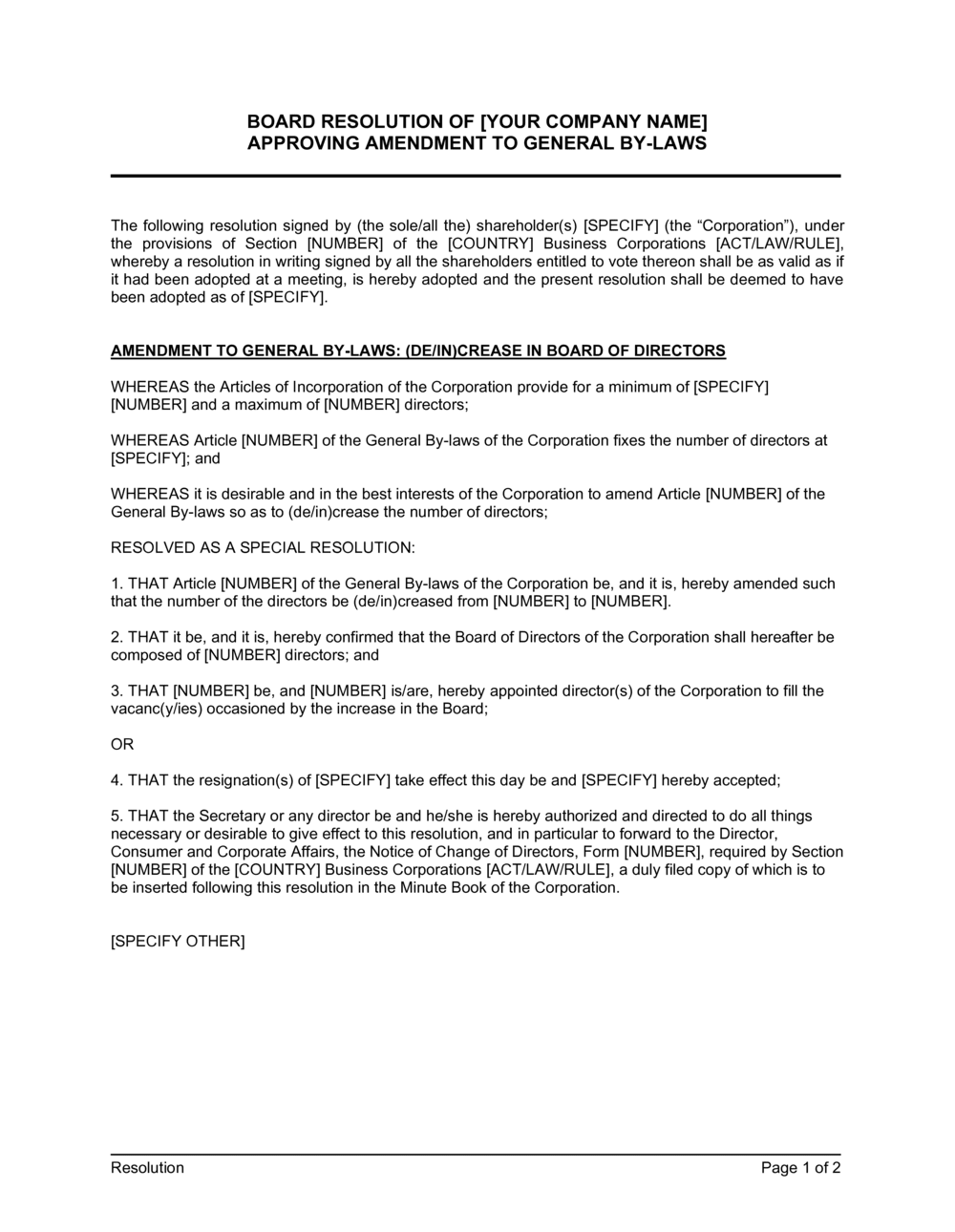
Board Resolution Approving Amendment to General By-Laws Template

Free Word download β€’ Edit online β€’ Save & share with Drive β€’ Export to PDF

2 pagesβ€’20–30 min to fillβ€’Difficulty: Standardβ€’Signature requiredβ€’Legal review recommended
Learn more ↓
FreeBoard Resolution Approving Amendment to General By-Laws Template

At a glance

What it is
A Board Resolution Approving Amendment to General By-Laws is a formal corporate document by which a company's board of directors officially records its decision to modify one or more provisions of the corporation's governing by-laws. This free Word download provides a structured, attorney-reviewed starting point you can edit online and export as PDF for execution, filing, and record retention.
When you need it
Use it whenever the board needs to formally authorize a change to the corporate by-laws β€” such as modifying quorum requirements, altering officer titles, updating meeting notice periods, or reflecting a change in share structure β€” and must create a permanent, auditable record of that decision.
What's inside
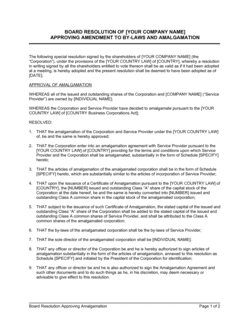
Header identifying the corporation and meeting details, recitals explaining the rationale for the amendment, the exact amended by-law language, the board vote record including yeas, nays, and abstentions, the effective date of the amendment, and signature blocks for the chairperson and corporate secretary.

What is a Board Resolution Approving Amendment to General By-Laws?

A Board Resolution Approving Amendment to General By-Laws is a formal corporate legal document through which a company's board of directors officially records, authorizes, and certifies a change to one or more provisions of the corporation's internal governing rules. It identifies the exact existing by-law text being replaced, states the full amended language, documents the vote by which the board adopted the change, and establishes the date the amendment takes effect. Once signed by the chairperson and corporate secretary and filed in the corporate minute book, the resolution becomes the permanent, auditable record of a binding governance decision.

Why You Need This Document

Operating without a properly documented by-laws amendment creates compounding governance risk. Banks, investors, and acquiring companies review the corporate minute book during due diligence β€” a verbal board decision to change the by-laws, or an unsigned draft amendment, will not satisfy that scrutiny and can delay or kill a financing or transaction. Regulators in financial services, healthcare, and other industries expect to find current, formally adopted by-laws on file; discrepancies between the filed version and how the company actually operates invite enforcement questions. Beyond third-party scrutiny, an undocumented amendment leaves the corporation's officers and directors uncertain about which rules actually govern β€” a particular problem when a dispute arises over meeting procedures, quorum calculations, or officer authority. This template gives you the correct structure to move from a board discussion to a binding, certified, minute-book-ready resolution in under an hour, with a clear record that protects the corporation and everyone who relies on its governance documents.

Which variant fits your situation?

If your situation is…Use this template
Amending by-laws by written consent instead of a formal meetingWritten Consent of Board of Directors
Shareholders, not directors, are required to approve the amendmentShareholder Resolution Approving By-Laws Amendment
Adopting an entirely new set of by-laws at incorporationCorporate By-Laws
Amending the articles of incorporation rather than the by-lawsBoard Resolution Approving Amendment to Articles of Incorporation
Recording a board decision on a matter other than by-lawsGeneral Board Resolution
Approving a specific officer appointment at the same meetingBoard Resolution Appointing an Officer
Nonprofit board amending its governing documentsNonprofit Board Resolution

Common mistakes to avoid

❌ Amending provisions that require shareholder approval

Why it matters: A board-only resolution that amends a provision reserved to shareholders is void under most corporate statutes, exposing the corporation to governance challenges and third-party reliance claims.

Fix: Review both the existing by-laws and the applicable corporate statute before drafting. If shareholder approval is required, prepare a parallel shareholder resolution and hold the required meeting or obtain written consent.

❌ Quoting the provision from an outdated version of the by-laws

Why it matters: If the 'currently reads' section quotes language that was already amended in a prior resolution, the resolution creates a false record and the amendment may fail to achieve its intended effect.

Fix: Retrieve the most recent signed, dated by-laws from the minute book and verify the quoted text against that source immediately before the meeting.

❌ Leaving cross-references to the amended section uncorrected

Why it matters: Other by-law provisions that reference the amended section by number or text will become internally inconsistent, creating ambiguity about which rule governs.

Fix: After drafting the amended text, run a complete search of the by-laws for every reference to the amended section and prepare follow-on amendments or a consolidated by-laws restatement.

❌ Using aspirational or conditional language in the operative clause

Why it matters: Phrases such as 'the board proposes to amend' or 'subject to further review' do not constitute a final board action and may be treated as non-binding minutes rather than a valid resolution.

Fix: Use 'RESOLVED, that the By-Laws be and hereby are amended' β€” present tense, declarative. The word 'RESOLVED' and the present tense together signal a final, binding decision.

❌ Failing to update the master by-laws document after adoption

Why it matters: If the resolution is filed in the minute book but the master by-laws document is never updated, future readers β€” officers, investors, banks β€” will rely on the stale version and may act contrary to the adopted amendment.

Fix: Assign a named officer the explicit task of updating the master by-laws document within five business days of adoption, and note the completion in the next board meeting minutes.

❌ Omitting the effective date

Why it matters: Without a specific effective date, disputes arise about which version of the by-laws applied to actions taken between the meeting date and when the minute book was updated.

Fix: Always state a specific calendar date β€” typically the meeting date or a date shortly after β€” in both the operative clause and the certification.

The 9 key clauses, explained

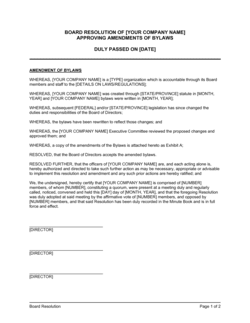
Corporation identification and meeting header

In plain language: States the full legal name of the corporation, the type of meeting (regular or special), the date, time, and location, and confirms that proper notice was given and a quorum was present.

Sample language
A [REGULAR / SPECIAL] meeting of the Board of Directors of [CORPORATION LEGAL NAME], a [STATE/PROVINCE] [ENTITY TYPE] ('Corporation'), was duly held on [DATE] at [TIME] at [LOCATION / via [PLATFORM]]. A quorum of directors was present throughout.

Common mistake: Omitting confirmation that proper notice was given and a quorum was present. Without this, the resolution can be challenged as adopted at an improperly convened meeting.

Recitals (WHEREAS clauses)

In plain language: Sets out the background and rationale for the amendment β€” why the board is making the change and what corporate purpose it serves.

Sample language
WHEREAS, the Board has reviewed the current [SECTION/ARTICLE] of the Corporation's By-Laws and has determined that it is in the best interests of the Corporation to amend [SPECIFIC PROVISION] to [REASON FOR CHANGE]; and WHEREAS, the Board has been presented with the proposed amended language;

Common mistake: Writing vague recitals such as 'the board deems it appropriate.' Recitals that state a specific business reason strengthen the resolution's legal defensibility if challenged.

Existing by-law provision (as currently reads)

In plain language: Reproduces verbatim the current text of the by-law section being amended, so the record shows exactly what language is being replaced.

Sample language
WHEREAS, [ARTICLE/SECTION NUMBER] of the By-Laws currently reads as follows: '[EXACT CURRENT TEXT OF THE PROVISION BEING AMENDED]';

Common mistake: Paraphrasing the existing provision instead of quoting it exactly. Any discrepancy between the quoted text and the official by-laws creates ambiguity about what was actually changed.

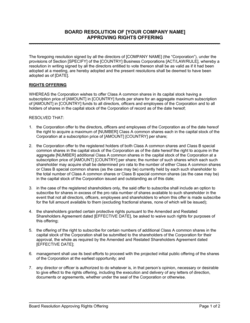
Operative resolution clause (RESOLVED)

In plain language: The core binding clause in which the board formally resolves to approve the amendment, stating so explicitly.

Sample language
RESOLVED, that the By-Laws of the Corporation be, and they hereby are, amended effective [DATE] by [deleting / replacing / adding] [ARTICLE/SECTION NUMBER] in its entirety to read as follows:

Common mistake: Using 'it is proposed' or 'it is recommended' instead of 'RESOLVED.' Aspirational or conditional language does not constitute a formal board action.

Amended by-law text

In plain language: The full exact text of the by-law provision as it will read after the amendment is adopted β€” this becomes the operative governing language.

Sample language
'[ARTICLE/SECTION NUMBER]: [FULL TEXT OF THE AMENDED PROVISION, INCLUDING ALL DEFINED TERMS AND CROSS-REFERENCES IN THEIR UPDATED FORM].'

Common mistake: Failing to update cross-references to other by-law sections that refer to the amended provision. Stale cross-references create internal inconsistencies that require a follow-on amendment to fix.

Vote record

In plain language: Documents the outcome of the vote β€” number of directors voting in favor, against, and abstaining β€” confirming the resolution passed by the required majority.

Sample language
The foregoing resolution was adopted by the following vote: [X] directors voting in favor; [X] directors voting against; [X] directors abstaining. The Chairperson declared the resolution duly adopted.

Common mistake: Recording only 'unanimous' or 'majority' without listing the actual count. If a director later disputes the vote, a count-free record is nearly impossible to verify.

Effective date and implementation authority

In plain language: States the date the amendment takes effect and authorizes a named officer or officers to take all actions necessary to implement it.

Sample language
RESOLVED FURTHER, that this amendment shall be effective as of [DATE], and that the officers of the Corporation are authorized and directed to take all steps necessary to implement this amendment, including updating the corporate minute book.

Common mistake: Leaving the effective date blank or writing 'immediately.' A specific calendar date prevents disputes about which version of the by-laws governed matters that arose between the meeting date and the implementation date.

Ratification of prior actions

In plain language: An optional but common clause confirming that any prior actions taken in anticipation of the amendment are ratified and approved by the board.

Sample language
RESOLVED FURTHER, that all actions previously taken by the officers and directors of the Corporation in connection with or in anticipation of this amendment are hereby ratified, confirmed, and approved in all respects.

Common mistake: Omitting this clause when officers have already begun acting under the anticipated new rule. Without ratification, those prior actions technically lacked authority under the old by-laws.

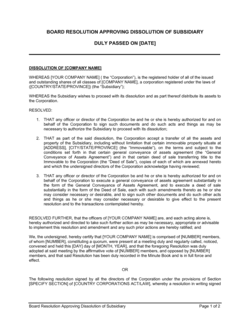
Certification and signature block

In plain language: The corporate secretary certifies that the resolution is a true and accurate record of the board's action, and the chairperson and secretary sign to authenticate the document.

Sample language
I, [SECRETARY NAME], Secretary of [CORPORATION LEGAL NAME], hereby certify that the foregoing is a true, correct, and complete copy of a resolution duly adopted by the Board of Directors at a meeting duly held on [DATE]. [SIGNATURE LINES FOR CHAIRPERSON AND SECRETARY]

Common mistake: Having only one officer sign when corporate policy or applicable law requires both the chairperson and the secretary. A single-signature resolution may be rejected by banks, registrars, and regulatory bodies.

How to fill it out

  1. 1

    Confirm amendment authority under existing by-laws and governing law

    Before drafting, review the corporation's current by-laws and the applicable corporate statute to determine whether the board alone can amend these provisions or whether shareholder approval is also required.

    πŸ’‘ Many by-laws reserve certain amendments β€” such as changes to shareholder voting rights or quorum thresholds β€” exclusively to the shareholders. Proceeding without shareholder approval on those items voids the resolution.

  2. 2

    Enter the corporation's legal name and meeting details

    Complete the header with the corporation's full registered name, the meeting type, date, time, and location. Confirm that notice was properly given according to the by-laws and that a quorum was present.

    πŸ’‘ If the meeting was held remotely, record the platform used and confirm that the by-laws or governing statute permit virtual meetings β€” not all do.

  3. 3

    Draft the recitals with a specific business rationale

    Write WHEREAS clauses explaining the reason for the amendment β€” e.g., to reflect a new share structure, align with updated legislation, or address an operational inefficiency identified by management.

    πŸ’‘ Specific recitals documenting a business purpose provide protection against claims that the amendment was adopted for an improper reason.

  4. 4

    Quote the existing provision verbatim

    Copy the exact current text of the by-law section being amended into the 'currently reads' recital. Do not paraphrase or summarize.

    πŸ’‘ Pull the text directly from the signed, dated version of the by-laws in the minute book β€” not from a draft or an emailed copy.

  5. 5

    Insert the full amended text in the RESOLVED clause

    Place the complete new text of the provision β€” as it will read after adoption β€” in the operative resolution clause. Include all defined terms, cross-references, and numbering in their final form.

    πŸ’‘ After inserting the amended text, re-read the entire by-laws document to identify any cross-references to the amended section that also need updating.

  6. 6

    Record the vote count accurately

    Enter the exact number of directors voting for, against, and abstaining. Confirm the result meets the required approval threshold β€” typically a majority of directors present, but check your by-laws.

    πŸ’‘ If any director joined remotely, note that in the vote record and confirm the by-laws or statute permit remote participation for quorum and voting purposes.

  7. 7

    Set a specific effective date and authorize implementation

    Enter the calendar date the amendment takes effect in the effective date clause and identify the officers authorized to update the minute book and take any other required steps.

    πŸ’‘ If the amendment affects regulatory filings β€” such as updated share rights that require a securities disclosure update β€” flag those obligations explicitly in the implementation authority clause.

  8. 8

    Obtain signatures and file the resolution in the minute book

    Have the chairperson and corporate secretary sign the certified resolution. Insert the signed original into the corporate minute book immediately after adoption and update the master by-laws document to incorporate the amendment.

    πŸ’‘ Send a certified copy to the corporation's bank and any regulatory bodies that maintain a copy of the by-laws β€” their records need to reflect the change.

Frequently asked questions

What is a board resolution approving an amendment to general by-laws?

It is a formal corporate document that records the board of directors' decision to change one or more provisions of the corporation's internal governing rules β€” its by-laws. The resolution identifies the existing text being replaced, states the new text, records the vote, and sets an effective date. Once signed by the chairperson and corporate secretary and filed in the minute book, it constitutes binding corporate action.

Can the board of directors amend the by-laws on its own?

In many corporations and jurisdictions, the board has authority to amend the by-laws unless the articles of incorporation or the by-laws themselves reserve certain amendments to the shareholders. For example, changes to shareholder voting rights, quorum thresholds for shareholder meetings, or fundamental governance structures often require a shareholder vote. Always review the existing by-laws and the applicable corporate statute before proceeding with a board-only resolution.

Does a by-laws amendment need to be filed with the government?

By-laws are internal documents and, unlike articles of incorporation, generally do not need to be filed with a state, provincial, or national registry. However, you should provide updated by-laws to your corporate bank, major lenders, and any regulatory bodies that hold a copy on file. In some jurisdictions and for certain entity types β€” such as nonprofits or public companies β€” regulatory filings may be required. Confirm with legal counsel for your specific jurisdiction.

What is the difference between by-laws and articles of incorporation?

Articles of incorporation are the founding document filed with the government that creates the corporation β€” they cover fundamental matters like name, registered address, share structure, and authorized capital. By-laws are the internal rulebook the corporation adopts after formation, governing day-to-day operations such as director duties, meeting procedures, officer roles, and quorum requirements. Amending the articles typically requires a more formal process, including shareholder approval and a government filing.

What quorum and vote threshold is required to approve a by-laws amendment?

The required quorum and vote threshold depend on your corporation's existing by-laws and the applicable corporate statute. Typically, a majority of directors present at a properly convened meeting where a quorum exists is sufficient for board-level amendments. However, some by-laws require a supermajority β€” two-thirds or three-quarters of directors. Always check your current by-laws and governing statute before the meeting.

How does this resolution interact with the corporate minute book?

The signed, certified original of the resolution must be inserted into the corporate minute book alongside the existing by-laws documentation. The master by-laws document should also be updated to reflect the amendment so readers see the current operative text. Banks, investors, and acquiring companies will review the minute book during due diligence β€” incomplete or inconsistent records are a common cause of delayed closings.

Do shareholders need to ratify a board-approved by-laws amendment?

Typically no, for matters within the board's amendment authority. However, some by-law provisions and some jurisdictions require shareholder ratification even where the board has primary amendment power. Additionally, even when not legally required, obtaining shareholder ratification of significant governance changes is considered best practice for closely held corporations where board and shareholder interests may diverge.

How long should we retain the board resolution?

Corporate governance documents, including board resolutions and by-laws, should be retained permanently. They form part of the corporation's constitutional record and are frequently required during financing rounds, regulatory examinations, M&A due diligence, and litigation. Retain the signed original in the physical or electronic minute book indefinitely, and maintain a backup in a secure off-site location.

How this compares to alternatives

vs General Board Resolution

A general board resolution records a board decision on any operational matter β€” approving a contract, opening a bank account, or authorizing a transaction. A by-laws amendment resolution specifically modifies the corporation's internal governing rules and must quote both the old and new text. The by-laws amendment resolution has a higher procedural standard and a permanent effect on governance.

vs Corporate By-Laws

The corporate by-laws are the foundational governing document itself. A board resolution approving an amendment is the instrument used to change that document. You need both: the by-laws as the baseline and the resolution as the formal record of every approved change.

vs Shareholder Resolution

A shareholder resolution records a decision made by the shareholders rather than the board β€” required when the amendment affects rights reserved to shareholders. If the board alone has authority to make the change, a board resolution suffices. When shareholder approval is needed, both a shareholder resolution and an updated by-laws text are required.

vs Board Resolution Appointing an Officer

An officer appointment resolution records the board's decision to name a specific individual to a corporate office. A by-laws amendment resolution changes the rules governing officer roles themselves β€” their duties, titles, or the process for appointment and removal. Both may be needed when restructuring an officer role: first amend the by-laws, then appoint the officer under the new rules.

Industry-specific considerations

Technology / SaaS

Startups commonly amend by-laws to accommodate new investor rights, board seat allocations, or drag-along provisions as they close funding rounds.

Financial Services

Regulated financial entities must ensure by-law amendments comply with banking regulator or securities commission requirements before they take effect.

Healthcare

Healthcare corporations frequently amend governance documents to address credentialing committee structures, compliance officer roles, and HIPAA accountability provisions.

Nonprofit Organizations

Nonprofits amend by-laws to reflect changes in board composition, grant compliance requirements, or IRS governance best practices for 501(c)(3) entities.

Professional Services

Law firms, accounting firms, and consulting partnerships update governing documents when admitting new partners, changing profit-sharing structures, or restructuring leadership.

Manufacturing

Manufacturing corporations revise by-laws when restructuring following mergers, divestitures, or plant closures that alter the operating entity's management structure.

Jurisdictional notes

United States

Under most state corporate statutes β€” including Delaware's DGCL Section 109 β€” the board of directors may amend the by-laws unless the certificate of incorporation or the by-laws reserve that power to the shareholders. California, New York, and several other states impose additional restrictions. For S-corporations and closely held corporations, verify that the amendment does not inadvertently affect S-election eligibility or shareholder agreement terms.

Canada

Under the Canada Business Corporations Act (CBCA) and most provincial statutes, the board may amend the by-laws by resolution, but the amendment must be submitted to shareholders for confirmation at the next annual or special meeting. Until shareholder confirmation, the amendment is effective but subject to reversal. Quebec corporations governed by the Business Corporations Act (LSAQ) follow a similar process. Resolutions should be drafted in both English and French for Quebec-based corporations subject to the Charter of the French Language.

United Kingdom

UK companies are governed by articles of association rather than by-laws. Under the Companies Act 2006, articles may only be amended by special resolution of the shareholders β€” a 75% majority β€” and the amended articles must be filed at Companies House within 15 days. A board-only resolution cannot amend the articles. This template is applicable to UK entities that maintain internal governance rules supplementary to their articles, but core constitutional changes require shareholder action.

European Union

EU member states generally require shareholder approval β€” often a supermajority β€” to amend a corporation's statutes or articles of association, with board-only authority being the exception rather than the rule. In Germany, amendments to the Satzung of a GmbH or AG require a notarized shareholder resolution. In France, extraordinary general meeting approval is required for SA statute changes. Confirm local requirements before relying on a board-only resolution for any EU-incorporated entity.

Template vs lawyer β€” what fits your deal?

PathBest forCostTime
Use the templateClosely held corporations making straightforward housekeeping amendments β€” notice periods, meeting format, officer titles β€” within clear board authorityFree30–60 minutes
Template + legal reviewCorporations amending provisions that affect investor rights, share rights, or quorum thresholds, or operating in multiple jurisdictions$300–$800 for a 1–2 hour corporate counsel review1–3 days
Custom draftedPublic companies, regulated entities, pre-transaction governance restructuring, or amendments that require shareholder approval and regulatory filings$1,000–$5,000+1–3 weeks

Glossary

By-Laws
The internal rules that govern a corporation's management, covering meetings, voting procedures, officer roles, and other operational matters.
Board Resolution
A formal written record of a decision made by a corporation's board of directors, typically adopted by vote at a duly convened meeting.
Quorum
The minimum number of directors who must be present at a board meeting for the meeting to be valid and decisions to be binding.
Recitals
Background clauses at the start of a resolution, beginning with 'WHEREAS,' that explain the context and rationale for the board's decision.
Operative Clause
The section of a resolution, introduced by 'RESOLVED,' that states the specific action the board is formally approving or directing.
Written Consent
A mechanism allowing directors to approve a resolution without a physical meeting, provided all required signatories sign the document.
Articles of Incorporation
The primary constitutional document filed with the state or province when a corporation is formed β€” distinct from by-laws, which are internal rules.
Effective Date
The specific date on which an approved by-law amendment takes legal effect, which may differ from the date the resolution was adopted.
Corporate Minute Book
The official record-keeping binder or file containing a corporation's formation documents, by-laws, share ledger, and all board and shareholder resolutions.
Ultra Vires
Latin for 'beyond the powers' β€” an act or resolution that exceeds the authority granted by the corporation's charter or applicable corporate law, rendering it void.

Part of your Business Operating System

This document is one of 3,000+ business & legal templates included in Business in a Box.

  • Fill-in-the-blanks β€” ready in minutes
  • 100% customizable Word document
  • Compatible with all office suites
  • Export to PDF and share electronically

Create your document in 3 simple steps.

From template to signed document β€” all inside one Business Operating System.
1
Download or open template

Access over 3,000+ business and legal templates for any business task, project or initiative.

2
Edit and fill in the blanks with AI

Customize your ready-made business document template and save it in the cloud.

3
Save, Share, Send, Sign

Share your files and folders with your team. Create a space of seamless collaboration.

Save time, save money, and create top-quality documents.

β˜…β˜…β˜…β˜…β˜…

"Fantastic value! I'm not sure how I'd do without it. It's worth its weight in gold and paid back for itself many times."

Managing Director Β· Mall Farm
Robert Whalley
Managing Director, Mall Farm Proprietary Limited
β˜…β˜…β˜…β˜…β˜…

"I have been using Business in a Box for years. It has been the most useful source of templates I have encountered. I recommend it to anyone."

Business Owner Β· 4+ years
Dr Michael John Freestone
Business Owner
β˜…β˜…β˜…β˜…β˜…

"It has been a life saver so many times I have lost count. Business in a Box has saved me so much time and as you know, time is money."

Owner Β· Upstate Web
David G. Moore Jr.
Owner, Upstate Web

Run your business with a system β€” not scattered tools

Stop downloading documents. Start operating with clarity. Business in a Box gives you the Business Operating System used by over 250,000 companies worldwide to structure, run, and grow their business.

Start freeΒ Β·Β No credit card required