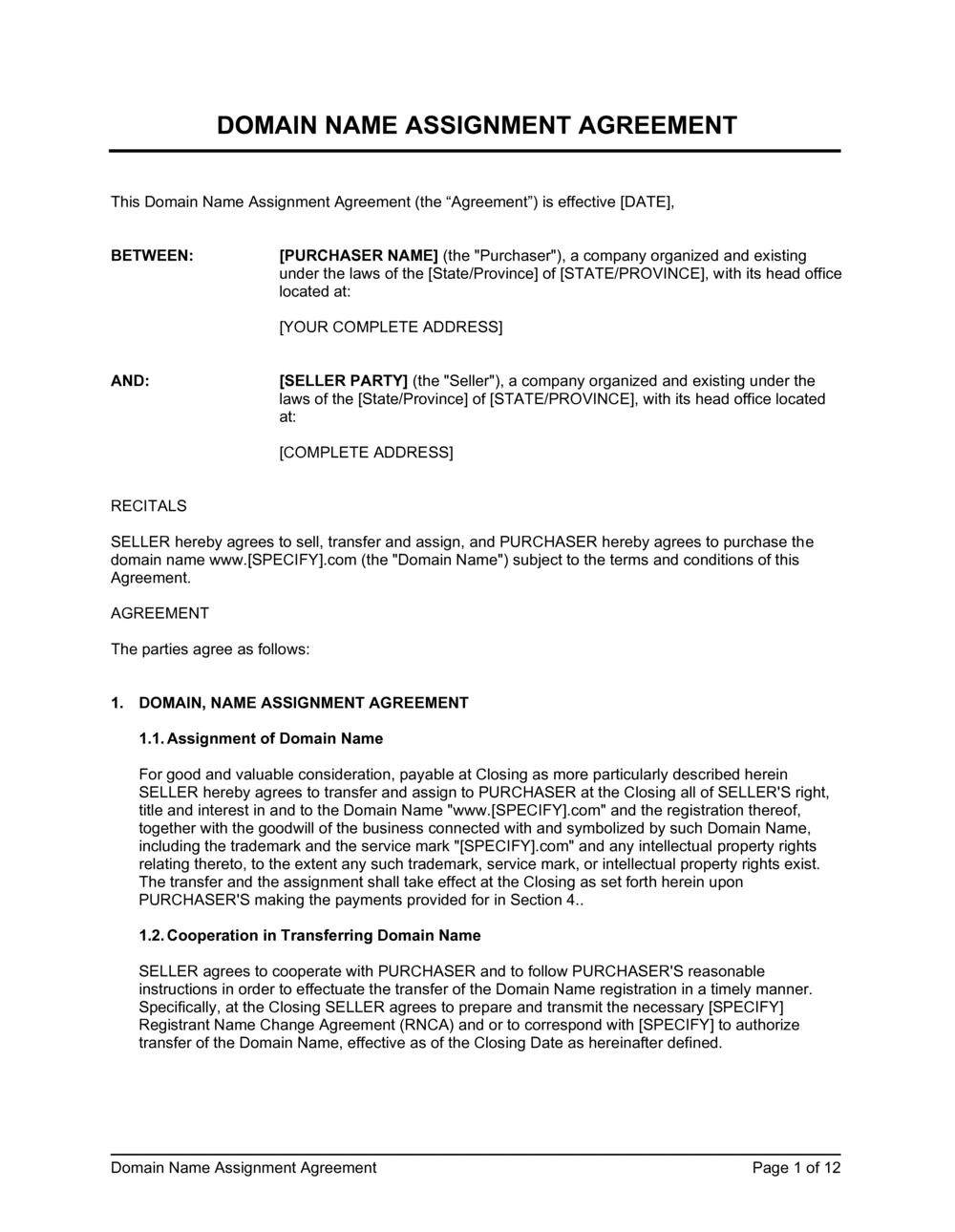
Domain Name Assignment Agreement Template

Free Word download β€’ Edit online β€’ Save & share with Drive β€’ Export to PDF

12 pagesβ€’30–40 min to fillβ€’Difficulty: Complexβ€’Signature requiredβ€’Legal review recommended
Learn more ↓
FreeDomain Name Assignment Agreement Template

At a glance

What it is
A Domain Name Assignment Agreement is a legally binding contract that transfers ownership of a registered internet domain name from one party (the assignor) to another (the assignee) in exchange for agreed consideration. This free Word download gives you a structured, attorney-reviewed starting point you can edit online and export as PDF β€” covering price, warranties, IP representations, and registrar transfer instructions in a single document.
When you need it
Use it whenever a domain name changes hands as part of a business acquisition, brand rebrand, IP portfolio sale, website purchase, or standalone domain transaction. It is equally necessary when the domain is sold independently or bundled with a broader asset purchase.
What's inside
Parties and domain identification, purchase price and payment terms, representations and warranties about clear title, IP non-infringement covenants, registrar transfer obligations, post-closing cooperation duties, governing law, and dispute resolution provisions.

What is a Domain Name Assignment Agreement?

A Domain Name Assignment Agreement is a legally binding contract that permanently transfers ownership of a registered internet domain name from its current owner (the assignor) to a new owner (the assignee) in exchange for agreed consideration. Unlike a registrar-level technical transfer β€” which simply moves a domain between accounts using an EPP authorization code β€” the assignment agreement creates a written legal record of who sold what, for how much, and under what warranties. It covers the purchase price, representations about clear title and trademark status, the specific technical steps each party must complete, and the consequences if either party fails to perform. Because domain names can carry significant brand equity, SEO authority, and trademark risk, documenting the transfer in a binding contract protects both the buyer's investment and the seller's payment.

Why You Need This Document

A domain transfer without a written assignment agreement is a technical action with no legal backbone. Without it, you have no enforceable recourse if the seller retransfers the domain, disputes the agreed price, or misrepresented that the domain was free of trademark conflicts β€” a problem that can surface months later in the form of a UDRP proceeding that the buyer must defend at their own cost. On the seller's side, an undocumented transfer leaves them unable to prove they authorized the transaction if the buyer later claims the domain was taken without consent. For transactions involving premium domains, bundled assets like email accounts or DNS records, or parties in different countries, the absence of a contract means disputes are resolved by registrar policies and ICANN procedures rather than the terms you actually negotiated. This template gives both parties a clear, enforceable record of the transaction β€” structured around market-standard domain transfer mechanics and backed by the representations and indemnification provisions that make that record worth having.

Which variant fits your situation?

If your situation is…Use this template
Transferring a domain as part of a full website and business purchaseWebsite Purchase Agreement
Selling a domain name portfolio with multiple domains in a single transactionIP Assignment Agreement
Temporarily licensing a domain name rather than permanently transferring itDomain Name License Agreement
Assigning all company IP, including domains, to a new holding entityIntellectual Property Assignment Agreement
Buying a domain that is subject to an active trademark disputeSettlement Agreement
Transferring a domain as part of a broader corporate asset saleAsset Purchase Agreement
Resolving a domain dispute under ICANN UDRP before assignmentCease and Desist Letter (Trademark)

Common mistakes to avoid

❌ Releasing payment before transfer is confirmed

Why it matters: An assignor who has already received payment has little practical incentive to resolve a stalled transfer β€” the buyer is left funding a dispute while the domain sits in limbo at the old registrar.

Fix: Use an escrow service for any transaction above $2,000 and specify in the agreement that funds are released only after the domain appears in the assignee's registrar account.

❌ No deadline for EPP code delivery

Why it matters: Without a contractual deadline, the assignor controls the entire transfer timeline β€” delays of weeks or months are common in unstructured domain transactions, and the buyer has no breach remedy to invoke.

Fix: Insert a specific business-day deadline (2–3 days is standard) after which the assignor is in material breach, entitling the assignee to a full refund from escrow.

❌ Omitting a trademark non-infringement warranty

Why it matters: A domain that incorporates a third-party trademark can expose the assignee to a UDRP proceeding or trademark infringement lawsuit within months of the transfer β€” at their cost, not the assignor's.

Fix: Require the assignor to warrant that the domain does not, to their knowledge after reasonable inquiry, infringe any registered or common-law trademark, and back it with an indemnification clause.

❌ Using an oral agreement or email chain instead of a written contract

Why it matters: ICANN registrars will process a technical transfer without requiring a written assignment, but the buyer has no legal recourse if the assignor later claims the transfer was unauthorized, the price was different, or additional assets were promised.

Fix: Execute a signed written agreement before sharing any EPP code or initiating any transfer request β€” email chains and verbal understandings are routinely disputed and difficult to enforce.

❌ Failing to include associated assets (email accounts, social handles, DNS records)

Why it matters: A domain acquired without its associated email accounts, subdomains, or linked social handles may be commercially useless β€” and there is no implied transfer of these assets in a domain-only agreement.

Fix: Attach a Schedule A listing every associated asset being transferred β€” email hosting, DNS configuration files, subdomains, and linked social profiles β€” and specify which party is responsible for each transfer step.

❌ Choosing a governing law with no connection to either party

Why it matters: Some domain sellers default to a neutral jurisdiction they have heard of but have no presence in β€” enforcing a judgment from a disconnected forum is expensive and sometimes impossible.

Fix: Choose the jurisdiction where the assignee is incorporated or where the primary bank account funding the purchase is held β€” courts in that jurisdiction are far more practical venues for any dispute.

The 10 key clauses, explained

Parties and domain identification

In plain language: Identifies both parties by full legal name and address, and precisely identifies the domain being transferred by its full registered name and TLD.

Sample language
This Domain Name Assignment Agreement is entered into as of [DATE] between [ASSIGNOR LEGAL NAME], a [ENTITY TYPE] organized under the laws of [STATE/JURISDICTION] ('Assignor'), and [ASSIGNEE LEGAL NAME], a [ENTITY TYPE] ('Assignee'). Assignor agrees to assign and transfer the domain name [DOMAIN.COM] (the 'Domain'), currently registered with [REGISTRAR NAME].

Common mistake: Identifying the domain by a nickname or abbreviation instead of its exact registered string including TLD β€” ambiguity about which domain is being transferred can void the agreement or require a corrective assignment.

Purchase price and payment terms

In plain language: States the total consideration the assignee pays, when payment is due, and how it is made β€” including whether an escrow service is used.

Sample language
In consideration for the assignment, Assignee shall pay Assignor the sum of $[AMOUNT] USD (the 'Purchase Price'), payable in full on [DATE / upon execution] via [WIRE TRANSFER / ESCROW SERVICE]. If paid through escrow, funds shall be released to Assignor within [X] business days after successful transfer confirmation.

Common mistake: Releasing payment before confirming the domain has fully propagated to the assignee's registrar account β€” a seller who receives funds before transfer is complete has no practical incentive to cooperate with a stalled transfer.

Assignment and transfer of ownership

In plain language: The operative clause in which the assignor irrevocably transfers all right, title, and interest in the domain to the assignee as of the closing date.

Sample language
Assignor hereby irrevocably assigns, transfers, and conveys to Assignee all of Assignor's right, title, and interest in and to the Domain, including any associated goodwill, effective as of the Closing Date. Assignor retains no rights in the Domain following the Closing Date.

Common mistake: Using permissive language like 'agrees to transfer' instead of the operative 'hereby assigns and transfers' β€” the former creates an obligation to act in the future, not an immediate transfer, which creates a gap in title.

Representations and warranties of the assignor

In plain language: The assignor's legally binding statements that they own the domain outright, that it is not encumbered by liens or disputes, and that the transfer does not infringe any third-party trademark.

Sample language
Assignor represents and warrants that: (a) Assignor is the sole registered owner of the Domain; (b) the Domain is free and clear of all liens, claims, and encumbrances; (c) no UDRP proceeding or legal dispute is pending or threatened; (d) the Domain does not, to Assignor's knowledge, infringe any third-party trademark or intellectual property right; and (e) Assignor has full authority to enter into and perform this Agreement.

Common mistake: Limiting warranty (d) to 'Assignor's knowledge' without requiring the assignor to have actually conducted a trademark search β€” courts in several jurisdictions have found this insufficient when the assignor had ready access to trademark databases.

Representations and warranties of the assignee

In plain language: The assignee's confirmation that they have authority to enter the agreement, that the domain's intended use will not infringe third-party rights, and that their payment is from lawful funds.

Sample language
Assignee represents and warrants that: (a) Assignee has full authority to enter into this Agreement; (b) the intended use of the Domain will comply with ICANN policies and applicable law; and (c) the Purchase Price is derived from lawful funds.

Common mistake: Omitting assignee warranties entirely β€” courts have used one-sided warranty structures to argue the agreement was a donative transfer rather than an arm's-length sale, creating tax and valuation complications.

Registrar transfer obligations

In plain language: Sets out the specific technical steps both parties must take to execute the registrar transfer β€” including unlocking the domain, providing the EPP authorization code, and approving the incoming transfer request.

Sample language
Within [2] business days of receipt of the Purchase Price (or escrow confirmation), Assignor shall: (a) unlock the Domain at the current Registrar; (b) provide Assignee with the EPP Authorization Code; (c) disable WHOIS privacy if enabled; and (d) approve any transfer confirmation emails. Assignee shall initiate the transfer request within [3] business days of receiving the Authorization Code.

Common mistake: Not specifying a deadline for the assignor to provide the EPP code β€” without a hard deadline, assignors sometimes delay for weeks, leaving the buyer with no contractual remedy.

Post-closing cooperation

In plain language: Requires the assignor to assist with any additional steps needed to complete the transfer after closing β€” such as responding to registrar verification emails or updating associated DNS records.

Sample language
Following the Closing Date, Assignor agrees to take all further actions reasonably requested by Assignee to perfect the transfer of the Domain, including responding to registrar communications, updating associated records, and executing any additional documents within [5] business days of request.

Common mistake: No time limit on the cooperation obligation β€” an unlimited post-closing duty to cooperate creates an open-ended liability for the assignor and is frequently struck or ignored as a result.

Indemnification

In plain language: Requires each party to indemnify the other for losses arising from their own breach of representations or warranties β€” particularly the assignor for any pre-existing trademark dispute or encumbrance on the domain.

Sample language
Assignor shall indemnify, defend, and hold harmless Assignee from and against any losses, claims, damages, and expenses (including reasonable attorneys' fees) arising from: (a) any breach of Assignor's representations or warranties; or (b) any claim by a third party that the Domain infringes their trademark or IP rights, where such claim relates to acts or omissions occurring prior to the Closing Date.

Common mistake: Capping indemnification at a nominal amount that is materially lower than the purchase price β€” a $500 indemnity cap on a $50,000 domain purchase leaves the buyer with virtually no protection against a pre-closing trademark claim.

Governing law and dispute resolution

In plain language: Specifies which jurisdiction's law governs the agreement and how disputes are resolved β€” court litigation, arbitration, or mediation β€” and in which venue.

Sample language
This Agreement is governed by the laws of [STATE / PROVINCE / COUNTRY], without regard to conflict of law principles. Any dispute arising under this Agreement shall be resolved by binding arbitration administered by [AAA / JAMS / LCIA] in [CITY], except that either party may seek injunctive relief in any court of competent jurisdiction.

Common mistake: Choosing a governing jurisdiction with no connection to either party or the registrar β€” several domain disputes have been complicated by enforceability questions when the chosen forum had no practical nexus to the transaction.

Entire agreement and amendments

In plain language: Confirms this document is the complete agreement between the parties, superseding all prior emails, verbal discussions, or letters of intent, and requires any amendments to be in writing.

Sample language
This Agreement constitutes the entire agreement between the parties with respect to the subject matter hereof and supersedes all prior representations, negotiations, and agreements. No amendment or modification shall be valid unless made in writing and signed by both parties.

Common mistake: No entire-agreement clause β€” prior email negotiations about the domain's valuation, included assets like associated social media handles, or seller financing terms can then be introduced as oral contractual obligations.

How to fill it out

  1. 1

    Identify both parties with full legal names and addresses

    Enter the assignor's and assignee's full registered legal names β€” not trade names β€” and their principal addresses. If either party is an entity, include the state or country of incorporation and entity type.

    πŸ’‘ Cross-check the assignor's legal name against the WHOIS record for the domain before signing β€” a mismatch means the signatory may not have legal authority to transfer.

  2. 2

    Specify the domain name exactly as registered

    Enter the complete domain name including TLD (e.g., acmebrand.com, not just 'acmebrand'). If multiple domains are being transferred, list each one individually or attach a Schedule A.

    πŸ’‘ If multiple TLD variants are included (e.g., .com, .net, .co), list each separately β€” an agreement covering 'acmebrand.com and variants' is ambiguous and may not transfer the variants cleanly.

  3. 3

    Set the purchase price, currency, and payment method

    State the total consideration in a specific currency (USD, CAD, GBP, etc.), the due date for payment, and the payment mechanism. For transactions above $5,000, specify use of an escrow service and name the escrow provider.

    πŸ’‘ Escrow.com and Sedo's escrow service are the most widely recognized in domain transactions β€” using a named escrow provider reduces disputes about fund-release timing.

  4. 4

    Complete the assignor's representations and warranties

    Confirm each warranty applies and is accurate: sole ownership, no liens or disputes, no pending UDRP proceedings, no known trademark conflicts, and full authority to transfer. Strike any warranty the assignor cannot honestly make and negotiate alternative language.

    πŸ’‘ Run a USPTO TESS or EUIPO trademark search on the domain keyword before finalizing the warranties β€” discovering a conflict post-closing is dramatically more expensive than pre-signing diligence.

  5. 5

    Set specific deadlines for the EPP code and transfer initiation

    Enter the number of business days after payment (or escrow confirmation) within which the assignor must provide the EPP authorization code, and the number of days within which the assignee must initiate the registrar transfer request.

    πŸ’‘ 2 business days for EPP code delivery and 3 business days for transfer initiation are market-standard timelines β€” tighter windows help prevent stalls without being commercially unreasonable.

  6. 6

    Define the post-closing cooperation period and scope

    Set a fixed duration for the post-closing cooperation obligation β€” 30 to 60 days is typical β€” and list specific tasks: responding to registrar emails, updating DNS records, and executing corrective documents if the transfer fails.

    πŸ’‘ Include a fallback provision: if the transfer is not confirmed within [15] business days of EPP code delivery, the parties will jointly contact the registrar to resolve the issue.

  7. 7

    Set the governing law and dispute resolution mechanism

    Choose a jurisdiction with a meaningful connection to both parties β€” typically where the assignee is incorporated or where the purchase price will be paid. Decide between arbitration and court litigation based on transaction size and the parties' preferences.

    πŸ’‘ Arbitration is often faster and more confidential than litigation for domain disputes β€” but make sure your chosen arbitration body (AAA, JAMS, LCIA) has enforceable awards in both parties' home jurisdictions.

  8. 8

    Execute before initiating the registrar transfer

    Both parties must sign the agreement before any EPP code is shared or transfer request is initiated. Store the fully executed copy in a secure document repository and share it with your escrow provider if one is being used.

    πŸ’‘ Use a timestamped e-signature platform to create an auditable record of when each party signed β€” this matters if a dispute arises about which version of the agreement controls.

Frequently asked questions

What is a domain name assignment agreement?

A domain name assignment agreement is a legally binding contract that transfers ownership of a registered internet domain name from its current owner (the assignor) to a new owner (the assignee) in exchange for agreed consideration. It documents the price, transfer mechanics, warranties about title and trademark status, and each party's obligations before and after the transfer. Without it, a domain transfer is a technical action with no legal record of who agreed to what.

Is a domain name assignment agreement legally required?

ICANN and most registrars do not technically require a written contract to process a domain transfer β€” the EPP code mechanism alone can move a domain. However, without a written agreement you have no legal recourse if the seller disputes the transaction, retransfers the domain, or misrepresented the domain's trademark status. For any transaction above a nominal amount, a written assignment agreement is essential protection for both parties.

What is the difference between a domain assignment and a domain transfer?

A domain transfer is the technical process of moving a domain from one registrar to another using an EPP authorization code. A domain assignment is the legal transfer of ownership rights from one person or entity to another. The two are related but distinct β€” an assignment agreement is the legal document that authorizes and governs the technical transfer. You need both: the legal agreement to establish rights, and the technical transfer to update the registrar record.

Should I use an escrow service for a domain purchase?

Yes, for any transaction above $2,000. An escrow service holds the purchase price in trust until the domain transfer is confirmed in the buyer's registrar account, protecting both parties simultaneously β€” the seller knows funds are committed, and the buyer knows funds are not released until transfer is complete. Escrow.com and Sedo's escrow service are the two most widely used in domain transactions and are recognized by major registrars.

What warranties should the seller provide in a domain assignment?

At minimum, the seller should warrant that they are the sole registered owner of the domain, that it is free of liens and pending disputes (including UDRP proceedings), that the domain does not infringe any third-party trademark to their knowledge after reasonable inquiry, and that they have full legal authority to transfer it. These warranties should be backed by an indemnification clause covering the buyer's costs if any warranty proves false after closing.

What is an EPP authorization code and why does it matter?

An EPP (Extensible Provisioning Protocol) authorization code, sometimes called an auth code or transfer key, is a unique alphanumeric string generated by the domain's current registrar. The receiving registrar requires this code to process an incoming transfer request. Without it, the transfer cannot proceed. The assignment agreement should specify the deadline by which the seller must provide the code and what happens if they fail to deliver it on time.

Does a domain name assignment transfer associated email accounts or websites?

No. A domain assignment transfers only the domain name registration itself. Email accounts, website hosting, DNS configurations, SSL certificates, and associated social media handles are separate assets that require their own transfer steps. The assignment agreement should include a Schedule A listing every associated asset the parties intend to transfer, along with each party's responsibility for completing those transfers.

Can a domain name assignment agreement be challenged after closing?

Yes, in several scenarios. A third-party trademark owner can file a UDRP proceeding to recover a domain that infringes their mark, regardless of how many times it has been assigned. A creditor of the assignor can challenge a transfer made to defraud them. And an assignor who lacked legal authority β€” such as a director acting without board approval β€” can potentially unwind the transfer. Proper due diligence and warranty representations significantly reduce but do not eliminate these risks.

How long does a domain transfer typically take after the agreement is signed?

Most gTLD transfers (.com, .net, .org) complete within 5 to 7 calendar days after the assignee initiates the transfer request with the receiving registrar. ICANN requires a 5-day transfer lock on most new registrations and recent transfers. The assignor can waive the 5-day waiting period at their current registrar, which can compress the timeline to 24–48 hours. Country-code TLDs (ccTLDs like .ca, .uk, .de) have their own transfer rules and timelines set by their respective registry operators.

How this compares to alternatives

vs Intellectual Property Assignment Agreement

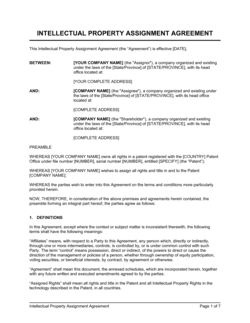
An IP assignment agreement transfers a broad portfolio of intellectual property rights β€” patents, trademarks, copyrights, and trade secrets β€” in a single document. A domain name assignment is narrower, covering only the registered domain and directly associated goodwill. Use a standalone domain assignment for single-domain transactions; use the broader IP assignment when the domain is one of several IP assets being transferred together.

vs Asset Purchase Agreement

An asset purchase agreement transfers an entire category of business assets β€” inventory, equipment, customer lists, contracts, and IP β€” typically as part of a business acquisition. A domain name assignment is a single-asset transfer document used when the domain is the primary or sole asset changing hands. For a full business or website acquisition, the asset purchase agreement should reference and incorporate the domain assignment.

vs Domain Name License Agreement

A domain name license agreement grants the licensee the right to use a domain for a defined period without transferring ownership β€” the licensor retains the registration and can reclaim the domain at license expiry. A domain assignment permanently transfers ownership with no reversion right. Use a license when the owner wants to retain long-term control; use an assignment when the goal is a clean, permanent sale.

vs Letter of Intent (Acquisition)

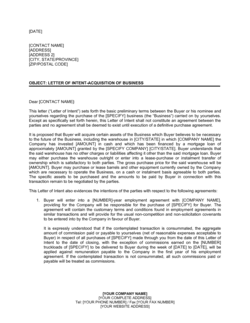
A letter of intent establishes the parties' intent to negotiate a domain or business acquisition and may include exclusivity and confidentiality obligations during due diligence, but it is typically non-binding on the core transaction terms. The domain name assignment agreement is the binding closing document that actually transfers title. An LOI may precede the assignment agreement in higher-value transactions but cannot replace it.

Industry-specific considerations

Technology / SaaS

Domain assignments frequently accompany software acquisitions and rebrands, where the domain is as valuable as the codebase β€” premium .io and .com domains in SaaS often trade for six to seven figures and require escrow and detailed IP warranty provisions.

E-commerce and Retail

Online retailers acquire exact-match domains for SEO value and brand authority; the assignment agreement must address DNS transfer, existing hosting configurations, and SSL certificate continuity to prevent revenue-impacting downtime.

Media and Publishing

Media properties are often built around a single domain; assignments in this sector routinely include associated subdomains, content licensing carve-outs, and transition-period arrangements where the seller continues operating the site under contract.

Financial Services

Regulated entities acquiring domains must ensure the domain's prior use does not carry reputational or compliance liability; assignments include enhanced WHOIS history diligence and representations about the domain's use in any prior financial promotions.

Jurisdictional notes

United States

Domain name ownership and transfer disputes in the US are primarily governed by the Anticybersquatting Consumer Protection Act (ACPA), which allows trademark owners to sue for domain names registered in bad faith. Courts apply the Lanham Act to trademark-domain conflicts. State contract law governs the assignment agreement itself, and choice-of-law clauses are generally enforced. Parties should also verify that the domain is not subject to an in rem ACPA action, which attaches to the domain itself regardless of the owner's location.

Canada

CIRA (Canadian Internet Registration Authority) administers .ca domains and has its own Domain Name Dispute Resolution Policy (CDRP), which differs from ICANN's UDRP. Transfers of .ca domains require both parties to meet CIRA's Canadian Presence Requirements β€” not all foreign entities qualify as .ca registrants. Quebec-based parties should ensure the agreement is available in French if required under the Charter of the French Language.

United Kingdom

Nominet administers .uk and .co.uk domains and operates its own Dispute Resolution Service (DRS) for trademark-domain conflicts. Domain transfers under Nominet require the assignor to initiate a registrant change request through their registrar. Post-Brexit, .eu domains are no longer available to UK residents, making .co.uk and .uk transfers particularly common for rebrands. The agreement should comply with the Consumer Rights Act 2015 if either party is a consumer.

European Union

EURid administers .eu domains and restricts registration and transfer to EU residents, EU-incorporated entities, or entities with a registered office in the EU β€” transfers to non-EU parties are not permitted. GDPR significantly restricts what WHOIS data registrars may publish, making ownership verification more complex; parties should request a registrar certificate to confirm registered ownership before signing. Some member states impose additional requirements for domain-related IP transactions under local trademark law.

Template vs lawyer β€” what fits your deal?

PathBest forCostTime
Use the templateStraightforward single-domain transfers between individuals or small businesses where the purchase price is under $10,000 and no known trademark issues existFree30–45 minutes
Template + legal reviewDomain purchases between $10,000 and $100,000, transactions involving TLDs with country-specific rules, or domains with prior UDRP history$300–$800 for a 1–2 hour attorney review1–3 days
Custom draftedPremium domain acquisitions above $100,000, domains bundled with trademarks or website content, cross-border transactions, or domains subject to active disputes$1,500–$5,000+ depending on complexity1–2 weeks

Glossary

Assignor
The current registered owner of the domain name who is transferring ownership to the buyer.
Assignee
The party receiving ownership of the domain name upon completion of the transfer.
ICANN
The Internet Corporation for Assigned Names and Numbers β€” the nonprofit body that coordinates domain name registration policy globally.
Registrar
An ICANN-accredited company (such as GoDaddy, Namecheap, or Google Domains) authorized to register and manage domain names on behalf of owners.
Authorization Code (EPP Code)
A unique alphanumeric code generated by the current registrar that is required to unlock and transfer a domain to a new registrar.
WHOIS Record
The publicly accessible database entry that displays a domain's registered owner, registrar, creation date, and expiration date.
Consideration
The value exchanged between the parties β€” typically a monetary payment β€” that makes the assignment agreement a binding contract.
Trademark Infringement
Unauthorized use of a protected brand name or mark in a domain name, which can expose the assignor to liability if not disclosed or warranted against.
UDRP (Uniform Domain-Name Dispute-Resolution Policy)
ICANN's mandatory arbitration process for resolving disputes between domain registrants and trademark owners without going to court.
Cybersquatting
Registering, trafficking, or using a domain name with bad-faith intent to profit from someone else's trademark β€” prohibited under the US Anticybersquatting Consumer Protection Act.
Escrow Service
A neutral third party (such as Escrow.com) that holds the purchase price in trust until the domain transfer is confirmed, protecting both buyer and seller.
Post-Closing Cooperation
The contractual obligation of the assignor to assist the assignee in completing the technical registrar transfer and updating associated records after the agreement is signed.

Part of your Business Operating System

This document is one of 3,000+ business & legal templates included in Business in a Box.

  • Fill-in-the-blanks β€” ready in minutes
  • 100% customizable Word document
  • Compatible with all office suites
  • Export to PDF and share electronically

Create your document in 3 simple steps.

From template to signed document β€” all inside one Business Operating System.
1
Download or open template

Access over 3,000+ business and legal templates for any business task, project or initiative.

2
Edit and fill in the blanks with AI

Customize your ready-made business document template and save it in the cloud.

3
Save, Share, Send, Sign

Share your files and folders with your team. Create a space of seamless collaboration.

Save time, save money, and create top-quality documents.

β˜…β˜…β˜…β˜…β˜…

"Fantastic value! I'm not sure how I'd do without it. It's worth its weight in gold and paid back for itself many times."

Managing Director Β· Mall Farm
Robert Whalley
Managing Director, Mall Farm Proprietary Limited
β˜…β˜…β˜…β˜…β˜…

"I have been using Business in a Box for years. It has been the most useful source of templates I have encountered. I recommend it to anyone."

Business Owner Β· 4+ years
Dr Michael John Freestone
Business Owner
β˜…β˜…β˜…β˜…β˜…

"It has been a life saver so many times I have lost count. Business in a Box has saved me so much time and as you know, time is money."

Owner Β· Upstate Web
David G. Moore Jr.
Owner, Upstate Web

Run your business with a system β€” not scattered tools

Stop downloading documents. Start operating with clarity. Business in a Box gives you the Business Operating System used by over 250,000 companies worldwide to structure, run, and grow their business.

Start freeΒ Β·Β No credit card required