Gift Deed Template

Free Word download β€’ Edit online β€’ Save & share with Drive β€’ Export to PDF

2 pagesβ€’20–30 min to fillβ€’Difficulty: Standardβ€’Signature requiredβ€’Legal review recommended
Learn more ↓
FreeGift Deed Template

At a glance

What it is
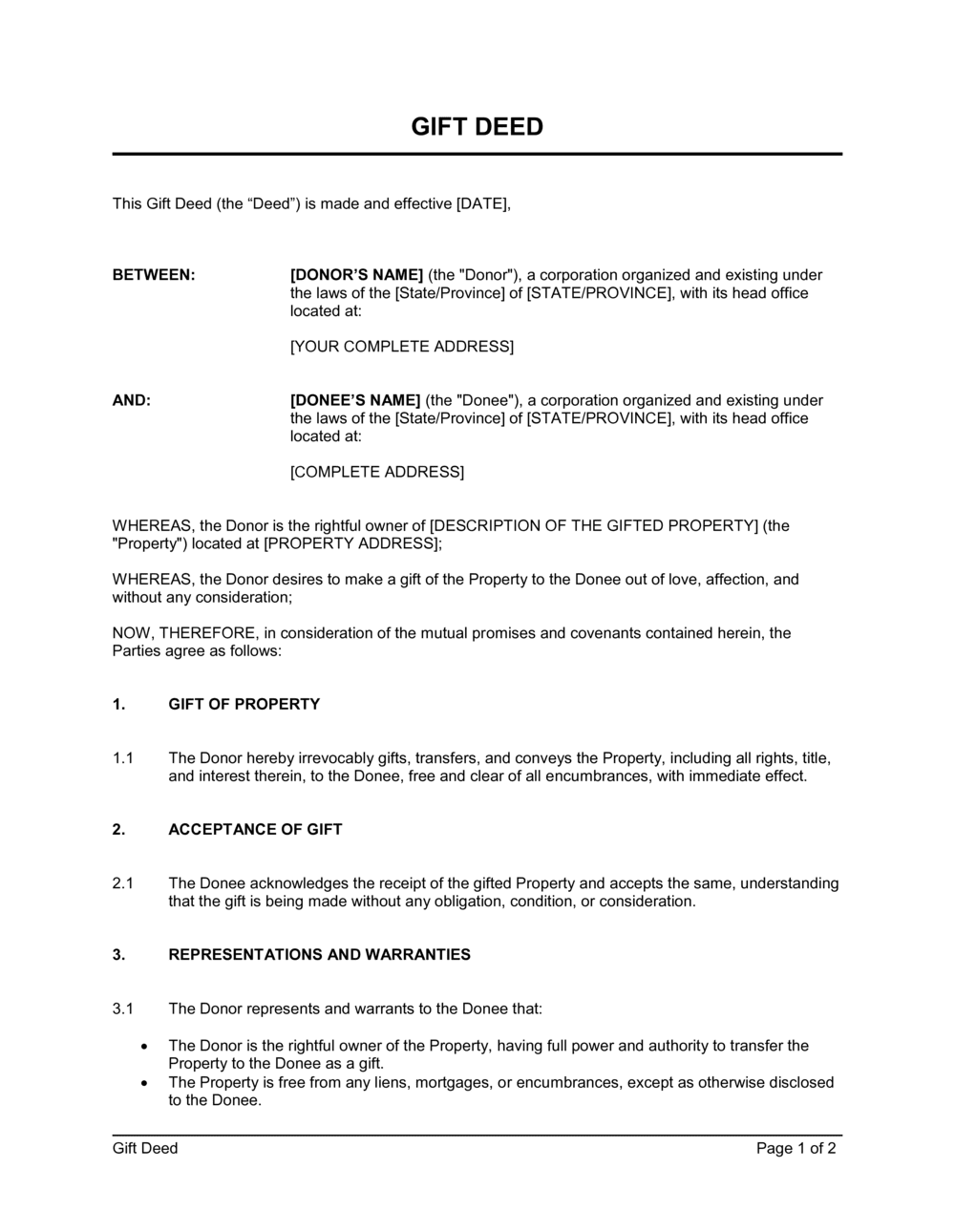
A Gift Deed is a legally binding document by which a donor voluntarily transfers ownership of property β€” real estate, money, vehicles, or valuables β€” to a donee without any payment or consideration in return. This free Word download gives you a structured, notarization-ready starting point you can edit online and export as PDF before recording or registering with the appropriate authority.
When you need it
Use it when transferring property to a family member, friend, or charitable organization as a gift, or when estate planning requires moving assets out of your name without a sale. Many jurisdictions require a recorded gift deed before a title transfer takes legal effect.
What's inside
Full identification of donor and donee, a precise description of the gifted property, an explicit statement that no consideration is exchanged, representations and warranties of clear title, acceptance by the donee, witness and notary blocks, and governing law. A separate gift tax disclosure section is included for US and Canadian use.

What is a Gift Deed?

A Gift Deed is a legally binding document by which a donor voluntarily and irrevocably transfers ownership of property β€” real estate, money, vehicles, or personal valuables β€” to a donee without receiving any payment, promise, or consideration in return. Unlike a sale or exchange, the transfer is driven entirely by the donor's intent to benefit the recipient, and this absence of consideration must be explicitly stated in the document to distinguish it from a disguised sale under tax law. For real estate, a gift deed must typically be notarized, signed by at least two disinterested witnesses, and recorded with the county recorder or land registry to take legal effect and protect the donee against subsequent third-party claims.

Why You Need This Document

Transferring property without a properly executed gift deed exposes both parties to serious legal and tax risk. An oral or informal gift of real estate has no legal standing β€” title remains in the donor's name, the property passes through probate on the donor's death, and the intended gift may be contested by other heirs. Without a written no-consideration statement, tax authorities in the US, Canada, and the UK may treat the transaction as a sale at market value, triggering capital gains tax on the donor and potentially stamp duty or transfer tax on the donee. A completed, notarized, and recorded gift deed eliminates these risks by creating an unambiguous public record of the transfer, supporting any gift tax filings, and providing the donee with defensible title. This template gives you the structure to do it correctly β€” covering every required clause from property description to notary block β€” so you spend your time on the details that matter rather than researching what to include.

Which variant fits your situation?

If your situation is…Use this template
Transferring real estate to a family memberGift Deed (Real Property)
Gifting a motor vehicle without a saleVehicle Gift Letter
Donating property to a charity or nonprofitDeed of Gift (Charitable Donation)
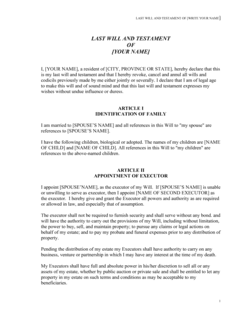
Transferring assets as part of a formal estate planLast Will and Testament
Establishing an irrevocable trust to hold gifted assetsIrrevocable Trust Agreement
Transferring business ownership shares as a giftStock Transfer Agreement
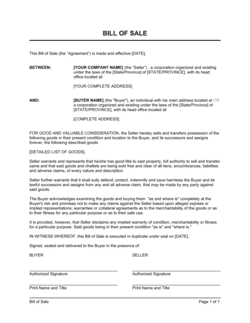
Gifting personal property such as jewelry or artworkBill of Sale (Gift)

Common mistakes to avoid

❌ Using a street address instead of a legal property description

Why it matters: County recorders and land registries reject deeds without a full legal description. The transfer has no legal effect until the deed is recorded, leaving the donee with no enforceable title.

Fix: Obtain the verbatim legal description from the existing title deed or county assessor records and attach it as Exhibit A. Call the recorder's office to confirm the required format.

❌ Failing to have the donee sign the acceptance clause

Why it matters: A gift is legally incomplete without delivery and acceptance. A deed without the donee's signature may be treated as undelivered, meaning the property reverts to the donor's estate on death.

Fix: Include a clearly labeled acceptance block with a signature line for the donee and have it executed at the same time as the donor's signature.

❌ Using an interested witness β€” a beneficiary or family member

Why it matters: Most jurisdictions disqualify witnesses who have a financial interest in the transaction, potentially invalidating the entire deed and requiring a re-execution.

Fix: Use two independent witnesses with no stake in the transfer β€” neighbors, coworkers, or professional colleagues are appropriate; children or other heirs of the donor are not.

❌ Transferring encumbered property without disclosing the mortgage

Why it matters: Many mortgages contain a due-on-sale or due-on-transfer clause that makes the full loan balance immediately payable if the property is transferred without lender consent β€” even by gift.

Fix: Review the mortgage documents and contact the lender before executing the deed. Request a formal consent to transfer in writing and attach it to the deed file.

❌ Ignoring the gift tax filing obligation

Why it matters: In the US, the donor must file IRS Form 709 for any gift exceeding the annual exclusion β€” even if no tax is owed. Failing to file triggers a late-filing penalty of 5% per month on any tax due, up to 25%.

Fix: Calculate the fair market value of the gift, compare it to the annual exclusion, and engage a tax professional to file Form 709 by the April 15 deadline following the year of the gift.

❌ Executing the deed before confirming jurisdiction-specific requirements

Why it matters: Recording requirements, witness counts, notarization rules, and stamp duty obligations vary significantly by state, province, and country. A deed that meets Texas requirements may be invalid in Florida or Ontario.

Fix: Check the recorder's website for the specific jurisdiction where the property is located before drafting. When in doubt, consult a local real estate attorney for a one-hour review.

The 10 key clauses, explained

Parties identification

In plain language: Names, addresses, and legal capacities of the donor and donee, establishing who is giving and who is receiving the property.

Sample language
This Gift Deed is made on [DATE] by [DONOR FULL LEGAL NAME] of [DONOR ADDRESS] ('Donor') to [DONEE FULL LEGAL NAME] of [DONEE ADDRESS] ('Donee').

Common mistake: Using nicknames or informal names instead of full legal names as they appear on government-issued ID β€” this can void the transfer or require a corrective deed.

Recitals and gift declaration

In plain language: An explicit statement that the donor transfers the property freely, voluntarily, and without any payment, promise, or expectation of return.

Sample language
For love and affection, and for no monetary consideration, Donor hereby gives, grants, and transfers to Donee the property described herein, absolutely and irrevocably.

Common mistake: Including language suggesting future obligations or conditions on the donee β€” courts may recharacterize the gift as a contract or conditional transfer, exposing both parties to tax and title complications.

Property description

In plain language: A precise legal description of the asset being transferred β€” for real estate, the full legal description from the title deed; for personal property, a detailed itemized description with identifying numbers.

Sample language
The property subject to this deed is: [FULL LEGAL DESCRIPTION / PARCEL NUMBER / VIN / SERIAL NUMBER] located at [PROPERTY ADDRESS OR DESCRIPTION], more particularly described in Exhibit A attached hereto.

Common mistake: Using a street address alone instead of the full legal description from the title or deed. Address-only descriptions are routinely rejected by county recorders and land registries.

Representations and warranties of title

In plain language: The donor's assurances that they own the property outright, have the right to transfer it, and that the property is free from undisclosed liens or encumbrances.

Sample language
Donor warrants that (a) Donor holds good and marketable title to the Property; (b) the Property is free from all encumbrances except [LIST EXCEPTIONS OR 'NONE']; and (c) Donor has full authority to make this gift.

Common mistake: Omitting the warranties entirely to keep the document short β€” a donee who later discovers an undisclosed mortgage or lien has no written recourse against the donor without this clause.

No consideration statement

In plain language: A clear affirmation that the donee is not paying anything β€” in money, services, or future obligations β€” in exchange for the property.

Sample language
The Donee has not paid, and is not obligated to pay, any money or other consideration to the Donor in exchange for the transfer effected by this Deed.

Common mistake: Skipping this clause and relying on the recitals alone. Tax authorities in the US, Canada, and UK look for an explicit no-consideration statement when reviewing gift transactions for disguised sales.

Acceptance by donee

In plain language: The donee's signed acknowledgment that they accept the gift and all associated rights, title, and obligations as of the transfer date.

Sample language
Donee hereby accepts the gift of the Property described herein and agrees to be bound by all terms of this Deed as of [TRANSFER DATE].

Common mistake: Failing to have the donee sign the acceptance block. Without the donee's signature, the gift is legally incomplete in most jurisdictions and may be treated as undelivered.

Gift tax disclosure and filing obligation

In plain language: A section that identifies whether the transfer triggers a gift tax filing requirement and confirms which party is responsible for any tax due.

Sample language
The Donor acknowledges that this transfer may trigger a gift tax reporting obligation under [APPLICABLE TAX CODE]. The Donor shall be solely responsible for filing [IRS Form 709 / applicable return] and paying any gift tax assessed.

Common mistake: Assigning gift tax responsibility to the donee without legal advice β€” in the US, the obligation falls on the donor by default, and shifting it contractually can create unexpected tax liability for the donee.

Witness and notary block

In plain language: Signature lines for two disinterested witnesses and a notary public, including the notary's commission expiry date and seal, required for recording in most jurisdictions.

Sample language
Signed by the Donor in the presence of the undersigned witnesses on [DATE]. Witness 1: [NAME / SIGNATURE]. Witness 2: [NAME / SIGNATURE]. Notarized before me, [NOTARY NAME], Notary Public, [STATE/PROVINCE], Commission Expires: [DATE].

Common mistake: Using a beneficiary or family member as a witness. Interested witnesses β€” those who benefit from the transfer β€” are disqualified in most jurisdictions and can invalidate the entire deed.

Governing law and recording instructions

In plain language: Specifies the jurisdiction whose law governs the deed and provides instructions for recording or registering the transfer with the relevant authority.

Sample language
This Deed shall be governed by the laws of [STATE / PROVINCE / COUNTRY]. Donee is responsible for recording this Deed with the [COUNTY RECORDER / LAND REGISTRY / REGISTRAR] within [30] days of execution.

Common mistake: Choosing a governing law that does not match the location of the property. For real estate, the law of the jurisdiction where the property is located governs the transfer regardless of what the deed states.

Entire agreement and severability

In plain language: Confirms the deed is the complete record of the gift transaction and that if any clause is found unenforceable, the rest of the deed remains valid.

Sample language
This Deed constitutes the entire agreement between the parties with respect to the gift described herein. If any provision is held invalid or unenforceable, the remaining provisions shall continue in full force and effect.

Common mistake: Omitting severability β€” if a court strikes a tax clause or a warranty, the absence of severability language can void the entire deed rather than just the offending clause.

How to fill it out

  1. 1

    Identify both parties with full legal names

    Enter the donor's and donee's full legal names exactly as they appear on government-issued ID or corporate registration documents. Include current addresses and, for real estate, the county or region of the property.

    πŸ’‘ For married donors, confirm whether the property is community or separate property β€” a spouse may need to co-sign even if not listed as a co-owner on the existing title.

  2. 2

    Obtain and copy the full legal property description

    Retrieve the legal description from the existing title deed, certificate of title, or the county assessor's records. Paste it verbatim into the property description clause and attach it as Exhibit A.

    πŸ’‘ Call the county recorder's office before drafting to confirm the exact format they require β€” some jurisdictions reject anything shorter than the full metes-and-bounds description.

  3. 3

    Confirm title is clear before proceeding

    Search for any liens, mortgages, or encumbrances on the property through the county recorder or a title company. List any known encumbrances in the warranties clause; transferring property with an undisclosed mortgage can expose the donor to fraud claims.

    πŸ’‘ A basic title search at a county recorder costs $25–$75 and takes one business day β€” cheap insurance before signing.

  4. 4

    Complete the gift tax disclosure section

    Determine whether the fair market value of the gift exceeds the applicable annual exclusion limit. In the US, gifts above $18,000 per recipient (2024) require the donor to file IRS Form 709. Enter the estimated fair market value and the responsible party for filing.

    πŸ’‘ Even if no tax is owed, the filing obligation exists once you exceed the annual exclusion β€” failure to file triggers penalties regardless of whether tax is due.

  5. 5

    Have both parties sign before two disinterested witnesses

    The donor signs first, followed by the donee completing the acceptance block. Two witnesses who are not beneficiaries of the gift must sign in the presence of all parties.

    πŸ’‘ Witnesses should print their names legibly below their signatures β€” illegible witness signatures are a common reason recorders return deeds unfiled.

  6. 6

    Arrange notarization before a licensed notary public

    All signing parties must appear in person before the notary with valid government-issued photo ID. The notary completes the acknowledgment block, affixes their seal, and records the transaction in their notary journal.

    πŸ’‘ Mobile notary services ($75–$150) will travel to a location of your choice β€” useful when the donor is elderly or cannot easily visit an office.

  7. 7

    Record the deed with the appropriate authority

    For real estate, file the executed, notarized deed with the county recorder or land registry in the jurisdiction where the property is located. Pay the applicable recording fee and retain the stamped, recorded copy for your files.

    πŸ’‘ Recording fees vary widely β€” from $15 to over $200 depending on the jurisdiction and number of pages. Confirm the current fee schedule and accepted payment methods before arriving.

  8. 8

    Notify relevant parties and update records

    Inform the property insurer, mortgage servicer (if any lien exists), HOA, and local tax assessor of the ownership change. Update vehicle titles with the DMV for gifted cars.

    πŸ’‘ Failure to update the property tax assessor can result in tax bills continuing to arrive in the donor's name β€” and in some jurisdictions, the reassessment clock for gift exemptions will not start until the assessor is formally notified.

Frequently asked questions

What is a gift deed?

A gift deed is a legal document by which a donor voluntarily transfers ownership of property β€” real estate, money, vehicles, or personal valuables β€” to a donee without receiving any payment or consideration in return. It must be executed with the required formalities (typically witnesses and notarization) and, for real estate, recorded with the appropriate government authority to take legal effect.

Does a gift deed need to be notarized?

In most jurisdictions, yes. For real estate, notarization is required before a deed can be recorded with a county recorder or land registry. For personal property such as vehicles, the DMV typically requires a notarized gift letter. Some jurisdictions also require two disinterested witnesses in addition to notarization. Check the specific requirements of the jurisdiction where the property is located before execution.

Is a gift deed irrevocable?

Generally yes. Once a gift deed has been signed, delivered to the donee, and accepted, it is typically irrevocable. Most jurisdictions allow revocation only in narrow circumstances β€” fraud, undue influence, failure of the donee to fulfill a condition precedent, or statutory exceptions for gifts to minors. A donor who wishes to retain control over the asset should consider a trust structure rather than an outright gift deed.

Does a gift deed trigger gift tax?

It may. In the US, gifts exceeding $18,000 per recipient per year (2024) require the donor to file IRS Form 709, though no tax is owed until cumulative lifetime gifts exceed the lifetime exemption ($13.61 million in 2024). In Canada, there is no gift tax, but capital gains tax may apply if the donor is deemed to have disposed of the asset at fair market value. In the UK, gifts are potentially exempt transfers subject to inheritance tax if the donor dies within seven years. Always consult a tax professional before executing a gift deed for high-value assets.

What is the difference between a gift deed and a will?

A gift deed transfers ownership during the donor's lifetime and takes effect immediately upon execution and delivery. A will transfers property only after the testator's death and must go through probate. A gift deed avoids probate for the transferred asset, but the transfer is permanent and irrevocable β€” the donor cannot reclaim the property. A will can be amended or revoked at any time before death.

Can a gift deed be used for any type of property?

Yes, though the formal requirements differ by asset type. Real estate requires a full legal description and recording with a land registry. Motor vehicles require a notarized gift letter and a title transfer through the DMV. Money transferred as a gift typically does not require a deed, but a written record is advisable for tax purposes. Personal property of significant value β€” jewelry, artwork, securities β€” benefits from a written gift deed to establish clear ownership and support any tax filings.

What happens if a gift deed is not recorded?

An unrecorded gift deed may still be valid between the parties, but it provides no protection against third-party claims. If the donor later sells or mortgages the property to a good-faith purchaser who has no notice of the prior gift, the purchaser's interest may prevail over the donee's in most jurisdictions. Recording creates a public record that protects the donee's ownership against subsequent claims.

Do I need a lawyer to prepare a gift deed?

For straightforward transfers of personal property between family members, a high-quality template is typically sufficient if completed carefully and reviewed against local recording requirements. Engage a real estate attorney when the property is high in value, subject to a mortgage, located in a jurisdiction with complex stamp duty or transfer tax rules, or when the gift has significant estate planning implications. A one-hour attorney review typically costs $200–$500 and is worthwhile for any real estate transfer above $50,000 in value.

Can a gift deed be challenged in court?

Yes. A gift deed can be challenged on grounds of lack of capacity (the donor did not understand what they were signing), undue influence (the donor was pressured into the transfer), fraud, or failure to meet execution formalities. Courts scrutinize gifts made by elderly donors to caregivers or non-family members particularly closely. Proper notarization, independent witnesses, and clear evidence of voluntary intent help defend against such challenges.

How this compares to alternatives

vs Quitclaim Deed

A quitclaim deed transfers whatever interest the grantor has in a property with no warranties of title β€” used most often between family members, divorcing spouses, or to clear a title defect. A gift deed explicitly states no consideration is exchanged and includes title warranties, making it the stronger document for tax purposes and for protecting the donee against undisclosed encumbrances.

vs Last Will and Testament

A will transfers property only after the testator's death and must pass through probate. A gift deed transfers ownership immediately and avoids probate for the specific asset transferred. The tradeoff is permanence β€” a will can be changed anytime before death; a delivered and accepted gift deed is generally irrevocable.

vs Bill of Sale

A bill of sale documents the transfer of personal property in exchange for payment β€” it is a sales transaction record. A gift deed documents the same type of transfer but with no money changing hands. Using a bill of sale with a nominal $1 consideration instead of a proper gift deed can create tax problems because authorities may treat it as a disguised gift subject to scrutiny.

vs Trust Agreement

A trust agreement allows a donor to transfer assets to a trustee for the benefit of named beneficiaries while retaining control over distribution terms, timing, and conditions. A gift deed transfers ownership outright and immediately with no ongoing control. Trusts are more appropriate when the donor wants to impose conditions, manage assets for minor beneficiaries, or retain a life estate.

Industry-specific considerations

Estate Planning and Elder Law

Gift deeds are a primary tool for reducing taxable estates through annual exclusion gifting and lifetime transfer programs structured around IRS Form 709 filings.

Real Estate

Intra-family property transfers require a recorded gift deed with a full legal description; some states impose transfer taxes or reassessment obligations triggered by the deed recording.

Financial Services

Advisors use gift deeds to document transfers of securities, brokerage accounts, and cash gifts that approach or exceed the annual exclusion, supporting Form 709 preparation.

Nonprofit and Charitable Sector

Charities receiving real property gifts require a notarized deed of gift to substantiate the donation for IRS charitable deduction purposes under IRC Section 170.

Jurisdictional notes

United States

Recording requirements vary by state β€” most require notarization plus two witnesses, but some states (e.g., Florida) mandate specific witness formalities. Gifts above the annual exclusion ($18,000 per recipient in 2024) trigger IRS Form 709 filing by the donor. Several states impose real estate transfer taxes even on gift transactions; California's Proposition 19 may trigger property tax reassessment unless the recipient uses the home as their primary residence within one year.

Canada

Canada has no gift tax, but the Income Tax Act deems a gift of appreciated property to be a disposition at fair market value, potentially triggering capital gains tax on the donor. Provincial land transfer taxes apply in most provinces even for gratuitous transfers. Quebec requires deeds affecting real property to be notarized before a notaire (civil law notary) and registered in the land register. Ontario and British Columbia impose land transfer tax regardless of whether consideration is paid.

United Kingdom

A deed of gift transferring real property must be executed as a deed β€” signed, witnessed, and delivered β€” and registered with HM Land Registry. Stamp Duty Land Tax (SDLT) is generally not payable on a pure gift, but if the donee assumes a mortgage, SDLT applies to the mortgage value. Gifts of property are potentially exempt transfers (PETs) for inheritance tax purposes; if the donor dies within seven years of the gift, taper relief applies on a sliding scale. Capital gains tax may arise on the donor's disposal at market value.

European Union

Gift taxation and registration requirements vary significantly by member state. France imposes droits de donation at rates up to 45% on non-family transfers, with allowances for direct-line family gifts. Germany levies Schenkungssteuer on gifts above allowance thresholds (€400,000 per child per ten years). Spain's Impuesto sobre Sucesiones y Donaciones applies at the regional level with wide variation. In most EU states, gifts of real property must be notarized and registered with the national land registry, and the notary typically also handles tax reporting.

Template vs lawyer β€” what fits your deal?

PathBest forCostTime
Use the templateTransferring personal property or low-value assets to a family member in a straightforward domestic transactionFree30–60 minutes to draft; 1–2 days to notarize and record
Template + legal reviewReal estate transfers up to $200K, vehicle gifts, or any transfer with gift tax reporting implications$200–$500 for a one-hour real estate attorney or tax professional review2–5 business days
Custom draftedHigh-value real estate, mortgaged property, cross-border transfers, or gifts with complex estate planning implications$500–$2,500+ depending on property value, jurisdiction, and complexity1–2 weeks

Glossary

Donor
The person or entity who owns the property and voluntarily transfers it to another party without receiving payment.
Donee
The person or entity who receives the gifted property and accepts the transfer under the terms of the deed.
Consideration
Something of value exchanged between parties to make a contract binding; a gift deed is notable precisely because no consideration is exchanged.
Notarization
The authentication of a document by a licensed notary public who verifies the identity of signatories and witnesses their signatures.
Recording
The official filing of a deed with a county recorder, land registry, or government authority to create a public record of the ownership transfer.
Gift Tax
A tax levied on the transfer of property from one person to another without full market-value compensation, subject to annual exclusion limits and lifetime exemptions.
Annual Exclusion
The dollar amount a donor may gift to any single recipient in a calendar year without triggering a gift tax filing obligation β€” $18,000 per recipient in 2024 under US federal rules.
Clear Title
Ownership of property free from liens, encumbrances, disputes, or third-party claims that would interfere with the transfer.
Deed of Gift
An alternative term for a gift deed, commonly used in the UK and Commonwealth jurisdictions; functionally identical.
Acceptance
The donee's formal acknowledgment that they receive the gifted property and agree to take on any obligations attached to it.
Revocability
Whether a gift deed can be cancelled after execution; most jurisdictions treat a delivered and accepted gift deed as irrevocable absent fraud, undue influence, or specific statutory exceptions.
Encumbrance
A claim, lien, mortgage, or restriction on a property that may limit the owner's ability to transfer it freely.

Part of your Business Operating System

This document is one of 3,000+ business & legal templates included in Business in a Box.

  • Fill-in-the-blanks β€” ready in minutes
  • 100% customizable Word document
  • Compatible with all office suites
  • Export to PDF and share electronically

Create your document in 3 simple steps.

From template to signed document β€” all inside one Business Operating System.
1
Download or open template

Access over 3,000+ business and legal templates for any business task, project or initiative.

2
Edit and fill in the blanks with AI

Customize your ready-made business document template and save it in the cloud.

3
Save, Share, Send, Sign

Share your files and folders with your team. Create a space of seamless collaboration.

Save time, save money, and create top-quality documents.

β˜…β˜…β˜…β˜…β˜…

"Fantastic value! I'm not sure how I'd do without it. It's worth its weight in gold and paid back for itself many times."

Managing Director Β· Mall Farm
Robert Whalley
Managing Director, Mall Farm Proprietary Limited
β˜…β˜…β˜…β˜…β˜…

"I have been using Business in a Box for years. It has been the most useful source of templates I have encountered. I recommend it to anyone."

Business Owner Β· 4+ years
Dr Michael John Freestone
Business Owner
β˜…β˜…β˜…β˜…β˜…

"It has been a life saver so many times I have lost count. Business in a Box has saved me so much time and as you know, time is money."

Owner Β· Upstate Web
David G. Moore Jr.
Owner, Upstate Web

Run your business with a system β€” not scattered tools

Stop downloading documents. Start operating with clarity. Business in a Box gives you the Business Operating System used by over 250,000 companies worldwide to structure, run, and grow their business.

Free Forever PlanΒ Β·Β No credit card required