Apology for System Downtime or Irregular Service Template

Free Word download β€’ Edit online β€’ Save & share with Drive β€’ Export to PDF

1 pageβ€’20–25 min to fillβ€’Difficulty: Standard
Learn more ↓
FreeApology for System Downtime or Irregular Service Template

At a glance

What it is
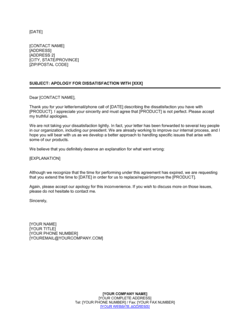
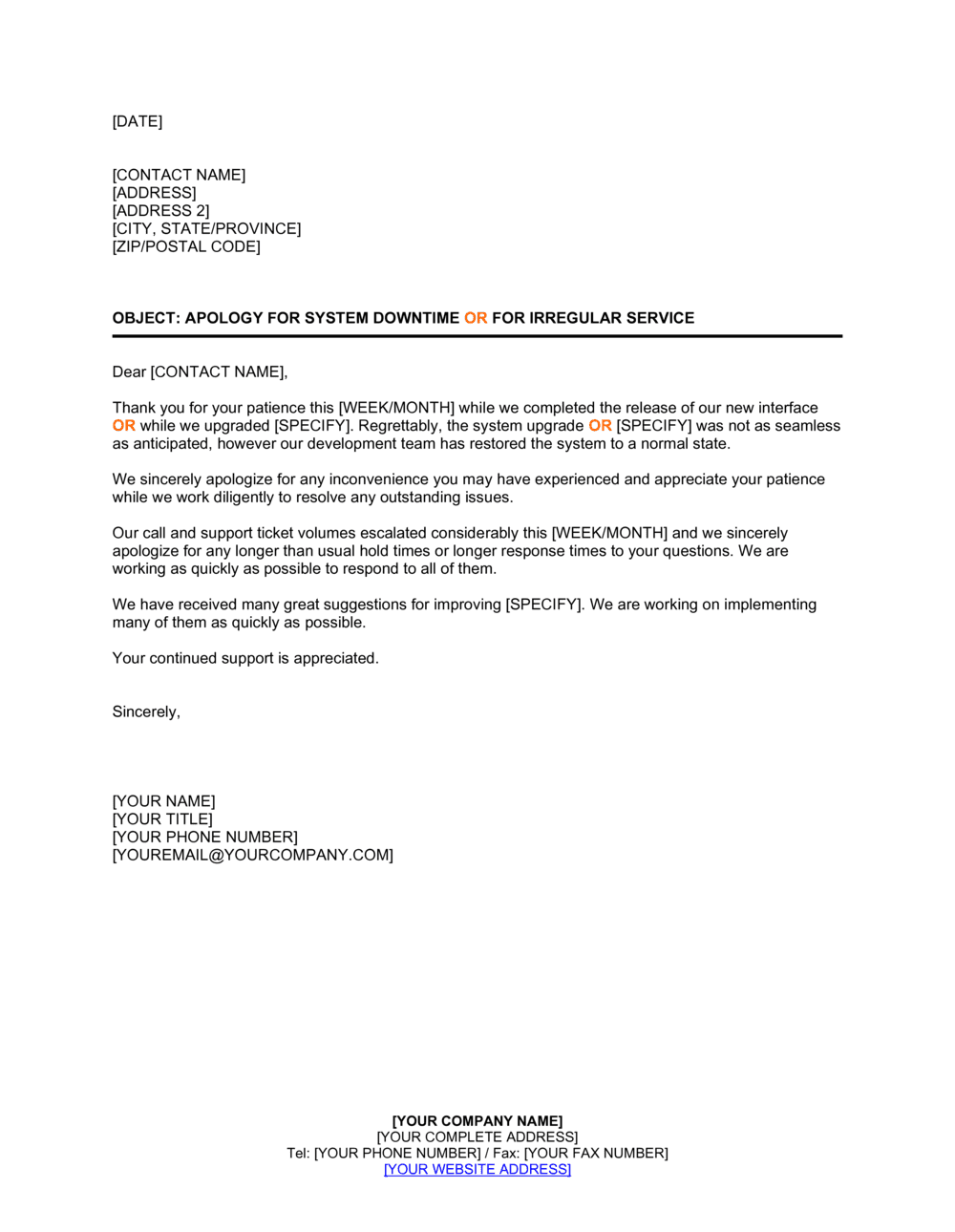
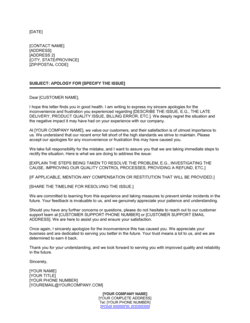
An Apology For System Downtime Or Irregular Service is a formal business letter sent to customers, clients, or users to acknowledge a service disruption, explain what happened, and outline corrective steps taken. This free Word download gives you a ready-to-edit template you can personalize with incident details and send by email or post within minutes of restoring service.
When you need it
Use it immediately after a system outage, platform interruption, or sustained service degradation that affected customers or business partners. Sending a prompt, structured apology limits reputational damage and demonstrates accountability before complaints escalate.
What's inside
Salutation and acknowledgment of the incident, a factual explanation of the cause and duration, a sincere apology statement, a summary of the corrective actions taken, any compensation or goodwill gesture offered, and a closing commitment to service quality.

What is an Apology For System Downtime Or Irregular Service?

An Apology For System Downtime Or Irregular Service is a formal business letter sent to customers, users, or clients to acknowledge that a technical failure or service disruption occurred, explain the cause and duration, and describe the steps taken to restore service and prevent recurrence. It functions as the primary customer-relations response to any unplanned outage β€” converting what could become a sustained complaint into a documented, accountable resolution. The letter is typically sent by email or post within 24 hours of service restoration, addressed either to named contacts or broadcast to all affected users.

Why You Need This Document

Staying silent after a service disruption is one of the fastest ways to lose customer trust β€” affected users who receive no communication will assume the worst, escalate to social media, or begin evaluating competitors. A structured apology letter gives you a controlled, professional channel to get ahead of that cycle: it confirms the incident was identified and taken seriously, delivers the facts customers need to explain the disruption internally to their own stakeholders, and documents the corrective actions taken. For businesses with SLA commitments, a written apology paired with a proactive service credit is often the difference between a retained customer and a churned one. This template ensures every incident communication covers the right elements β€” acknowledgment, cause, apology, corrective action, and remedy β€” without starting from a blank page under time pressure.

Which variant fits your situation?

If your situation is…Use this template
Brief outage lasting under two hours with no data lossApology For System Downtime Or Irregular Service
Extended multi-day disruption with significant customer impactService Disruption Notice (Extended)
Data breach or security incident affecting customer dataData Breach Notification Letter
Delayed product or service delivery to a specific clientApology Letter For Delay In Service
General customer complaint response not related to a system eventResponse To Customer Complaint Letter
Proactive maintenance notice sent before a planned outagePlanned Maintenance Notification Letter

Common mistakes to avoid

❌ Delaying the apology letter more than 24 hours

Why it matters: Customers who receive no communication within 24 hours assume the company either does not know or does not care. Silence converts a service incident into a trust incident.

Fix: Send an initial acknowledgment within hours of restoration, even if the root cause analysis is not yet complete. Follow up with the full letter once you have the details.
❌ Using 'if this caused any inconvenience'

Why it matters: Conditional language signals uncertainty about whether customers were affected β€” which reads as dismissive to anyone who lost access to a critical system.

Fix: Replace all conditional phrasing with direct acknowledgment: 'We understand this disruption affected your operations and we take full responsibility.'

❌ Overloading the letter with technical jargon

Why it matters: Most recipients are not infrastructure engineers. A letter full of technical terms makes the communication feel like an IT post-mortem rather than a customer apology.

Fix: Write the explanation at the reading level of a business manager, not a sysadmin. One sentence on the cause is almost always enough.

❌ Omitting a compensation clause for significant outages

Why it matters: For outages lasting more than two to three hours or breaching a contracted SLA, an apology without a remedy is considered inadequate by most business customers β€” and can trigger escalation or churn.

Fix: Define an internal threshold (e.g., any outage exceeding two hours or any SLA breach) that automatically triggers a service credit, and apply it proactively before the customer asks.

The 10 key clauses, explained

Date, recipient address, and subject line

In plain language: Identifies when the letter was written, who it is addressed to, and summarizes the topic in a clear subject line so the reader immediately understands the context.

Sample language
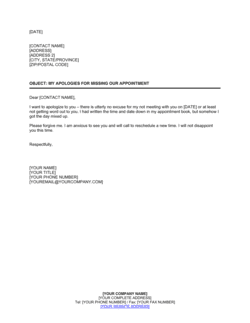
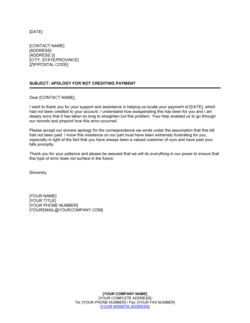
[DATE] | [RECIPIENT NAME / TITLE] | [COMPANY NAME] | [ADDRESS] | Re: Apology for Service Disruption on [DATE OF INCIDENT]

Common mistake: Using a vague subject line like 'Important Notice.' A specific subject line referencing the incident date improves open rates on email and helps recipients file the letter correctly.

Salutation

In plain language: Opens the letter with an appropriate greeting β€” either a named contact or a collective address for a broadcast communication.

Sample language
Dear [CUSTOMER NAME], / Dear Valued Customers,

Common mistake: Using 'To Whom It May Concern' for customers you have on record by name. Personalized salutations improve tone and reduce the perception that the apology is automated.

Acknowledgment of the incident

In plain language: States directly that a disruption occurred, specifying the affected service, the date, and the duration of the incident.

Sample language
We are writing to acknowledge that [SERVICE NAME] experienced an outage on [DATE] from [START TIME] to [END TIME] ([DURATION]), during which [DESCRIPTION OF IMPACT].

Common mistake: Burying the acknowledgment in the second or third paragraph. Customers who were affected want confirmation first β€” leading with the acknowledgment signals accountability immediately.

Explanation of the cause

In plain language: Provides a plain-language, factual explanation of what caused the disruption without placing blame on third parties or using technical jargon the reader cannot understand.

Sample language
The disruption was caused by [PLAIN-LANGUAGE CAUSE β€” e.g., a configuration error in our database failover system] that prevented users from accessing [AFFECTED FEATURE OR SERVICE].

Common mistake: Over-technical explanations that obscure the cause. Customers do not need to understand infrastructure architecture β€” they need to understand that you know what went wrong and that it is fixed.

Sincere apology statement

In plain language: Delivers a direct, unqualified apology for the disruption and its impact on the customer's operations or experience β€” without defensive language or minimizing the effect.

Sample language
We sincerely apologize for the inconvenience and disruption this caused to your business operations. We understand that [SERVICE NAME] is critical to your workflow, and we take full responsibility for this failure.

Common mistake: Qualifying the apology with 'if this caused any inconvenience.' Using 'if' signals that you are not certain the disruption had an impact β€” which reads as dismissive to anyone who was genuinely affected.

Corrective actions taken

In plain language: Describes the specific steps the company has already taken to resolve the issue and restore normal service.

Sample language
We have [SPECIFIC ACTION β€” e.g., rolled back the configuration change, restored data from backup, and added automated failover monitoring] to ensure service is fully restored as of [RESTORATION TIME / DATE].

Common mistake: Describing actions in vague terms like 'our team worked to fix the problem.' Specific corrective actions build confidence that the organization has the technical competence to manage incidents.

Preventive measures and commitments

In plain language: States the concrete steps the company will take to prevent recurrence, signaling to the customer that the root cause has been addressed systemically.

Sample language
To prevent a recurrence, we have [PREVENTIVE MEASURE β€” e.g., implemented additional redundancy, updated our monitoring thresholds, and scheduled a full infrastructure audit by DATE].

Common mistake: Making commitments that are too broad to be verifiable, such as 'we will ensure this never happens again.' Specific, time-bound measures β€” a new monitoring system deployed by a named date β€” are far more credible.

Compensation or goodwill gesture (if applicable)

In plain language: Offers a concrete remedy β€” service credit, extended subscription, or discount β€” proportionate to the severity and duration of the disruption.

Sample language
As a gesture of goodwill, we are applying a [X]-day service credit to your account, which will be reflected on your next billing statement. No action is required on your part.

Common mistake: Omitting this clause entirely for significant outages. For disruptions that breached an SLA or lasted more than a few hours, a goodwill gesture is expected β€” its absence becomes a second complaint.

Contact information and support offer

In plain language: Provides a direct point of contact β€” name, email, or phone number β€” where affected customers can ask questions or report ongoing issues.

Sample language
If you continue to experience any issues or have questions about this incident, please contact our support team directly at [SUPPORT EMAIL] or [PHONE NUMBER], available [HOURS].

Common mistake: Directing customers to a generic support portal without a specific contact name or ticket priority. Affected customers need to feel they have a direct channel, not a queue.

Closing and signature

In plain language: Closes the letter with a reaffirmation of commitment to service quality and the sender's name, title, and company.

Sample language
Thank you for your patience and continued trust in [COMPANY NAME]. We remain committed to providing you with reliable, high-quality service. Sincerely, [SENDER NAME] | [TITLE] | [COMPANY NAME]

Common mistake: Closing with a generic 'Thank you for your business' without reaffirming the service commitment. The closing is the last impression β€” a specific commitment lands better than a transactional sign-off.

How to fill it out

  1. 1

    Enter the date and recipient details

    Add the date the letter is being sent, the recipient's name and title, and their organization and address. For broadcast emails, use a collective salutation.

    πŸ’‘ Send the letter as close to service restoration as possible β€” within 24 hours is the accepted standard for business-facing outages.

  2. 2

    State the incident details precisely

    Fill in the affected service name, the exact start and end times of the outage, and a one-sentence description of how users were impacted.

    πŸ’‘ Use your incident tracking system to pull exact timestamps β€” 'approximately 3 hours' is less credible than '10:14 AM to 1:09 PM EST.'

  3. 3

    Write the cause in plain language

    Describe the root cause in terms a non-technical reader can understand. Avoid acronyms and infrastructure jargon. One to three sentences is sufficient.

    πŸ’‘ Test the explanation with someone outside your IT team. If they cannot paraphrase it back to you, simplify it further.

  4. 4

    Deliver the apology without qualifications

    Write a direct apology statement that acknowledges the impact on the customer's operations. Remove any language that minimizes or hedges the apology.

    πŸ’‘ Delete the word 'if' from your apology sentence entirely β€” 'we apologize for the disruption this caused' not 'we apologize if this caused disruption.'

  5. 5

    List corrective and preventive actions with specifics

    Describe what was done to resolve the issue and what will be done to prevent it recurring. Attach dates and owners to each preventive commitment where possible.

    πŸ’‘ Separate what has already been done (past tense) from what is planned (future with a date). Mixing them creates ambiguity about whether the fix is complete.

  6. 6

    Add compensation details if applicable

    If the outage breached an SLA or exceeded a threshold you consider significant, specify the credit amount, how it will be applied, and when it will appear.

    πŸ’‘ Apply the credit automatically and say so β€” requiring customers to claim a credit creates friction and generates additional complaints.

  7. 7

    Insert support contact and close with commitment

    Add a named support contact or priority email address, state available hours, and close with a reaffirmation of your service quality commitment.

    πŸ’‘ Have the letter signed by a Director, VP, or C-suite executive for outages affecting a large number of users β€” the seniority of the signatory signals how seriously the company takes the incident.

Frequently asked questions

When should I send an apology for system downtime?

Send an apology letter as soon as service has been fully restored and you have confirmed the root cause. The accepted window for business-facing communications is within 24 hours of restoration. For extended outages lasting more than four hours, consider sending an interim acknowledgment while the fix is in progress, followed by the full apology once service is back. Waiting until you have a perfect explanation costs you credibility.

Does a system downtime apology letter need to be legally reviewed?

For most routine outages, legal review is not necessary. However, if the disruption involved a data breach, affected regulated industries such as healthcare or financial services, or breached a contractual SLA with significant penalties, have your legal or compliance team review the letter before sending. In those situations, the wording of admissions and remedy offers can have contractual or regulatory implications.

Should the apology letter include technical details about the cause?

Include a plain-language summary of the cause β€” one to three sentences β€” but avoid deep technical detail in the customer-facing letter. Customers need to know what went wrong and that it is fixed; they do not need infrastructure architecture. If technical stakeholders on the customer side request a full post-incident report, offer to share one separately.

What is the difference between a service downtime apology and an SLA breach notice?

An apology letter is a customer-relations communication focused on acknowledgment, explanation, and goodwill. An SLA breach notice is a formal contractual document that triggers specific remedies β€” credits, penalties, or reporting obligations β€” defined in the service agreement. In practice, a significant outage often requires both: the apology letter addresses the relationship, while the SLA breach notice handles the contractual obligations.

How detailed should the corrective action section be?

Specific enough to be credible, brief enough to be readable. Name the fix that was applied, state whether it is permanent or temporary, and list one to three preventive measures with expected completion dates. Avoid committing to actions you have not yet planned β€” vague future promises erode trust faster than honest uncertainty.

Should I offer a service credit automatically or wait for customers to request it?

Apply significant credits automatically and notify customers in the apology letter. Requiring customers to submit a claim for a credit they are entitled to creates friction, generates additional support volume, and signals that the company is hoping most customers won't bother. Proactive credits consistently produce better retention outcomes than reactive ones.

Who should sign the apology letter?

For minor, brief outages, a customer support manager or director-level signature is appropriate. For significant outages affecting a large number of users, lasting several hours, or breaching a major SLA, the letter should come from a VP of Operations, CTO, or CEO. The seniority of the signatory communicates the weight the company assigns to the incident.

Can I use the same apology letter for internal and external audiences?

No. An internal incident communication typically includes more technical detail, references internal systems and teams by name, and may discuss root cause hypotheses still being investigated. An external customer apology must be finalized, plain-language, and focused on customer impact and remedies. Using an internal draft externally risks releasing unconfirmed technical details or internal process information.

How this compares to alternatives

vs Response To Customer Complaint Letter

A customer complaint response addresses a specific grievance raised by an individual customer, typically about product quality, billing, or service delivery. A system downtime apology is a proactive broadcast communication sent to all affected users before they complain. Use the complaint response for reactive, one-to-one situations; use this template for proactive, one-to-many incident communications.

vs Service Level Agreement

An SLA is a contractual document that defines uptime commitments, measurement methods, and remedies for breaches β€” signed before any incident occurs. A downtime apology is the operational communication sent after an incident. The apology letter should reference and honor the remedies defined in the SLA rather than replace it.

vs Planned Maintenance Notification Letter

A planned maintenance notice is sent before a scheduled outage to give customers advance warning and minimize disruption. A downtime apology is sent after an unplanned incident. The two are structurally similar but differ in timing and tone β€” maintenance notices are informational, while apology letters are remedial.

vs Data Breach Notification Letter

A data breach notification is a legally required communication triggered when customer data is compromised, with specific regulatory content requirements under laws such as GDPR, HIPAA, and US state breach notification statutes. A system downtime apology covers service unavailability without data exposure. If a downtime event also involves a breach, the data breach notification governs β€” do not substitute this template for that requirement.

Industry-specific considerations

SaaS / Technology

Platform outages directly affect subscriber workflows; SLA breach credits and a public status-page reference are expected alongside the letter.

Financial Services

Online banking or payment processing downtime triggers regulatory reporting obligations in addition to the customer apology, and wording must be reviewed for compliance.

E-commerce / Retail

Checkout or payment system outages during peak periods can represent significant lost revenue for customers, making a goodwill discount or credit particularly important.

Telecommunications

Network outages affect both consumer and business subscribers; regulatory bodies in most jurisdictions require formal incident disclosure within defined timeframes.

Template vs pro β€” what fits your needs?

PathBest forCostTime
Use the templateAny business needing to communicate a routine system outage or service disruption to customersFree15–30 minutes per incident
Template + professional reviewOutages in regulated industries, incidents involving potential data exposure, or SLA breach scenarios with contractual remedies$150–$400 for a legal or compliance reviewSame day to 24 hours
Custom draftedLarge-scale incidents with regulatory disclosure requirements, class-action exposure, or multi-jurisdiction customer bases$500–$2,000+ for legal counsel drafting1–3 days

Glossary

Service Level Agreement (SLA)
A contractual commitment between a provider and a customer defining the expected uptime, response times, and remedies for service failures.
Root Cause Analysis (RCA)
A structured investigation process that identifies the underlying reason a system failure or service disruption occurred.
Incident Duration
The total time between the start of a service disruption and the confirmed restoration of normal service.
Service Credit
A partial refund or billing adjustment offered to customers as compensation for downtime that breaches a contractual SLA.
Post-Incident Review
An internal or shared document summarizing what went wrong, why it happened, and what changes prevent recurrence β€” sometimes shared with affected customers.
Goodwill Gesture
A voluntary benefit β€” discount, free period, or gift β€” offered to affected customers beyond any contractual obligation, intended to restore goodwill.
Affected Users
The specific segment of customers or users whose access to a service was interrupted or degraded during the incident period.
Mitigation Steps
The immediate actions taken during an incident to limit its scope or impact while a permanent fix is being applied.

Part of your Business Operating System

This document is one of 3,000+ business & legal templates included in Business in a Box.

  • Fill-in-the-blanks β€” ready in minutes
  • 100% customizable Word document
  • Compatible with all office suites
  • Export to PDF and share electronically

Create your document in 3 simple steps.

From template to signed document β€” all inside one Business Operating System.
1
Download or open template

Access over 3,000+ business and legal templates for any business task, project or initiative.

2
Edit and fill in the blanks with AI

Customize your ready-made business document template and save it in the cloud.

3
Save, Share, Send, Sign

Share your files and folders with your team. Create a space of seamless collaboration.

Save time, save money, and create top-quality documents.

β˜…β˜…β˜…β˜…β˜…

"Fantastic value! I'm not sure how I'd do without it. It's worth its weight in gold and paid back for itself many times."

Managing Director Β· Mall Farm
Robert Whalley
Managing Director, Mall Farm Proprietary Limited
β˜…β˜…β˜…β˜…β˜…

"I have been using Business in a Box for years. It has been the most useful source of templates I have encountered. I recommend it to anyone."

Business Owner Β· 4+ years
Dr Michael John Freestone
Business Owner
β˜…β˜…β˜…β˜…β˜…

"It has been a life saver so many times I have lost count. Business in a Box has saved me so much time and as you know, time is money."

Owner Β· Upstate Web
David G. Moore Jr.
Owner, Upstate Web

Run your business with a system β€” not scattered tools

Stop downloading documents. Start operating with clarity. Business in a Box gives you the Business Operating System used by over 250,000 companies worldwide to structure, run, and grow their business.

Start freeΒ Β·Β No credit card required