Apology for Not Crediting Payment Template

Free Word download β€’ Edit online β€’ Save & share with Drive β€’ Export to PDF

1 pageβ€’15–25 min to fillβ€’Difficulty: Standard
Learn more ↓
FreeApology for Not Crediting Payment Template

At a glance

What it is
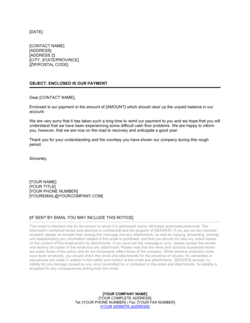
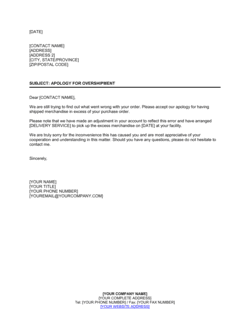
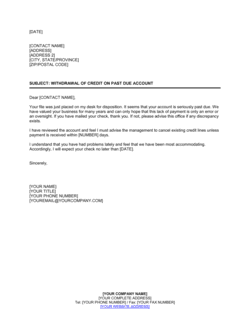
An Apology For Not Crediting Payment is a formal business letter sent by a company to a customer, client, or vendor to acknowledge that a payment was received but not properly applied or recorded in the recipient's account. This free Word download gives you a ready-to-edit template you can personalize and send in minutes, then export as PDF for your records.
When you need it
Use it whenever your accounts receivable or billing team discovers that a payment received from a customer was not credited to their account β€” whether due to a posting error, system issue, or administrative oversight. It is especially important when the oversight has generated a follow-up statement, a late-payment notice, or a customer complaint.
What's inside
A formal salutation and apology, a clear acknowledgment of the specific payment and error, a description of the corrective action already taken or scheduled, a confirmation that no penalty or late fee applies, and a professional closing with contact details for follow-up.

What is an Apology For Not Crediting Payment?

An Apology For Not Crediting Payment is a formal business letter sent by a company to a customer, client, or vendor to acknowledge that a payment was received but was not properly applied to their account. It confirms the error in plain terms, documents the corrective action taken β€” including the date the credit was applied and the corrected account balance β€” and explicitly waives any late fees or penalties that may have been generated as a result. Unlike a general apology letter, this document is transactional and specific: it references the exact payment amount, receipt date, and account or invoice number so the recipient can verify the correction in their own records.

Why You Need This Document

When a customer's payment goes unrecorded, the consequences compound quickly: automated billing systems generate late-payment notices, account balances appear incorrect on statements, and the customer begins to question the reliability of your financial operations. Left unaddressed, a simple posting error can escalate into a formal complaint, a lost contract renewal, or β€” in regulated industries β€” a compliance finding. A prompt, professionally worded apology letter stops that escalation by confirming the error in writing, documenting the fix, and giving the customer a named person to contact if further questions arise. It also creates a paper trail that protects your business if the customer later claims the issue was never resolved. Using this template ensures every billing correction letter your team sends covers the essential elements β€” acknowledgment, correction date, penalty waiver, and contact details β€” in a consistent, professional format that takes less than ten minutes to complete.

Which variant fits your situation?

If your situation is…Use this template
Payment was received but posted to the wrong customer accountApology For Not Crediting Payment
Overcharge was billed and a refund is being issuedApology For Overcharging
Payment was received but an invoice was never generatedBilling Correction Letter
Customer was incorrectly sent a late-payment noticeApology For Sending Incorrect Invoice
Vendor payment was processed late and a formal notice is neededApology For Late Payment
Customer account was suspended in error due to uncredited paymentAccount Reinstatement Letter

Common mistakes to avoid

❌ Sending the letter before applying the correction

Why it matters: The customer reads the letter, checks their account, sees the error still present, and escalates β€” turning a single complaint into two.

Fix: Process the credit and verify it appears on the account before sending the apology. If a system delay prevents immediate posting, state the exact posting date in the letter.
❌ Omitting the penalty waiver clause when a late notice was sent

Why it matters: The customer received a late-payment notice and will assume it remains valid unless you explicitly cancel it in writing. Silence on this point causes confusion and distrust.

Fix: Audit your billing system to confirm whether any automated notices went out, and include the waiver clause in every letter where a late notice was generated.

❌ Hedging the acknowledgment with phrases like 'there may have been'

Why it matters: Qualified language reads as blame-shifting and makes the customer feel they are still fighting to be believed β€” which undermines the entire purpose of the letter.

Fix: State the error directly and in the past tense: 'your payment was not credited to your account.' One clear sentence restores confidence faster than three paragraphs of explanation.

❌ Directing the customer to a general helpdesk or shared inbox for follow-up

Why it matters: After a billing error, a customer who has to navigate a phone tree or wait for a generic queue response is far more likely to escalate to a formal complaint or churn.

Fix: Name a specific team member with a direct phone number and email address in the closing paragraph. Personal accountability shortens resolution time and signals that the company takes the error seriously.

The 9 key clauses, explained

Reference header (date, account number, invoice reference)

In plain language: Identifies the letter with a date, the customer's account number, and the specific invoice or payment reference so the recipient can match it to their own records.

Sample language
Date: [DATE] | Account No.: [ACCOUNT NUMBER] | Re: Payment of [AMOUNT] received [DATE] β€” Invoice [INVOICE NUMBER]

Common mistake: Omitting the invoice or payment reference number. Without it, the customer cannot match the letter to their own records, creating unnecessary back-and-forth.

Formal salutation

In plain language: Addresses the specific contact person or accounts payable department by name or title.

Sample language
Dear [CONTACT NAME / Accounts Payable Team],

Common mistake: Using a generic 'To Whom It May Concern' when the customer's name is known β€” this signals carelessness and undermines the sincerity of the apology.

Acknowledgment of the error

In plain language: States clearly and without deflection that the payment was received but was not applied to the customer's account, and gives the date the payment was received.

Sample language
We write to acknowledge that your payment of [AMOUNT], received by us on [DATE], was not credited to your account due to [BRIEF REASON β€” e.g., an administrative oversight / a system processing error].

Common mistake: Using vague language like 'there may have been an issue' instead of a direct acknowledgment. Hedging the error reads as an attempt to avoid accountability and frustrates the recipient.

Apology statement

In plain language: A direct, unqualified apology for the error and any inconvenience it caused β€” without over-explaining or assigning blame to third parties.

Sample language
We sincerely apologize for this error and for any inconvenience or concern it may have caused you.

Common mistake: Over-explaining internal processes or blaming a software system. The customer is not interested in the cause β€” they want to know the problem is resolved.

Confirmation of corrective action

In plain language: States specifically what has been done to fix the error β€” the payment has been credited, the account updated, and any erroneous charges reversed.

Sample language
We have now credited your account with the full amount of [AMOUNT] as of [DATE]. Your account now reflects a balance of [CORRECTED BALANCE / $0.00 outstanding].

Common mistake: Stating that the correction 'will be' made without providing a specific date. The customer needs to know when they can verify the fix, not that it is pending at some unspecified future time.

Waiver of late fees or penalties

In plain language: Explicitly confirms that no late-payment fees, interest, or penalties have been or will be applied as a result of the uncredited payment.

Sample language
Please be assured that no late fees or interest charges have been applied to your account as a result of this error, and your payment history has not been adversely noted.

Common mistake: Omitting this clause when a late-payment notice was previously sent. If a penalty notice went out, the customer will assume it still applies unless you explicitly cancel it in writing.

Goodwill gesture (optional)

In plain language: An optional offer β€” such as a credit on the next invoice or a nominal discount β€” as a tangible acknowledgment of the inconvenience caused.

Sample language
As a gesture of goodwill, we have applied a [AMOUNT / PERCENTAGE] credit to your account, which will be reflected on your next statement.

Common mistake: Making a goodwill offer so small it reads as insincere (e.g., a $5 credit on a $10,000 account). If the error caused significant disruption, calibrate the gesture to the impact.

Assurance and prevention statement

In plain language: Briefly states the steps taken to prevent a recurrence without over-promising or going into operational detail.

Sample language
We have reviewed our payment processing procedures to prevent a similar error from occurring in the future and will ensure your account is monitored closely.

Common mistake: Promising specific operational changes in writing (e.g., 'we are replacing our accounting software') that could create expectations or liability if not followed through.

Call to action and contact details

In plain language: Invites the customer to contact a named person directly if they have further questions, providing a direct phone number and email address.

Sample language
Should you have any questions or require further confirmation, please contact [NAME] at [PHONE NUMBER] or [EMAIL ADDRESS]. We are happy to provide a corrected account statement on request.

Common mistake: Directing the customer to a general helpdesk or generic email address. After an error, the customer wants to speak to a person β€” a named contact reduces escalation risk.

How to fill it out

  1. 1

    Enter the date, account number, and payment reference

    Complete the reference header with today's date, the customer's account number, and the specific invoice number and payment amount involved.

    πŸ’‘ Cross-reference your accounts receivable ledger to confirm the exact payment amount and receipt date before completing the letter β€” accuracy in these details is the foundation of the apology.

  2. 2

    Address the correct contact person

    Use the name of the customer's accounts payable contact or finance manager if known. If the account is a consumer account, use the customer's full name.

    πŸ’‘ Check the original invoice or remittance advice for the contact name rather than guessing β€” sending to the wrong person can delay resolution.

  3. 3

    State the error clearly and without ambiguity

    Fill in the acknowledgment clause with the payment amount, the date it was received, and a brief factual reason for the error (e.g., 'administrative oversight' or 'system processing error').

    πŸ’‘ Keep the explanation to one sentence. The customer does not need a detailed postmortem β€” they need a clear acknowledgment.

  4. 4

    Confirm the corrective action with a specific date

    State the exact date on which the payment was credited and the corrected account balance. If the correction has not yet been made, state the specific date by which it will be completed.

    πŸ’‘ Do not send the letter until the correction has been processed, or commit to a date within 24 hours β€” sending an apology before fixing the error creates a second problem.

  5. 5

    Explicitly waive any late fees

    Complete the penalty waiver clause if a late-payment notice or statement was issued after the uncredited payment. This step is critical if the customer received any overdue communication.

    πŸ’‘ Check your system to confirm whether an automated late notice was sent β€” many billing platforms generate these automatically, and the customer may have received one without anyone on your team knowing.

  6. 6

    Add a goodwill gesture if appropriate

    Include the optional goodwill clause if the error caused a significant disruption β€” for example, if a service was suspended, a credit check was initiated, or the customer spent time chasing the issue.

    πŸ’‘ Calibrate the gesture to the disruption, not the payment amount. A few hours of staff time chasing an error justifies a meaningful credit.

  7. 7

    Sign off with a named contact and direct details

    Replace all generic placeholders in the closing and contact section with the name, phone number, and email of the specific team member the customer should contact.

    πŸ’‘ Use the accounts receivable manager's direct contact rather than a shared inbox β€” personal accountability here significantly reduces the chance of a formal complaint.

Frequently asked questions

What is an apology for not crediting payment letter?

An apology for not crediting payment letter is a formal business letter sent by a company to a customer or vendor to acknowledge that a payment was received but not properly applied to their account. It states the error clearly, confirms the corrective action taken, waives any penalties generated as a result, and provides a direct contact for follow-up. It serves both as a client-relations tool and as a written record of the error and its resolution.

When should I send this letter?

Send it as soon as the error is discovered and the correction has been processed β€” ideally within one business day of identifying the problem. If the oversight generated a late-payment notice or statement showing an outstanding balance, send the letter the same day the correction is applied. The longer the gap between error and apology, the higher the risk of a formal complaint or damaged relationship.

Should I send this letter before or after fixing the error?

Always after. Sending an apology before the credit is applied creates a second problem: the customer reads the letter, checks their account, and finds nothing has changed. Process the credit first, verify it appears correctly on the account, and then send the letter confirming what was done and when.

Do I need to waive late fees in this letter?

Yes, if a late-payment notice, overdue statement, or interest charge was generated after the payment was received but before it was credited. Explicitly state in the letter that no fees or interest have been applied and that the customer's payment record has not been adversely noted. Leaving this unstated forces the customer to follow up, which prolongs the issue.

Is a goodwill credit or discount required?

It is not required, but it is worth considering when the error caused genuine disruption β€” for example, a service suspension, a failed credit check, or significant staff time spent chasing the issue. A goodwill gesture should be proportionate to the disruption. For a minor administrative error quickly corrected, a sincere written apology is generally sufficient.

Does this letter need to be signed?

A formal signature adds professionalism and personal accountability, but the letter does not require a signature to be effective. At minimum, include the name, title, and direct contact details of the person sending it. For high-value accounts or escalated situations, a handwritten signature on company letterhead reinforces the seriousness of the apology.

Can this letter be used for vendor or supplier payments as well as customer accounts?

Yes. The same structure applies when a vendor or supplier payment was received or processed but not recorded correctly in your payables ledger. Adjust the language from 'your account' to 'your invoice' as appropriate, and reference the vendor's invoice number rather than a customer account number in the header.

What tone should this letter use?

Direct, professional, and accountable β€” without being defensive or excessively apologetic. State the error clearly in the first paragraph, confirm the fix in the second, and close with a named contact for follow-up. Avoid lengthy explanations of internal processes; the customer is not interested in why it happened, only that it has been resolved and will not happen again.

How this compares to alternatives

vs Apology For Overcharging

An apology for overcharging is sent when a customer was billed more than the correct amount and a refund or credit is being issued. An apology for not crediting payment addresses the opposite scenario β€” the correct payment was received but not recorded. Both require a clear correction statement, but overcharging letters must specify the refund method and timeline.

vs Late Payment Apology Letter

A late payment apology letter is sent by the party who paid late to acknowledge the delay and any resulting inconvenience. An apology for not crediting payment is sent by the receiving party to acknowledge an internal error in recording a payment already made. The direction and responsibility are reversed.

vs Billing Dispute Response Letter

A billing dispute response is sent when a customer challenges an invoice amount and the company is investigating or defending the charge. An apology for not crediting payment is used when the error is already confirmed and the correction is being communicated β€” there is no dispute to resolve, only an acknowledgment to make.

vs Customer Account Statement

A customer account statement is a periodic summary of all transactions, balances, and amounts due. An apology for not crediting payment is a targeted letter addressing one specific error. The letter should prompt the customer to request an updated statement if they need confirmation of the corrected balance.

Industry-specific considerations

Financial Services

Payment posting errors carry regulatory record-keeping implications; the correction letter serves as an audit trail entry and must reference transaction IDs precisely.

Retail and E-commerce

High transaction volumes mean automated billing errors are common; the letter should include a confirmation that the online account portal reflects the corrected balance.

Professional Services

Client billing relationships are long-term and trust-dependent; a prompt, professional correction letter is often the difference between retaining and losing a retainer client.

Healthcare

Patient billing errors are subject to compliance scrutiny; the letter should confirm correction in the patient's billing record and reference any applicable payment plan adjustments.

Template vs pro β€” what fits your needs?

PathBest forCostTime
Use the templateAny business handling a routine payment posting error with a standard customer or vendor accountFree5–10 minutes per letter
Template + professional reviewHigh-value accounts, escalated disputes, or cases involving a formal complaint or regulatory inquiry$50–$200 (finance manager or legal review)Same day
Custom draftedInstitutional clients, regulated industries, or cases where the error may have triggered a formal audit or credit report$200–$5001–2 business days

Glossary

Credit (accounting)
A bookkeeping entry that records a payment received and reduces the outstanding balance on a customer's account.
Posting error
A mistake in which a payment is recorded in the wrong account, at the wrong amount, or not recorded at all.
Accounts receivable
The record of money owed to a business by customers for goods or services already delivered.
Outstanding balance
The total unpaid amount remaining on a customer's account after all credits and payments have been applied.
Late-payment notice
A formal communication sent to a customer when a payment appears overdue on the seller's records.
Reconciliation
The process of matching payment records against bank statements or account ledgers to identify and correct discrepancies.
Remittance advice
A document sent by a payer alongside a payment that identifies which invoice or account the payment is intended to settle.
Goodwill gesture
A voluntary offer β€” such as waiving a late fee or providing a discount β€” made to a customer to repair a damaged relationship after an error.

Part of your Business Operating System

This document is one of 3,000+ business & legal templates included in Business in a Box.

  • Fill-in-the-blanks β€” ready in minutes
  • 100% customizable Word document
  • Compatible with all office suites
  • Export to PDF and share electronically

Create your document in 3 simple steps.

From template to signed document β€” all inside one Business Operating System.
1
Download or open template

Access over 3,000+ business and legal templates for any business task, project or initiative.

2
Edit and fill in the blanks with AI

Customize your ready-made business document template and save it in the cloud.

3
Save, Share, Send, Sign

Share your files and folders with your team. Create a space of seamless collaboration.

Save time, save money, and create top-quality documents.

β˜…β˜…β˜…β˜…β˜…

"Fantastic value! I'm not sure how I'd do without it. It's worth its weight in gold and paid back for itself many times."

Managing Director Β· Mall Farm
Robert Whalley
Managing Director, Mall Farm Proprietary Limited
β˜…β˜…β˜…β˜…β˜…

"I have been using Business in a Box for years. It has been the most useful source of templates I have encountered. I recommend it to anyone."

Business Owner Β· 4+ years
Dr Michael John Freestone
Business Owner
β˜…β˜…β˜…β˜…β˜…

"It has been a life saver so many times I have lost count. Business in a Box has saved me so much time and as you know, time is money."

Owner Β· Upstate Web
David G. Moore Jr.
Owner, Upstate Web

Run your business with a system β€” not scattered tools

Stop downloading documents. Start operating with clarity. Business in a Box gives you the Business Operating System used by over 250,000 companies worldwide to structure, run, and grow their business.

Free Forever PlanΒ Β·Β No credit card required