Apology Letter_Dissatisifed with Quality of Product Template

Free Word download β€’ Edit online β€’ Save & share with Drive β€’ Export to PDF

1 pageβ€’15–25 min to fillβ€’Difficulty: Standard
Learn more ↓
FreeApology Letter_Dissatisifed with Quality of Product Template

At a glance

What it is
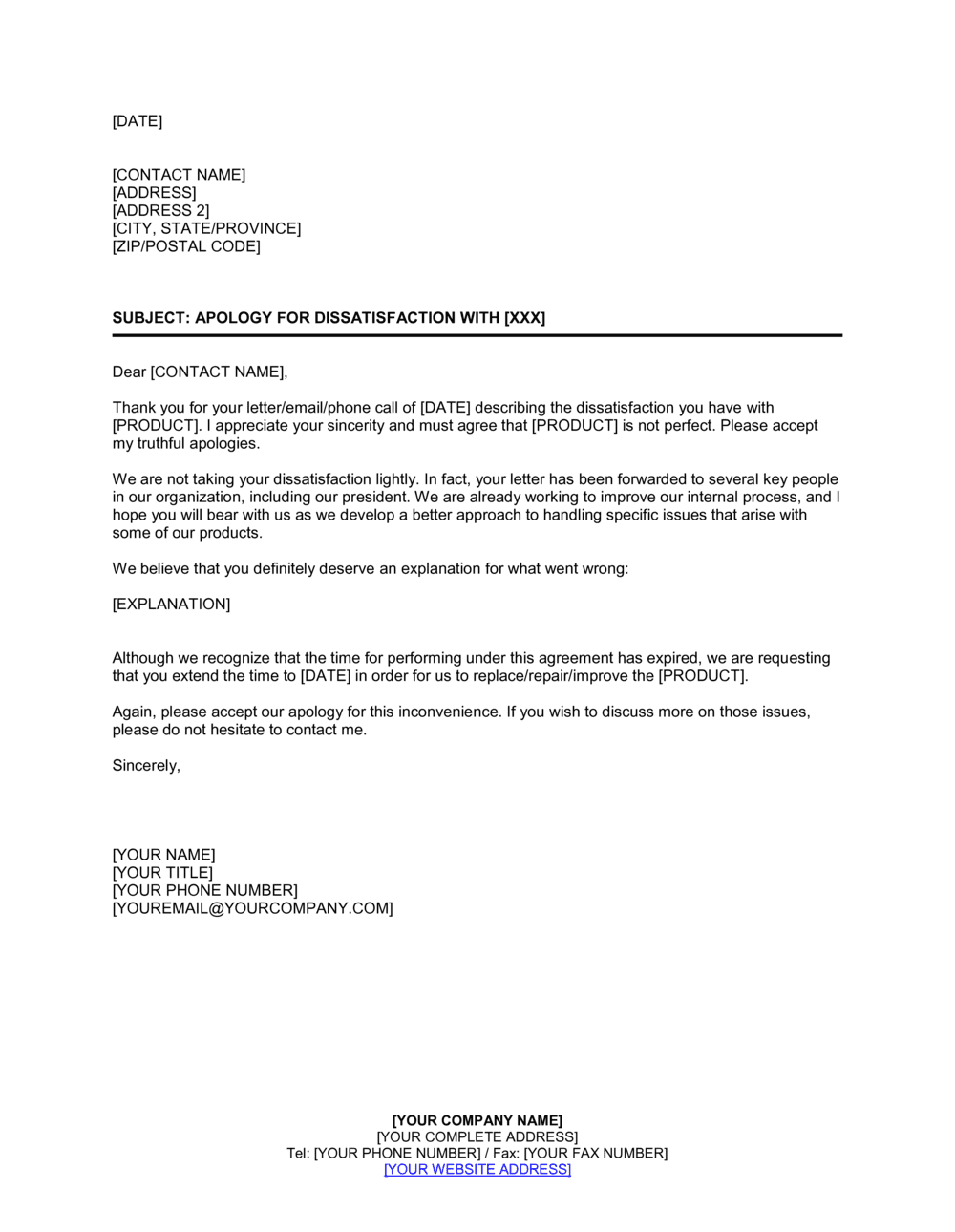
An Apology Letter Dissatisfied With Quality Of Product is a formal written response a business sends to a customer who has reported receiving a defective, damaged, or substandard product. This free Word download gives you a professionally structured letter you can edit online, personalize with the customer's details and your proposed remedy, and send or export as PDF within minutes.
When you need it
Use it whenever a customer contacts you with a complaint about product quality β€” whether the item arrived damaged, failed to meet advertised specifications, or did not perform as expected. Sending a prompt, written apology demonstrates accountability and is typically the first step toward retaining the customer relationship.
What's inside
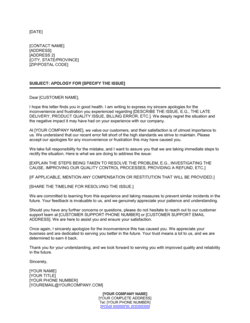
The letter includes a direct acknowledgment of the complaint, a sincere apology without deflection, a brief explanation of how the issue occurred (if known), a concrete remedy offer such as a replacement or refund, and a closing commitment to quality. Each component is structured as a distinct paragraph so you can adapt or expand any section to fit your situation.

What is an Apology Letter Dissatisfied With Quality Of Product?

An Apology Letter Dissatisfied With Quality Of Product is a formal written communication a business sends to a customer who has reported receiving a defective, damaged, or substandard product. It acknowledges the specific quality issue, offers a sincere and direct apology, explains the cause if known, and proposes a concrete remedy β€” replacement, refund, or store credit β€” with a defined timeline. Unlike a casual email response, a formal apology letter creates a documented record of the company's acknowledgment and proposed resolution, which matters if the complaint later escalates to a chargeback dispute or a review platform.

Why You Need This Document

Ignoring or mishandling a product quality complaint is one of the fastest ways to lose a customer permanently β€” and, in the era of public reviews, potentially dozens more. Research consistently shows that customers who receive a prompt, genuine written apology are significantly more likely to make another purchase than those who receive a generic response or no response at all. Beyond retention, a well-structured apology letter with a specific remedy reduces chargeback rates by giving payment processors documented evidence that the seller attempted resolution. For wholesale or B2B buyers, a formal written response is often required before they will process a credit or accept a replacement shipment. This template gives you a professional, ready-to-personalize letter that covers every component of an effective response β€” so you can address quality complaints consistently, protect the customer relationship, and keep a clear paper trail, all in under ten minutes.

Which variant fits your situation?

If your situation is…Use this template
Customer received a physically damaged product during shippingApology Letter for Damaged Product
Product did not match the description or specifications advertisedApology Letter Dissatisfied With Quality Of Product
Customer received the wrong item entirelyApology Letter for Wrong Shipment
Service rather than a product fell below expectationsApology Letter Dissatisfied With Service
Product defect caused financial loss or injury and requires escalationFormal Product Liability Response Letter
Bulk or wholesale order failed quality inspectionB2B Product Quality Complaint Response

Common mistakes to avoid

❌ Using a conditional apology

Why it matters: Phrases like 'sorry if you were disappointed' or 'apologize that you feel this way' read as dismissive and routinely trigger escalation to chargebacks, reviews, or social media complaints.

Fix: Write an unconditional apology: 'We sincerely apologize for the quality of the [PRODUCT NAME] you received.' Own the outcome regardless of cause.

❌ No specific remedy or timeline

Why it matters: A letter that apologizes but offers no concrete next step leaves the customer in the same position as before β€” frustrated and without resolution β€” which often triggers a second, angrier complaint.

Fix: State exactly what you will do (refund, replacement, credit) and when it will happen. Use a specific date or business-day count, not vague language.

❌ Overly long explanation of the cause

Why it matters: A multi-paragraph explanation of supply chain issues or production errors reads as excuse-making and shifts focus away from the customer's experience.

Fix: Limit the cause explanation to one or two sentences. Customers want resolution, not a manufacturing post-mortem.

❌ Sending the letter from a no-reply address

Why it matters: A formal apology letter that arrives from a no-reply inbox signals the company does not actually want a response, undermining the sincerity of the apology.

Fix: Send from a monitored inbox and include a named contact. Invite the customer to reply directly with any follow-up questions.

The 9 key clauses, explained

Date and recipient address block

In plain language: The opening of the letter β€” date, customer's name, and mailing or email address β€” formatted in standard business letter style.

Sample language
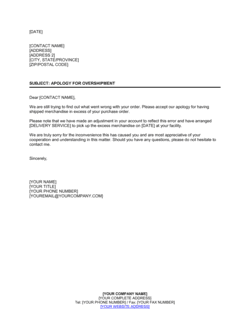
[DATE] [CUSTOMER FULL NAME] [ADDRESS LINE 1] [CITY, STATE, ZIP]

Common mistake: Omitting the date. A dated letter creates a documented paper trail that matters if the complaint escalates to a chargeback or legal claim.

Subject line

In plain language: A brief reference line that tells the reader exactly what the letter addresses, helping busy customers and their records match correspondence to a transaction.

Sample language
Re: Apology and Resolution β€” Order #[ORDER NUMBER] | [PRODUCT NAME]

Common mistake: Using a vague subject like 'Your Recent Order.' A specific order number or product name confirms you have reviewed the customer's actual complaint.

Opening acknowledgment

In plain language: The first paragraph directly acknowledges receipt of the complaint and names the specific product and issue the customer raised.

Sample language
Dear [CUSTOMER NAME], Thank you for bringing the issue with your [PRODUCT NAME] to our attention. We have reviewed your complaint dated [DATE] and fully understand your disappointment with the quality of the item you received.

Common mistake: Leading with generic pleasantries like 'We hope this letter finds you well.' It signals the apology is a template rather than a genuine response to the specific complaint.

Sincere apology

In plain language: A clear, unqualified apology for the customer's experience β€” without conditional language or blame-shifting to third parties.

Sample language
We sincerely apologize for the substandard quality of the [PRODUCT NAME] you received. This falls short of the standards we hold ourselves to, and we take full responsibility for your experience.

Common mistake: Writing 'We are sorry you feel that way' or 'We apologize if there was an issue.' Conditional apologies read as dismissive and often escalate complaints rather than resolving them.

Brief explanation of the cause

In plain language: A short, factual statement explaining what went wrong β€” only if the root cause is known and can be shared without assigning personal blame to staff.

Sample language
Upon investigation, we identified that a batch of [PRODUCT NAME] units produced between [DATE RANGE] contained [SPECIFIC DEFECT] due to [CAUSE, e.g., a calibration error in our packaging line]. We have since corrected this process.

Common mistake: Providing a lengthy technical explanation that reads as excuse-making. One to two sentences is sufficient β€” the focus should remain on resolution, not justification.

Proposed remedy

In plain language: The concrete action the company will take to make the customer whole β€” replacement, full refund, store credit, or a combination β€” with a specific timeline.

Sample language
To resolve this matter, we would like to [offer a full refund of $[AMOUNT] to your original payment method / send a replacement [PRODUCT NAME] at no charge]. Please expect [the refund within 5–7 business days / your replacement to ship within 2 business days].

Common mistake: Stating a remedy without a timeline. 'We will take care of this' leaves the customer uncertain and likely to follow up repeatedly until they have a concrete commitment.

Goodwill gesture (optional)

In plain language: An additional, unsolicited token β€” discount code, store credit, or complimentary item β€” offered to acknowledge the inconvenience beyond the direct remedy.

Sample language
As a gesture of goodwill, we would also like to offer you a [X]% discount on your next purchase. Please use code [DISCOUNT CODE] at checkout β€” valid through [EXPIRY DATE].

Common mistake: Including the goodwill gesture but burying it in the last sentence of a long paragraph. Put it in its own sentence so the customer clearly sees the additional effort.

Commitment to quality improvement

In plain language: A brief statement affirming that the company has or will take steps to prevent the same quality issue from recurring.

Sample language
We have reviewed our quality control procedures and are implementing [SPECIFIC ACTION, e.g., additional inspection steps for this product line] to ensure this does not happen again.

Common mistake: Promising improvements with no specifics β€” 'We are committed to doing better' adds no credibility. Name one concrete action, even a general one, to show accountability.

Closing and contact details

In plain language: A warm, professional closing that invites the customer to reach out with further questions and provides direct contact information.

Sample language
If you have any additional questions or concerns, please do not hesitate to contact us directly at [EMAIL ADDRESS] or [PHONE NUMBER]. We value your business and look forward to the opportunity to serve you better. Sincerely, [SIGNATORY NAME], [TITLE], [COMPANY NAME]

Common mistake: Closing with only a general customer service email. Providing a direct contact name signals personal ownership of the resolution and accelerates trust recovery.

How to fill it out

  1. 1

    Enter the date and customer's contact details

    Fill in today's date and the customer's full name and address at the top of the letter. For email delivery, replace the postal address block with the customer's email address.

    πŸ’‘ Send the letter within 48 hours of receiving the complaint β€” response speed is as important as the content in retaining the customer.

  2. 2

    Add the order or product reference in the subject line

    Insert the specific order number and product name in the subject line so the customer can immediately match the letter to their complaint.

    πŸ’‘ If the customer referenced a case or ticket number in their complaint, include that too β€” it confirms you are treating it as a tracked issue.

  3. 3

    Personalize the acknowledgment paragraph

    Name the specific product and the exact quality issue the customer described β€” defective stitching, incorrect specifications, premature failure, etc. Do not use generic language.

    πŸ’‘ Quote the customer's own words back to them briefly to show the letter is not a mass response.

  4. 4

    Write a direct, unqualified apology

    State the apology clearly in one or two sentences. Avoid conditional phrasing like 'if' or 'you feel.' Own the issue fully.

    πŸ’‘ Read the apology sentence aloud β€” if it sounds defensive to you, it will read that way to the customer. Rewrite until it sounds genuine.

  5. 5

    State the remedy and the timeline

    Choose the appropriate remedy β€” refund, replacement, or store credit β€” and enter the specific dollar amount or action and the exact timeframe for completion.

    πŸ’‘ A specific date ('by [DATE]') is more reassuring than a range ('within 5–7 business days') when the customer relationship is at risk.

  6. 6

    Add a goodwill gesture if appropriate

    For high-value customers or significant quality failures, add a discount code or store credit. Enter the specific percentage, code, and expiry date.

    πŸ’‘ Goodwill gestures are most effective when they are proportionate β€” a 10–15% discount on a future order is a meaningful but sustainable offer for most businesses.

  7. 7

    Confirm the signatory and direct contact details

    Replace the placeholder name and title with the actual person signing or sending the letter. Include a direct email or phone number, not just a general inbox.

    πŸ’‘ A customer service manager's name in the closing carries more weight than a company name alone β€” it signals personal accountability for the resolution.

Frequently asked questions

What should an apology letter for a product quality complaint include?

An effective apology letter should include a specific acknowledgment of the complaint (naming the product and the issue), a direct and unconditional apology, a brief explanation of the cause if known, a concrete remedy with a timeline, and a closing that provides direct contact details. Optional but recommended: a goodwill gesture such as a discount or store credit to acknowledge the inconvenience beyond the immediate fix.

How quickly should I send an apology letter after a product complaint?

Within 24–48 hours is the standard expectation in most consumer-facing industries. Studies consistently show that response speed is one of the top factors in whether a dissatisfied customer returns. A prompt written response β€” even a brief acknowledgment while the full investigation is underway β€” is better than a thorough letter sent five days later.

Should I admit fault in an apology letter for a defective product?

For most standard product quality complaints, acknowledging the issue and taking responsibility for the customer's experience is appropriate and generally does not create legal liability. However, if the defect may have caused injury, property damage, or significant financial loss, consider consulting a lawyer before admitting fault in writing. For routine quality complaints β€” wrong color, poor stitching, premature wear β€” a direct apology and remedy are the correct response.

What is the best remedy to offer in a product quality apology letter?

A replacement product is the most preferred remedy for most customers because it solves the original problem β€” they wanted the item. A full refund is the next best option. Store credit is typically the least preferred because it requires the customer to spend more money with the same business that disappointed them. Match the remedy to the severity of the complaint and the customer's stated preference where possible.

Can a written apology letter help prevent a chargeback or negative review?

Yes β€” a prompt, sincere written apology with a concrete remedy significantly reduces chargeback rates and negative public reviews. Many customers file chargebacks or post reviews not because of the defect itself but because they felt ignored or dismissed. A documented written response also gives you evidence to dispute a chargeback with your payment processor if one is filed despite your resolution attempt.

Do I need a lawyer to write an apology letter for a product complaint?

No, for standard product quality complaints a professionally worded template is sufficient. Reserve legal review for situations involving product-related injury, property damage, large-scale recalls, or complaints from commercial buyers with significant contract exposure. For routine consumer complaints, the template handles 95% of cases without legal involvement.

How is this apology letter different from a product recall notice?

This letter is a direct, one-to-one response to an individual customer's complaint about a specific product they received. A product recall notice is a mass communication issued when a defect affects multiple products in the market and may involve regulatory reporting obligations. If you identify a pattern of complaints across multiple customers, that situation may warrant a formal recall process rather than individual apology letters.

Should I include a goodwill gesture in every product apology letter?

Not necessarily. A goodwill gesture β€” discount code, store credit, or complimentary item β€” is most effective for high-value customers, repeat buyers, or cases where the quality failure caused significant inconvenience beyond just the product itself. For first-time buyers with a minor complaint, a prompt replacement or refund plus a sincere apology is usually sufficient. Overuse of goodwill gestures can train customers to complain in order to receive discounts.

How this compares to alternatives

vs Apology Letter Dissatisfied With Service

A service apology letter addresses failures in how a service was delivered β€” slow turnaround, poor communication, or unsatisfactory work. A product quality apology letter focuses on a tangible item that did not meet standards. The core structure is similar, but the remedy and cause-explanation language differ significantly: service apologies focus on process improvement, while product apologies focus on replacement or refund.

vs Customer Complaint Response Letter

A general customer complaint response letter handles a broad range of complaint types β€” billing errors, delivery delays, customer service interactions. This template is specifically written for product quality failures and uses language calibrated to that context. For complaints unrelated to product quality, use the general complaint response letter instead.

vs Product Recall Notice

A product recall notice is a mass communication issued when a defect affects a wide range of units and may involve regulatory reporting. An apology letter for product quality is a one-to-one response to an individual customer's complaint. Use this letter for individual complaints; escalate to a recall notice if the same defect is reported across multiple customers or product batches.

vs Refund Request Acknowledgment Letter

A refund request acknowledgment letter confirms receipt of a refund request and outlines the processing steps. An apology letter for product quality takes a broader approach β€” it acknowledges the complaint, apologizes, explains the cause, and proposes a remedy that may or may not be a refund. Use the apology letter when you want to repair the customer relationship; use the refund acknowledgment when the customer has already requested a refund and simply needs confirmation.

Industry-specific considerations

E-commerce and retail

High complaint volume makes a templated but personalizable letter essential for consistent, scalable responses without sacrificing tone.

Manufacturing and wholesale

B2B buyers expect a formal written record of complaint acknowledgment and remedy; the letter often accompanies a replacement shipment or credit memo.

Food and beverage

Quality complaints can involve food safety, making prompt written acknowledgment and a clear remedy critical for both customer retention and liability documentation.

Consumer goods and apparel

Defects in physical goods β€” tears, sizing errors, premature wear β€” are common triggers; a well-worded apology with a no-hassle replacement offer is the standard resolution path.

Template vs pro β€” what fits your needs?

PathBest forCostTime
Use the templateAny business responding to routine consumer or B2B product quality complaintsFree5–10 minutes per letter
Template + professional reviewComplaints involving significant financial loss, commercial contracts, or potential repeat liability$100–$300 for a brief legal or communications review1–2 hours
Custom draftedProduct defects that caused injury, property damage, or large-scale commercial loss requiring formal legal positioning$500–$2,000+1–3 days

Glossary

Acknowledgment
The opening statement in a complaint-response letter that confirms receipt and understanding of the customer's specific concern.
Remedy
The corrective action offered to the customer β€” typically a refund, replacement, store credit, or discount on a future order.
Quality Control (QC)
The internal process a company uses to inspect products and verify they meet defined standards before reaching the customer.
Root Cause
The underlying reason a product defect or quality failure occurred, identified so the same issue does not recur.
Goodwill Gesture
An unsolicited benefit β€” such as a discount voucher or complimentary item β€” offered beyond the standard remedy to rebuild customer trust.
Customer Retention
A business's ability to keep existing customers purchasing over time; a prompt apology letter is one of the lowest-cost retention tools available.
Product Recall
A formal process of withdrawing a defective product from the market, often triggered when a quality issue affects multiple customers or poses a safety risk.
Complaint Log
An internal record tracking customer complaints by date, type, and resolution β€” used to identify patterns and improve quality processes.
Tone of Voice
The style and manner of written communication; in an apology letter, a warm, direct, and non-defensive tone is critical to a positive customer response.
Resolution Timeline
The specific date or timeframe by which the business commits to completing the remedy β€” replacing the product, issuing the refund, or following up.

Part of your Business Operating System

This document is one of 3,000+ business & legal templates included in Business in a Box.

  • Fill-in-the-blanks β€” ready in minutes
  • 100% customizable Word document
  • Compatible with all office suites
  • Export to PDF and share electronically

Create your document in 3 simple steps.

From template to signed document β€” all inside one Business Operating System.
1
Download or open template

Access over 3,000+ business and legal templates for any business task, project or initiative.

2
Edit and fill in the blanks with AI

Customize your ready-made business document template and save it in the cloud.

3
Save, Share, Send, Sign

Share your files and folders with your team. Create a space of seamless collaboration.

Save time, save money, and create top-quality documents.

β˜…β˜…β˜…β˜…β˜…

"Fantastic value! I'm not sure how I'd do without it. It's worth its weight in gold and paid back for itself many times."

Managing Director Β· Mall Farm
Robert Whalley
Managing Director, Mall Farm Proprietary Limited
β˜…β˜…β˜…β˜…β˜…

"I have been using Business in a Box for years. It has been the most useful source of templates I have encountered. I recommend it to anyone."

Business Owner Β· 4+ years
Dr Michael John Freestone
Business Owner
β˜…β˜…β˜…β˜…β˜…

"It has been a life saver so many times I have lost count. Business in a Box has saved me so much time and as you know, time is money."

Owner Β· Upstate Web
David G. Moore Jr.
Owner, Upstate Web

Run your business with a system β€” not scattered tools

Stop downloading documents. Start operating with clarity. Business in a Box gives you the Business Operating System used by over 250,000 companies worldwide to structure, run, and grow their business.

Start freeΒ Β·Β No credit card required