Apology for Missing Appointment Template

Free Word download β€’ Edit online β€’ Save & share with Drive β€’ Export to PDF

1 pageβ€’15–25 min to fillβ€’Difficulty: Standard
Learn more ↓
FreeApology for Missing Appointment Template

At a glance

What it is
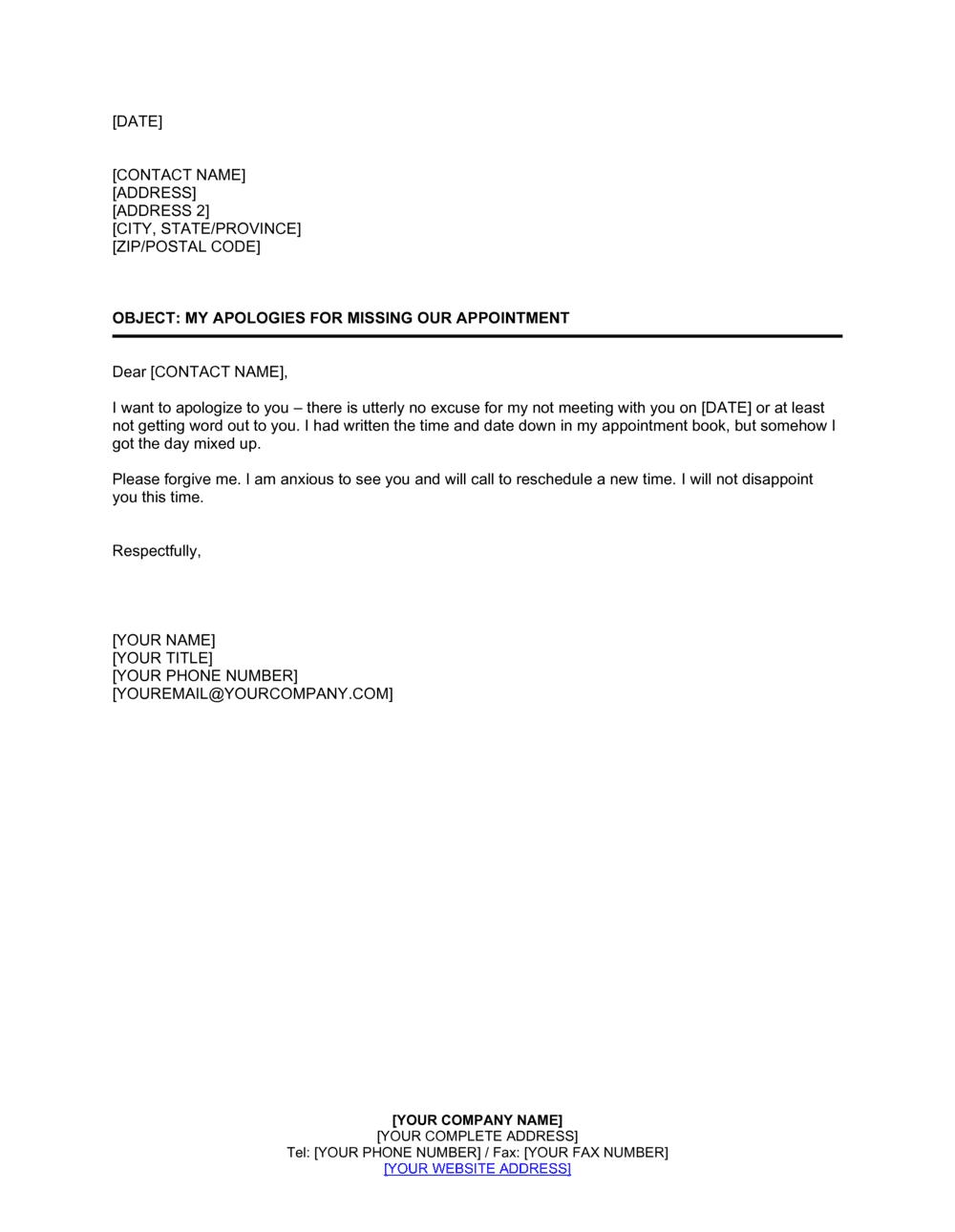
An Apology For Missing Appointment is a formal business letter sent to a client, colleague, or professional contact to acknowledge a missed meeting or appointment, take responsibility, and propose a path forward. This free Word download gives you a professionally worded structure you can edit online and send in under ten minutes.
When you need it
Use it any time you fail to appear for a scheduled meeting, consultation, or appointment β€” whether due to an emergency, scheduling error, or miscommunication β€” and need to address the situation in writing.
What's inside
Sender and recipient details, a clear acknowledgment of the missed appointment, a concise and honest explanation, a sincere apology, a proposed reschedule, and a professional closing.

What is an Apology For Missing Appointment?

An Apology For Missing Appointment is a formal business letter sent to acknowledge that you failed to attend a scheduled meeting or appointment, take clear responsibility for the absence, and propose a path to reschedule. It follows standard business letter structure β€” header, salutation, body paragraphs, and professional closing β€” and serves both a relational purpose (repairing goodwill) and a practical one (moving the conversation forward). Whether the missed appointment was with a client, employer, healthcare provider, or business partner, the letter creates a written record of accountability and demonstrates that the relationship is a priority.

Why You Need This Document

Failing to appear for a scheduled appointment without a prompt, professional follow-up can permanently damage a business relationship, cost you a sales opportunity, or signal unreliability to a potential employer. A well-written apology letter sent within 24 hours of the missed appointment demonstrates self-awareness and respect for the other person's time β€” two qualities that matter in every professional context. Without it, the recipient is left to assume the absence was intentional or that they are unimportant, which is far harder to recover from than the missed appointment itself. This template gives you a complete, professionally structured letter you can personalize and send in under ten minutes β€” turning a potentially damaging situation into an opportunity to reinforce your professionalism and commitment to the relationship.

Which variant fits your situation?

If your situation is…Use this template
Missed a scheduled job interviewApology For Missing Appointment (Interview)
Failed to attend a client consultationApology For Missing Appointment
Missed a medical or professional referral appointmentApology For Missing Appointment (Healthcare)
No-showed a business meeting with a partner or vendorApology Letter To A Business Partner
Need to apologize and formally resign from a commitmentApology Letter
Missed a court-ordered or regulatory appointmentFormal Apology Letter
Requesting to reschedule a missed meeting proactivelyMeeting Request Letter

Common mistakes to avoid

❌ Conditional or qualified apology language

Why it matters: Phrases like 'I'm sorry if this was inconvenient' imply the inconvenience may not have been real, which reads as dismissive and can worsen the recipient's reaction.

Fix: Use direct, unqualified language: 'I apologize for missing our appointment on [DATE].' No conditionals, no qualifiers.

❌ Waiting too long to send the letter

Why it matters: An apology sent three or more days after the missed appointment signals that the relationship is low priority, which compounds the original damage.

Fix: Send the apology within 24 hours of the missed appointment β€” the same business day when possible.

❌ Over-explaining the reason for missing

Why it matters: A lengthy justification shifts the focus from the recipient's experience to the sender's circumstances, making the letter feel self-serving rather than accountable.

Fix: Limit the explanation to one or two sentences. If the reason is not compelling, omit it entirely and focus on the apology and reschedule.

❌ Failing to propose a concrete reschedule

Why it matters: An apology without a reschedule offer is a dead end β€” it tells the recipient you are sorry but does not demonstrate commitment to the original purpose of the meeting.

Fix: Always include at least two specific date and time options, or a clear invitation for the recipient to name a time that works for them.

The 9 key clauses, explained

Header and date

In plain language: The sender's name, title, company, and address, followed by the date the letter is written, appearing at the top of the page.

Sample language
[YOUR NAME] | [YOUR TITLE] | [COMPANY NAME] | [ADDRESS] | [DATE]

Common mistake: Using the date the appointment was missed rather than the date the letter is written β€” this confuses the timeline and can make the response seem delayed.

Recipient details and salutation

In plain language: The recipient's full name, title, company, and address, followed by a formal greeting that uses their name directly.

Sample language
[RECIPIENT NAME] | [RECIPIENT TITLE] | [COMPANY NAME] | [ADDRESS] Dear [RECIPIENT NAME],

Common mistake: Using a generic 'To Whom It May Concern' salutation when the recipient's name is known β€” it signals low effort and undermines the sincerity of the apology.

Reference line (optional)

In plain language: A brief subject line near the top of the letter that identifies the missed appointment by date and purpose so the recipient can file it easily.

Sample language
Re: Missed Appointment β€” [MEETING PURPOSE] Scheduled for [DATE] at [TIME]

Common mistake: Omitting the reference line when writing to a large organization β€” without it, the letter may be routed to the wrong department or lost in a filing system.

Acknowledgment of the missed appointment

In plain language: The opening paragraph that directly and specifically acknowledges the missed appointment without deflecting or minimizing it.

Sample language
I am writing to sincerely apologize for failing to attend our scheduled [MEETING PURPOSE] on [DATE] at [TIME]. I recognize that my absence caused you inconvenience and wasted time you had set aside specifically for our meeting.

Common mistake: Opening with 'I'm sorry if you were inconvenienced' β€” the conditional phrasing suggests the inconvenience is in doubt, which reads as insincere.

Explanation of the circumstances

In plain language: A brief, honest explanation of what caused the missed appointment β€” kept to one or two sentences without over-justifying or making excuses.

Sample language
The absence was due to [BRIEF EXPLANATION β€” e.g., an unexpected medical emergency / a scheduling system error / a family situation] that arose without warning on the morning of [DATE].

Common mistake: Providing an overly detailed explanation that shifts focus from accountability to self-defense β€” the longer the excuse, the less sincere the apology appears.

Apology statement

In plain language: A direct, unqualified statement of apology that accepts responsibility and acknowledges the impact on the recipient.

Sample language
I sincerely apologize for any disruption this caused to your schedule. This was not reflective of the respect I have for your time and our professional relationship, and I take full responsibility for the lapse.

Common mistake: Combining the apology with a justification in the same sentence β€” e.g., 'I apologize, but the situation was out of my control' β€” which cancels out the accountability.

Reschedule proposal

In plain language: A concrete offer to meet again at a time that is convenient for the recipient, showing commitment to fulfilling the original purpose of the meeting.

Sample language
I would very much like to reschedule our meeting at your earliest convenience. I am available on [DATE/TIME OPTION 1] or [DATE/TIME OPTION 2], but I am happy to accommodate whatever time suits you best.

Common mistake: Proposing only one very specific time slot β€” this puts the burden on the recipient to either accept or negotiate, rather than demonstrating genuine flexibility.

Goodwill gesture (optional)

In plain language: An optional paragraph offering a tangible gesture to offset the inconvenience β€” such as traveling to the recipient's location, reducing fees, or offering priority scheduling.

Sample language
As a gesture of goodwill, I would be pleased to [GESTURE β€” e.g., hold the next meeting at your office / waive the [AMOUNT] rescheduling fee / prioritize your request upon rescheduling].

Common mistake: Including a goodwill gesture in every letter regardless of context β€” in casual professional relationships it can feel transactional rather than genuine.

Professional closing

In plain language: A brief final sentence reaffirming commitment to the relationship, followed by a formal sign-off and the sender's name and contact information.

Sample language
I value our relationship and look forward to the opportunity to connect. Please do not hesitate to reach me at [PHONE] or [EMAIL] at any time. Sincerely, [YOUR NAME] [YOUR TITLE] [COMPANY NAME]

Common mistake: Ending with 'Thanks' or 'Best' instead of a formal closing β€” the informal sign-off undermines the professional tone established throughout the letter.

How to fill it out

  1. 1

    Fill in the header with your contact details and the date

    Enter your full name, title, company name, and mailing address at the top, followed by the date you are writing the letter β€” not the date the appointment was missed.

    πŸ’‘ If sending by email rather than post, you can omit the mailing address block but keep the date in the opening line.

  2. 2

    Enter the recipient's full details

    Include the recipient's name, title, organization, and address. Use the exact name and title they use professionally β€” check their email signature or LinkedIn if unsure.

    πŸ’‘ If you are unsure of gender-neutral preferences, use the recipient's full name in the salutation: 'Dear Jordan Smith,' avoids any misstep.

  3. 3

    Add the reference line if writing to an organization

    Insert a 'Re:' line identifying the meeting type, original date, and time. This helps large organizations route the letter to the right person and match it to calendar records.

    πŸ’‘ Keep the reference line to one line β€” 'Re: Missed Consultation β€” April 28, 2026, 10:00 AM' is enough.

  4. 4

    Write the acknowledgment paragraph

    Open the body with a clear, direct admission that you missed the appointment β€” including the specific date and time β€” and acknowledge the inconvenience caused.

    πŸ’‘ Name the appointment specifically rather than saying 'our recent meeting.' Specificity signals genuine awareness of the impact.

  5. 5

    State the explanation briefly

    Give a one-to-two sentence honest explanation. If the reason is personal or sensitive, a brief reference is sufficient β€” you do not owe the recipient a detailed account.

    πŸ’‘ If there is no strong external reason, skip the explanation and move directly to the apology β€” a clean admission of oversight is more effective than a weak excuse.

  6. 6

    Deliver the apology clearly and without qualification

    Write a direct apology statement that accepts responsibility and acknowledges the impact on the recipient's schedule and expectations.

    πŸ’‘ Read the apology sentence aloud β€” if it contains any 'but,' 'however,' or 'if,' revise it. Qualified apologies are consistently perceived as insincere.

  7. 7

    Propose two or three reschedule options

    Offer two or three concrete date and time options that work for you, and explicitly invite the recipient to name a time that suits them better.

    πŸ’‘ Proposing options that span different times of day β€” morning and afternoon β€” increases the likelihood of finding a match on the first exchange.

  8. 8

    Close professionally with your contact information

    End with a sentence affirming the relationship, a formal sign-off ('Sincerely,' or 'Respectfully,'), and your full name, title, and direct contact details.

    πŸ’‘ Include both phone and email in the closing block β€” giving the recipient multiple ways to reach you signals you are ready to respond promptly.

Frequently asked questions

When should I send an apology for missing an appointment?

Send it as soon as possible after the missed appointment β€” ideally within the same business day and no later than 24 hours afterward. The faster you respond, the more clearly you signal that the relationship matters. A delayed apology compounds the original inconvenience and can permanently damage a professional relationship.

Should I send the apology as a letter or an email?

For most business contexts, email is acceptable and faster. A formal printed letter is more appropriate when the relationship is high-stakes β€” such as a key client, a regulatory body, or a senior executive β€” or when the original appointment was formal in nature. In either format, the structure and content of this template apply equally.

What should I not say in an apology for missing an appointment?

Avoid conditional language ("I'm sorry if..."), blame-shifting ("The calendar invite was unclear..."), and excessive justification that prioritizes your circumstances over the recipient's experience. Also avoid vague language like "our recent meeting" β€” always name the specific date and time so the recipient knows you are aware of exactly what was missed.

Do I need to explain why I missed the appointment?

A brief explanation is courteous and helps the recipient understand the situation, but it is not mandatory. If the reason is personal, sensitive, or simply a scheduling error, one sentence is sufficient. If there is no strong external reason, skipping the explanation and offering a clean, direct apology is often more effective than a weak justification.

How do I reschedule after missing an appointment?

Propose two or three specific date and time options that work for you, and explicitly invite the recipient to suggest an alternative if none of those are convenient. Avoid proposing only one option, which puts the burden of negotiation on the recipient. Offering flexibility demonstrates that rescheduling is a genuine priority for you.

Is this template suitable for a missed job interview?

Yes. The structure applies directly to missed interviews β€” acknowledge the specific interview date, apologize without qualification, offer a brief explanation if appropriate, and request an opportunity to reschedule. Sending this letter promptly after a missed interview can recover the candidacy in many cases, particularly if the reason is genuine and clearly communicated.

How formal should the tone be?

Match the formality of the original appointment and the relationship. For a first meeting with a new client or senior stakeholder, use the full formal letter format with a professional salutation and closing. For a colleague or ongoing client relationship, a shorter, warmer tone is acceptable β€” but the core elements of acknowledgment, apology, and reschedule proposal should still be present.

How this compares to alternatives

vs Apology Letter (General)

A general apology letter addresses a broader range of professional mistakes β€” billing errors, product failures, communication lapses. An apology for missing an appointment is narrower in scope, focused specifically on the failure to appear and the need to reschedule. Use the general template when the issue is not tied to a scheduled meeting.

vs Meeting Request Letter

A meeting request letter initiates a new appointment from scratch without any prior context. An apology for missing an appointment both addresses the failure and requests a reschedule β€” it carries the additional weight of accountability and relationship repair that a standard meeting request does not.

vs Follow-Up Letter After Meeting

A follow-up letter after a meeting documents outcomes and next steps from a meeting that did take place. An apology for missing an appointment addresses the opposite situation β€” a meeting that did not happen β€” and focuses on repairing the relationship rather than documenting results.

vs Late Delivery Apology Letter

A late delivery apology addresses a failure to deliver a product or service on time, often with compensation or remedy provisions. An apology for missing an appointment is interpersonal and scheduling-focused, with no physical deliverable involved. The tone and structure are similar, but the stakes and remedies differ significantly.

Industry-specific considerations

Professional Services

Consultants and attorneys use this letter to preserve client relationships after a missed billable consultation, often including a reschedule and a fee adjustment.

Healthcare

Providers and administrators send formal missed-appointment apologies to patients or referral partners to maintain trust and comply with patient communication standards.

Financial Services

Advisors and relationship managers use this letter after missing a scheduled client review, where the relationship and regulatory expectations demand prompt, formal acknowledgment.

Retail and Sales

Sales teams send this letter to prospects after a missed product demo or discovery call to recover pipeline opportunities before the lead goes cold.

Template vs pro β€” what fits your needs?

PathBest forCostTime
Use the templateAny professional who needs to send a prompt, well-worded apology for a missed appointmentFree5–10 minutes
Template + professional reviewHigh-stakes relationships such as key clients, regulatory contacts, or executives where wording requires extra care$50–$150 (communications advisor or executive assistant review)30–60 minutes
Custom draftedSituations where the missed appointment carries legal or contractual implications and legal counsel input is advisable$200–$500 (lawyer or communications consultant)1–2 days

Glossary

No-Show
A situation in which a scheduled party fails to appear for an appointment without prior cancellation or notice.
Reschedule Request
A formal proposal to set a new date and time for a meeting or appointment that did not take place as originally planned.
Salutation
The opening greeting of a formal letter, typically 'Dear [NAME],' which establishes the professional tone of the correspondence.
Acknowledgment
A statement that directly recognizes a specific event or failure β€” in this context, confirming that the appointment was missed.
Mitigating Circumstances
Conditions or events β€” such as an emergency or system failure β€” that explain but do not excuse a failure to meet an obligation.
Goodwill Gesture
An optional offer of something of value β€” a discount, priority scheduling, or complimentary service β€” to compensate the other party for the inconvenience caused.
Professional Closing
The sign-off block of a formal letter, typically 'Sincerely,' or 'Respectfully,' followed by the sender's name and title.
Reference Line
An optional line near the top of a formal letter β€” formatted as 'Re: [SUBJECT]' β€” that tells the recipient what the letter concerns before they read the body.

Part of your Business Operating System

This document is one of 3,000+ business & legal templates included in Business in a Box.

  • Fill-in-the-blanks β€” ready in minutes
  • 100% customizable Word document
  • Compatible with all office suites
  • Export to PDF and share electronically

Create your document in 3 simple steps.

From template to signed document β€” all inside one Business Operating System.
1
Download or open template

Access over 3,000+ business and legal templates for any business task, project or initiative.

2
Edit and fill in the blanks with AI

Customize your ready-made business document template and save it in the cloud.

3
Save, Share, Send, Sign

Share your files and folders with your team. Create a space of seamless collaboration.

Save time, save money, and create top-quality documents.

β˜…β˜…β˜…β˜…β˜…

"Fantastic value! I'm not sure how I'd do without it. It's worth its weight in gold and paid back for itself many times."

Managing Director Β· Mall Farm
Robert Whalley
Managing Director, Mall Farm Proprietary Limited
β˜…β˜…β˜…β˜…β˜…

"I have been using Business in a Box for years. It has been the most useful source of templates I have encountered. I recommend it to anyone."

Business Owner Β· 4+ years
Dr Michael John Freestone
Business Owner
β˜…β˜…β˜…β˜…β˜…

"It has been a life saver so many times I have lost count. Business in a Box has saved me so much time and as you know, time is money."

Owner Β· Upstate Web
David G. Moore Jr.
Owner, Upstate Web

Run your business with a system β€” not scattered tools

Stop downloading documents. Start operating with clarity. Business in a Box gives you the Business Operating System used by over 250,000 companies worldwide to structure, run, and grow their business.

Free Forever PlanΒ Β·Β No credit card required