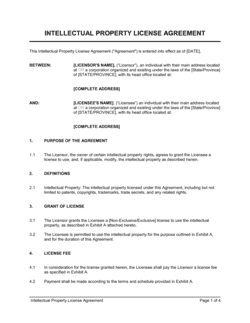
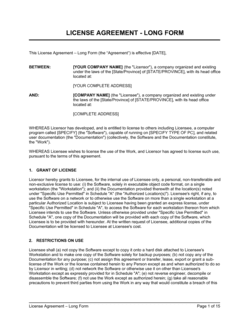
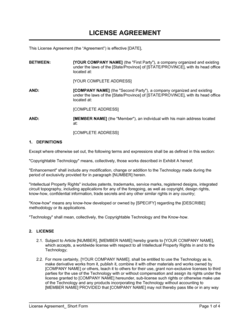
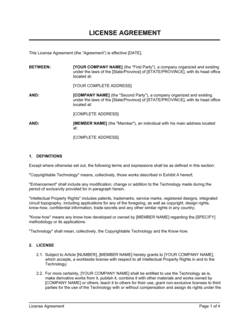
API License Agreement Template

Free Word download β€’ Edit online β€’ Save & share with Drive β€’ Export to PDF

3 pagesβ€’25–30 min to fillβ€’Difficulty: Complexβ€’Signature requiredβ€’Legal review recommended
Learn more ↓
FreeAPI License Agreement Template

At a glance

What it is
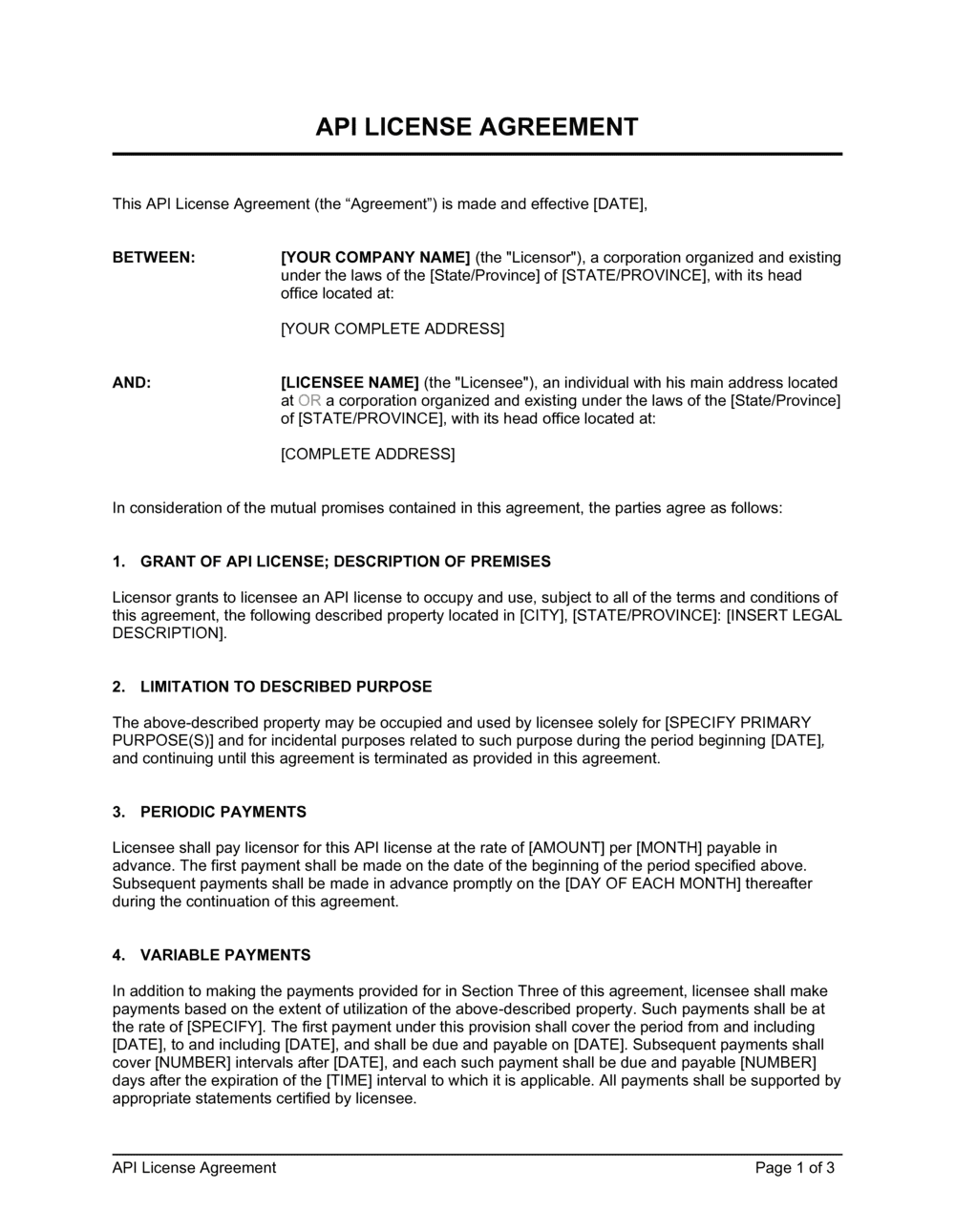
An API License Agreement is a legally binding contract between an API provider and a licensee (typically a developer or business) that defines the terms under which the licensee may access, integrate, and use the provider's application programming interface. This free Word download covers access rights, usage restrictions, rate limits, IP ownership, confidentiality, liability, and termination in a single enforceable document you can edit online and export as PDF.
When you need it
Use it whenever you grant third-party developers, partners, or customers programmatic access to your software platform, data service, or infrastructure API. It is also used by businesses integrating a third-party API into their own product when the provider requires a signed agreement rather than just click-through terms.
What's inside
Definitions of the API and permitted use, grant of license with scope and restrictions, rate limits and quotas, intellectual property assignment and ownership, confidentiality obligations, warranties and disclaimers, liability caps, indemnification, term and termination conditions, and governing law.

What is an API License Agreement?

An API License Agreement is a legally binding contract between an API provider and a licensee β€” typically a developer, partner, or business β€” that defines the precise terms under which the licensee may access and integrate the provider's application programming interface. It establishes what the licensee can do with the API, what is prohibited, who owns the IP in the API and its outputs, how access credentials must be protected, what fees apply, and under what conditions access may be suspended or terminated. Unlike click-through API terms of use, an API license agreement is a negotiated, signed instrument designed for commercial, enterprise, or partner-level access where the stakes justify enforceable obligations on both sides.

Why You Need This Document

Without a signed API license agreement, every developer or business that integrates your API does so on undefined terms β€” leaving your intellectual property, your data, and your platform unprotected. A licensee with no contractual restrictions can reverse-engineer your API architecture, sublicense access to their own customers, cache and resell your data, or exceed rate limits without consequence. When something goes wrong β€” a credential leak, unauthorized data use, or a billing dispute β€” you have no enforceable framework to act on. Conversely, if you are the party signing an API agreement presented by a vendor, an unreviewed contract may lock you into liability exposure, restrict your ability to switch providers, or assign away rights to data your product depends on. This template gives both sides a structured starting point that protects access rights, IP ownership, and commercial terms from the moment the first API call is made.

Which variant fits your situation?

If your situation is…Use this template
Granting free access to a public API with standardized self-serve termsAPI Terms of Use
Licensing an API commercially with per-call or subscription feesAPI License Agreement (Commercial)
Sharing proprietary data or a dataset via API with a partnerData Sharing Agreement
Giving a developer access under an NDA before a formal agreementNon-Disclosure Agreement
Embedding a third-party API into a SaaS product under an OEM arrangementOEM Software License Agreement
Providing white-label API access to a resellerSoftware Reseller Agreement
Governing API access between related corporate entitiesIntercompany Services Agreement

Common mistakes to avoid

❌ No sublicensing restriction

Why it matters: Without an explicit prohibition, the licensee can grant their own customers or partners access to your API, multiplying usage far beyond what you agreed to support or charge for.

Fix: Add 'non-sublicensable' to the license grant clause and explicitly state that the licensee may not share API keys or credentials with any third party.

❌ Omitting post-termination data obligations

Why it matters: If the agreement ends but the licensee continues to hold cached API output, your IP and your users' data may remain in an unauthorized system indefinitely.

Fix: Add a clause requiring the licensee to cease all API calls, delete or return all stored API outputs, and deliver written certification of deletion within 30 days of termination.

❌ Vague permitted-use definition

Why it matters: A licensee who integrates your API for 'internal business purposes' can argue that building a competing product using your data is an internal business purpose.

Fix: Define permitted use with a specific named application or a closed list of use cases, and add an explicit prohibition on using the API to develop a competing product or service.

❌ No credential-breach notification obligation

Why it matters: A compromised API key can be exploited for hours or days before the provider discovers it, resulting in unauthorized data access and potential regulatory liability for both parties.

Fix: Include a clause requiring the licensee to notify the provider within 24 hours of discovering any unauthorized access to or disclosure of API credentials.

❌ Liability cap set to a nominal fixed amount

Why it matters: Courts in several jurisdictions have found extreme liability caps β€” such as $100 on a high-value contract β€” unconscionable and void, leaving the provider with no cap at all.

Fix: Tie the aggregate liability cap to fees paid in the preceding 12 months, with a minimum floor of at least $1,000, and ensure the cap excludes fraud and indemnification obligations.

❌ Issuing API keys before the agreement is signed

Why it matters: Any usage before signature is unprotected β€” the IP, confidentiality, and rate-limit obligations only attach from the date of execution, leaving the pre-agreement period in a legal grey zone.

Fix: Implement a technical gate in your developer portal that prevents API key generation until the licensee has executed the agreement, either by eSign or click-through acknowledgment.

The 10 key clauses, explained

Definitions

In plain language: Establishes precise meanings for all technical and legal terms used throughout the agreement so both parties interpret the document consistently.

Sample language
'API' means the [PROVIDER NAME] application programming interface described in the Documentation available at [URL], including all updates and versions made available during the Term.

Common mistake: Using informal or abbreviated definitions that don't match the actual technical implementation β€” a mismatch between 'API' as defined and the endpoints actually provided creates enforcement gaps.

License grant and scope

In plain language: Specifies exactly what the licensee is permitted to do with the API β€” access, integrate, call, and build upon it β€” and carves out everything else as prohibited.

Sample language
Provider grants Licensee a limited, non-exclusive, non-transferable, revocable license to access and use the API solely for [PERMITTED PURPOSE] during the Term, subject to the restrictions in Section [X].

Common mistake: Granting a license without explicitly stating it is non-sublicensable. Without this restriction, the licensee can pass API access to their own customers, multiplying unauthorized usage.

Usage restrictions

In plain language: Lists what the licensee cannot do with the API β€” resell, reverse-engineer, exceed rate limits, use for prohibited purposes, or access endpoints not covered by the agreement.

Sample language
Licensee shall not: (a) reverse engineer the API; (b) use the API to build a competing product; (c) exceed [RATE LIMIT] calls per [TIME PERIOD]; (d) share API credentials with any third party.

Common mistake: Omitting a prohibition on using the API to build a competing product. Without this, a licensee can study the API's architecture and replicate core functionality.

Intellectual property ownership

In plain language: Confirms the provider retains all rights in the API, its documentation, and any data it returns, and that the licensee acquires no ownership interest through use.

Sample language
All right, title, and interest in and to the API, Documentation, and all associated IP remain with Provider. This Agreement does not transfer any ownership rights to Licensee. Any feedback Licensee provides may be used by Provider without restriction.

Common mistake: Failing to address ownership of output data β€” if the licensee's application generates derived datasets from API responses, the agreement should specify who owns them.

Confidentiality

In plain language: Prohibits the licensee from disclosing API credentials, technical documentation, and any non-public information about the API's architecture or data to third parties.

Sample language
Licensee shall keep all API Keys, Documentation, and non-public technical specifications strictly confidential and shall not disclose them to any third party without Provider's prior written consent.

Common mistake: Not including an obligation to notify the provider of a credential breach within a defined window β€” typically 24 to 72 hours β€” leaving the provider unable to revoke compromised keys promptly.

Fees and payment terms

In plain language: States the pricing model (per-call, monthly subscription, tiered), billing frequency, and consequences of non-payment, including suspension of API access.

Sample language
Licensee shall pay Provider the fees set out in Schedule A, invoiced [monthly / quarterly] in arrears. Undisputed invoices are due Net [30] days. Provider may suspend API access upon [10] days' written notice of non-payment.

Common mistake: No suspension right for non-payment. Without it, the provider must pursue breach-of-contract litigation before cutting off access, losing leverage entirely.

Warranties and disclaimers

In plain language: States the provider's limited warranty (typically that the API will perform materially as documented) and disclaims all implied warranties β€” fitness for purpose, merchantability, error-free operation.

Sample language
Provider warrants that the API will perform materially in accordance with the Documentation. EXCEPT AS EXPRESSLY SET OUT ABOVE, THE API IS PROVIDED 'AS IS' AND PROVIDER DISCLAIMS ALL IMPLIED WARRANTIES.

Common mistake: Providing a warranty that the API will be error-free or uninterrupted without a corresponding SLA and service credit mechanism β€” this creates an obligation the provider cannot technically guarantee.

Limitation of liability

In plain language: Caps the provider's total financial exposure to a defined amount β€” typically fees paid in the prior 12 months β€” and excludes consequential, indirect, or lost-profit damages.

Sample language
In no event shall Provider's aggregate liability exceed the fees paid by Licensee in the [12] months preceding the claim. Neither party shall be liable for indirect, incidental, or consequential damages.

Common mistake: Setting the liability cap to a nominal fixed amount (e.g., $100) regardless of contract value. Courts in several jurisdictions have found extreme liability caps unconscionable, voiding them entirely.

Term and termination

In plain language: Defines the initial agreement period, auto-renewal conditions, grounds for termination for cause (with a cure period), and termination for convenience with required notice.

Sample language
This Agreement commences on [START DATE] and continues for [1 year], auto-renewing for successive [1-year] terms unless either party gives [30] days' written notice. Either party may terminate for material breach upon [30] days' notice if the breach is not cured.

Common mistake: No cure period for breach β€” allowing immediate termination for any violation exposes the provider to liability if a licensee's technical error (e.g., an accidental rate-limit burst) triggers termination without warning.

Governing law and dispute resolution

In plain language: Specifies the jurisdiction whose law governs the agreement and the mechanism for resolving disputes β€” arbitration, mediation, or litigation β€” including venue.

Sample language
This Agreement is governed by the laws of [STATE / PROVINCE / COUNTRY]. Any dispute shall be resolved by binding arbitration administered by [AAA / JAMS] in [CITY], except that either party may seek injunctive relief in any court of competent jurisdiction.

Common mistake: Choosing a governing law with no meaningful connection to where the provider operates. Some jurisdictions β€” California in particular β€” apply local consumer protection and IP laws regardless of what the contract states.

How to fill it out

  1. 1

    Identify the parties and define the API precisely

    Enter the provider's and licensee's full legal entity names, jurisdiction of incorporation, and registered addresses. In the definitions section, describe the API specifically β€” include the endpoint URL, version number, and link to the technical documentation.

    πŸ’‘ Pin the agreement to a specific API version. If you update the API materially, a versioned definition prevents disputes about whether new endpoints are covered.

  2. 2

    Define permitted use with specificity

    List the exact purposes for which the licensee may use the API β€” internal product integration, resale to end users, research, or a specific named application. Anything not listed is implicitly prohibited.

    πŸ’‘ The narrower the permitted-use definition, the more control you retain. Use a 'solely for' construction rather than 'including but not limited to' to prevent scope creep.

  3. 3

    Set rate limits and quotas in Schedule A

    State the maximum number of API calls per second, minute, day, and month. Reference these limits in the usage restrictions clause so exceeding them is a contractual breach, not just a technical block.

    πŸ’‘ Include a process for the licensee to request a quota increase rather than leaving overages unaddressed β€” otherwise heavy users simply exceed limits and force a renegotiation under pressure.

  4. 4

    Address IP ownership of output data

    Specify who owns data returned by the API and any derived datasets the licensee creates from API responses. State whether the licensee can cache, store, or resell output data.

    πŸ’‘ If your API returns data generated by your users (e.g., a social platform API), you likely need a three-way IP clause covering provider, licensee, and underlying data owners.

  5. 5

    Complete the fees and payment schedule

    Fill in Schedule A with the pricing model β€” per-call, tiered, flat monthly β€” invoice frequency, payment method, and late-payment interest rate. Confirm the suspension-for-non-payment clause references the correct notice period.

    πŸ’‘ Specify the currency explicitly for any cross-border agreement. USD and CAD ambiguity in a North American deal has triggered real disputes.

  6. 6

    Calibrate the liability cap to the contract value

    Set the aggregate liability cap to the fees paid in the prior 12 months, or a fixed floor (e.g., $5,000) whichever is greater. Ensure the consequential-damages exclusion carves out indemnification obligations and fraud.

    πŸ’‘ A $100 liability cap on a $50,000-per-year API contract signals bad faith to sophisticated counterparties and will be renegotiated or litigated.

  7. 7

    Set the term, renewal, and termination conditions

    Choose an initial term of 1 or 2 years with auto-renewal. Set a 30-day cure period for material breach and a 30- to 60-day notice period for termination for convenience. Add a wind-down period requiring the licensee to stop using the API and delete cached data after termination.

    πŸ’‘ Include a data-deletion certification requirement post-termination β€” ask the licensee to confirm in writing that all stored API outputs have been destroyed within 30 days.

  8. 8

    Execute before granting API key access

    Both parties must sign the agreement before the provider issues API keys or credentials. Post-access signatures create a fresh-consideration problem and leave the pre-agreement period unprotected.

    πŸ’‘ Use an eSign platform that timestamps execution and stores the fully executed copy automatically β€” API integrations move fast and paper-based signing creates operational delays.

Frequently asked questions

What is an API license agreement?

An API license agreement is a legally binding contract between an API provider and a licensee that defines the terms under which the licensee may access, integrate, and use the provider's application programming interface. It covers permitted use, rate limits, IP ownership, confidentiality, fees, liability, and termination. It differs from click-through API terms of use in that it is a negotiated, signed document β€” typically used for commercial, partner, or enterprise API access rather than public developer access.

When do I need an API license agreement instead of API terms of use?

Use a signed API license agreement when the API access is commercial (fee-bearing), involves sensitive or proprietary data, is granted to a named business partner rather than the general developer public, or when you need negotiated terms on rate limits, SLAs, liability, or IP. Click- through terms of use are appropriate for free, public APIs with standardized conditions. For enterprise integrations or revenue-generating API products, a signed agreement is the correct instrument.

What should an API license agreement include?

At minimum: a precise definition of the API and its documentation, a license grant specifying scope and restrictions (non-exclusive, non-transferable, non-sublicensable), usage restrictions and rate limits, IP ownership and output-data rights, confidentiality obligations including credential security, fees and payment terms, warranties and disclaimers, a liability cap with consequential-damages exclusion, indemnification, term and termination conditions including post-termination data deletion, and governing law with a dispute resolution mechanism.

Who owns the data returned by an API?

In most API license agreements, the provider retains ownership of the API and all data it returns. The licensee receives a limited right to use that data for the permitted purposes defined in the agreement. Ownership of derived datasets β€” analytics, aggregations, or models built from API output β€” is a separate question that the agreement should address explicitly. If the API returns user-generated content, a three-party IP framework covering provider, licensee, and end users is typically required.

Is an API license agreement enforceable?

An API license agreement is generally enforceable when it is signed by authorized representatives of both parties, the obligations are clearly defined, and the governing law clause points to a recognized jurisdiction. Clauses that are routinely challenged include extremely broad non-compete provisions, nominal liability caps that courts find unconscionable, and provisions that conflict with mandatory local law β€” particularly in EU jurisdictions. Legal review is recommended before deploying the agreement with commercial partners.

Can I use a click-through API agreement instead of a signed contract?

For public or freemium APIs, click-through terms are common and generally enforceable when the acceptance mechanism is clear and logged. For commercial APIs with negotiated fees, enterprise integrations, or access to sensitive data, a signed agreement is strongly preferred β€” it provides a clearer record of negotiated terms, supports better enforcement of IP and confidentiality obligations, and reduces ambiguity if disputes arise.

What happens to the licensee's API access when the agreement terminates?

Upon termination, the licensee's right to call the API ends immediately or on the termination date specified in the agreement. A well-drafted agreement also requires the licensee to stop using any cached or stored API output, delete all copies of API documentation and credentials, and deliver written confirmation of deletion within a defined window β€” typically 30 days. The provider should have a technical mechanism to revoke API keys at the moment of termination.

Do I need a lawyer to draft an API license agreement?

For straightforward commercial API access between domestic parties, a high-quality template reviewed by a technology lawyer for 1–2 hours is typically sufficient. Legal review becomes critical when the API transmits personal data subject to GDPR or CCPA, when the licensee is a large enterprise with negotiating leverage, when the API is central to a revenue-generating product, or when cross-border access involves jurisdictions with mandatory data-localization or IP laws.

How do rate limits work in an API license agreement?

Rate limits are defined in a schedule or exhibit attached to the agreement and incorporated by reference into the usage restrictions clause. They specify the maximum number of API calls per second, minute, hour, and month. Exceeding a rate limit is a contractual breach, not merely a technical block. The agreement should also state the process for requesting a quota increase and whether overage usage is billed at a defined rate or triggers suspension.

How this compares to alternatives

vs Software License Agreement

A software license agreement governs access to a complete software product β€” typically installed or downloaded β€” where the licensee uses the full application. An API license agreement is narrower, covering only programmatic access to specific endpoints for integration purposes. The API agreement places greater emphasis on rate limits, credential security, and output-data rights that are not relevant in a traditional software license.

vs Non-Disclosure Agreement

An NDA protects confidential information shared during evaluation or negotiation but grants no access rights. An API license agreement includes confidentiality obligations as one clause within a broader framework that also governs access, usage, fees, and IP. Use an NDA before granting developer sandbox access; use the API license agreement when granting production access.

vs Data Sharing Agreement

A data sharing agreement governs the transfer and use of a specific dataset between parties, typically as a file or database export. An API license agreement governs real-time programmatic access to data or functionality. When data is delivered via API rather than as a static export, the API license agreement is the correct instrument β€” though it often incorporates data-use restrictions by reference.

vs Independent Contractor Agreement

An independent contractor agreement governs a service relationship where a person builds something for a client. An API license agreement governs a technology-access relationship where a provider grants programmatic rights to an existing system. If a contractor is being engaged to build an integration using your API, you need both documents β€” the contractor agreement for the service, and the API license for the access.

Industry-specific considerations

Financial Services and Fintech

Open banking APIs, payment processing integrations, and financial data feeds require strict data-residency, PCI-DSS compliance, and enhanced liability provisions given the sensitivity of transactional data.

SaaS and Cloud Platforms

Platform APIs enabling third-party app ecosystems need tiered rate-limit schedules, app-review processes incorporated by reference, and deprecation-notice obligations when API versions are retired.

Healthcare and MedTech

APIs transmitting protected health information require HIPAA business-associate provisions, strict data-deletion obligations, and access-log retention requirements incorporated into the agreement.

Mapping, Data, and Geospatial Services

Geospatial and data APIs typically restrict caching of returned data, prohibit use in competing mapping products, and tie permitted use to specific named applications rather than open-ended integration rights.

Jurisdictional notes

United States

US API agreements are primarily governed by contract law, with the Computer Fraud and Abuse Act (CFAA) providing criminal and civil exposure for unauthorized access that exceeds agreed terms. California law applies additional scrutiny to broad IP-assignment clauses and non-compete provisions. CCPA compliance obligations should be incorporated by reference when the API processes personal data of California residents. State trade-secret laws (DTSA federally and state equivalents) reinforce confidentiality clauses.

Canada

Canadian API agreements must consider PIPEDA (federally) and provincial privacy laws β€” notably Quebec's Law 25, which imposes GDPR-like obligations on data processing. Quebec contracts must be available in French for provincially regulated counterparties. Limitation-of-liability clauses must not conflict with consumer protection legislation in B2C contexts, though B2B agreements have more flexibility. Canadian courts have generally enforced well-drafted arbitration clauses.

United Kingdom

Post-Brexit, the UK operates under its own retained GDPR (UK GDPR) and the Data Protection Act 2018. API agreements that transmit personal data must include appropriate data-processing addenda. The Unfair Contract Terms Act 1977 limits the enforceability of exclusion clauses in standard-form B2B agreements β€” liability caps must be reasonable in relation to the contract value to withstand challenge. IP ownership of software-generated outputs is addressed under the Copyright, Designs and Patents Act 1988.

European Union

GDPR applies to any API that processes personal data of EU residents, regardless of where the provider is based. A Data Processing Agreement (DPA) must be attached to or incorporated into the API license agreement when personal data is processed. The EU's proposed Data Act (in force 2025) introduces new obligations around data portability and sharing for connected-product APIs. Member states vary in enforceability of consequential-damage exclusions β€” some jurisdictions require gross negligence carve-outs for disclaimers to be valid.

Template vs lawyer β€” what fits your deal?

PathBest forCostTime
Use the templateDomestic API access between two commercial parties with straightforward usage terms and no personal data involvedFree30–60 minutes
Template + legal reviewCommercial API products, enterprise licensees, or any integration involving personal data subject to GDPR, CCPA, or HIPAA$500–$1,5002–5 business days
Custom draftedHigh-value API platform businesses, fintech or healthcare APIs, multi-jurisdiction deployments, or agreements with enterprise clients requiring extensive negotiation$2,500–$8,000+2–4 weeks

Glossary

API (Application Programming Interface)
A set of protocols and tools that allows one software application to communicate with another, typically over HTTP, to request data or trigger actions.
License Grant
The contractual clause that defines the specific permissions given to the licensee β€” what they may do with the API, in what scope, and for what purpose.
Rate Limit
A technical and contractual cap on the number of API calls a licensee may make within a defined time window, such as 1,000 requests per minute.
API Key
A unique authentication credential issued to a licensee that identifies their application and enforces access controls when calling the API.
Permitted Use
The specific, enumerated purposes for which the licensee is authorized to access and use the API β€” anything outside this list is a breach.
Intellectual Property (IP)
Ownership rights in the API, its underlying code, documentation, and any data returned β€” almost always retained by the provider under a license agreement.
Confidential Information
Non-public technical details, API documentation, authentication credentials, and business data that the licensee may not disclose to third parties.
Indemnification
A clause requiring one party to compensate the other for losses arising from a specific category of breach or third-party claim β€” commonly covering the licensee's misuse of the API.
SLA (Service Level Agreement)
A contractual commitment by the provider on API uptime, response time, and support β€” sometimes incorporated by reference rather than embedded in the license agreement.
Termination for Convenience
A clause allowing either party to end the agreement without cause upon a defined notice period, typically 30 to 90 days.
Derivative Work
A new work that incorporates or is substantially based on the API or its outputs β€” licensing of derivative works is a critical IP boundary issue in API agreements.
Reverse Engineering
The process of analyzing a compiled or obfuscated system to reconstruct its design or source code β€” universally prohibited by API license agreements.

Part of your Business Operating System

This document is one of 3,000+ business & legal templates included in Business in a Box.

  • Fill-in-the-blanks β€” ready in minutes
  • 100% customizable Word document
  • Compatible with all office suites
  • Export to PDF and share electronically

Create your document in 3 simple steps.

From template to signed document β€” all inside one Business Operating System.
1
Download or open template

Access over 3,000+ business and legal templates for any business task, project or initiative.

2
Edit and fill in the blanks with AI

Customize your ready-made business document template and save it in the cloud.

3
Save, Share, Send, Sign

Share your files and folders with your team. Create a space of seamless collaboration.

Save time, save money, and create top-quality documents.

β˜…β˜…β˜…β˜…β˜…

"Fantastic value! I'm not sure how I'd do without it. It's worth its weight in gold and paid back for itself many times."

Managing Director Β· Mall Farm
Robert Whalley
Managing Director, Mall Farm Proprietary Limited
β˜…β˜…β˜…β˜…β˜…

"I have been using Business in a Box for years. It has been the most useful source of templates I have encountered. I recommend it to anyone."

Business Owner Β· 4+ years
Dr Michael John Freestone
Business Owner
β˜…β˜…β˜…β˜…β˜…

"It has been a life saver so many times I have lost count. Business in a Box has saved me so much time and as you know, time is money."

Owner Β· Upstate Web
David G. Moore Jr.
Owner, Upstate Web

Run your business with a system β€” not scattered tools

Stop downloading documents. Start operating with clarity. Business in a Box gives you the Business Operating System used by over 250,000 companies worldwide to structure, run, and grow their business.

Free Forever PlanΒ Β·Β No credit card required