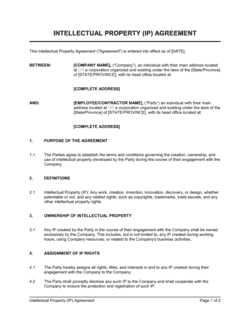
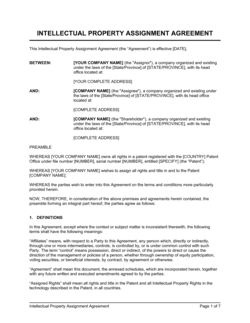
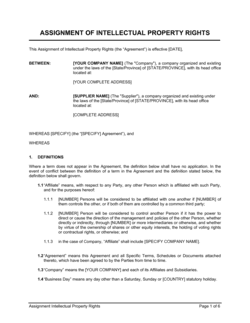
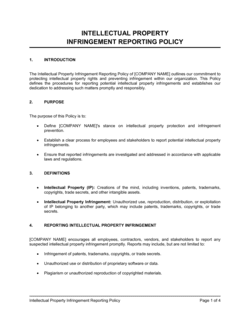
Intellectual Property License Agreement Template

Free Word download • Edit online • Save & share with Drive • Export to PDF

4 pages25–30 min to fillDifficulty: ComplexSignature requiredLegal review recommended
Learn more ↓
FreeIntellectual Property License Agreement Template

At a glance

What it is
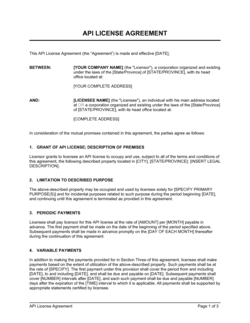
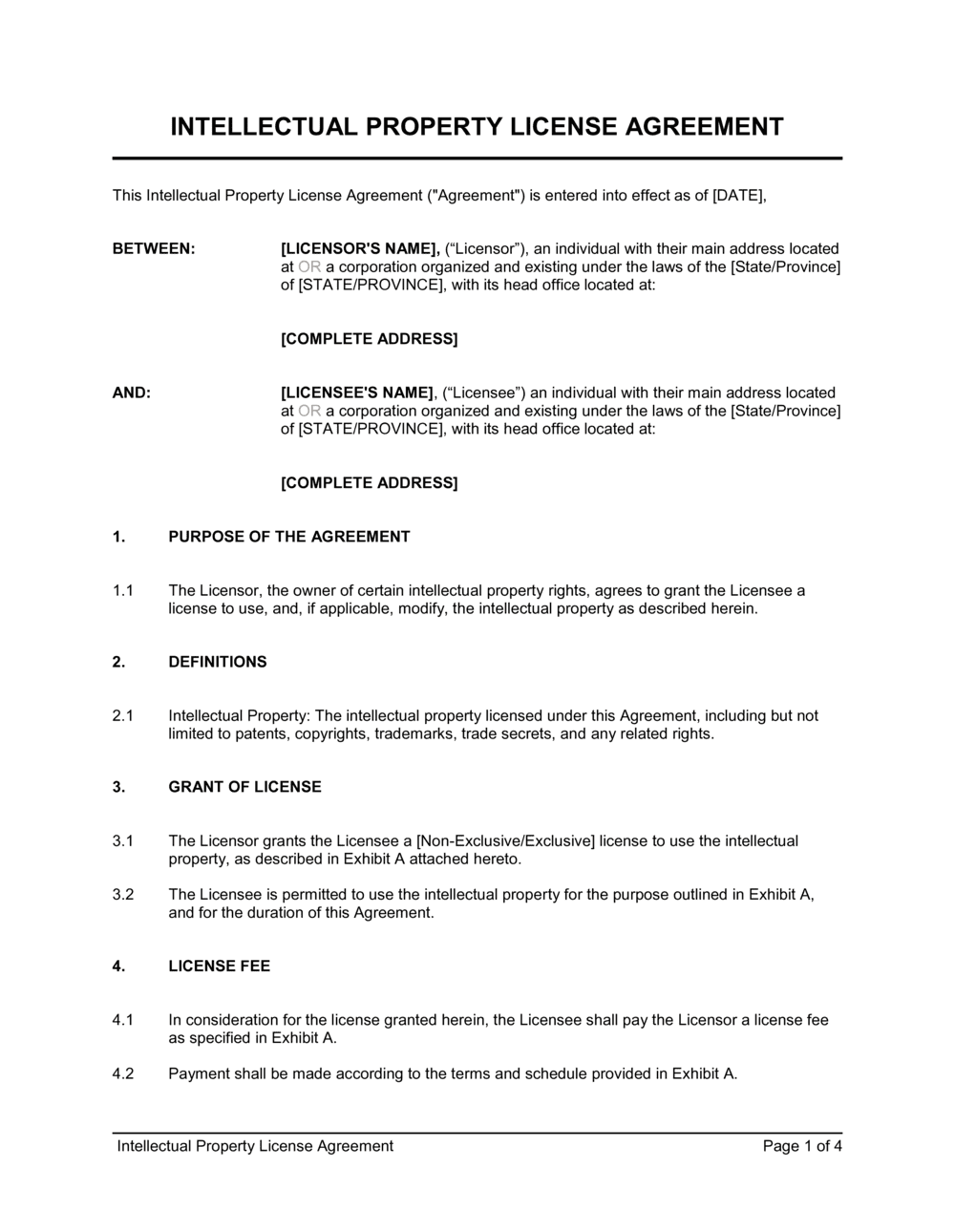
An Intellectual Property License Agreement is a legally binding contract in which an IP owner (the licensor) grants another party (the licensee) the right to use, reproduce, distribute, or commercialize specific intellectual property — such as patents, trademarks, copyrights, or trade secrets — under defined conditions. This free Word download gives you a structured, attorney-reviewed starting point you can edit online and export as PDF.
When you need it
Use it whenever you allow another business or individual to use your IP commercially, when you are acquiring rights to use someone else's IP in your products or services, or when formalizing a licensing arrangement that was previously handled by informal agreement. It is also required when a lender, investor, or acquirer asks for documented IP ownership and licensing chains during due diligence.
What's inside
Grant of license and scope of permitted use, exclusivity terms, territory and field-of-use restrictions, royalty and payment structure, sublicensing rights, IP ownership and improvements, confidentiality, representations and warranties, indemnification, and termination conditions — covering the full lifecycle of a commercial IP arrangement.

What is an Intellectual Property License Agreement?

An Intellectual Property License Agreement is a legally binding contract in which the owner of intellectual property — the licensor — grants a defined set of rights to another party — the licensee — to use, reproduce, distribute, or commercialize that IP under specified conditions. Crucially, the licensor retains ownership throughout; what transfers is a permission to use, not title to the asset itself. The agreement defines whether those rights are exclusive or shared, the geographic territory and permitted applications covered, the royalties or fees owed in exchange, and the conditions under which the relationship can be ended. IP subject to these agreements includes patents, registered and unregistered trademarks, copyrights covering software or content, trade secrets, and proprietary know-how.

Why You Need This Document

Allowing another party to use your IP without a written license agreement is one of the most commercially dangerous decisions a business can make. Without documented terms, there is no enforceable limit on how the licensee uses your IP, no agreed royalty or audit mechanism, no clear ownership of improvements the licensee develops, and no defined path to terminate the arrangement if the relationship breaks down. Courts in most jurisdictions will not imply reasonable terms into an undocumented IP arrangement — they will either find no license at all (making prior use infringement) or an implied perpetual license with no royalty obligation. On the licensee side, operating without a signed license exposes the business to infringement claims the moment the licensor changes its mind or sells the IP to a third party. This template gives both parties a professionally structured starting point that covers every material term — grant scope, royalties, improvements, indemnification, and termination — so that the commercial relationship is protected from the first day of use.

Which variant fits your situation?

If your situation is…Use this template
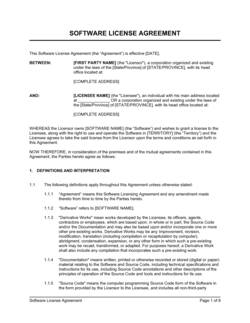
Licensing proprietary software to end users or enterprise customersSoftware License Agreement
Allowing a third party to use your brand name or logoTrademark License Agreement
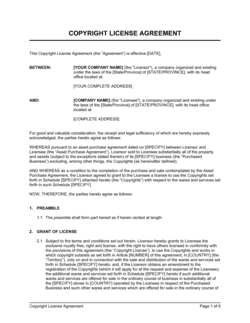
Granting rights to reproduce or distribute copyrighted contentCopyright License Agreement
Licensing a patented invention to a manufacturer or distributorPatent License Agreement
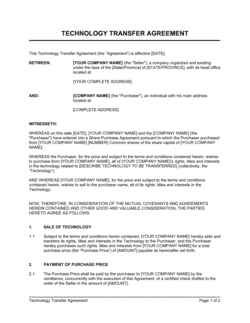
Sharing technology rights between two co-development partnersTechnology Transfer Agreement
Licensing IP within a franchise systemFranchise Agreement
Sharing confidential know-how without a full licenseNon-Disclosure Agreement

Common mistakes to avoid

❌ Vague IP description in the grant clause

Why it matters: If the licensed IP is described loosely as 'all software' or 'all technology,' the scope of the license — and therefore what constitutes infringement — becomes a matter of litigation rather than contract.

Fix: List every licensed asset by registration number, version, or a specific technical description in a Schedule A attached to and incorporated into the agreement.

❌ No minimum royalty obligation in an exclusive license

Why it matters: An exclusive licensee who pays no minimum royalty can effectively shelve the IP, blocking the licensor from licensing it to anyone else while generating zero income.

Fix: Include an annual minimum royalty that the licensee must pay regardless of actual sales, with the licensor's right to convert the license to non-exclusive — or terminate — if the minimum is not met.

❌ Omitting an improvements and ownership clause

Why it matters: Without this clause, ownership of enhancements the licensee builds on top of the licensed IP is legally uncertain and typically the most contested issue when the relationship ends.

Fix: Explicitly state who owns improvements — licensor, licensee, or jointly — and whether a grant-back or license-back applies. Document this decision before signing, not after a dispute arises.

❌ Unlimited indemnification exposure

Why it matters: An uncapped indemnity obligation can expose either party to liability that dwarfs the commercial value of the license, making the deal effectively uninsurable and financially catastrophic in a third-party IP dispute.

Fix: Cap indemnification at a reasonable multiple of total fees paid or a fixed ceiling (e.g., 12 months of royalties), except for fraud, willful misconduct, or death and personal injury claims.

❌ No audit rights for royalty verification

Why it matters: Without an audit right, the licensor has no mechanism to verify whether royalty reports are accurate — underpayment is common and often goes undetected for years.

Fix: Include a right to audit the licensee's books once per year upon reasonable notice, with the licensee bearing audit costs if an underpayment of more than 5% is discovered.

❌ Governing law chosen without considering IP registration jurisdiction

Why it matters: For patents and trademarks, the law of the registration country governs validity and infringement regardless of what the contract's governing law clause says — creating conflicts that override contractual intent.

Fix: Align the governing law clause with the primary jurisdiction where the IP is registered, or obtain legal advice on the interaction between contract law and IP law in each relevant territory.

The 10 key clauses, explained

Grant of license

In plain language: Defines exactly which IP rights are being licensed, whether the grant is exclusive or non-exclusive, the territory covered, and the permitted field of use.

Sample language
Licensor hereby grants to Licensee a [exclusive / non-exclusive], non-transferable license to use, reproduce, and distribute the [DESCRIPTION OF IP] (the 'Licensed IP') solely within [TERRITORY] and solely for the purpose of [FIELD OF USE].

Common mistake: Using vague language like 'all rights to the IP' instead of enumerating specific rights. Overly broad grants can inadvertently transfer ownership rather than a license, or create implied sublicensing rights the licensor never intended.

Exclusivity and reserved rights

In plain language: Specifies whether the licensor retains the right to use the IP itself or license it to others, and carves out any uses or territories the licensor keeps for itself.

Sample language
During the Term, Licensor reserves the right to [use the Licensed IP for internal purposes / license the Licensed IP to third parties outside [TERRITORY]]. No rights are granted beyond those expressly stated herein.

Common mistake: Granting an exclusive license without explicitly reserving the licensor's own right to use the IP. Under a pure exclusive grant, the licensor itself may be prohibited from using its own property.

Royalties and payment terms

In plain language: Sets out the royalty rate or fee structure, the calculation base (net sales, gross revenue, units), payment frequency, reporting obligations, and the process for auditing royalty calculations.

Sample language
Licensee shall pay Licensor a royalty of [X]% of Net Sales of Licensed Products, payable quarterly within [30] days of each quarter end, accompanied by a written royalty report. 'Net Sales' means gross invoice price less [returns, taxes, shipping].

Common mistake: Failing to define 'Net Sales' or the royalty calculation base precisely. Ambiguous definitions lead to disputes over deductions — discounts, chargebacks, and bundled pricing are common flashpoints.

Sublicensing rights

In plain language: States whether the licensee may grant sublicenses to third parties, and if so, what conditions apply — including licensor consent, sublicense terms, and responsibility for sublicensee conduct.

Sample language
Licensee [shall / shall not] have the right to sublicense the rights granted herein without the prior written consent of Licensor. Any permitted sublicense shall be in writing, shall be consistent with this Agreement, and Licensee shall remain fully liable for the sublicensee's compliance.

Common mistake: Silently omitting sublicensing language. In many jurisdictions, silence does not preclude sublicensing — an explicit prohibition or permission is required to create certainty.

Ownership and IP improvements

In plain language: Confirms that the licensor retains ownership of the licensed IP and addresses who owns any improvements or derivative works created by the licensee during the term.

Sample language
Licensor retains all right, title, and interest in and to the Licensed IP. All Improvements created by Licensee shall be owned by [LICENSOR / LICENSEE], and Licensee hereby [grants / does not grant] Licensor a [royalty-free / royalty-bearing] license to any such Improvements.

Common mistake: No improvements clause at all, leaving ownership of licensee-created enhancements legally uncertain. This is the most common source of post-termination IP disputes between the parties.

Representations and warranties

In plain language: The licensor warrants that it owns the IP, has the right to license it, and that the IP does not infringe third-party rights. The licensee warrants it has authority to enter the agreement and will use the IP only as permitted.

Sample language
Licensor represents and warrants that: (a) it is the sole owner of the Licensed IP; (b) it has full authority to grant the rights herein; and (c) to Licensor's knowledge, the Licensed IP does not infringe any third-party intellectual property rights.

Common mistake: Omitting the infringement warranty or limiting it excessively. A licensee commercializing IP without an infringement warranty bears the full risk of third-party patent or trademark claims — a significant and often unpriced exposure.

Confidentiality

In plain language: Requires both parties to protect trade secrets, technical know-how, and other confidential information disclosed in connection with the license, including source code, formulas, and pricing.

Sample language
Each party agrees to hold the other's Confidential Information in strict confidence, to use it only as necessary to exercise rights or fulfill obligations under this Agreement, and not to disclose it to third parties without prior written consent.

Common mistake: Using a mutual confidentiality clause when the information flow is one-directional. When only the licensor discloses sensitive IP, a one-sided obligation with a lower burden on the licensor is more appropriate.

Indemnification

In plain language: Allocates responsibility between the parties for third-party claims — typically requiring the licensor to indemnify against IP ownership disputes and the licensee to indemnify against misuse of the licensed IP.

Sample language
Licensor shall indemnify Licensee against any third-party claims alleging that the Licensed IP infringes such party's intellectual property rights. Licensee shall indemnify Licensor against any claims arising from Licensee's use of the Licensed IP in breach of this Agreement.

Common mistake: An indemnification clause with no cap on liability. Unlimited indemnity exposure is commercially unacceptable to most parties and should be limited to a multiple of fees paid or a fixed dollar ceiling.

Term and termination

In plain language: Sets the duration of the license, conditions allowing either party to terminate early (breach, insolvency, change of control), the notice period required, and the consequences of termination — including what the licensee must do with the IP.

Sample language
This Agreement commences on [START DATE] and continues for [X] years unless earlier terminated. Either party may terminate upon [30] days' written notice if the other party materially breaches this Agreement and fails to cure within [15] days of notice.

Common mistake: No cure period before termination for breach. Without a cure window, a minor technical default — late royalty report, administrative oversight — can trigger immediate termination, which is disproportionate and often litigated.

Governing law and dispute resolution

In plain language: Specifies which jurisdiction's law governs the agreement and whether disputes are resolved through litigation, mediation, or binding arbitration, including the seat and rules.

Sample language
This Agreement is governed by the laws of [STATE / PROVINCE / COUNTRY], without regard to conflict-of-law principles. Any dispute shall be resolved by binding arbitration administered by [AAA / JAMS / ICC] under its Commercial Arbitration Rules, seated in [CITY].

Common mistake: Choosing a governing law with no connection to either party's location or the IP's registration jurisdiction. Courts in some jurisdictions may override the chosen law for IP-specific issues regardless of what the contract states.

How to fill it out

  1. 1

    Identify and describe the licensed IP precisely

    List every IP asset being licensed — patent numbers, trademark registration numbers, copyright registration details, or a specific description of proprietary software or trade secrets. Attach a schedule if the IP portfolio is large.

    💡 Vague descriptions like 'all technology' are the single most litigated term in IP license agreements. Specificity protects both parties.

  2. 2

    Choose exclusivity and define the territory and field of use

    Decide whether the grant is exclusive or non-exclusive, then define the geographic territory (e.g., United States, European Union, worldwide) and the permitted field of use (e.g., consumer electronics, healthcare software, retail channels only).

    💡 An exclusive license in a narrow field of use is often more commercially valuable to the licensee and less risky to the licensor than a broad non-exclusive grant.

  3. 3

    Set the royalty structure and payment terms

    Enter the royalty rate or fixed fee, define the calculation base (net sales, gross revenue, units shipped), set the payment frequency (monthly, quarterly), and specify the royalty report format and audit rights.

    💡 Include an annual minimum royalty floor if you are granting exclusivity — it ensures the licensee actively commercializes the IP rather than shelving it.

  4. 4

    Address sublicensing rights explicitly

    State clearly whether sublicensing is permitted, and if so, whether it requires prior written consent, how sublicense fees flow back to the licensor, and who is liable for sublicensee breaches.

    💡 If the licensee is a distributor who will need to sub-license to end users (e.g., software reseller), pre-approve a standard-form sublicense as an exhibit to avoid repeated consent requests.

  5. 5

    Allocate ownership of improvements and derivative works

    Decide whether improvements made by the licensee belong to the licensor, the licensee, or are jointly owned. Include a grant-back clause if the licensor wants rights to licensee improvements, and specify whether that grant-back is royalty-free.

    💡 Grant-back clauses that assign all improvements to the licensor can deter licensees from investing in the technology. A royalty-free license-back (rather than assignment) is often more commercially acceptable.

  6. 6

    Set the term and termination conditions

    Enter the start date, the initial term (commonly 2–5 years for commercial licenses), automatic renewal terms if any, and the specific conditions for early termination — material breach, insolvency, change of control, or non-payment.

    💡 Include a 15–30 day cure period before termination for monetary breaches and a 30-day cure period for non-monetary breaches. Courts expect proportionality.

  7. 7

    Include post-termination obligations

    Specify what the licensee must do upon termination — cease using the IP, destroy or return materials, wind down sales of licensed products within a sell-off period, and certify compliance in writing.

    💡 A 90-day sell-off period for physical goods is standard and avoids disputes over unsold inventory. Software licenses typically require immediate cessation.

  8. 8

    Execute with dated signatures before use begins

    Both parties should sign the agreement — and any attached schedules — before the licensee begins using the IP. For high-value licenses, consider a countersignature process with execution copies exchanged by secure email or eSign.

    💡 Date-stamp execution precisely. In patent licensing, the effective date of the license can affect whether prior use constitutes infringement — a gap between signature and effective date creates ambiguity.

Frequently asked questions

What is an intellectual property license agreement?

An intellectual property license agreement is a contract in which the owner of IP (the licensor) grants another party (the licensee) defined rights to use, reproduce, distribute, or commercialize that IP — such as patents, trademarks, copyrights, or trade secrets — in exchange for royalties, fees, or other consideration. It transfers usage rights without transferring ownership, which remains with the licensor unless the agreement expressly provides otherwise. It is the foundational document for nearly all commercial IP transactions.

What is the difference between an exclusive and non-exclusive IP license?

In an exclusive license, the licensee is the only party permitted to use the IP in the defined territory and field — the licensor typically cannot even use it themselves unless explicitly reserved. In a non-exclusive license, the licensor retains the right to license the same IP to multiple parties simultaneously. Exclusive licenses command higher royalties and are typically granted with minimum royalty floors to prevent the IP from being shelved. Non-exclusive licenses are standard in software and content distribution where broad reach is the commercial goal.

Do I need a lawyer to draft an IP license agreement?

For straightforward licenses covering a single, clearly defined IP asset with a domestic counterparty, a high-quality template is a sound starting point. Legal review is strongly recommended when the IP has significant commercial value, the license is exclusive, the licensee or licensor operates in multiple jurisdictions, the agreement involves patents (where claim scope matters), or when royalty structures are complex. A 2–3 hour attorney review typically costs $600–$1,500 and is worthwhile for any license generating over $50,000 in annual royalties.

What is a royalty and how is it calculated in an IP license?

A royalty is a payment from the licensee to the licensor for the right to use the licensed IP. Royalties are most commonly calculated as a percentage of net sales (typically 3–15% depending on the IP type and industry), a fixed fee per unit produced, or a combination of an upfront license fee plus ongoing percentage royalties. The royalty base — what counts as "net sales" and which deductions are permitted — must be defined precisely in the agreement to avoid disputes.

What happens to the IP license if the licensor sells the IP?

In most jurisdictions, a registered license (recorded with the relevant IP office) survives a sale of the underlying IP — the new owner takes the IP subject to the existing license. An unregistered license may not bind a purchaser who acquires the IP without notice of the license. To protect the licensee's rights, the agreement should include an assignment restriction on the licensor and a clause requiring the licensor to ensure any buyer assumes the license obligations.

Can an IP licensee sublicense to third parties?

Only if the agreement expressly permits it. In most jurisdictions, a licensee cannot sublicense without the licensor's consent unless the agreement says otherwise. Sublicensing provisions should address whether consent is required for each sublicense, whether sublicense fees flow back to the licensor, and who bears liability for sublicensee breaches. Software distribution agreements commonly grant broad sublicensing rights to end users; exclusive patent licenses rarely do.

What IP types can be covered by a license agreement?

A single license agreement can cover one or multiple IP types: patents (utility, design, plant), registered and unregistered trademarks, copyrights (software, content, designs), trade secrets, know-how, database rights, and domain names. Each IP type has different legal characteristics — patents expire after 20 years; copyrights last the author's life plus 70 years in most jurisdictions; trade secrets have no fixed term but can be lost through disclosure. The agreement should identify each IP type separately and address type-specific issues.

What is a grant-back clause and should I include one?

A grant-back clause requires the licensee to license any improvements or derivative works it creates using the licensed IP back to the licensor. Licensors favor them to maintain control over the technology's evolution; licensees resist them because they reduce the incentive to invest in improvement. A royalty-free license-back (rather than an assignment of ownership) is a common compromise. In some jurisdictions, broad grant-back clauses can raise competition law concerns if they effectively prevent the licensee from commercializing its own innovations.

How long should an IP license agreement last?

Commercial IP licenses typically run 2–5 years for technology and software licenses, with auto-renewal provisions. Patent licenses often run to the expiry of the underlying patent (up to 20 years from filing). Trademark licenses are usually co-extensive with the trademark registration term and its renewals. Perpetual licenses — common in software — carry no fixed end date but should include termination-for-cause provisions. The right term depends on the IP's commercial lifecycle and how long both parties need certainty.

What must a licensee do when an IP license is terminated?

Standard post-termination obligations include immediately ceasing all use of the licensed IP, destroying or returning all materials embodying the IP, paying any outstanding royalties, and providing a written certification of compliance. Agreements covering physical goods typically allow a 90-day sell-off period for existing inventory. Software licenses typically require immediate cessation and deletion. Any sublicenses granted by the licensee should automatically terminate unless the agreement provides that sublicensees may continue under a direct license with the licensor.

How this compares to alternatives

vs IP Assignment Agreement

An IP assignment permanently transfers full ownership of the intellectual property from the assignor to the assignee — after signing, the original owner has no further rights unless granted back by contract. An IP license agreement transfers only usage rights while the licensor retains ownership. Use an assignment when the goal is a clean transfer of title (e.g., in an M&A deal or employee IP transfer); use a license when the owner wants to monetize the IP repeatedly or retain long-term control.

vs Non-Disclosure Agreement

An NDA protects confidential information shared between parties during discussions or a relationship — it does not grant any right to use that information commercially. An IP license agreement actively grants usage rights, defines commercialization terms, and sets royalties. Parties typically sign an NDA before negotiating a license, then replace or supplement it with the full license agreement once terms are agreed.

vs Software License Agreement

A software license agreement is a specialized form of IP license focused specifically on copyright and usage rights for software products — covering installation, permitted number of users, SaaS access terms, and acceptable use restrictions. A general IP license agreement is broader and covers patents, trademarks, trade secrets, and other IP types. Use the software-specific template for pure software products; use the general IP license when the arrangement involves multiple IP types or non-software assets.

vs Technology Transfer Agreement

A technology transfer agreement is used when know-how, technical documentation, training, and implementation support are transferred alongside — or instead of — formal IP rights. It is common between universities and industry partners or between companies in different jurisdictions where patent protection may not exist. An IP license agreement focuses on the legal grant of rights to existing registered or protectable IP; a technology transfer agreement focuses on the practical transmission of the knowledge needed to implement it.

Industry-specific considerations

Technology / SaaS

Patent and copyright licenses for core algorithms, API access rights, white-label software arrangements, and OEM technology bundling agreements.

Pharmaceutical and Life Sciences

Patent licenses for drug compounds and manufacturing processes, milestone-based royalty structures tied to FDA approval stages, and co-development IP allocation clauses.

Media and Entertainment

Copyright licensing for music, film, and publishing content, synchronization and master use licenses, performance royalties, and territory-by-territory streaming rights.

Manufacturing and Consumer Products

Patent licenses for production processes and product designs, trademark licenses for co-branded goods, and field-of-use restrictions separating retail from industrial channels.

Retail and Franchise

Trademark licenses embedded in franchise agreements, quality control and brand standards clauses, and territory exclusivity tied to minimum sales commitments.

Professional Services and Consulting

Licenses for proprietary methodologies, frameworks, and assessment tools, with field-of-use restrictions limiting competitors from accessing consulting IP.

Jurisdictional notes

United States

US IP licenses are governed by federal IP law (Patent Act, Copyright Act, Lanham Act) and state contract law. Patent licenses must be recorded with the USPTO to be enforceable against subsequent purchasers of the patent. California limits certain non-exclusive patent license restrictions under antitrust principles. Non-compete clauses within IP licenses affecting California employees or licensees require careful drafting given California's broad non-compete prohibition.

Canada

Canadian IP is governed federally under the Patent Act, Trade-marks Act, and Copyright Act. Patent and trademark licenses should be recorded with the Canadian Intellectual Property Office (CIPO) to provide constructive notice. Quebec-based licensees may require French-language agreement provisions or a certified French translation under the Charter of the French Language. Royalty payments from Canada to foreign licensors are typically subject to 25% withholding tax, reducible under applicable tax treaties.

United Kingdom

UK IP licenses are governed by the Patents Act 1977, Trade Marks Act 1994, and Copyright, Designs and Patents Act 1988. Exclusive patent licenses must be in writing and signed by or on behalf of the licensor to be valid. Post-Brexit, separate filings are required for UK and EU trademarks and designs — a pre-2020 EU-wide license may no longer cover the UK. UK competition law (based on the retained EU block exemption framework as of 2026) applies to IP licensing arrangements that affect markets in the UK.

European Union

EU IP licensing is subject to the Technology Transfer Block Exemption Regulation (TTBER), which provides safe harbors from EU competition law for qualifying patent and know-how licenses between non-competing parties with market shares below 20–30%. GDPR applies where the licensed IP involves personal data — data processing terms must be addressed in the agreement or a separate data processing addendum. EU Unitary Patent protection (effective 2023) allows a single patent filing to cover most EU member states, simplifying multi-territory licensing.

Template vs lawyer — what fits your deal?

PathBest forCostTime
Use the templateNon-exclusive licenses for clearly defined IP with domestic counterparties and straightforward royalty structuresFree1–2 hours
Template + legal reviewExclusive licenses, cross-border arrangements, patent licenses, or deals generating over $50,000 annually in royalties$600–$1,5003–7 days
Custom draftedHigh-value patent portfolios, pharmaceutical or biotech licensing, multi-jurisdiction IP portfolios, or licenses tied to M&A transactions$3,000–$15,000+2–6 weeks

Glossary

Licensor
The party that owns the intellectual property and grants the right to use it to another party under the terms of the agreement.
Licensee
The party that receives the right to use the licensor's intellectual property under the conditions set out in the agreement.
Exclusive License
A grant of rights in which the licensee is the only party permitted to use the IP in the defined territory or field, including the licensor itself unless explicitly reserved.
Non-Exclusive License
A grant of rights that allows the licensor to simultaneously license the same IP to multiple parties in the same territory or field.
Royalty
A periodic payment made by the licensee to the licensor, typically calculated as a percentage of net sales, revenue, or a fixed fee per unit produced.
Field of Use
A contractual restriction limiting the licensee's right to use the IP to a specific industry, application, product category, or channel.
Sublicense
A secondary license granted by the licensee to a third party, permitting that third party to exercise some or all of the rights the licensee holds — only permitted when the agreement expressly allows it.
Grant-Back Clause
A provision requiring the licensee to license back to the licensor any improvements or derivative works the licensee develops using the licensed IP.
IP Improvements
Modifications, enhancements, or derivative works based on the licensed IP created by the licensee during the term of the agreement.
Milestone Payment
A lump-sum payment triggered by the licensee reaching a defined commercial or development milestone, such as a product launch or revenue threshold.
Perpetual License
A license that does not expire on a fixed date and continues indefinitely unless terminated for cause or by mutual agreement.
Upfront License Fee
A one-time payment made by the licensee at execution, separate from ongoing royalties, to secure access to the licensed IP.

Part of your Business Operating System

This document is one of 3,000+ business & legal templates included in Business in a Box.

  • Fill-in-the-blanks — ready in minutes
  • 100% customizable Word document
  • Compatible with all office suites
  • Export to PDF and share electronically

Create your document in 3 simple steps.

From template to signed document — all inside one Business Operating System.
1
Download or open template

Access over 3,000+ business and legal templates for any business task, project or initiative.

2
Edit and fill in the blanks with AI

Customize your ready-made business document template and save it in the cloud.

3
Save, Share, Send, Sign

Share your files and folders with your team. Create a space of seamless collaboration.

Save time, save money, and create top-quality documents.

★★★★★

"Fantastic value! I'm not sure how I'd do without it. It's worth its weight in gold and paid back for itself many times."

Managing Director · Mall Farm
Robert Whalley
Managing Director, Mall Farm Proprietary Limited
★★★★★

"I have been using Business in a Box for years. It has been the most useful source of templates I have encountered. I recommend it to anyone."

Business Owner · 4+ years
Dr Michael John Freestone
Business Owner
★★★★★

"It has been a life saver so many times I have lost count. Business in a Box has saved me so much time and as you know, time is money."

Owner · Upstate Web
David G. Moore Jr.
Owner, Upstate Web

Run your business with a system — not scattered tools

Stop downloading documents. Start operating with clarity. Business in a Box gives you the Business Operating System used by over 250,000 companies worldwide to structure, run, and grow their business.

Start free · No credit card required