1
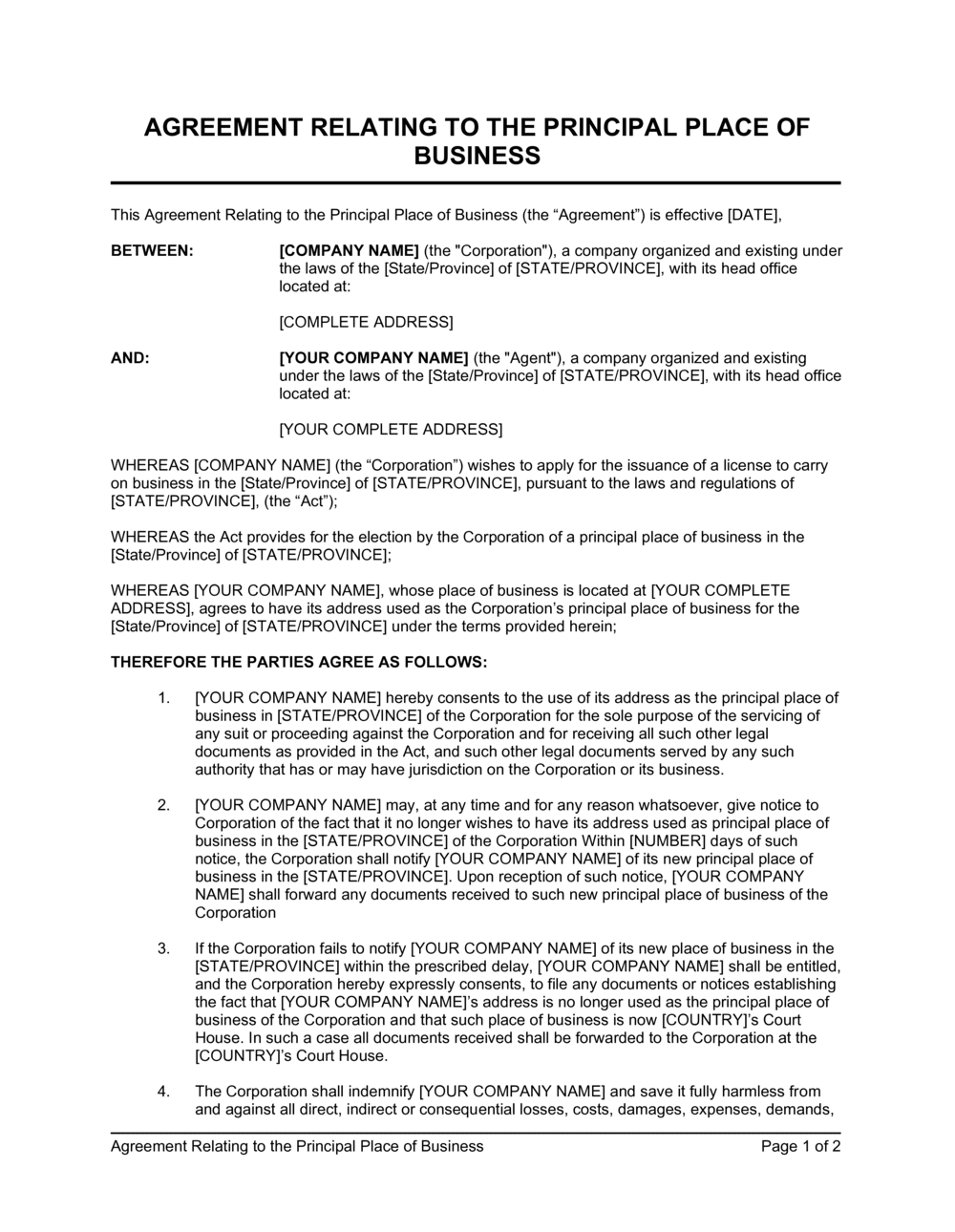
Enter the full legal names and entity details of all parties
Use each party's complete registered legal name as it appears in their state or provincial formation documents. Include the entity type (LLC, corporation, partnership) and state or province of formation.
💡 Pull entity names directly from the secretary of state's online search tool to avoid spelling discrepancies that can invalidate the agreement.
2
Insert the complete civic address of the principal place of business
Enter the full street address, suite or unit number if applicable, city, state or province, ZIP or postal code, and country. Confirm the address is a real, physical location — not a PO box, which most states and countries do not accept as a principal place of business.
💡 Verify the address format matches exactly what you intend to file with the secretary of state — even minor differences (abbreviations, suite formatting) can cause filing rejections.
3
Set the effective date and term
Choose an effective date that aligns with the planned regulatory filings. If the company is relocating, coordinate the effective date with the move date and the deadline for state or provincial address-change filings.
💡 Set the effective date at least 15 business days before any critical filing deadline to give yourself time to resolve errors.
4
Define permitted use and access rights
Specify exactly how the address may be used — mail receipt, official registration, business stationery — and whether the hosting party must provide physical access. If the address belongs to a co-working provider or landlord, confirm their consent before including access rights.
💡 If physical access is not guaranteed, note that explicitly and designate a registered agent's address for service of process instead.
5
Detail the hosting party's mail and correspondence obligations
Set a specific forwarding timeline — 1 to 2 business days is standard — and require immediate notification for service of process. Confirm the hosting party has agreed to these obligations before execution.
💡 Include a fallback forwarding address or email notification requirement so time-sensitive legal documents reach the right person even if the primary contact is unavailable.
6
Complete the representations and warranties section
Both parties should confirm the address is a real, accessible location; that its use complies with all leases, zoning laws, and HOA rules; and that the company is in good standing. If any representation cannot be made truthfully, resolve the underlying issue before signing.
💡 If the principal address is a residential property, check the local zoning ordinance and any HOA or condo association rules before executing.
7
Assign the regulatory filing obligations and set a deadline
Name the party responsible for updating the address with the secretary of state, the IRS (Form 8822-B or equivalent), and other agencies. Set a specific number of business days — 15 is typical — from the effective date for completing all filings.
💡 Create a checklist of every agency that has the current address on file before signing so no filing is missed after execution.
8
Execute before the effective date and retain signed copies
Both parties must sign before or on the effective date. Retain a fully executed copy in the company's corporate records file alongside the corresponding secretary of state filing confirmation.
💡 Use a timestamped e-signature tool and store the executed agreement in the same records folder as the state filing receipt so both documents can be produced together during audits or due diligence.