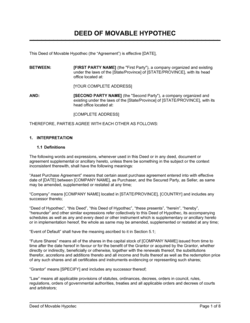
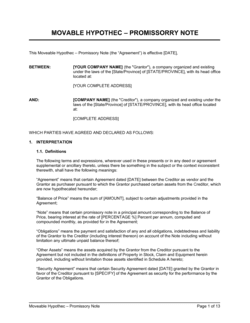
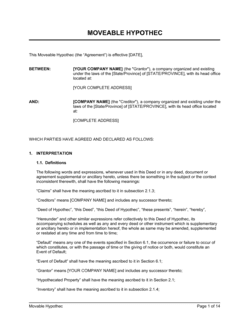
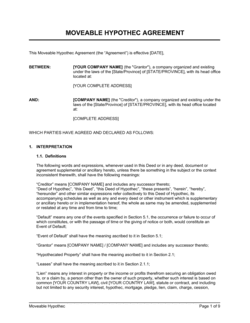
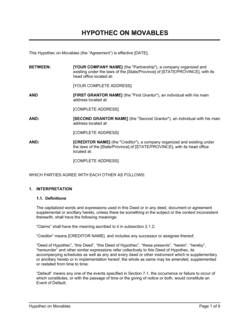
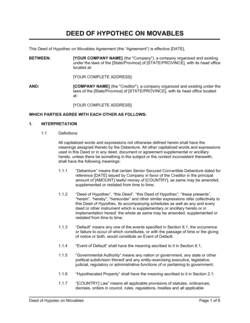
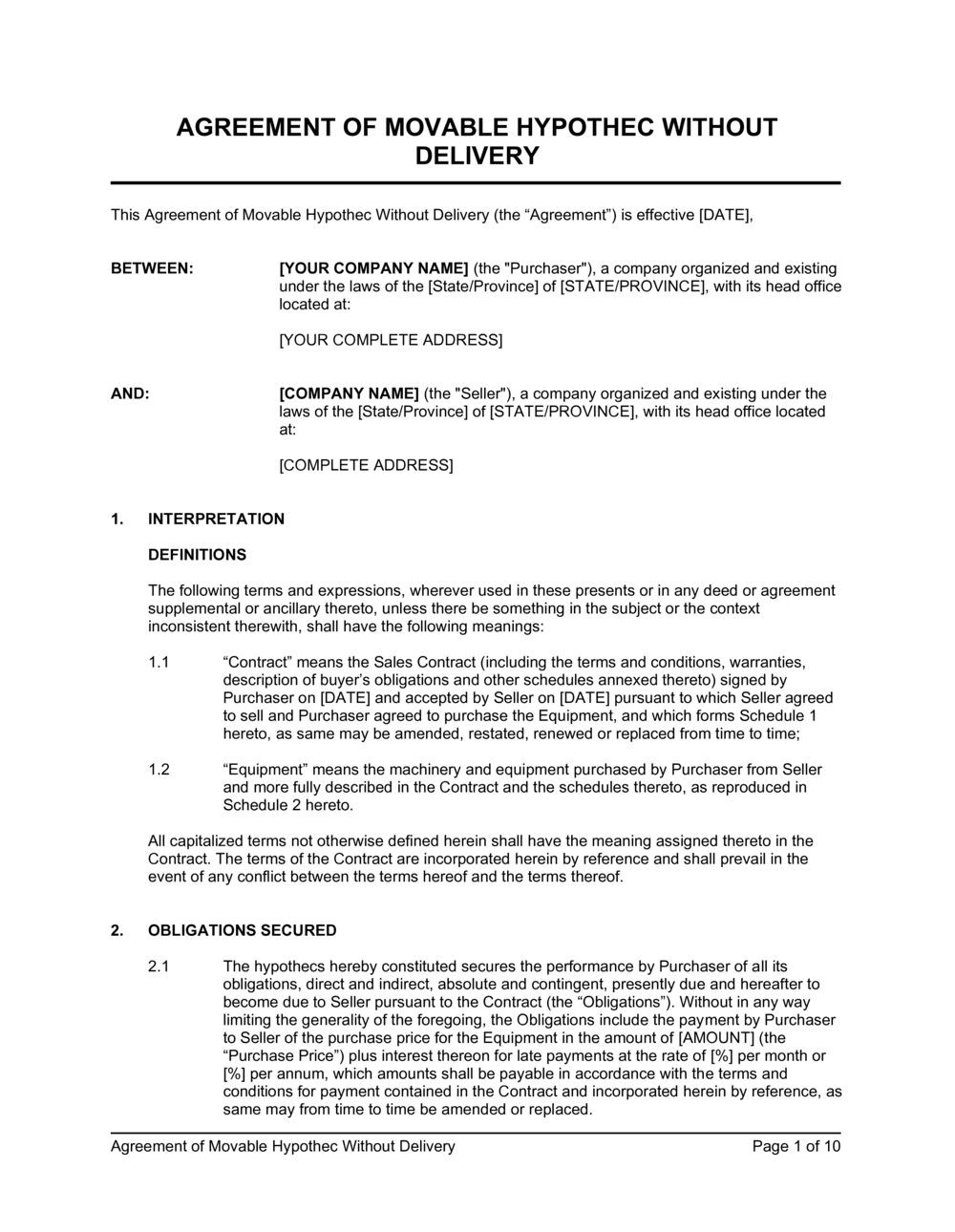
Agreement of Movable Hypothec Without Delivery Template

Free Word download • Edit online • Save & share with Drive • Export to PDF

10 pages30–40 min to fillDifficulty: ComplexSignature requiredLegal review recommended
Learn more ↓
FreeAgreement of Movable Hypothec Without Delivery Template

At a glance

What it is
An Agreement of Movable Hypothec Without Delivery is a secured financing document in which a debtor grants a creditor a security interest over specified movable assets — such as equipment, inventory, or receivables — without physically transferring possession of those assets to the creditor. This free Word download lets you document the security interest, define the collateral, and set the rights and obligations of both parties, exportable as PDF for execution and registration.
When you need it
Use it when a lender or creditor requires a registered security interest over a borrower's movable property as collateral for a loan or credit facility, and both parties agree the debtor will retain possession and continued use of the assets during the term. It is particularly common in Quebec civil law transactions and in cross-border commercial lending where movable property serves as the primary collateral base.
What's inside
Identification of the debtor and creditor, a precise description of the collateral assets, the secured obligation amount and terms, registration requirements, debtor covenants for maintaining collateral, events of default, creditor enforcement rights, and governing law provisions.

What is an Agreement of Movable Hypothec Without Delivery?

An Agreement of Movable Hypothec Without Delivery is a legally binding secured financing document in which a debtor grants a creditor a registered security right over specified movable assets — such as equipment, machinery, inventory, accounts receivable, or intellectual property — while retaining physical possession and continued use of those assets throughout the term of the obligation. Unlike a pledge or hypothec with delivery, where the creditor takes physical control of the collateral, this structure allows the debtor to operate their business normally while the creditor's interest is protected through registration in the applicable public registry. In Quebec, movable hypothecs are governed by the Civil Code of Quebec and must be executed by notarial act; in common-law jurisdictions, the functional equivalent is a security agreement perfected under personal property security legislation. The registered hypothec gives the creditor priority over subsequently registered creditors and, upon default, the right to seize and sell the collateral or exercise other statutory enforcement remedies.

Why You Need This Document

Without a properly drafted and registered movable hypothec, a creditor who advances funds against a borrower's assets has no enforceable security interest — and in the event of the borrower's insolvency, ranks as an unsecured creditor behind all registered secured parties, often recovering nothing. A vague or improperly registered hypothec is equally dangerous: competing creditors with a registered interest in the same collateral take priority, and a bankruptcy trustee can set aside an unpublished security right entirely. For the debtor, a well-structured agreement defines exactly what assets are encumbered, what covenants apply, and what cure rights are available before the creditor can enforce — preventing a technical breach from triggering an immediate seizure of business-critical equipment. This template gives both parties a clear, complete foundation covering collateral description, the secured obligation, debtor covenants, events of default, and enforcement rights, reducing the drafting time and the risk of omitting a clause that would otherwise cost far more than the original loan to litigate.

Which variant fits your situation?

If your situation is…Use this template
Securing a loan where the creditor takes physical possession of the collateralAgreement of Movable Hypothec With Delivery (Pledge)
Securing a loan over real property such as land or buildingsImmovable Hypothec Agreement
Financing equipment with the lender retaining a purchase-money security interestEquipment Financing Agreement
Securing a revolving line of credit against accounts receivableGeneral Security Agreement
Documenting a personal guarantee to support a business loanPersonal Guarantee Agreement
Granting a floating charge over all present and future business assetsDebenture Agreement
Common-law jurisdiction secured loan against personal propertySecurity Agreement (PPSA)

Common mistakes to avoid

❌ Advancing funds before registering the hypothec

Why it matters: An unregistered hypothec is unpublished and unenforceable against third parties, including a bankruptcy trustee who can set it aside entirely, leaving the creditor as an unsecured creditor.

Fix: Make registration confirmation a condition precedent to disbursement in the loan agreement. Confirm the registration number and effective date before releasing any funds.

❌ Setting the registered hypothec amount equal to the loan principal only

Why it matters: Default interest, legal fees, and enforcement costs routinely push the creditor's actual claim 20–30% above principal. If the registered amount is insufficient, the creditor cannot recover the excess from the collateral proceeds.

Fix: Register a hypothec amount that is at least 20–25% above the principal loan amount and confirm the buffer with counsel based on the expected interest rate and loan term.

❌ Using a generic or vague collateral description

Why it matters: A description like 'all assets of the debtor' may be rejected by the registry or successfully challenged by a competing creditor who registered a more specific interest over the same assets.

Fix: Describe the collateral by category, type, and identifying details — serial numbers for equipment, invoice dates for receivables, SKU ranges for inventory — and attach a Schedule A for the full list.

❌ No insurance requirement naming the creditor as loss payee

Why it matters: If the collateral is destroyed or damaged and the creditor is not named on the insurance policy, the debtor collects the proceeds and the creditor is left with an unsecured claim against an insolvent debtor.

Fix: Require the debtor to maintain property and casualty insurance on the collateral for full replacement value, name the creditor as additional insured and first loss payee, and provide annual proof of coverage.

❌ Omitting a cure period for non-payment and covenant breaches

Why it matters: A default clause that triggers immediately on any technical breach, without notice or a cure period, may be found commercially unreasonable by a court and could expose the creditor to a wrongful enforcement claim.

Fix: Include a 10-business-day cure period for payment defaults and a 30-day cure period for other covenant breaches, each triggered by written notice from the creditor.

❌ Governing law that does not match the collateral's location

Why it matters: Personal property security regimes are territorial — a court will apply the law of the jurisdiction where the collateral is located to determine perfection and priority, regardless of the governing-law clause in the contract.

Fix: Set the governing law to the jurisdiction where the collateral is physically located and register in that jurisdiction's applicable registry. If the collateral spans multiple provinces or countries, seek advice on a multi-jurisdiction registration strategy.

The 10 key clauses, explained

Identification of parties

In plain language: Names the creditor and debtor with their full legal names, addresses, and corporate identifiers, establishing who holds the security and who grants it.

Sample language
This Agreement of Movable Hypothec Without Delivery is entered into as of [DATE] between [CREDITOR LEGAL NAME], a [PROVINCE/STATE] [ENTITY TYPE] ('Creditor'), and [DEBTOR LEGAL NAME], a [PROVINCE/STATE] [ENTITY TYPE] ('Debtor').

Common mistake: Using a trade name or operating name instead of the registered legal entity name. If the debtor's registered name does not match the registration filing, the hypothec may be unpublished against the wrong entity and lose its priority against third parties.

Description of the secured obligation

In plain language: States the principal amount of the loan or credit facility being secured, the interest rate, repayment schedule, and all other monetary obligations the hypothec is designed to guarantee.

Sample language
The Hypothec secures the payment and performance of all obligations of the Debtor to the Creditor under the Loan Agreement dated [DATE], including principal of $[AMOUNT], interest at [RATE]% per annum, fees, and all related costs.

Common mistake: Describing the secured obligation too narrowly — for example, referencing only the principal amount. Future interest, fees, and enforcement costs should be expressly included or the creditor may not recover them from the collateral.

Description of collateral

In plain language: Identifies the specific movable assets subject to the hypothec, with enough precision that a third party reading the registration can determine what is and is not covered.

Sample language
The Hypothec is granted over all present and after-acquired [EQUIPMENT / INVENTORY / RECEIVABLES] of the Debtor described in Schedule A, including all proceeds, replacements, and accessions thereto.

Common mistake: Using generic descriptions like 'all business assets' without specifying the category. Overly broad descriptions may be rejected at registration or challenged by competing creditors claiming priority over specific assets.

Hypothec amount and ranking

In plain language: States the monetary cap of the hypothec as registered — which may exceed the loan principal to cover interest and costs — and the agreed priority ranking relative to other charges on the same assets.

Sample language
The Hypothec is granted for the sum of $[HYPOTHEC AMOUNT], bearing interest at [RATE]% per annum. The Debtor represents that the Collateral is free of prior charges except as disclosed in Schedule B.

Common mistake: Setting the hypothec amount equal to the loan principal only. Registration costs, default interest, and enforcement expenses routinely push the actual claim above principal — the registered amount should include a reasonable buffer.

Debtor covenants

In plain language: Lists the positive and negative obligations of the debtor during the term: maintaining and insuring the collateral, not disposing of or encumbering it without consent, and notifying the creditor of material changes.

Sample language
The Debtor covenants to: (a) maintain the Collateral in good repair; (b) keep the Collateral insured for full replacement value naming Creditor as loss payee; (c) not sell, transfer, or further hypothecate the Collateral without prior written consent of Creditor; and (d) notify Creditor within [5] business days of any loss, damage, or seizure of the Collateral.

Common mistake: Omitting the insurance requirement or not naming the creditor as additional insured or loss payee. If the collateral is destroyed and the creditor is not named on the policy, the insurance proceeds may flow to the debtor and disappear.

Events of default

In plain language: Defines the specific events that trigger the creditor's enforcement rights — non-payment, covenant breach, insolvency, change of control, or material deterioration of the collateral.

Sample language
Each of the following constitutes an Event of Default: (a) failure to pay any amount due within [10] days of the due date; (b) breach of any covenant that is not remedied within [30] days of written notice; (c) commencement of insolvency proceedings by or against the Debtor; (d) any attachment or seizure of the Collateral by a third party.

Common mistake: No cure period for technical or administrative covenant breaches. Immediate default on a minor breach can be commercially unreasonable and unenforceable in some jurisdictions — always include a notice and cure period for non-payment and covenant violations.

Creditor's enforcement rights

In plain language: Sets out what the creditor may do upon default: seize and sell the collateral, appoint a receiver, take the collateral in payment, or pursue other remedies under applicable law.

Sample language
Upon an Event of Default, Creditor may exercise any remedy available under the Civil Code of Quebec / applicable legislation, including: (a) taking in payment of the Collateral; (b) selling the Collateral by judicial or private sale; or (c) appointing a receiver of the Collateral.

Common mistake: Failing to specify whether the sale of collateral is by judicial or private sale, and omitting the required prior-notice period. Many jurisdictions mandate advance written notice to the debtor before a private sale — skipping this step can expose the creditor to damages.

Representations and warranties of the debtor

In plain language: Statements of fact the debtor makes at signing — that it owns the collateral free of competing claims, has authority to grant the hypothec, and that the collateral information is accurate.

Sample language
The Debtor represents and warrants that: (a) it has full legal authority to grant this Hypothec; (b) the Collateral is owned by the Debtor free and clear of all encumbrances except as disclosed; and (c) no insolvency proceedings are pending or threatened against the Debtor.

Common mistake: No warranty of ownership of the collateral. If a third party has a prior unregistered interest in the assets, the creditor may discover they hold a security interest over property the debtor did not fully own.

Registration and publication obligations

In plain language: Addresses who is responsible for registering the hypothec in the applicable public registry, who bears the registration costs, and what happens if registration lapses or must be renewed.

Sample language
The Creditor shall, at the Debtor's expense, register this Hypothec in the Register of Personal and Movable Real Rights (RPMRR) [or applicable registry] within [5] business days of execution. The Debtor shall cooperate fully and execute any further documents required to perfect and maintain the publication of the Hypothec.

Common mistake: No deadline for registration and no allocation of registration costs. Delays in publishing the hypothec leave the creditor unperfected against third-party creditors and trustees in bankruptcy, who take priority over an unpublished security right.

Governing law and dispute resolution

In plain language: Specifies the jurisdiction whose law governs the agreement and how disputes will be resolved — whether by court, arbitration, or mediation.

Sample language
This Agreement is governed by the laws of the Province of [PROVINCE] / [JURISDICTION]. Any dispute shall be submitted to the exclusive jurisdiction of the courts of [CITY/DISTRICT], except that the Creditor may seek injunctive or enforcement relief in any competent jurisdiction.

Common mistake: Selecting a governing law that has no real connection to where the collateral is located. Personal property security regimes are territorial — the law of the jurisdiction where the collateral is physically situated typically governs perfection and priority regardless of what the contract says.

How to fill it out

  1. 1

    Identify both parties with their full legal names

    Enter the creditor's and debtor's complete registered legal names, principal addresses, and corporate registration numbers. For individuals, include government-issued ID references if required by local registration rules.

    💡 Run a corporate registry search on the debtor's entity name before drafting — a mismatch between the agreement and the registry filing is one of the most common causes of a rejected registration.

  2. 2

    Define the secured obligation precisely

    Reference the underlying loan agreement or credit facility by date and amount. Include principal, interest rate, payment schedule, and any fees or future advances that the hypothec is intended to secure.

    💡 If the credit facility allows future advances, include a 'future advances' clause so that amounts drawn after signing are automatically covered by the existing hypothec without requiring a new agreement.

  3. 3

    Draft a detailed description of the collateral

    Identify each category of asset by type, serial number (for equipment), or description (for inventory and receivables). Include proceeds and after-acquired property language if the hypothec is meant to cover assets acquired in the future.

    💡 Use Schedule A for the full asset list — keeping it separate from the body of the agreement makes it easier to update if the collateral changes without amending the main document.

  4. 4

    Set the hypothec amount and registration cap

    State a registered amount that is at least 20–25% above the loan principal to cover accrued interest, default interest, and enforcement costs. Confirm this cap with the creditor's counsel before filing.

    💡 In Quebec, the registered hypothec amount is the maximum the creditor can claim from the proceeds of the collateral — underestimating it leaves enforcement costs unrecovered.

  5. 5

    List all debtor covenants and negative pledges

    Include affirmative covenants (maintain and insure the collateral, pay taxes on it) and negative covenants (no disposal, no further encumbrance without consent). Specify the notice period for cure of any breach.

    💡 Add a specific requirement that the debtor notify you within 5 business days if the collateral is seized, damaged, or becomes the subject of any third-party claim — early notice gives you enforcement options before value deteriorates.

  6. 6

    Define events of default and cure periods

    List specific default triggers — payment failure, insolvency, covenant breach, change of control — and assign appropriate cure periods (typically 10 days for payment, 30 days for other breaches).

    💡 Avoid a blanket 'cross-default' clause that triggers default on this hypothec whenever the debtor defaults on any other obligation, unless you are a senior secured lender with the capacity to manage concurrent enforcement.

  7. 7

    Specify enforcement remedies and required notices

    State clearly which remedies the creditor may exercise on default, the notice period required before exercising each remedy, and whether a private or judicial sale is permitted. Reference the applicable statute.

    💡 In Quebec, creditors must give 20 days' prior notice before exercising hypothecary rights against a business debtor — build this into your enforcement timeline from the start.

  8. 8

    Execute and register before advancing funds

    Both parties must sign the agreement, then register it in the applicable public registry before the loan is advanced. Advancing funds before registration exposes the creditor to an unperfected security interest that ranks behind any subsequently registered creditor.

    💡 Use a condition precedent in the loan agreement requiring confirmed registration before disbursement — this protects you if registration is delayed for administrative reasons.

Frequently asked questions

What is a movable hypothec without delivery?

A movable hypothec without delivery is a security right granted by a debtor to a creditor over specified movable property — such as equipment, inventory, or receivables — as collateral for a loan or obligation, while the debtor retains physical possession and continued use of the assets. It is the civil law equivalent of a common-law security agreement or chattel mortgage and is a foundational secured lending instrument in Quebec and other civil law jurisdictions. The creditor's interest is protected by registering the hypothec in a public registry rather than by holding the assets.

What is the difference between a movable hypothec with and without delivery?

A movable hypothec with delivery — commonly called a pledge — requires the debtor to physically hand over the collateral to the creditor, who holds it until the obligation is satisfied. A hypothec without delivery allows the debtor to keep and use the assets (operate equipment, sell inventory) while the creditor's security interest is published in a public registry. In commercial lending, the without-delivery structure is far more common because businesses cannot operate without access to their own assets.

Where is a movable hypothec without delivery typically registered?

In Quebec, movable hypothecs are registered in the Register of Personal and Movable Real Rights (RPMRR), maintained by the Registrar of Civil Status. Registration must occur before the hypothec is enforceable against third parties — including other creditors and a bankruptcy trustee. In common-law Canadian provinces, the equivalent registration is a financing statement under the applicable Personal Property Security Act (PPSA). In the US, UCC-1 financing statements filed under Article 9 serve the same function.

Who can grant a movable hypothec without delivery?

Under Quebec civil law, only a person who operates an enterprise — meaning a business or commercial undertaking — may grant a movable hypothec without delivery. Individuals who are not operating an enterprise are generally restricted to hypothecs with delivery (pledge) for movable property. This enterprise requirement is a key distinction from common-law personal property security regimes, which apply broadly to both businesses and individuals.

What assets can be used as collateral under a movable hypothec without delivery?

Any movable property owned by the debtor can serve as collateral, including equipment and machinery, inventory and stock-in-trade, accounts receivable and trade claims, intellectual property, financial instruments, and the proceeds of any of the above. The hypothec can cover present assets, after-acquired assets, or a combination of both. The description of collateral in the agreement and in the registration must be sufficient to identify the assets with reasonable certainty.

What happens if the debtor defaults under a movable hypothec?

Upon default, the creditor may exercise hypothecary rights — the specific remedies available under the Civil Code of Quebec include taking in payment (acquiring ownership of the collateral in satisfaction of the debt), selling the collateral by judicial or private sale, and having a receiver appointed to manage or liquidate the assets. In most cases, the creditor must give the debtor prior written notice (20 days for business debtors in Quebec) before exercising these rights. The debtor has the right to remedy the default during the notice period.

Does a movable hypothec without delivery need to be notarized?

Under Quebec civil law, a movable hypothec without delivery must be executed by notarial act — that is, signed before a notary — to be valid and registrable in the RPMRR. This is a formal requirement that distinguishes it from many common-law security agreements, which require only signatures of the parties. In other jurisdictions, comparable documents may not require notarization but should be executed with appropriate formalities to ensure enforceability.

How does priority work between competing hypothecs on the same collateral?

Priority among competing security interests in movable property is generally determined by the order of registration, not the order of creation. A hypothec registered first will rank ahead of one registered later, even if the later hypothec was created earlier. Certain statutory prior claims — such as claims for unpaid wages or government taxes — may rank ahead of all registered hypothecs regardless of registration date. Before granting a second-ranking hypothec, a creditor should conduct a full registry search to assess the priority landscape.

Do I need a lawyer to prepare a movable hypothec without delivery?

In Quebec, a movable hypothec without delivery must be executed by notarial act, which requires the involvement of a notary. For other jurisdictions with equivalent instruments, legal review is strongly recommended given the technical requirements for collateral description, registration, and enforcement. A template provides the structural framework and standard clauses, but the specific terms — hypothec amount, collateral scope, covenants, and remedies — should be reviewed by counsel familiar with the applicable secured lending regime before execution.

How this compares to alternatives

vs General Security Agreement

A General Security Agreement (GSA) is the common-law equivalent used in Canadian provinces outside Quebec and in common-law jurisdictions generally. It grants a security interest over all present and after-acquired personal property of the debtor and is registered as a financing statement under the applicable PPSA. A movable hypothec without delivery is the civil law instrument used in Quebec, governed by the Civil Code, and registered in the RPMRR. The economic effect is similar, but the formalities, registration regimes, and enforcement remedies differ significantly between the two.

vs Personal Guarantee Agreement

A personal guarantee is a personal obligation by an individual (typically a business owner) to repay the debtor's debt if the debtor defaults — it is a promise to pay, not a security right over specific assets. A movable hypothec without delivery creates a registered property right over specific collateral that the creditor can enforce directly. Both are commonly used together: the hypothec secures the business assets while the personal guarantee provides recourse against the individual.

vs Equipment Lease Agreement

An equipment lease grants the lessee the right to use equipment owned by the lessor in exchange for periodic payments — title never transfers. A movable hypothec without delivery is used when the debtor already owns the equipment and pledges it as security for a loan. The key distinction is ownership: the lessor retains title in a lease; the hypothec debtor owns the asset and grants only a security interest over it.

vs Loan Agreement

A loan agreement documents the terms of the lending arrangement — principal, interest, repayment schedule, and borrower obligations. A movable hypothec without delivery is the security instrument that backs the loan by granting the creditor rights over specific collateral if the borrower defaults. The two documents work together: the loan agreement creates the debt obligation; the hypothec creates the security interest that protects the lender's recovery in the event of default.

Industry-specific considerations

Manufacturing

Equipment and machinery are pledged as collateral while remaining in production; the hypothec amount must account for depreciation and replacement cost over the loan term.

Retail and wholesale trade

Inventory hypothecs require careful collateral description and floating-charge language to cover stock that turns over continuously, with the creditor monitoring inventory levels against the outstanding loan balance.

Technology / SaaS

Intellectual property — software, patents, and licensing receivables — can serve as movable collateral, requiring specific IP assignment or charge language beyond standard equipment descriptions.

Construction and real estate development

Construction equipment and materials are commonly secured under movable hypothecs, with particular attention to priority conflicts with suppliers claiming retention of title or prior lien rights.

Healthcare

Medical equipment financing frequently uses movable hypothecs, with covenants requiring maintenance certifications and regulatory compliance to protect collateral value.

Agriculture

Farm equipment, livestock, and crop inventory can be pledged under movable hypothecs, with seasonal collateral value fluctuations requiring lenders to set conservative loan-to-value ratios and monitoring covenants.

Jurisdictional notes

United States

US law does not use the term 'movable hypothec' — the functional equivalent is an Article 9 security agreement under the Uniform Commercial Code, perfected by filing a UCC-1 financing statement with the applicable state Secretary of State. Priority among competing secured creditors is determined by the order of filing. The UCC applies broadly to all personal property security transactions regardless of whether the debtor is a business or an individual.

Canada

Quebec is the primary Canadian jurisdiction where movable hypothecs apply, governed by the Civil Code of Quebec (CCQ). Execution must be by notarial act, and registration is in the RPMRR. In all other Canadian provinces and territories, the equivalent instrument is a security agreement under the applicable Personal Property Security Act (PPSA), perfected by a financing statement. Cross-provincial transactions involving collateral in both Quebec and common-law provinces require parallel registrations under both regimes.

United Kingdom

English law uses fixed and floating charges over personal property, documented in a debenture and registered at Companies House under the Companies Act 2006. Scotland applies a distinct legal system with its own security instruments. The movable hypothec concept does not exist in English law, but the economic function is achieved through a fixed charge (over specific identified assets) or a floating charge (over a class of assets as they exist from time to time), with registration required within 21 days of creation.

European Union

The movable hypothec is recognized in several EU civil law jurisdictions — France, Belgium, Luxembourg, and others — under their respective civil codes. The EU Financial Collateral Arrangements Directive harmonizes security over financial assets, but movable property security over physical assets remains governed by national law. Priority and enforcement rules vary significantly by member state. GDPR considerations may apply where the collateral includes databases or personal data assets.

Template vs lawyer — what fits your deal?

PathBest forCostTime
Use the templateStraightforward commercial loans secured by clearly identified equipment or receivables in a single jurisdiction, where the lender has prior experience with movable hypothec registrationsFree1–2 hours to draft, plus registration time
Template + legal reviewAny transaction involving Quebec notarial requirements, multi-asset collateral, or borrowers with existing encumbrances on the collateral$500–$1,500 for legal or notarial review2–5 business days
Custom draftedComplex syndicated loans, cross-border multi-jurisdiction collateral, distressed borrowers, or significant loan amounts where priority and enforcement strategy require specialized secured lending counsel$2,500–$10,000+1–3 weeks

Glossary

Movable Hypothec
A security right granted by a debtor over movable property to secure the performance of an obligation, without the creditor taking physical possession of the property.
Without Delivery
A hypothec structure in which the debtor retains physical possession and use of the collateral assets throughout the term of the security agreement.
Collateral
The specific movable assets — equipment, inventory, receivables, or other property — pledged by the debtor to secure the obligation owed to the creditor.
Secured Obligation
The principal amount of the loan or credit facility, together with interest and fees, that the hypothec is created to secure.
Grantor / Debtor
The party who owns the collateral assets and grants the security interest to the creditor as part of the financing arrangement.
Hypothecary Creditor
The lender or creditor in whose favor the hypothec is created, entitling them to enforce against the collateral if the debtor defaults.
Publication / Registration
The formal act of recording the hypothec in the applicable public registry — the Register of Personal and Movable Real Rights (RPMRR) in Quebec — to make it enforceable against third parties.
Prior Claim
A statutory right of certain creditors (e.g., employees for unpaid wages, government for taxes) that ranks ahead of a registered hypothec in a priority dispute.
Default
A triggering event — such as failure to pay, breach of covenant, or insolvency — that entitles the creditor to exercise enforcement rights against the collateral.
Taking in Payment
A Quebec-specific enforcement remedy allowing a hypothecary creditor to acquire ownership of the collateral in full satisfaction of the secured debt, subject to court oversight.
Subrogation
The substitution of one creditor for another in respect of a debt or security right, allowing the subrogated party to exercise the original creditor's rights against the debtor.
Floating Charge
A security interest that attaches to a class of assets as they exist from time to time — such as all inventory — rather than identified fixed items, crystallizing into a fixed charge upon default.

Part of your Business Operating System

This document is one of 3,000+ business & legal templates included in Business in a Box.

  • Fill-in-the-blanks — ready in minutes
  • 100% customizable Word document
  • Compatible with all office suites
  • Export to PDF and share electronically

Create your document in 3 simple steps.

From template to signed document — all inside one Business Operating System.
1
Download or open template

Access over 3,000+ business and legal templates for any business task, project or initiative.

2
Edit and fill in the blanks with AI

Customize your ready-made business document template and save it in the cloud.

3
Save, Share, Send, Sign

Share your files and folders with your team. Create a space of seamless collaboration.

Save time, save money, and create top-quality documents.

★★★★★

"Fantastic value! I'm not sure how I'd do without it. It's worth its weight in gold and paid back for itself many times."

Managing Director · Mall Farm
Robert Whalley
Managing Director, Mall Farm Proprietary Limited
★★★★★

"I have been using Business in a Box for years. It has been the most useful source of templates I have encountered. I recommend it to anyone."

Business Owner · 4+ years
Dr Michael John Freestone
Business Owner
★★★★★

"It has been a life saver so many times I have lost count. Business in a Box has saved me so much time and as you know, time is money."

Owner · Upstate Web
David G. Moore Jr.
Owner, Upstate Web

Run your business with a system — not scattered tools

Stop downloading documents. Start operating with clarity. Business in a Box gives you the Business Operating System used by over 250,000 companies worldwide to structure, run, and grow their business.

Free Forever Plan · No credit card required