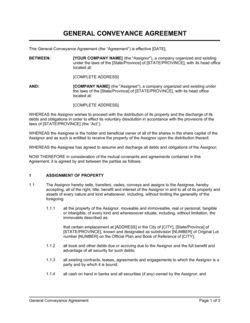
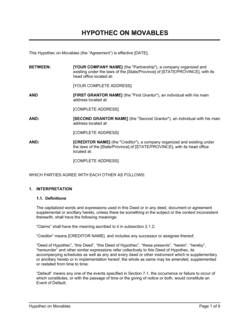
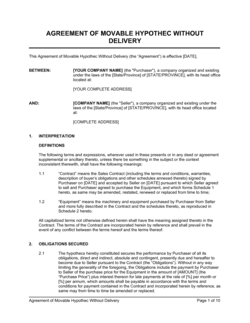
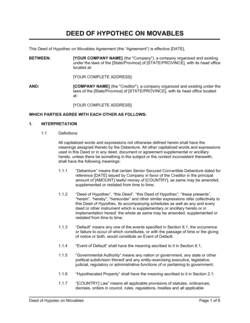
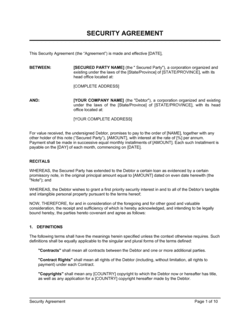
Moveable Hypothec Agreement Template

Free Word download • Edit online • Save & share with Drive • Export to PDF

9 pages30–40 min to fillDifficulty: ComplexSignature requiredLegal review recommended
Learn more ↓
FreeMoveable Hypothec Agreement Template

At a glance

What it is
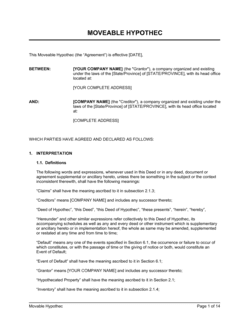
A Moveable Hypothec Agreement is a legally binding security document in which a debtor grants a creditor a security interest over moveable property — such as equipment, inventory, receivables, or intellectual property — as collateral for a loan or credit facility. This free Word download gives you a structured, attorney-ready starting point you can edit online and export as PDF for execution by both parties.
When you need it
Use it when a lender requires collateral security over personal or moveable business property before advancing funds, or when a borrower wishes to grant a security interest without transferring ownership or possession of the collateral to the creditor.
What's inside
Identification of the parties and collateral, the secured obligations, representations and warranties, covenants to preserve collateral value, default and enforcement rights, priority and registration provisions, release conditions, and governing law.

What is a Moveable Hypothec Agreement?

A Moveable Hypothec Agreement is a legally binding security document in which a debtor grants a creditor a registered security interest over moveable property — such as equipment, inventory, vehicles, receivables, or intellectual property — as collateral for a loan, credit facility, or other financial obligation. Unlike a mortgage, which attaches to land and buildings, a moveable hypothec covers personal and moveable assets that the debtor typically continues to possess and use while the security is in force. The creditor's interest is recorded in the applicable personal property security registry, giving it a publicly enforceable priority right over the collateral that survives third-party transfers and insolvency proceedings when properly perfected.

Why You Need This Document

Advancing funds without a registered moveable hypothec leaves you with an unsecured claim — one that ranks behind every registered secured creditor in a default or insolvency, often recovering nothing. Without this agreement, the debtor faces no contractual obligation to maintain, insure, or preserve the collateral; assets can be sold, damaged, or encumbered by a subsequent creditor while your exposure remains unprotected. A signed and registered hypothec agreement closes these gaps: it perfects your security interest on day one, establishes enforceable covenants around collateral maintenance and insurance, defines exactly what constitutes default and how quickly you can act, and gives you a documented priority position that a bankruptcy trustee cannot easily challenge. This template gives you a professionally structured starting point that captures all material provisions — collateral description, future advances, default triggers, enforcement rights, and discharge mechanics — reducing the legal and operational risk of secured lending for both parties.

Which variant fits your situation?

If your situation is…Use this template
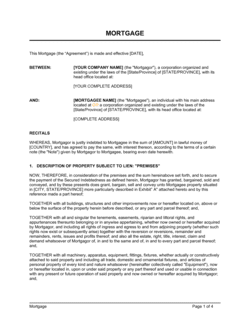
Securing a loan against real property such as land or a buildingMortgage Agreement
Creating a general security interest over all present and after-acquired personal propertyGeneral Security Agreement
Pledging shares or financial instruments as collateralShare Pledge Agreement
Securing a specific piece of equipment under a conditional sale arrangementEquipment Lease Agreement
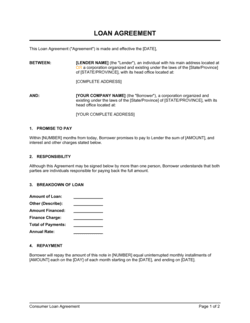
Documenting the underlying loan that the hypothec securesLoan Agreement
Assigning receivables as collateral for short-term working capitalAssignment of Receivables Agreement
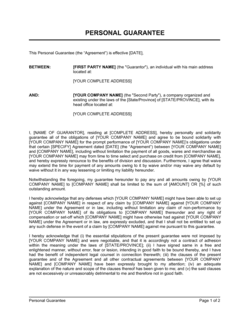
Guaranteeing a third party's obligations secured by moveable propertyPersonal Guarantee Agreement

Common mistakes to avoid

❌ Failing to register the security interest before advancing funds

Why it matters: An unregistered hypothec is unperfected. A bankruptcy trustee or a subsequent registered secured creditor takes the collateral free of an unregistered interest, leaving the creditor with an unsecured claim only.

Fix: Register the financing statement in the applicable personal property registry before or simultaneously with advancing any funds. Make registration a condition precedent to the first advance.

❌ Using an imprecise collateral description

Why it matters: A vague description such as 'all business assets' without a Schedule A may fail to meet the registry's specificity requirements and can be challenged as insufficient to identify the collateral in enforcement proceedings.

Fix: Attach a Schedule A listing collateral by category with specific identifiers — serial numbers for equipment, account numbers for receivables, registration numbers for IP — and include an after-acquired property clause where applicable.

❌ Omitting a future advances clause in a revolving facility

Why it matters: Without a future advances clause, each new draw under a revolving credit line may require a fresh hypothec and new registration filing, creating gaps in security coverage and additional transaction costs.

Fix: Include language confirming the hypothec secures 'all present and future advances' up to a stated maximum, and register the full maximum amount at the outset.

❌ Choosing a governing law with no connection to the collateral's location

Why it matters: Personal property security law is territorial. Courts routinely apply the law of the jurisdiction where the collateral is situated at the time of the dispute, overriding a contractual governing-law clause — and the creditor may find itself bound by a law it never considered.

Fix: Select the governing law of the jurisdiction where the collateral is primarily located and used, and register in that jurisdiction's personal property registry regardless of where the parties are incorporated.

❌ No minimum insurance covenant or loss-payee designation

Why it matters: If the collateral is destroyed by fire, flood, or theft and the debtor carries no adequate insurance naming the creditor as payee, the creditor's security disappears with the assets and the remaining claim is unsecured.

Fix: Require the debtor to maintain all-risk insurance at replacement value, name the creditor as additional insured and loss payee, and obtain a certificate of insurance at closing with annual renewal obligations.

❌ No deadline for the creditor to file a discharge after repayment

Why it matters: Without a contractual deadline, discharged debts can leave active financing statements on the registry for years, damaging the debtor's credit profile and blocking subsequent financing.

Fix: Specify that the creditor must file a discharge financing change statement within 30 days of full repayment and written request by the debtor, and include a liquidated damages clause for non-compliance.

The 10 key clauses, explained

Parties and recitals

In plain language: Identifies the creditor (hypothecary creditor) and debtor (hypothecary grantor) as legal entities and states the commercial context for granting the security.

Sample language
This Moveable Hypothec Agreement is entered into as of [DATE] between [CREDITOR LEGAL NAME], a [ENTITY TYPE] incorporated under the laws of [JURISDICTION] ('Creditor'), and [DEBTOR LEGAL NAME], a [ENTITY TYPE] incorporated under the laws of [JURISDICTION] ('Debtor').

Common mistake: Using a trade name instead of the registered legal entity name — the security interest may be unenforceable against a bankruptcy trustee if the debtor's name in the registry does not match the correct legal name.

Description of collateral

In plain language: Precisely identifies the moveable property over which the hypothec is granted — whether specific named assets, a category of assets, or an after-acquired property clause covering future acquisitions.

Sample language
The Debtor hereby hypothecates in favour of the Creditor all present and after-acquired [EQUIPMENT / INVENTORY / RECEIVABLES / INTELLECTUAL PROPERTY] described in Schedule A attached hereto, including all proceeds, replacements, and accessions thereto.

Common mistake: Describing collateral too broadly without a Schedule A — vague descriptions like 'all assets' without specific enumeration can fail registration requirements and create priority disputes with other secured creditors.

Secured obligations

In plain language: Defines the specific debt or obligation the hypothec secures, including the principal amount, interest rate, maturity date, and any fees or future advances covered.

Sample language
This hypothec secures all present and future obligations of the Debtor to the Creditor, including the principal sum of $[AMOUNT] advanced pursuant to the Loan Agreement dated [DATE], interest at [RATE]% per annum, and all costs of enforcement.

Common mistake: Limiting the secured amount to the initial advance without including a future advances clause — this prevents the same collateral from securing additional draws under a revolving credit facility without a new registration.

Representations and warranties

In plain language: The debtor confirms ownership of the collateral, absence of prior encumbrances, legal authority to grant the hypothec, and that the collateral description is accurate.

Sample language
The Debtor represents and warrants that: (a) it is the sole legal and beneficial owner of the Collateral free of any Encumbrance except as disclosed in Schedule B; (b) it has full authority to grant this hypothec; and (c) the Collateral descriptions in Schedule A are complete and accurate.

Common mistake: Omitting a warranty that no prior security interests exist — if an undisclosed prior hypothec surfaces after funding, the new creditor may rank behind the existing secured party with no recourse.

Covenants to maintain collateral

In plain language: The debtor's ongoing obligations while the hypothec is in force — maintaining insurance, keeping collateral in good repair, not disposing of it without consent, and notifying the creditor of material changes.

Sample language
Until full discharge, the Debtor shall: (a) insure the Collateral against loss or damage for not less than $[AMOUNT] naming Creditor as additional insured; (b) maintain the Collateral in good working order; and (c) not sell, transfer, or further encumber the Collateral without Creditor's prior written consent.

Common mistake: No minimum insurance requirement — if the collateral is destroyed and uninsured, the creditor's security evaporates with no contractual recourse against the debtor beyond an unsecured claim.

Events of default

In plain language: Lists the specific events — missed payments, insolvency, breach of covenant, material adverse change, or cross-default — that trigger the creditor's right to enforce the hypothec.

Sample language
Each of the following constitutes an Event of Default: (a) failure to pay any amount due under the Secured Obligations within [X] days of the due date; (b) the Debtor becoming insolvent or making an assignment for the benefit of creditors; (c) any material breach of a covenant in this Agreement that is not remedied within [X] days of written notice.

Common mistake: Omitting a cure period for non-payment defaults — courts in several jurisdictions have refused to enforce immediate enforcement rights where the debtor was not given reasonable notice and an opportunity to remedy.

Enforcement rights

In plain language: States the creditor's remedies upon default — appointment of a receiver, seizure and sale of collateral, collection of receivables, and the right to enter premises — along with any notice requirements before enforcement begins.

Sample language
Upon an Event of Default, Creditor may, without further notice except as required by law: (a) appoint a receiver over the Collateral; (b) take possession of and sell the Collateral by private sale or public auction; (c) collect and apply any receivables forming part of the Collateral to the Secured Obligations.

Common mistake: Waiving the statutory notice period required before seizure — many personal property security statutes impose a mandatory minimum notice period of 10–20 days before the creditor can seize and sell; contractual waivers of this period are void.

Registration and priority

In plain language: Obligates the debtor to cooperate with registration filings, confirms the creditor's right to register the security interest in the applicable personal property registry, and addresses priority ranking relative to other creditors.

Sample language
The Debtor authorizes the Creditor to register a financing statement in the [PROVINCE / STATE] Personal Property Registry describing the Collateral. The Debtor shall execute all documents reasonably required to perfect and maintain the priority of the Creditor's security interest.

Common mistake: Granting the hypothec but failing to register it — an unregistered security interest is unperfected and loses priority to a subsequent registered creditor or a bankruptcy trustee who takes free of unregistered interests.

Release and discharge

In plain language: Sets out the conditions under which the hypothec is discharged — full repayment of the secured obligations — and the creditor's obligation to file a discharge with the personal property registry within a specified period.

Sample language
Upon full and final payment and satisfaction of all Secured Obligations, the Creditor shall, within [30] days of written request by the Debtor, execute and deliver a discharge of this hypothec and file a financing change statement discharging any registered financing statement.

Common mistake: No deadline for the creditor to file a discharge — debtors have experienced registry encumbrances persisting for months after repayment because the agreement imposed no obligation on the creditor to act promptly.

Governing law and dispute resolution

In plain language: Specifies the jurisdiction whose law governs the agreement and how disputes are resolved — litigation, arbitration, or mediation — including venue.

Sample language
This Agreement is governed by the laws of [PROVINCE / STATE / COUNTRY] and the federal laws applicable therein. Any dispute arising under this Agreement shall be resolved by [binding arbitration administered by [BODY] in [CITY] / proceedings in the courts of [JURISDICTION]].

Common mistake: Choosing a governing law with no real connection to where the collateral is located — personal property security law is territorial, and courts often apply the law of the jurisdiction where the collateral is situated regardless of the contractual choice.

How to fill it out

  1. 1

    Identify both parties with their full legal names

    Enter the creditor's and debtor's registered legal entity names exactly as they appear in the applicable corporate registry. Include entity type, jurisdiction of incorporation, and registered addresses.

    💡 Search the relevant corporate registry before signing — a single word difference between the contract name and the registry name can invalidate the security registration.

  2. 2

    Describe the collateral with precision in Schedule A

    List every category of moveable property being hypothecated — equipment by serial number where applicable, inventory by description, receivables by reference to the underlying contracts, and IP by registration number. Include an after-acquired property clause if the collateral pool will grow over time.

    💡 For floating charges over inventory, add language that the hypothec covers all inventory 'of whatever nature, now owned or hereafter acquired' to avoid disputes when stock turns over.

  3. 3

    Define the secured obligations completely

    State the principal amount, interest rate, maturity date, and all fees covered. Add a future advances clause if the facility is revolving or if additional draws are anticipated.

    💡 Cap the secured amount at 150% of the initial advance if you want to cover future advances and enforcement costs without registering a new hypothec for each draw.

  4. 4

    Complete the representations and warranties section

    Have the debtor confirm in writing that it owns the collateral free of undisclosed encumbrances, that no prior security interests exist except as listed in Schedule B, and that it has authority to grant the hypothec.

    💡 Request a personal property registry search in the debtor's jurisdiction before closing — this confirms whether prior security interests exist that would outrank yours.

  5. 5

    Set the insurance and maintenance covenants

    Specify the minimum insurance coverage amount, require the creditor to be named as an additional insured or loss payee, and state the debtor's obligations to maintain collateral in good repair and report any material damage or loss within a defined period.

    💡 Request a certificate of insurance naming the creditor as additional insured at closing and require annual renewal certificates — do not rely on the debtor's verbal confirmation.

  6. 6

    Define events of default and cure periods

    List each triggering event explicitly — payment default, insolvency, covenant breach, change of control, or material adverse change. Include a cure period of 10–30 days for non-payment defaults to reduce legal vulnerability.

    💡 A cross-default clause — making default under any other material agreement an event of default here — is standard for multi-facility borrowers but should be calibrated to avoid triggering on immaterial debts.

  7. 7

    Register the security interest promptly after signing

    File a financing statement in the applicable personal property security registry immediately after execution. The priority clock starts on the registration date, not the agreement date.

    💡 In Canada's Quebec civil law system, hypothecs over certain assets must be published in the Register of Personal and Movable Real Rights (RPMRR) — a different registry from common-law provinces. Confirm the correct registry before filing.

  8. 8

    Execute and store the agreement securely

    Both parties sign the agreement and each Schedule before or on the same day the funds are advanced. Store the executed original and registry confirmation number together in a secure document management system.

    💡 Use Business in a Box eSign to timestamp execution and create an immutable audit trail — this matters if the security interest is challenged in insolvency proceedings.

Frequently asked questions

What is a moveable hypothec agreement?

A moveable hypothec agreement is a security document in which a debtor grants a creditor a registered security interest over moveable property — such as equipment, inventory, receivables, or intellectual property — as collateral for a loan or credit obligation. Unlike a mortgage, which attaches to real property, a moveable hypothec covers personal or moveable assets. The debtor typically retains possession and use of the collateral while the hypothec is in force, and the creditor's interest is extinguished upon full repayment.

What types of property can be covered by a moveable hypothec?

Moveable property includes tangible assets such as machinery, vehicles, equipment, and inventory, as well as intangible assets such as accounts receivable, intellectual property rights, financial instruments, and licences. A well-drafted hypothec can cover a specific identified asset, a defined category of assets, or a floating pool of after-acquired property that changes over time — such as a retailer's revolving inventory.

What is the difference between a moveable hypothec and a general security agreement?

A moveable hypothec and a general security agreement (GSA) are functionally similar — both create a security interest over personal property to secure a debt — but they arise from different legal traditions. Hypothecs are the terminology used in civil law jurisdictions (Quebec, France, Louisiana), while GSAs are the standard instrument in common-law jurisdictions governed by personal property security legislation (most Canadian provinces, US UCC Article 9). In practice, the operational mechanics of collateral description, registration, priority, and enforcement are broadly comparable.

Does a moveable hypothec need to be registered?

Yes. Registration in the applicable personal property security registry is essential to perfect the security interest and establish priority over subsequent creditors and a bankruptcy trustee. In Quebec, moveable hypothecs are published in the Register of Personal and Movable Real Rights (RPMRR). In common-law provinces, the equivalent filing is a financing statement under the applicable Personal Property Security Act. An unregistered hypothec is binding between the parties but ranks behind any registered interest and is generally void against a trustee in bankruptcy.

Can a debtor still use collateral while a moveable hypothec is in force?

Yes. One of the defining features of a hypothec is that the debtor retains possession and ordinary use of the collateral while it is in force. The creditor holds a security interest in the property but does not take physical custody. The debtor is typically required to maintain the collateral in good repair, keep it insured, and not dispose of it without the creditor's consent. Ordinary use — operating machinery, selling inventory in the normal course of business — is generally permitted.

What happens if the debtor defaults under a moveable hypothec agreement?

Upon a defined event of default — typically missed payments, insolvency, or breach of a material covenant — the creditor may enforce its security interest by appointing a receiver, taking possession of the collateral, and selling it by private sale or public auction. Most personal property security statutes require the creditor to provide a minimum notice period (commonly 10–20 days) before seizure and sale, and the proceeds are applied first to enforcement costs and then to the outstanding secured obligation. Any surplus belongs to the debtor.

Is a moveable hypothec agreement the same as a pledge?

No. A pledge requires the creditor to take physical possession of the collateral — the debtor hands over the asset as security. A hypothec allows the debtor to retain possession and use of the property while granting the creditor a registered security right over it. Pledges are common for financial instruments and valuables; hypothecs are more practical for operating assets like equipment and inventory that the business needs to keep running.

Do I need a lawyer to prepare a moveable hypothec agreement?

For straightforward secured lending over a single identified asset with a simple loan structure, a high-quality template reviewed by the parties is generally adequate. Legal counsel is strongly recommended when the collateral pool is complex or includes IP, when the borrower operates in multiple jurisdictions requiring parallel registrations, when the facility is revolving or involves future advances, or when the debtor is in a financial difficulty situation. Errors in collateral description, governing law, or registration can cost the creditor its entire security position.

How long does a moveable hypothec registration remain valid?

In most personal property security registries, a financing statement filed to support a hypothec or security agreement remains valid for the period stated at registration — commonly 1, 3, 5, 10, or 25 years, or an indefinitely renewable term. The creditor must renew the registration before it lapses to preserve priority. Upon full repayment of the secured obligations, the creditor is obligated to file a discharge to clear the debtor's title on the registry.

How this compares to alternatives

vs General Security Agreement

A general security agreement (GSA) is the common-law equivalent of a moveable hypothec — both create a security interest over personal property. A GSA typically covers all present and after-acquired personal property of the debtor, while a moveable hypothec can be scoped to specific assets. In Quebec, the hypothec is the proper instrument under the Civil Code; in common-law provinces and US states, the GSA governed by PPSA or UCC Article 9 is the standard vehicle.

vs Mortgage Agreement

A mortgage attaches to immoveable property — land, buildings, and fixtures permanently affixed to land. A moveable hypothec covers personal, moveable assets. The two instruments are used in parallel when a lender takes a package of security over both real property and the operating assets of a business. Registration requirements, priority rules, and enforcement procedures differ significantly between the two.

vs Loan Agreement

A loan agreement documents the terms of the debt — amount, interest rate, repayment schedule, and covenants. A moveable hypothec agreement creates the security interest that backs that debt. The two documents are complementary, not alternatives: the loan agreement creates the obligation; the hypothec secures it. A loan advanced without a hypothec is unsecured and ranks behind all secured creditors in a default or insolvency.

vs Personal Guarantee Agreement

A personal guarantee makes an individual — typically a director or shareholder — personally liable for the debtor's obligations. A moveable hypothec is a security interest in specific property, not a personal obligation. Lenders often require both: the hypothec provides asset-backed recourse against the collateral; the guarantee provides recourse against the guarantor's personal assets if the collateral is insufficient to cover the debt.

Industry-specific considerations

Manufacturing

Hypothecs over production equipment, raw material inventory, and finished goods stock are standard collateral for working capital and equipment finance lines.

Transportation and Logistics

Commercial vehicle fleets and specialized transport equipment are commonly hypothecated by unit, with VIN-level collateral schedules and fleet replacement covenants.

Technology / SaaS

IP assets — patents, software licences, and trademarks — are increasingly used as hypothec collateral for non-dilutive revenue-based financing and IP-backed loans.

Retail and Wholesale

Floating charges over revolving inventory are the dominant structure, with after-acquired property clauses to capture new stock and a borrowing base formula tying the credit limit to inventory value.

Agriculture

Crop inputs, harvested grain, and agricultural equipment are common collateral under agricultural hypothecs, often with seasonal advance structures tied to planting and harvest cycles.

Healthcare

Medical equipment financing frequently uses hypothecs over imaging machines, surgical equipment, and diagnostic devices, with strict maintenance and certification covenants.

Jurisdictional notes

United States

In the United States, security interests in moveable personal property are governed by Article 9 of the Uniform Commercial Code (UCC), adopted in all 50 states with minor variations. The equivalent of a hypothec is a 'security agreement,' and perfection is achieved by filing a UCC-1 financing statement with the Secretary of State in the debtor's jurisdiction of organization. Priority is generally determined by order of filing. Louisiana, as a civil law state, uses hypothec terminology under its Civil Code but has largely harmonized its personal property security rules with the broader UCC framework.

Canada

Canada is a mixed jurisdiction. Quebec operates under the Civil Code of Quebec, which expressly provides for the moveable hypothec (hypothèque mobilière) published in the Register of Personal and Movable Real Rights (RPMRR). Common-law provinces (Ontario, British Columbia, Alberta, and others) use Personal Property Security Acts (PPSAs) modelled on UCC Article 9, where the instrument is called a 'security agreement' and perfection is by PPSA registration. A business with assets in both Quebec and common-law provinces must register separately in each applicable registry.

United Kingdom

England and Wales use a fixed or floating charge over personal property as the functional equivalent of a moveable hypothec. Charges created by a company must be registered at Companies House within 21 days of creation or they are void against a liquidator or administrator. Scotland has a distinct legal tradition closer to civil law, where floating charges are created under the Companies Act 1985 and certain moveable assets can be secured under the Moveable Transactions (Scotland) Act 2023, which significantly modernised Scottish personal property security law.

European Union

The EU has no harmonised personal property security law — each member state has its own rules. France, Belgium, and Luxembourg use the hypothèque mobilière or gage (pledge) framework, with registration requirements varying by asset type and jurisdiction. Germany uses the Sicherungsübereignung (security transfer of title) rather than a true hypothec. The EU Financial Collateral Directive provides a streamlined regime for financial collateral (cash, securities) but does not extend to operating assets such as equipment or inventory. Creditors taking security across multiple EU member states must comply with each country's registration and priority rules independently.

Template vs lawyer — what fits your deal?

PathBest forCostTime
Use the templateSimple secured loans over a single identified asset between parties in the same jurisdiction with a straightforward repayment structureFree30–60 minutes
Template + legal reviewWorking capital facilities with floating charges over inventory, multi-asset collateral pools, or cross-provincial arrangements$400–$900 for a lawyer review and registry filing assistance2–5 days
Custom draftedComplex multi-jurisdictional credit facilities, IP-backed lending, syndicated loans, or transactions where the debtor is in financial difficulty$2,000–$8,000+1–3 weeks

Glossary

Hypothec
A security right granted over property as collateral for an obligation, without transferring ownership or physical possession to the creditor.
Moveable Property
Property that can be physically moved or transferred — including equipment, inventory, vehicles, receivables, and intellectual property — as distinct from immoveable property such as land.
Hypothecation
The act of pledging moveable property as collateral for a debt while the debtor retains use and possession of that property.
Secured Obligation
The specific loan, credit facility, or other debt that the hypothec is created to secure, including principal, interest, fees, and enforcement costs.
Collateral
The specific moveable assets identified in the agreement over which the creditor holds a security interest until the secured obligation is repaid.
Default
A defined event — such as missed payment, insolvency, or breach of covenant — that entitles the creditor to enforce its security interest against the collateral.
Registration
The public filing of a security interest in the applicable personal property registry, giving the creditor priority over subsequent creditors and third-party buyers.
Priority
The ranking of competing security interests over the same collateral, generally determined by the order of registration in the personal property security registry.
Floating Charge
A security interest that attaches to a changing pool of assets — such as inventory — and crystallizes into a fixed charge upon a defined default event.
Enforcement
The creditor's legal right to seize, sell, or otherwise realize on the collateral following the debtor's default on the secured obligation.
Release
The formal discharge of the hypothec once the secured obligation has been repaid in full, typically accompanied by a discharge filing in the personal property registry.

Part of your Business Operating System

This document is one of 3,000+ business & legal templates included in Business in a Box.

  • Fill-in-the-blanks — ready in minutes
  • 100% customizable Word document
  • Compatible with all office suites
  • Export to PDF and share electronically

Create your document in 3 simple steps.

From template to signed document — all inside one Business Operating System.
1
Download or open template

Access over 3,000+ business and legal templates for any business task, project or initiative.

2
Edit and fill in the blanks with AI

Customize your ready-made business document template and save it in the cloud.

3
Save, Share, Send, Sign

Share your files and folders with your team. Create a space of seamless collaboration.

Save time, save money, and create top-quality documents.

★★★★★

"Fantastic value! I'm not sure how I'd do without it. It's worth its weight in gold and paid back for itself many times."

Managing Director · Mall Farm
Robert Whalley
Managing Director, Mall Farm Proprietary Limited
★★★★★

"I have been using Business in a Box for years. It has been the most useful source of templates I have encountered. I recommend it to anyone."

Business Owner · 4+ years
Dr Michael John Freestone
Business Owner
★★★★★

"It has been a life saver so many times I have lost count. Business in a Box has saved me so much time and as you know, time is money."

Owner · Upstate Web
David G. Moore Jr.
Owner, Upstate Web

Run your business with a system — not scattered tools

Stop downloading documents. Start operating with clarity. Business in a Box gives you the Business Operating System used by over 250,000 companies worldwide to structure, run, and grow their business.

Start free · No credit card required