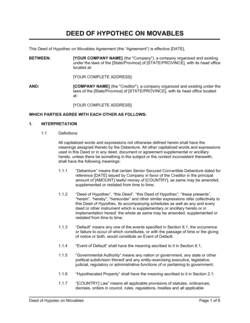
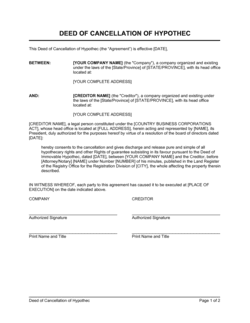
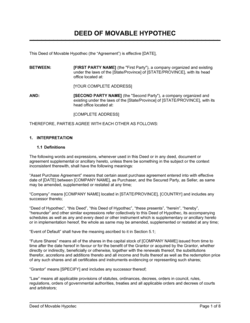
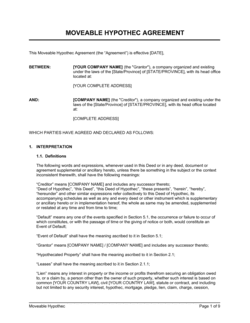
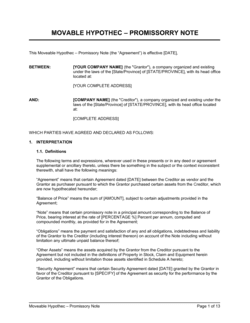
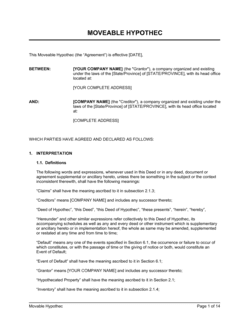
Hypothec on Movables Template

Free Word download • Edit online • Save & share with Drive • Export to PDF

9 pages25–35 min to fillDifficulty: ComplexSignature requiredLegal review recommended
Learn more ↓
FreeHypothec on Movables Template

At a glance

What it is
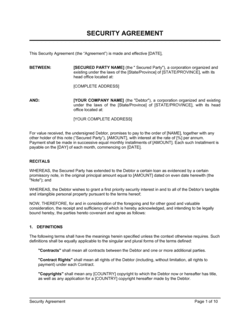
A Hypothec on Movables is a legally binding security document in which a debtor grants a creditor a security interest over specified movable (personal) property — such as equipment, inventory, receivables, or vehicles — as collateral for a loan or obligation. This free Word download provides a structured template you can edit online and export as PDF, covering collateral description, secured obligations, debtor covenants, default triggers, and enforcement rights.
When you need it
Use it when a lender extends credit or a creditor accepts a deferred obligation and requires movable assets as collateral security. It is commonly executed alongside a loan agreement, line of credit, or commercial financing arrangement where real property security is unavailable or insufficient.
What's inside
Identification of the parties and the secured obligation, a precise description of the collateral, debtor covenants on maintenance and insurance, representations and warranties, default and enforcement provisions, registration requirements, and governing law.

What is a Hypothec on Movables?

A Hypothec on Movables is a civil-law security instrument in which a debtor grants a creditor a formal security right over specified personal (movable) property — such as equipment, vehicles, inventory, accounts receivable, or intellectual property — as collateral for a loan or other obligation, without transferring possession of the property to the creditor. It is the personal property equivalent of a real estate mortgage in civil-law jurisdictions, and it must be registered in the applicable public registry to be effective against third parties. The hypothec remains attached to the collateral for the duration of the secured obligation and gives the creditor the right to seize and sell the property if the debtor defaults.

The instrument is most closely associated with Quebec, where it is governed by the Civil Code of Quebec, but functionally equivalent instruments — personal property security agreements, chattel mortgages, and general security agreements — serve the same role in common-law jurisdictions across North America, the UK, and Europe.

Why You Need This Document

Extending credit or deferring payment without documented security over movable assets leaves a creditor in the same position as any unsecured trade creditor — last in line behind secured lenders, tax authorities, and preferred creditors in any insolvency proceeding. A properly executed and registered hypothec on movables transforms that exposure into a priority claim against specific assets. Without it, equipment a borrower pledged verbally, inventory earmarked as collateral, or receivables promised as security provide no enforceable rights when the debtor becomes insolvent or sells the assets to a third party. Registration is the critical step that makes the security real: a signed but unregistered hypothec binds the debtor personally but is invisible to the rest of the world. This template provides the documented structure — collateral description, covenants, default triggers, and enforcement rights — that a lender needs to hold enforceable, registerable security from the first day of the financing relationship.

Which variant fits your situation?

If your situation is…Use this template
Securing a loan against business equipment or machineryHypothec on Movables (Equipment)
Taking security over all present and future business assetsGeneral Security Agreement
Securing a mortgage or loan against immovable real propertyDeed of Hypothec (Immovable)
Pledging receivables as collateral under a factoring arrangementAssignment of Receivables Agreement
Documenting a personal property security interest under common lawPersonal Property Security Agreement
Financing a vehicle purchase with the vehicle as collateralChattel Mortgage Agreement
Securing inventory under a revolving credit facilityInventory Security Agreement

Common mistakes to avoid

❌ Failing to register the hypothec after signing

Why it matters: An unregistered hypothec is generally ineffective against third parties — including a trustee in bankruptcy and competing secured creditors. You may hold a valid contract but have no enforceable priority.

Fix: Register with the applicable personal property or movable security registry on the same day the document is signed. Treat registration as part of the closing checklist, not an afterthought.

❌ Vague or incomplete collateral description

Why it matters: A description like 'all business equipment' without serial numbers, categories, or a Schedule A may be insufficient to identify the property at the time of enforcement, allowing the debtor or a trustee to dispute what is covered.

Fix: Attach a Schedule A listing each asset with make, model, serial number, and condition, or use a defined category description for fungible assets like inventory and receivables.

❌ Omitting a maximum secured amount

Why it matters: In civil-law jurisdictions — particularly Quebec — registration of a hypothec requires a specific maximum sum. Without it, the registration may be rejected or the security limited to the stated amount if the debt grows.

Fix: Calculate the maximum exposure including principal, projected interest over the term, and estimated enforcement costs, then register for that total.

❌ Not conducting a registry search before execution

Why it matters: An undiscovered prior-ranking registration can reduce your security to second or third priority — meaning in a default scenario, the prior creditor is paid in full before you receive anything.

Fix: Run a registry search against the grantor's legal name and any trade names before signing. If prior registrations exist, negotiate a subordination agreement or require their discharge as a condition of lending.

❌ Choosing a governing law unconnected to the collateral's location

Why it matters: Most security law regimes apply the law of the jurisdiction where the collateral is located, regardless of what the contract states. An Ontario-governed hypothec over assets permanently located in Quebec may be assessed under Quebec civil law.

Fix: Set the governing law to match the jurisdiction where the collateral is ordinarily located. For multi-province or multi-state collateral, take separate registrations in each jurisdiction.

❌ No cure period for remediable defaults

Why it matters: Immediate acceleration on a first missed payment with no notice or cure period is frequently challenged as acting in bad faith, and courts in several jurisdictions have refused to allow enforcement on this basis.

Fix: Include a written notice requirement and a 5–15 business day cure period for payment and covenant defaults. Reserve zero-cure triggers for incurable events like insolvency or intentional fraud.

The 10 key clauses, explained

Parties and Recitals

In plain language: Identifies the grantor (debtor) and the secured creditor by their full legal names and roles, and sets out the background context — the nature of the underlying obligation being secured.

Sample language
This Hypothec on Movables is granted on [DATE] by [GRANTOR FULL LEGAL NAME] (the 'Grantor') in favour of [CREDITOR FULL LEGAL NAME] (the 'Creditor') to secure the obligations described herein.

Common mistake: Using a trade name instead of the registered legal entity name for either party. Enforcement actions and registry filings must match the exact legal name or priority can be challenged.

Description of Secured Obligation

In plain language: Precisely states the debt or obligation being secured — including principal amount, interest rate, maturity date, and any related loan agreement by reference.

Sample language
This Hypothec secures the payment of all amounts owing by the Grantor to the Creditor pursuant to the Loan Agreement dated [DATE], including principal of $[AMOUNT], interest at [RATE]% per annum, and all fees and costs, up to a maximum secured amount of $[MAXIMUM AMOUNT].

Common mistake: Failing to state a maximum secured amount where required by the applicable registry system. In Quebec, the RPMRR requires a specific sum certain for registration to be valid.

Description of Collateral

In plain language: Provides a specific and complete description of the movable property pledged as security, including serial numbers, categories of assets, or an all-assets description where applicable.

Sample language
The Grantor hereby hypothecates in favour of the Creditor all present and after-acquired movables of the Grantor, including but not limited to: [SPECIFIC EQUIPMENT / INVENTORY CATEGORY / VEHICLE MAKE, MODEL, SERIAL NO.], as more particularly described in Schedule A attached hereto.

Common mistake: Vague collateral descriptions such as 'business assets' without specifics. Courts and registries require sufficient description to identify the property; overbroad language without Schedule A support can render the security unenforceable against third parties.

Grant of Security Interest

In plain language: The operative clause in which the debtor formally and irrevocably grants the hypothec — the security right — over the described collateral to the creditor.

Sample language
As security for the full and punctual payment of the Secured Obligation, the Grantor hereby grants, hypothecates, and charges in favour of the Creditor a first-ranking hypothec on the Collateral described herein, with all rights of realization attached thereto.

Common mistake: Omitting ranking language ('first-ranking') when the parties intend priority. Without it, a subsequent creditor who registers first may claim superior priority.

Debtor Covenants

In plain language: The obligations the grantor agrees to fulfil for the duration of the hypothec — including maintaining and insuring the collateral, not disposing of it without consent, and notifying the creditor of material changes.

Sample language
The Grantor covenants and agrees to: (a) maintain the Collateral in good repair; (b) keep the Collateral insured against risk of loss for no less than $[AMOUNT] naming the Creditor as loss payee; (c) not sell, transfer, or encumber the Collateral without prior written consent of the Creditor; and (d) promptly notify the Creditor of any loss, damage, or threatened seizure of the Collateral.

Common mistake: No insurance clause or failure to name the creditor as loss payee. If the collateral is destroyed, the creditor loses security and may have no claim against the insurance proceeds.

Representations and Warranties

In plain language: Statements by the grantor confirming that they own the collateral free and clear, have authority to grant the hypothec, and that no prior encumbrances exist except as disclosed.

Sample language
The Grantor represents and warrants that: (a) the Grantor is the lawful owner of the Collateral with good and marketable title; (b) the Collateral is free and clear of all encumbrances except as disclosed in Schedule B; (c) the Grantor has full authority to execute this Hypothec; and (d) no insolvency proceedings are pending or threatened against the Grantor.

Common mistake: No schedule or disclosure of prior encumbrances. An undisclosed prior registration discovered after the fact can expose the grantor to breach of warranty liability and deprive the creditor of expected priority.

Default and Acceleration

In plain language: Defines specific events that constitute default and triggers the creditor's right to demand immediate repayment of the full outstanding amount and to exercise enforcement rights.

Sample language
Each of the following constitutes an Event of Default: (a) failure to pay any amount under the Secured Obligation within [X] days of the due date; (b) breach of any covenant herein not remedied within [X] days of written notice; (c) insolvency, bankruptcy, or appointment of a receiver; (d) any material loss, destruction, or unauthorized disposition of the Collateral.

Common mistake: Omitting a cure period for technical or administrative defaults. Courts may find immediate acceleration without notice or a reasonable cure window to be unenforceable or in bad faith.

Enforcement and Realization Rights

In plain language: Sets out the creditor's rights upon default — including the right to take possession of the collateral, sell it by private or public sale, and apply the proceeds to the secured debt.

Sample language
Upon an Event of Default, the Creditor may, without further notice to the Grantor: (a) take possession of and sell the Collateral by private sale or public auction; (b) appoint a receiver or receiver-manager; and (c) apply proceeds of realization first to costs of enforcement, then to accrued interest, then to principal of the Secured Obligation.

Common mistake: Not specifying the order of application of proceeds. Disputes over whether enforcement costs, fees, or principal are recovered first frequently result in litigation.

Registration and Publication

In plain language: Authorizes the creditor to register the hypothec in the applicable public registry and requires the grantor to cooperate with any additional filings needed to perfect the security interest.

Sample language
The Grantor authorizes the Creditor to register this Hypothec in the [REGISTER OF PERSONAL AND MOVABLE REAL RIGHTS / PPSA REGISTRY / OTHER APPLICABLE REGISTRY] and to file all documents necessary to perfect and maintain the Creditor's security interest. The Grantor shall execute any further documents reasonably required for this purpose.

Common mistake: Failing to actually register after execution. An unregistered hypothec is generally ineffective against third parties — other creditors, a trustee in bankruptcy, or a subsequent buyer of the collateral.

Governing Law and Jurisdiction

In plain language: Specifies which jurisdiction's law governs the hypothec and which courts have jurisdiction to resolve disputes — critical given that security law varies significantly between civil-law and common-law provinces and states.

Sample language
This Hypothec shall be governed by and construed in accordance with the laws of [PROVINCE / STATE / COUNTRY]. The parties attorn to the exclusive jurisdiction of the courts of [JURISDICTION] for any dispute arising hereunder.

Common mistake: Choosing a governing law that has no connection to where the collateral is located. Most security law systems apply the law of the location of the collateral at the time of registration, regardless of what the contract says.

How to fill it out

  1. 1

    Identify both parties by full legal name

    Enter the grantor's and creditor's exact registered legal names — for corporations, as they appear on the certificate of incorporation or articles. Include addresses and, where applicable, registration or tax identification numbers.

    💡 Cross-reference the company's registry filing before completing this section. A name mismatch between the hypothec and a registry filing can defeat priority.

  2. 2

    Describe the secured obligation precisely

    State the principal amount, interest rate, payment schedule, and maturity date. Reference the underlying loan agreement by its full title and date. Include a maximum secured amount if the applicable registry requires it.

    💡 In Quebec, registration under the RPMRR requires a specific sum — use the total maximum exposure including interest and enforcement costs, not just the principal.

  3. 3

    Draft a complete collateral description

    List all movable property covered by the hypothec in Schedule A: include serial numbers for equipment and vehicles, category descriptions for inventory or receivables, and an after-acquired property clause if the parties intend ongoing security.

    💡 For revolving inventory or receivables, use a category description ('all inventory now owned or hereafter acquired') rather than specific items — specific descriptions become stale the moment the asset turns over.

  4. 4

    Confirm the ranking and any prior encumbrances

    Search the applicable registry before execution to identify any existing registrations against the grantor. Disclose prior encumbrances in Schedule B and confirm whether the hypothec is first-ranking or subordinated.

    💡 A registry search costs $10–$50 and takes under an hour. Skipping it and discovering a prior ranking creditor after default can make your security worthless.

  5. 5

    Complete the debtor covenants and insurance requirements

    Specify the required insurance coverage amount, the insurer's minimum rating if applicable, and confirm the creditor is named as loss payee or additional insured. List all prohibited dispositions and any permitted exceptions.

    💡 Require the grantor to provide proof of insurance at signing — not just a promise to obtain it. A certificate of insurance on the closing date is the industry standard.

  6. 6

    Define default events and cure periods

    List every event of default clearly, including payment failure, covenant breach, insolvency, and collateral loss. Set a cure period (typically 5–15 business days) for remediable defaults and make cure periods shorter or absent for material events like insolvency.

    💡 Differentiate between curable defaults (missed payment, lapsed insurance) and incurable ones (insolvency, fraud). Treating both identically invites a court challenge.

  7. 7

    Execute and register immediately

    Both parties must sign the hypothec — wet ink or qualified eSignature as permitted by jurisdiction. File with the applicable registry (RPMRR in Quebec, PPSA registry in other Canadian provinces, UCC-1 in the US) on the same day or within 24 hours of execution.

    💡 Priority against other creditors runs from the date of registration, not the date of signing. Every day between execution and registration is a window during which another creditor can leapfrog your position.

  8. 8

    Retain the executed copy and monitor the registration

    Store the fully executed hypothec and proof of registration in your legal file. Set a calendar reminder to renew the registration before expiry — most PPSA registrations expire after 5 years unless renewed.

    💡 A lapsed registration is treated as if the security interest was never registered. Automated renewal reminders 90 days before expiry prevent this common and avoidable mistake.

Frequently asked questions

What is a hypothec on movables?

A hypothec on movables is a civil-law security instrument that grants a creditor a right over specified personal (movable) property owned by a debtor to secure the repayment of a debt or the performance of an obligation. Unlike a pledge, the debtor retains possession of the collateral during the loan term. The hypothec must be registered in a public registry to be effective against third parties. It is most common in Quebec and other civil-law jurisdictions, where it serves the same function as a personal property security agreement or chattel mortgage in common-law provinces and states.

How is a hypothec on movables different from a mortgage?

A mortgage traditionally applies to immovable property — real estate and buildings. A hypothec on movables applies to personal property: equipment, vehicles, inventory, receivables, and similar assets. Both create a security interest without requiring the debtor to hand over possession, and both must be registered to bind third parties. In Quebec civil law, the term 'hypothec' covers both immovable and movable security; in common-law jurisdictions, movable-property security is typically governed by a Personal Property Security Act rather than mortgage law.

Does a hypothec on movables need to be registered?

Yes, in virtually every jurisdiction where hypothecs on movables are used. In Quebec, registration in the Register of Personal and Movable Real Rights (RPMRR) is required for the hypothec to be enforceable against third parties, including a trustee in bankruptcy and competing creditors. In other Canadian provinces, an equivalent registration under the applicable Personal Property Security Act is required. In the United States, a UCC-1 financing statement must be filed. An unregistered security interest generally binds only the debtor personally — it does not create priority against anyone else.

What types of property can be covered by a hypothec on movables?

A hypothec on movables can cover virtually any category of personal property: physical equipment and machinery, commercial vehicles, inventory, accounts receivable, intellectual property rights, investment securities, bank accounts, and insurance proceeds. It can also be drafted to cover after-acquired property — assets the debtor acquires after the hypothec is granted — which is essential for revolving-credit facilities secured by inventory or receivables that constantly turn over.

What happens if the debtor defaults on a hypothec on movables?

Upon default, the secured creditor typically has the right to take possession of the collateral, sell it by private or public sale, and apply the proceeds to the outstanding debt. In Quebec, the creditor must generally follow the specific realization procedures in the Civil Code — including prior notice to the debtor — before taking possession or selling. In common-law jurisdictions, equivalent PPSA provisions apply. The creditor may also appoint a receiver over the collateral assets. Any surplus after repayment of the debt and enforcement costs is returned to the debtor.

Can a hypothec on movables cover future or after-acquired assets?

Yes, provided the document includes a clear after-acquired property clause. This is especially important for security over inventory, receivables, or other assets that change frequently. The clause should specifically state that the hypothec covers all property of the described category now owned or hereafter acquired by the debtor. Registration of such a clause is generally effective to create priority over after-acquired assets from the date of the original registration.

Is a hypothec on movables the same as a general security agreement?

They serve the same commercial purpose — securing a debt against personal property — but arise from different legal traditions. A hypothec on movables is a civil-law instrument used primarily in Quebec; a general security agreement is a common-law document used in other Canadian provinces under PPSA legislation. A general security agreement typically covers all present and after-acquired personal property of the debtor, while a hypothec on movables can be limited to specific assets or asset categories. Businesses operating in Quebec typically use a hypothec; those in other provinces use a GSA or PPSA security agreement.

Do I need a lawyer to prepare a hypothec on movables?

For straightforward commercial loans secured by specific identified equipment, a well-structured template reviewed by the parties is generally sufficient. Legal counsel is advisable when the collateral is complex (mixed movable and immovable assets, intellectual property, or investment securities), when the transaction is high-value, when prior encumbrances exist, or when the debtor operates across multiple jurisdictions requiring coordinated registrations. A lawyer review typically costs $500–$1,500 and is worthwhile for any secured facility above $100,000.

How long does a hypothec on movables registration last?

Registration duration depends on the jurisdiction and the term chosen at filing. In Quebec's RPMRR, registration can be made for a fixed term or indefinitely. Under most Canadian PPSA regimes, registrations are made for a specific number of years — commonly 5 years — and must be renewed before expiry or they lapse automatically. In the US, a UCC-1 filing is effective for 5 years from the date of filing and must be continued by filing a UCC-3 continuation statement before the expiry date. A lapsed registration is treated as if it was never filed.

What is the priority rule for competing hypothecs on the same collateral?

Priority is generally determined by the date and time of registration, not the date of signing. The first creditor to register against a specific debtor and collateral has priority over later-registered creditors in the event of default or insolvency. This is why immediate registration after execution is critical. Exceptions apply for purchase-money security interests — a seller or financier who funds the acquisition of specific collateral may obtain super-priority over an earlier general security holder if they register within the prescribed period, typically 10–20 days of the debtor taking possession of the collateral.

How this compares to alternatives

vs General Security Agreement

A general security agreement is the common-law equivalent of a hypothec on movables, used in Canadian provinces outside Quebec under PPSA legislation. Both create a security interest over personal property, but a GSA typically covers all present and after-acquired personal property of the debtor in a single document. A hypothec on movables is the appropriate instrument when the debtor or collateral is located in Quebec or another civil-law jurisdiction. Choose based on where the collateral is situated, not the governing law preference of the parties.

vs Pledge Agreement

A pledge requires the debtor to physically transfer possession of the collateral to the creditor for the security interest to exist. A hypothec on movables allows the debtor to retain possession — meaning the business can continue using its equipment or selling its inventory while the security is in place. Pledges are used for financial instruments and documents of title; hypothecs are used for operating assets where possession transfer would disrupt the business.

vs Chattel Mortgage

A chattel mortgage is a common-law security instrument used primarily in the UK, Australia, and parts of the US to secure a loan against specific tangible movable property. It historically required transfer of legal title to the creditor until the debt was repaid. A hypothec on movables is a civil-law instrument that creates a security right without any title transfer. In jurisdictions where both concepts overlap, the functional outcome is similar, but the applicable procedural and registration rules differ significantly.

vs Personal Property Security Agreement

A personal property security agreement is the generic term for any document creating a security interest over personal property under PPSA legislation in common-law Canadian provinces and equivalent US UCC Article 9 regimes. A hypothec on movables is specifically a civil-law instrument with its own rules under the Quebec Civil Code. If the debtor operates solely in Quebec, use a hypothec; if they operate in other provinces, use a PPSA-compliant security agreement; if they operate in both, consider taking both instruments simultaneously.

Industry-specific considerations

Manufacturing

Securing loans against production equipment, machinery lines, and raw material inventory, often with after-acquired property clauses to capture new equipment purchases automatically.

Transportation and Logistics

Fleet financing arrangements where each vehicle is individually identified by VIN, with the hypothec registered in the province or state where the vehicle is ordinarily located.

Retail and Wholesale

Revolving credit facilities secured by fluctuating inventory, requiring floating-charge collateral descriptions and periodic inventory audits as a covenant.

Professional Services and Technology

Security interests over accounts receivable, intellectual property licences, and software assets for firms with limited tangible property but substantial intangible asset value.

Jurisdictional notes

United States

In the United States, security interests over personal property are governed by Article 9 of the Uniform Commercial Code (UCC), adopted in all 50 states. The equivalent of a hypothec on movables is a security agreement combined with a UCC-1 financing statement filed with the Secretary of State. Priority runs from the date of filing, not the date of the security agreement. The UCC-1 must be renewed every 5 years by filing a UCC-3 continuation statement or it lapses automatically.

Canada

In Quebec, the hypothec on movables is a civil-law instrument governed by the Civil Code of Quebec (Articles 2660–2802) and must be registered in the Register of Personal and Movable Real Rights (RPMRR) to be enforceable against third parties. In all other Canadian provinces and territories, the equivalent instrument is a security agreement registered under the applicable Personal Property Security Act (PPSA). Businesses operating in both Quebec and other provinces may need parallel documentation under both regimes.

United Kingdom

The UK does not use the term 'hypothec on movables' except in Scottish law, where a hypothec is a limited common-law lien concept. For movable property security in England and Wales, a fixed or floating charge registered at Companies House under the Companies Act 2006 is the standard instrument. In Scotland, floating charges and standard securities serve equivalent functions. The UK Financial Collateral Arrangements Regulations 2003 also provide a streamlined security regime for financial collateral.

European Union

The hypothec on movables is a recognized civil-law security instrument across many EU member states, including France, Belgium, Luxembourg, and the Netherlands, each with their own registration requirements and priority rules. France's pledge over business assets (nantissement de fonds de commerce) and Belgium's enterprise pledge (gage sur fonds de commerce) serve similar functions. The EU has no unified personal property security law; practitioners must comply with the national law of the jurisdiction where the collateral is located. GDPR considerations arise when receivables secured include personal data of customers.

Template vs lawyer — what fits your deal?

PathBest forCostTime
Use the templateStraightforward secured loans against identified equipment or vehicles in a single jurisdiction below $100,000Free30–60 minutes
Template + legal reviewCommercial loans above $50,000, multi-asset collateral, receivables security, or first-time lenders unfamiliar with registry procedures$500–$1,5002–5 days
Custom draftedComplex multi-jurisdiction financing, high-value transactions, cross-border secured lending, or collateral involving intellectual property or securities$2,000–$8,000+1–3 weeks

Glossary

Hypothec
A civil-law security right granted over property to secure payment of a debt, without requiring transfer of possession to the creditor.
Movables
Property that can be physically moved or transferred, including equipment, inventory, vehicles, accounts receivable, and intellectual property rights — as opposed to immovable real estate.
Grantor / Debtor
The party who owns the collateral and grants the security interest to the creditor in exchange for credit or the performance of an obligation.
Secured Creditor
The lender or obligee who holds the security interest and has priority over unsecured creditors against the collateral in the event of default or insolvency.
Collateral
The specific movable property described in the hypothec document that the creditor may seize or realize upon if the debtor defaults.
Secured Obligation
The underlying debt, loan, or contractual obligation that the hypothec is created to guarantee — typically a principal amount plus interest.
Registration / Publication
The act of filing or recording the security interest in a public registry — such as the RPMRR in Quebec or a PPSA registry — to establish priority over subsequent creditors.
Default
A failure by the debtor to meet the terms of the secured obligation or to comply with the covenants in the hypothec document, triggering the creditor's enforcement rights.
Realization / Enforcement
The legal process by which a secured creditor exercises rights over the collateral after default — including seizure, sale, or taking possession — to recover the secured amount.
Priority
The ranking of competing security interests against the same collateral, generally determined by the date of registration; a first-registered creditor has priority over later-registered ones.
Floating Charge
A security interest that attaches to a changing pool of assets — such as inventory — rather than specific identified items, crystallizing into a fixed charge upon default.
After-Acquired Property
Property acquired by the debtor after the hypothec is granted that automatically falls within the scope of the security interest if the document so provides.

Part of your Business Operating System

This document is one of 3,000+ business & legal templates included in Business in a Box.

  • Fill-in-the-blanks — ready in minutes
  • 100% customizable Word document
  • Compatible with all office suites
  • Export to PDF and share electronically

Create your document in 3 simple steps.

From template to signed document — all inside one Business Operating System.
1
Download or open template

Access over 3,000+ business and legal templates for any business task, project or initiative.

2
Edit and fill in the blanks with AI

Customize your ready-made business document template and save it in the cloud.

3
Save, Share, Send, Sign

Share your files and folders with your team. Create a space of seamless collaboration.

Save time, save money, and create top-quality documents.

★★★★★

"Fantastic value! I'm not sure how I'd do without it. It's worth its weight in gold and paid back for itself many times."

Managing Director · Mall Farm
Robert Whalley
Managing Director, Mall Farm Proprietary Limited
★★★★★

"I have been using Business in a Box for years. It has been the most useful source of templates I have encountered. I recommend it to anyone."

Business Owner · 4+ years
Dr Michael John Freestone
Business Owner
★★★★★

"It has been a life saver so many times I have lost count. Business in a Box has saved me so much time and as you know, time is money."

Owner · Upstate Web
David G. Moore Jr.
Owner, Upstate Web

Run your business with a system — not scattered tools

Stop downloading documents. Start operating with clarity. Business in a Box gives you the Business Operating System used by over 250,000 companies worldwide to structure, run, and grow their business.

Free Forever Plan · No credit card required