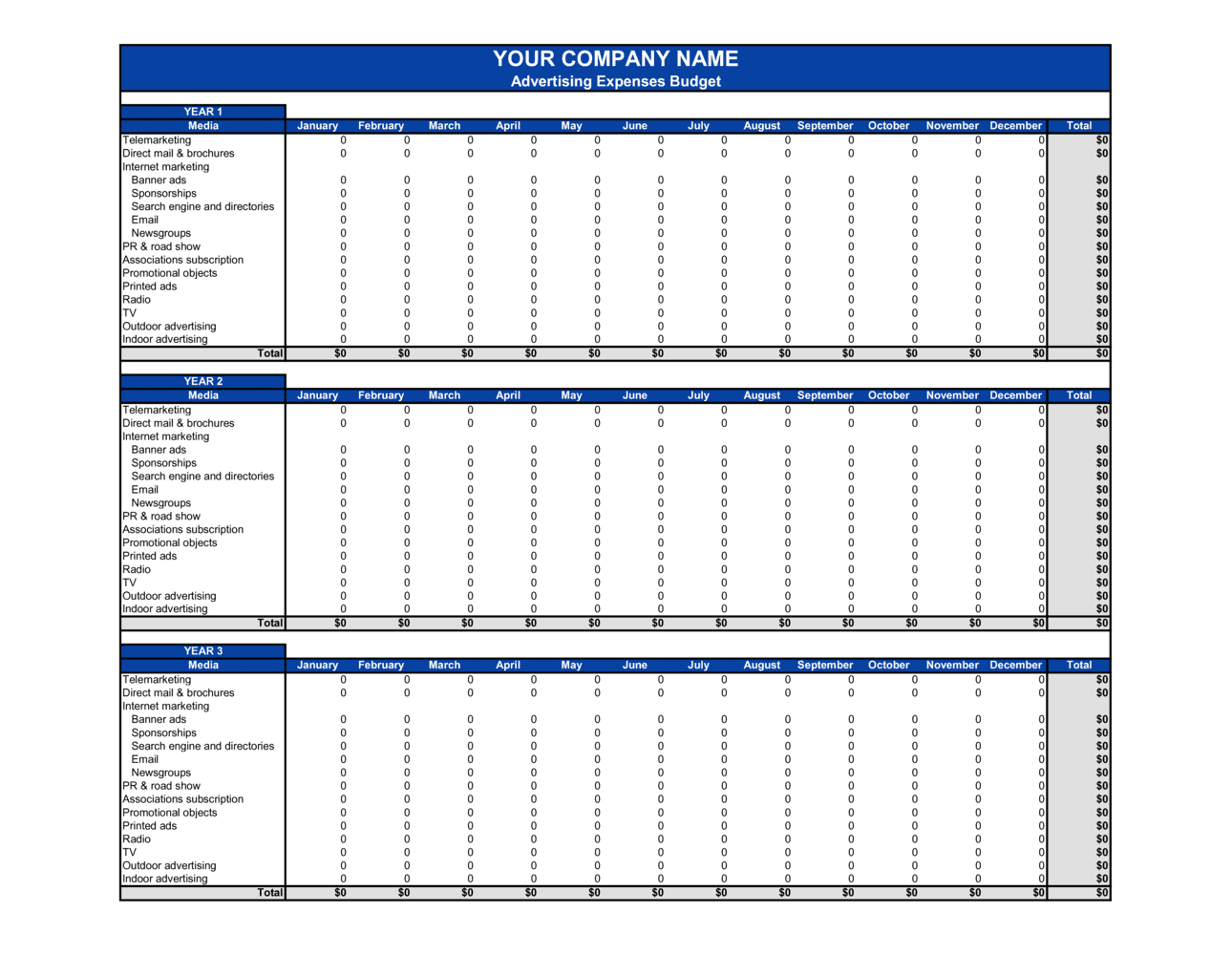
Advertising Expenses Template

Free Excel download β€’ Edit online β€’ Save & share with Drive β€’ Export to PDF

1 pageβ€’20–30 min to fillβ€’Difficulty: Standardβ€’Signature requiredβ€’Legal review recommended
Learn more ↓
FreeXLSAdvertising Expenses Template

At a glance

What it is
An Advertising Expenses agreement is a legally binding document that defines how advertising and promotional costs are allocated, approved, and reimbursed between two or more parties β€” typically a brand or franchisor and a distributor, reseller, or franchisee. This free Word download gives you a structured, editable starting point you can customize online and export as PDF for execution before any joint campaign or co-op advertising arrangement begins.
When you need it
Use it whenever two parties are sharing, contributing to, or seeking reimbursement for advertising and promotional expenditures β€” including co-op advertising programs, franchise marketing fund contributions, vendor-funded promotional campaigns, and multi-party brand initiatives.
What's inside
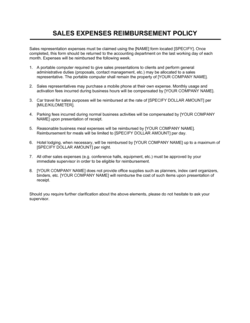
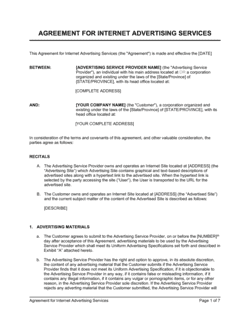
The agreement covers the scope of eligible advertising expenses, budget caps and approval thresholds, contribution ratios between the parties, reimbursement procedures and timelines, required documentation and substantiation, audit rights, IP and brand usage restrictions, and dispute resolution terms.

What is an Advertising Expenses Agreement?

An Advertising Expenses Agreement is a legally binding contract that defines how advertising and promotional costs are allocated, approved, and reimbursed between two commercial parties β€” most commonly a brand, manufacturer, or franchisor and a distributor, retailer, or franchisee. The agreement establishes which categories of advertising spend qualify for cost-sharing or reimbursement, what documentation the claiming party must submit, how much each party contributes and when payment is due, and what audit rights the funding party retains to verify claims. This free Word download gives you a structured, fully editable starting point that can be customized and exported as PDF for execution before any joint advertising campaign or co-op program begins.

Why You Need This Document

Committing to shared advertising spend without a written agreement is one of the most reliably expensive mistakes in commercial partnerships. Without defined eligible expense categories, Participants submit claims for sponsorships, branded merchandise, internal labor, and events that the funding party never intended to cover β€” and disputes over what counts as "advertising" routinely outlast the campaigns they funded. Without an approval threshold, a single large unauthorized media buy can exhaust an entire annual budget before the Brand has a chance to object. Without a clawback clause and audit rights, a reimbursing party that discovers inflated or fabricated claims after payment has no contractual basis for recovery and must pursue costly general law remedies instead. A signed advertising expenses agreement, executed before any campaign commitment is made, closes all of these gaps β€” protecting the funding party's budget, giving the Participant clear rules for compliant claims, and providing both sides with an enforceable framework for resolving disputes without litigation.

Which variant fits your situation?

If your situation is…Use this template
Franchisor and franchisee splitting local advertising costsCo-Op Advertising Agreement
Manufacturer funding retailer promotional campaignsVendor Advertising Allowance Agreement
Tracking and reporting internal advertising spend by departmentAdvertising Budget Report
Marketing agency managing spend on behalf of a clientMarketing Services Agreement
Formalizing a full marketing partnership between two brandsJoint Marketing Agreement
Reimbursing an employee for out-of-pocket promotional expensesExpense Reimbursement Form
Outlining the broader media and advertising strategyAdvertising Plan

Common mistakes to avoid

❌ No explicit exclusions list for ineligible expenses

Why it matters: Without stated exclusions, Participants routinely submit claims for sponsorships, branded merchandise, internal labor, and trade events that the Brand never intended to fund β€” triggering costly disputes and deducting from the intended media budget.

Fix: Add a numbered exclusions list in the eligible-expenses clause covering at minimum: internal labor, agency commissions above a stated cap, production costs above a stated threshold, hospitality, and any expenses not pre-approved above the approval threshold.

❌ Setting a budget cap without a per-transaction approval threshold

Why it matters: A party can commit large individual expenditures that cumulatively exhaust the budget cap before the period ends, leaving the Brand exposed to the full aggregate obligation with no control over individual commitments.

Fix: Pair every budget cap with a single-transaction pre-approval threshold β€” typically set at 15–20% of the periodic cap β€” so material commitments require advance sign-off.

❌ Accepting summary spreadsheets instead of original invoices

Why it matters: Summary submissions cannot be independently verified and are the most common vehicle for inflated or fabricated advertising claims. Without third-party invoices, audits are inconclusive.

Fix: Require original third-party invoices, media affidavits for broadcast placements, and platform-generated reports for digital spend as mandatory submission requirements.

❌ No record retention period specified

Why it matters: Without a contractual retention obligation, the Participant may lawfully dispose of supporting records before the Brand exercises its audit right β€” making verification of past claims impossible.

Fix: Specify a minimum 3-year retention period tied to the later of the claim date or the termination of the agreement, and align it to the applicable tax authority's audit window.

❌ Auto-renewal clause with no notice deadline

Why it matters: Parties miss the renewal opt-out window and find themselves contractually obligated for another full year of advertising fund contributions they did not budget for.

Fix: State a specific calendar-day notice deadline for non-renewal β€” for example, 'at least 30 days before the anniversary date' β€” and flag it prominently in the agreement's term section.

❌ Omitting a clawback right for ineligible reimbursements

Why it matters: Without a clawback clause, a Brand that discovers post-payment that claims were ineligible or inflated has no contractual mechanism to recover funds and must rely on general unjust enrichment claims, which are harder to prove.

Fix: Include an explicit clawback clause permitting demand for repayment or offset against future reimbursements, with an escalation to termination for cause in cases of fraudulent submission.

The 10 key clauses, explained

Parties and recitals

In plain language: Identifies both parties by legal name, describes the nature of their commercial relationship, and states the purpose of the advertising expense arrangement.

Sample language
This Advertising Expenses Agreement ('Agreement') is entered into as of [DATE] between [PARTY A LEGAL NAME], a [STATE/PROVINCE] [ENTITY TYPE] ('Brand'), and [PARTY B LEGAL NAME], a [STATE/PROVINCE] [ENTITY TYPE] ('Participant').

Common mistake: Using trade names or doing-business-as names instead of registered legal entity names β€” creating ambiguity about which entity bears the financial obligations.

Scope of eligible advertising expenses

In plain language: Defines exactly which categories of advertising and promotional spend qualify for cost-sharing or reimbursement β€” and explicitly excludes ineligible categories.

Sample language
'Eligible Expenses' means costs incurred by Participant for [PRINT / DIGITAL / BROADCAST / OUTDOOR] advertising that (a) features Brand's approved marks, (b) is pre-approved in writing by Brand, and (c) is documented by third-party invoices. Excluded: internal labor, agency commissions exceeding [X]%, and production costs above $[AMOUNT].

Common mistake: Listing eligible categories without an exclusions list. Without explicit exclusions, parties routinely dispute whether sponsorships, trade show booths, branded merchandise, and hospitality expenses qualify.

Budget cap and approval thresholds

In plain language: Sets the maximum aggregate amount available for cost-sharing per period and the dollar threshold above which individual expenditures require advance written approval.

Sample language
Brand's aggregate obligation under this Agreement shall not exceed $[AMOUNT] per calendar [quarter / year] ('Budget Cap'). Any single Eligible Expense exceeding $[THRESHOLD] requires Brand's prior written approval at least [X] business days before commitment.

Common mistake: Setting a budget cap without a per-transaction approval threshold β€” leaving the reimbursing party unable to manage individual commitments until the full cap is exhausted.

Contribution ratio and payment mechanics

In plain language: States each party's share of the eligible expense, how and when payment is made, and in which currency.

Sample language
Brand shall reimburse Participant [X]% of each approved Eligible Expense, up to the Budget Cap. Reimbursement shall be paid by [ACH / wire / check] within [30] days of Brand's receipt of a compliant reimbursement claim. All amounts are in [USD / CAD / GBP].

Common mistake: Stating a percentage without a dollar ceiling per transaction. A flat percentage with no cap can result in reimbursement obligations far exceeding the advertiser's intended exposure.

Substantiation and documentation requirements

In plain language: Lists the specific documents the claimant must submit to support a reimbursement request β€” invoices, affidavits, screenshots, or tearsheets β€” and the submission deadline.

Sample language
Participant shall submit a reimbursement claim within [45] days of the close of the advertising campaign, accompanied by: (a) original third-party invoices, (b) proof of payment, (c) media affidavits or tearsheets confirming placement, and (d) a copy of the pre-approval if required under Section [X].

Common mistake: Requiring only a summary spreadsheet rather than original third-party invoices. Summary submissions without underlying documentation make it impossible to verify actual spend or detect inflated claims.

Brand and IP usage standards

In plain language: Requires the Participant to use only approved brand assets and comply with the Brand's style guidelines, and grants a limited license for that purpose.

Sample language
Participant shall use only Brand-approved logos, taglines, and creative assets as specified in the Brand Guidelines dated [DATE] ('Guidelines'). Brand grants Participant a limited, non-exclusive, revocable license to use the Brand Marks solely for Eligible Advertising during the Term. Any deviation from the Guidelines requires prior written consent.

Common mistake: Omitting a revocable license clause and instead treating brand usage as an implied right. Without a formal license, the Participant may argue they have broader rights to the brand assets beyond the agreement's term.

Audit rights and record retention

In plain language: Grants Brand the right to inspect Participant's advertising records and requires Participant to retain supporting documentation for a defined period.

Sample language
Participant shall retain all records relating to Eligible Expenses for a minimum of [3] years following the relevant claim date. Brand may, upon [10] business days' written notice, audit Participant's records at Brand's cost; if an audit reveals overstatements exceeding [5]% of claimed amounts, Participant shall bear audit costs and repay the overstatement.

Common mistake: No record-retention period specified. Without a minimum retention requirement, documents needed to audit a claim may be lawfully destroyed before the audit window closes.

Clawback and offset rights

In plain language: Allows Brand to recover previously paid reimbursements if the Participant submitted ineligible or fraudulent claims, and to offset those amounts against future payments.

Sample language
If any reimbursed expense is subsequently determined to be ineligible or unsupported, Brand may (a) demand repayment within [15] business days, or (b) offset the amount against future reimbursements payable to Participant. Fraudulent claims entitle Brand to terminate this Agreement immediately for cause.

Common mistake: No clawback right at all. Without one, a reimbursing party that discovers fraudulent or ineligible claims after payment has no contractual basis for recovery.

Term, termination, and wind-down

In plain language: Sets the agreement's duration, the notice required to terminate, and how pending claims and outstanding balances are handled after termination.

Sample language
This Agreement commences on [START DATE] and continues for [1 year], renewing automatically unless either party provides [30] days' written notice of non-renewal. Upon termination, Participant may submit final claims for Eligible Expenses incurred before the termination date within [45] days. Brand's obligation to reimburse claims submitted after that period is extinguished.

Common mistake: Auto-renewal without a notice deadline. Parties miss the notice window and find themselves contractually obligated for another full year of advertising fund contributions.

Governing law and dispute resolution

In plain language: Specifies which jurisdiction's law governs the agreement and how disputes β€” including reimbursement claim rejections and audit findings β€” are resolved.

Sample language
This Agreement is governed by the laws of [STATE / PROVINCE / COUNTRY], without regard to conflict-of-law principles. Any dispute shall first be submitted to non-binding mediation for [30] days. If unresolved, disputes shall be determined by binding arbitration administered by [AAA / JAMS / ADR Institute] in [CITY], except claims for injunctive relief.

Common mistake: Specifying a governing law with no connection to either party's operating jurisdiction. Courts in some jurisdictions β€” notably California and EU member states β€” apply local law regardless of a choice-of-law clause.

How to fill it out

  1. 1

    Enter legal entity names and the commercial relationship

    Insert the full registered legal name, entity type, and state or province of incorporation for both Brand and Participant. Add a one-sentence recital describing the existing commercial relationship β€” distributor, franchisee, retailer, or reseller.

    πŸ’‘ Confirm legal names against current corporate registry filings before executing β€” a mismatch between the contract name and the remitting entity's name can delay reimbursement payments.

  2. 2

    Define eligible expense categories and exclusions

    List every qualifying advertising medium β€” print, digital, broadcast, outdoor, in-store β€” and explicitly enumerate exclusions such as internal labor, production markups above a defined percentage, and hospitality or sponsorship costs.

    πŸ’‘ If the parties have an existing co-op program guide, attach it as Schedule A and cross-reference it here rather than duplicating the category list in the body.

  3. 3

    Set the budget cap and per-transaction approval threshold

    Enter the maximum aggregate reimbursement obligation per quarter or year, and the single-transaction dollar amount above which prior written approval is required. Both figures should reflect the Brand's realistic marketing contribution budget.

    πŸ’‘ A useful rule of thumb: set the approval threshold at 15–20% of the quarterly budget cap. This captures material commitments while avoiding approval bottlenecks on routine spend.

  4. 4

    Specify the contribution ratio and payment timeline

    State each party's percentage share clearly β€” for example, 50/50 or 70/30 β€” and enter the payment method, currency, and number of days after a compliant claim is received that reimbursement must be made.

    πŸ’‘ Net 30 from receipt of a complete claim is the market standard. If the Brand requires internal finance approval, build in Net 45 to avoid inadvertent breach.

  5. 5

    List required substantiation documents

    Specify every document the Participant must submit with a reimbursement claim β€” original invoices, proof of payment, media affidavits or tearsheets, and copies of any required pre-approvals. Set a hard claim submission deadline measured from campaign close.

    πŸ’‘ For digital advertising, add a requirement for platform-generated performance reports (Google Ads, Meta Ads Manager) as additional substantiation alongside invoices.

  6. 6

    Complete brand usage and IP license terms

    Reference the specific version of the Brand Guidelines, confirm the scope of the limited license (medium, geography, term), and note any approval required for deviations from approved creative assets.

    πŸ’‘ Attach the current Brand Guidelines as an exhibit and note the version date. This prevents disputes when guidelines are updated mid-term.

  7. 7

    Set audit rights, record retention period, and clawback mechanics

    Enter the minimum record retention period (3 years is standard), the advance notice required before an audit, and the overstatement percentage threshold that triggers cost-shifting to the Participant.

    πŸ’‘ Align the retention period to the longer of (a) 3 years and (b) the applicable tax authority's audit window in the governing jurisdiction.

  8. 8

    Confirm term, termination notice, and governing law

    Set the start date, initial term length, auto-renewal notice period, and the final claim submission window after termination. Select a governing jurisdiction that has a meaningful connection to at least one party's principal place of business.

    πŸ’‘ Execute the agreement before any advertising commitment is made or invoice received β€” obligations that predate the agreement's effective date may not be covered.

Frequently asked questions

What is an advertising expenses agreement?

An advertising expenses agreement is a legally binding contract that defines how advertising and promotional costs are divided, approved, and reimbursed between two or more parties β€” most commonly a brand, franchisor, or manufacturer and its distribution partner, franchisee, or retailer. It establishes eligible expense categories, contribution ratios, budget caps, substantiation requirements, and audit rights so both parties have clear, enforceable expectations before any joint campaign begins.

When do I need an advertising expenses agreement?

You need one whenever two parties are sharing advertising costs or when one party is reimbursing the other for promotional spend. Common triggers include co-op advertising programs between manufacturers and retailers, franchise marketing fund contributions, vendor-funded promotional campaigns, and joint brand initiatives. Committing to shared advertising spend without a written agreement leaves contribution ratios, approval processes, and reimbursement timelines undefined β€” and disputes follow predictably.

What is co-op advertising and how does this agreement govern it?

Co-op advertising is a cost-sharing arrangement where a manufacturer or brand contributes to advertising costs incurred by a distributor or retailer to promote the brand's products. This agreement formalizes the arrangement by specifying which media and formats qualify, what percentage the brand will fund, what documentation the retailer must provide to claim reimbursement, and what happens if claims are ineligible or fraudulent. Without a written agreement, co-op programs are frequently abused through inflated or unsupported claims.

What documentation must a party submit to claim advertising reimbursement?

At minimum, a compliant claim should include original third-party invoices from media outlets or agencies, proof of payment, media affidavits or tearsheets for print and broadcast placements, platform-generated reports for digital campaigns, and copies of any pre-approvals required under the agreement. Summary spreadsheets without underlying third-party documentation are insufficient and create audit risk. The agreement should specify a submission deadline β€” typically 30 to 45 days after campaign close.

Are advertising expenses agreements legally enforceable?

Yes, advertising expenses agreements are generally enforceable as standard commercial contracts when they meet the basic requirements of offer, acceptance, and consideration, are signed by authorized representatives of both parties, and include sufficiently definite terms on contribution ratios, eligible expenses, and payment obligations. Specific clauses β€” such as non-compete restrictions embedded in a co-op program or provisions touching on advertising practices β€” may be subject to additional regulatory requirements in certain jurisdictions.

What is an advertising allowance and how is it different from reimbursement?

An advertising allowance is a credit β€” typically a fixed amount or percentage of purchases β€” that a supplier or manufacturer provides to a buyer to fund promotional activity. It is earned upfront and deducted from invoices or applied as a credit. Reimbursement, by contrast, requires the Participant to incur and pay the advertising cost first, then submit a claim for recovery. Both arrangements can be governed by this agreement, but the payment flow and documentation requirements differ β€” reimbursement demands more substantiation because the Brand is paying after the fact.

How does an audit right clause work in an advertising expenses agreement?

An audit right clause gives the Brand the contractual authority to inspect the Participant's advertising records, invoices, and accounts to verify that reimbursement claims were accurate and compliant. Typically, the Brand must give advance written notice β€” commonly 10 business days β€” and audit costs are borne by the Brand unless the audit reveals overstatements above a defined threshold, in which case costs shift to the Participant. The clause should also specify a minimum document retention period β€” 3 years is standard β€” to ensure records exist when an audit is requested.

What should the budget cap and approval threshold be set at?

The budget cap should reflect the Brand's actual annual or quarterly advertising contribution budget for the relevant channel or partner. The per-transaction approval threshold is typically set at 15–20% of the periodic budget cap β€” high enough to avoid bottlenecks on routine spend, low enough to catch material individual commitments before they are made. For example, a $100,000 annual cap might carry a $15,000 single-transaction approval threshold, requiring prior written sign-off for any individual campaign exceeding that amount.

Do I need a lawyer to draft an advertising expenses agreement?

For standard co-op advertising arrangements between established commercial partners, a high-quality template is typically sufficient. Legal review is recommended when the total reimbursement obligation exceeds $50,000 annually, when the agreement is tied to a franchise disclosure document or dealer agreement, when the arrangement involves cross-border parties and multi-currency payment, or when the Brand's IP or marketing fund has complex governance requirements. A 1–2 hour review typically costs $300–$600 and is worthwhile when the financial exposure is significant.

How this compares to alternatives

vs Marketing Services Agreement

A marketing services agreement engages an agency or consultant to plan and execute advertising on behalf of a client β€” it governs the service relationship, deliverables, and fees. An advertising expenses agreement governs cost-sharing or reimbursement between two commercial partners who are each contributing to or funding advertising. The distinction is service versus cost allocation.

vs Advertising Plan

An advertising plan is a strategic operational document outlining campaign objectives, target audiences, channels, and budgets. It is not a binding contract and creates no legal obligation to fund or reimburse. An advertising expenses agreement is the binding instrument that enforces the financial obligations described in a plan.

vs Joint Marketing Agreement

A joint marketing agreement covers a broader marketing partnership β€” joint content creation, co-branding, lead sharing, and event participation β€” in addition to cost-sharing. An advertising expenses agreement is narrower, focused specifically on the mechanics of who pays for advertising and on what terms. Use the joint marketing agreement when the collaboration extends beyond media spend.

vs Expense Reimbursement Form

An expense reimbursement form is an internal document used to recover out-of-pocket costs incurred by employees or contractors. It has no contractual governance around budget caps, approval authorities, or audit rights. An advertising expenses agreement is a bilateral contract between two legal entities governing a structured, recurring cost-sharing program.

Industry-specific considerations

Retail and consumer goods

Vendor advertising allowances tied to purchase volume, in-store promotional co-funding, and retailer-specific campaign cost recovery are the dominant use cases in this sector.

Franchise systems

Franchise marketing fund contribution rates, national versus local advertising splits, and franchisee compliance with brand creative standards require a formal written framework to avoid fund disputes.

Automotive and dealership networks

Manufacturer advertising programs for dealer networks typically govern a fixed per-vehicle advertising allowance, pre-approved media formats, and monthly substantiation submission requirements.

Technology and SaaS

Channel partner co-marketing programs, market development funds (MDF), and reseller promotional reimbursements are formalized through advertising expense agreements that specify digital-first eligible formats and platform-generated substantiation.

Jurisdictional notes

United States

The Robinson-Patman Act requires that advertising allowances offered to competing resellers be made available on proportionally equal terms β€” failure to comply can expose the Brand to federal antitrust liability. FTC guidelines also require that promotional allowances be disclosed and accessible to all competing customers. California's stricter franchise investment law may impose additional disclosure obligations when advertising expense requirements are embedded in franchise agreements.

Canada

Canada's Competition Act contains provisions analogous to Robinson-Patman requiring that promotional allowances be offered proportionally to competing customers. Quebec requires that commercial agreements with Quebec-based parties be available in French. Franchise systems operating in Ontario, Alberta, PEI, New Brunswick, and Manitoba must comply with provincial franchise disclosure acts, which may require advertising fund disclosures in the FDD.

United Kingdom

UK competition law under the Competition Act 1998 and the Groceries Supply Code of Practice (for retail supply chains) may restrict how advertising allowances are structured and presented. Post-Brexit, UK GDPR applies independently of EU rules if any campaign data involving UK data subjects is collected or processed under the arrangement. Payment terms in commercial contracts are subject to the Late Payment of Commercial Debts (Interest) Act 1998 if reimbursement is delayed.

European Union

The EU Unfair Trading Practices Directive prohibits certain promotional payment demands imposed on weaker suppliers by larger buyers, which may be relevant to co-op arrangements where the reimbursing party has significant market power. GDPR applies when advertising campaigns involve the collection or processing of personal data of EU residents. Franchise advertising fund obligations in EU member states may require additional disclosure under national franchise or commercial agency legislation.

Template vs lawyer β€” what fits your deal?

PathBest forCostTime
Use the templateStandard co-op advertising or vendor reimbursement arrangements between established domestic commercial partners with annual exposure under $50,000Free30–60 minutes
Template + legal reviewFranchise marketing fund programs, cross-border arrangements, or agreements tied to a dealer or distribution contract with over $50,000 in annual reimbursement exposure$300–$7002–4 days
Custom draftedComplex national co-op programs with multiple tiers of partners, multi-currency obligations, or advertising arrangements governed by franchise disclosure law or regulated industries$1,500–$4,000+1–3 weeks

Glossary

Co-Op Advertising
A cost-sharing arrangement in which a manufacturer or brand contributes to the advertising costs incurred by a retailer, distributor, or franchisee to promote the brand's products or services.
Advertising Allowance
A fixed sum or percentage of purchases that a supplier or manufacturer credits to a buyer, intended to fund promotional activity on the supplier's behalf.
Eligible Expenses
The categories of advertising and promotional costs contractually defined as qualifying for reimbursement or cost-sharing under the agreement.
Substantiation
The documentation β€” invoices, media affidavits, tearsheets, screenshots, or broadcast logs β€” required to prove that an advertising expense was actually incurred and was compliant.
Contribution Ratio
The agreed percentage or dollar share each party pays toward the total advertising cost β€” for example, 50/50, 70/30, or a fixed cap per period.
Approval Threshold
The maximum expenditure a party may commit to without obtaining prior written consent from the other party under the agreement.
Audit Rights
A clause granting one party the contractual right to inspect the other party's records, receipts, and accounts to verify compliance with the expense agreement.
Marketing Fund
A pooled account, common in franchise systems, into which franchisees contribute a percentage of revenue; the fund is used collectively for brand-level advertising.
Clawback
A contractual right to recover previously reimbursed advertising funds if the recipient is later found to have submitted ineligible, fraudulent, or improperly documented claims.
Media Affidavit
A sworn statement from a broadcaster, publisher, or media outlet confirming that a specific advertisement ran as scheduled β€” commonly required to substantiate broadcast spend reimbursement claims.
Pre-Approval
The process by which one party must obtain written sign-off from the other before committing to an advertising expense or creative execution, ensuring brand and budget compliance.

Part of your Business Operating System

This document is one of 3,000+ business & legal templates included in Business in a Box.

  • Fill-in-the-blanks β€” ready in minutes
  • 100% customizable Word document
  • Compatible with all office suites
  • Export to PDF and share electronically

Create your document in 3 simple steps.

From template to signed document β€” all inside one Business Operating System.
1
Download or open template

Access over 3,000+ business and legal templates for any business task, project or initiative.

2
Edit and fill in the blanks with AI

Customize your ready-made business document template and save it in the cloud.

3
Save, Share, Send, Sign

Share your files and folders with your team. Create a space of seamless collaboration.

Save time, save money, and create top-quality documents.

β˜…β˜…β˜…β˜…β˜…

"Fantastic value! I'm not sure how I'd do without it. It's worth its weight in gold and paid back for itself many times."

Managing Director Β· Mall Farm
Robert Whalley
Managing Director, Mall Farm Proprietary Limited
β˜…β˜…β˜…β˜…β˜…

"I have been using Business in a Box for years. It has been the most useful source of templates I have encountered. I recommend it to anyone."

Business Owner Β· 4+ years
Dr Michael John Freestone
Business Owner
β˜…β˜…β˜…β˜…β˜…

"It has been a life saver so many times I have lost count. Business in a Box has saved me so much time and as you know, time is money."

Owner Β· Upstate Web
David G. Moore Jr.
Owner, Upstate Web

Run your business with a system β€” not scattered tools

Stop downloading documents. Start operating with clarity. Business in a Box gives you the Business Operating System used by over 250,000 companies worldwide to structure, run, and grow their business.

Start freeΒ Β·Β No credit card required