The 4 Expenses You Can Eliminate To Avoid Unnecessary Spending Template

Free to read • Save or share with one click

FreeThe 4 Expenses You Can Eliminate To Avoid Unnecessary Spending Template

At a glance

What it is
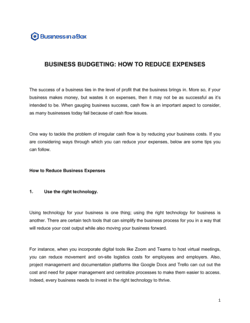
This document is a structured business expense-reduction guide and formal cost-control commitment that identifies four recurring categories of unnecessary spending and provides a binding framework for eliminating them. Available as a free Word download, it walks owners and finance leads through each expense category with analysis, action steps, and sign-off fields so that cost-reduction decisions are documented and enforceable across a team or organization.
When you need it
Use it when a business is experiencing margin pressure, preparing for a budget review, responding to a cash-flow shortfall, or formalizing a cost-reduction initiative that requires accountability from multiple stakeholders. It is equally useful before fundraising rounds, when lenders request evidence of fiscal discipline, or when onboarding a new CFO or finance manager.
What's inside
The document covers four defined expense categories — each with a diagnostic checklist, elimination strategy, and responsible-party sign-off. It also includes an acknowledgment clause, a review schedule, and a governing authority section that makes the commitments binding on the signatories.

What is The 4 Expenses You Can Eliminate To Avoid Unnecessary Spending?

The 4 Expenses You Can Eliminate To Avoid Unnecessary Spending is a structured business document that combines a cost-diagnostic framework with a formal, signed commitment to eliminate four recurring categories of unnecessary expenditure: redundant software subscriptions, excess staffing or contractor costs, non-essential travel and entertainment, and underperforming marketing spend. Unlike a general budget template, this document functions as a binding internal agreement — naming responsible parties, setting dollar-denominated savings targets, and establishing a review schedule that keeps cost-reduction commitments live after the initial sign-off. It is available as a free Word download that can be edited online and exported as PDF for distribution to stakeholders.

Why You Need This Document

Businesses that cut costs informally — through email instructions or verbal agreements — rarely sustain those cuts beyond 60 days because there is no named accountability, no measurable target, and no review date to enforce follow-through. The consequence is predictable: subscriptions renew, contractor hours creep back up, and marketing budgets drift toward familiar channels regardless of their return. Over a 12-month period, unmanaged discretionary spending in these four categories typically represents 8–15% of a small business's total operating costs — money that is recoverable without touching revenue-generating activity. This template closes that gap by turning an informal intention into a signed, dated, measurable plan with individual sign-offs for each expense category, giving owners, CFOs, and lenders a concrete record that financial discipline is being actively managed rather than aspirationally discussed.

Which variant fits your situation?

If your situation is…Use this template
Reducing overhead across an entire organization with board sign-offCost Reduction Plan
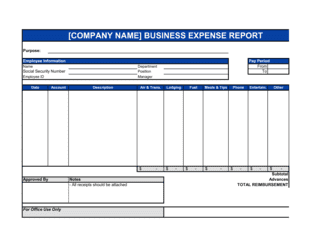
Tracking and approving employee expense claimsExpense Report Template
Setting and controlling a department-level budgetDepartment Budget Template
Formalizing a company-wide financial policy for spending limitsExpense Policy Template
Preparing a cash flow forecast after cutting costsCash Flow Projection Template
Documenting a vendor contract renegotiation or cancellationContract Termination Letter
Conducting a full financial health review for a small businessBusiness Financial Review Template

Common mistakes to avoid

❌ Vague expense descriptions without named items and amounts

Why it matters: A commitment to 'reduce software costs' assigns no one to a specific tool and generates no measurable saving. Reviews become debates about what was meant rather than checks on what was done.

Fix: List every item by name, monthly cost, responsible party, and cancellation deadline before the document is signed.

❌ Cutting all four expense categories simultaneously without phasing

Why it matters: Simultaneous cuts across marketing, staffing, travel, and software can disrupt revenue-generating activities and create a cash-flow trough 60–90 days later that exceeds the savings.

Fix: Sequence cuts by impact risk: start with pure overhead (unused subscriptions), then travel caps, then marketing reallocation, then staffing reviews — each separated by 30 days.

❌ No named individual accountable for each expense category

Why it matters: When accountability is assigned to a team or department rather than a named person, no one follows through and the review meeting confirms nothing was actually cut.

Fix: Assign one named signatory per expense category. That person's name appears next to the savings target and the review date.

❌ Signing the document after cuts have already been made

Why it matters: A signed commitment that post-dates the actions it describes has no prospective accountability value and cannot bind future behavior.

Fix: Complete the document, obtain all signatures, and only then begin cancellations, terminations, or spending freezes.

❌ Omitting a review schedule

Why it matters: Without a fixed review date, expense-reduction commitments revert to old patterns within 60–90 days as day-to-day operations crowd out strategic disciplines.

Fix: Set a 30-day and a 90-day review date at the time of signing and calendar both immediately. Make the actuals report a standing agenda item in the monthly finance meeting.

❌ No exception-approval process for retained discretionary categories

Why it matters: Blanket bans on travel or marketing spend without an exception path create bottlenecks on legitimate client activity and breed workarounds that bypass the document entirely.

Fix: Define a named approver and a written approval process for any spend above the stated threshold. Document every approved exception as an appendix.

The 9 key clauses, explained

Identification of Parties and Authority

In plain language: Names the business entity, its legal representative, and any co-signatories such as department heads or board members who are bound by the cost-reduction commitments.

Sample language
This document is entered into by [COMPANY LEGAL NAME], a [ENTITY TYPE] registered in [JURISDICTION], represented by [AUTHORIZED SIGNATORY NAME], [TITLE], effective [DATE].

Common mistake: Listing a department name rather than a named individual. If the signatory leaves, the commitment becomes unenforceable without a named replacement.

Expense Category 1 — Redundant Software and Subscriptions

In plain language: Identifies all recurring software licenses, SaaS tools, and membership fees that are unused, duplicated, or underutilized, and commits to cancelling or consolidating them by a stated date.

Sample language
The following subscriptions have been identified as redundant or underutilized: [LIST OF TOOLS / SERVICES]. [RESPONSIBLE PARTY] commits to cancelling or consolidating these services by [DATE], reducing monthly recurring costs by an estimated $[AMOUNT].

Common mistake: Setting a vague elimination target like 'reduce subscriptions' without listing specific tools and amounts. Unspecific commitments are never actioned.

Expense Category 2 — Excess Staffing and Contractor Costs

In plain language: Documents positions, roles, or contractor engagements that exceed current operational needs and establishes the process for renegotiating, reassigning, or ending those engagements.

Sample language
The following roles or contractor agreements have been identified as exceeding current operational requirements: [ROLE / CONTRACTOR NAME]. [RESPONSIBLE PARTY] shall initiate a formal review by [DATE] and implement changes no later than [DATE], in compliance with applicable employment law.

Common mistake: Naming specific individuals in the binding document before HR or legal review is complete. This creates wrongful-dismissal exposure before proper process is followed.

Expense Category 3 — Non-Essential Travel and Entertainment

In plain language: Defines which travel and entertainment expenditures are non-essential, sets per-event or per-month spending caps going forward, and identifies who must approve exceptions.

Sample language
Effective [DATE], travel and entertainment expenses exceeding $[THRESHOLD] per event require written pre-approval from [APPROVER TITLE]. The following recurring travel commitments are suspended: [LIST]. Annual T&E budget is capped at $[AMOUNT].

Common mistake: Suspending all travel without an exception-approval process. Key client relationships or regulatory obligations may require travel, and a blanket ban creates operational risk.

Expense Category 4 — Underperforming Marketing and Advertising Spend

In plain language: Identifies marketing channels or campaigns delivering below a defined cost-per-acquisition or ROI threshold and commits to pausing or reallocating that budget.

Sample language
Channels or campaigns with a cost-per-acquisition exceeding $[THRESHOLD] or a return on ad spend below [X]x as of [MEASUREMENT DATE] are hereby paused. Reallocated budget of $[AMOUNT] shall be directed to [CHANNEL / INITIATIVE] by [DATE].

Common mistake: Cutting all marketing spend simultaneously. Revenue-generating channels paused without replacement cause a revenue lag 60–90 days after the cut that is harder to recover from than the original overspend.

Savings Targets and Measurement Criteria

In plain language: States the total projected monthly and annual savings from all four categories, defines how savings will be measured, and names the person responsible for tracking actuals against targets.

Sample language
Total projected monthly savings: $[AMOUNT]. Total projected annual savings: $[AMOUNT]. [RESPONSIBLE PARTY] shall report actual savings versus target in the monthly financial review, commencing [DATE].

Common mistake: Projecting savings without a defined measurement method. Without a baseline and a tracking cadence, it is impossible to confirm whether cuts were actually made.

Review Schedule and Amendment Process

In plain language: Sets a mandatory review date — typically 30, 60, or 90 days after implementation — and describes the process for amending the commitments if business conditions change.

Sample language
A formal review of all cost-reduction commitments shall occur on [DATE] and quarterly thereafter. Amendments require written agreement of all signatories and must be appended to this document.

Common mistake: No review schedule at all. Without a fixed review date, cost-reduction plans are abandoned within 90 days as operational priorities crowd them out.

Acknowledgment and Accountability Clause

In plain language: Confirms that each signatory has reviewed and understood the commitments, accepts personal accountability for their assigned categories, and agrees to report non-compliance to the designated authority.

Sample language
Each signatory acknowledges they have reviewed the expense categories assigned to them, understand the elimination targets, and accept accountability for implementing the stated actions by the stated deadlines.

Common mistake: Having only one signatory for all four expense categories. Single-signatory structures remove accountability from the department heads who actually control day-to-day spending.

Governing Law and Dispute Resolution

In plain language: States which jurisdiction's laws govern any dispute arising from non-compliance with the document's commitments and how such disputes will be resolved.

Sample language
This document is governed by the laws of [STATE / PROVINCE / COUNTRY]. Any dispute arising from non-compliance with the commitments herein shall be resolved by [MEDIATION / ARBITRATION / APPLICABLE COURTS] in [CITY / JURISDICTION].

Common mistake: Omitting a governing law clause in a document signed by parties in multiple jurisdictions, leaving the applicable legal framework ambiguous if a dispute arises.

How to fill it out

  1. 1

    Identify the legal entity and authorized signatories

    Enter the company's full registered name, entity type, and the names and titles of all individuals who will be bound by the commitments. Include any department heads responsible for specific expense categories.

    💡 Use the same entity name that appears on your bank account and tax filings to avoid ambiguity if the document is ever referenced in a financial audit.

  2. 2

    Audit each of the four expense categories before filling in amounts

    Pull the last 90 days of bank statements and credit card records. For each category, list every individual line item, its cost, and whether it has generated a measurable return in the same period.

    💡 Sort subscriptions by cost descending — the largest unused subscriptions are almost always in the top 10 items and can be cancelled within 24 hours.

  3. 3

    Enter specific tools, roles, and campaigns — not categories

    Replace every placeholder with named items. 'Redundant software' is not actionable; '[TOOL NAME] — $149/month — last used [DATE] — cancelled by [PERSON] by [DATE]' is.

    💡 Assign a single responsible person to each line item, not a team. Shared accountability is no accountability.

  4. 4

    Set dollar-denominated savings targets for each category

    Calculate the monthly and annual savings from each category individually, then sum them into the totals on the savings targets clause. Confirm the figures against your current budget or P&L.

    💡 If projected savings exceed 20% of total operating expenses, review the figures with your accountant before signing — cuts of that magnitude often have second-order revenue impacts.

  5. 5

    Define approval thresholds for retained discretionary expenses

    For travel and marketing in particular, set explicit per-transaction or per-month thresholds above which a second approver must sign off. Name the approver by title, not just name.

    💡 Threshold amounts should be low enough to catch meaningful spend — $500 per event is more effective than $5,000 per event for most SMEs.

  6. 6

    Set the review schedule and assign a tracker

    Pick a fixed review date 30–60 days from signing and a quarterly cadence thereafter. Name the individual responsible for producing the actuals report — typically the CFO, controller, or bookkeeper.

    💡 Calendar the review dates immediately after signing. Cost-reduction plans that rely on memory rather than calendar events are rarely followed.

  7. 7

    Obtain signatures before implementation begins

    All named signatories must sign before any cancellations, terminations, or spending freezes take effect. Post-implementation signatures weaken the accountability structure.

    💡 Use a timestamped eSign tool so the execution date is unambiguous — disputes about when cuts were authorized are common in finance teams.

  8. 8

    Append evidence as you complete each elimination

    As each subscription is cancelled, contractor agreement ended, or campaign paused, attach the confirmation email or cancellation receipt to the document as a dated appendix.

    💡 A document with attached evidence is far more useful in a lender review or audit than one with only signed commitments and no proof of execution.

Frequently asked questions

What is this expense elimination document and how does it work?

This document is a structured cost-reduction commitment that identifies four categories of unnecessary business spending — redundant subscriptions, excess staffing or contractor costs, non-essential travel and entertainment, and underperforming marketing spend — and formalizes a plan to eliminate or reduce each with named responsible parties, dollar targets, and review dates. It functions as both a strategic guide and a binding internal agreement signed by the business owners or managers accountable for each category.

Why do businesses need a formal document for expense reduction rather than just cutting costs informally?

Informal cost-cutting instructions are rarely executed consistently because they lack named accountability, measurable targets, and review dates. A signed document creates a record of what was committed, by whom, and by when — making follow-up conversations factual rather than subjective. It also provides evidence for lenders, investors, or board members that a structured cost-control process is in place, which can directly affect credit decisions and valuations.

What are the four expense categories covered in this document?

The four categories are: (1) redundant or unused software subscriptions and SaaS tools, (2) excess staffing and contractor costs relative to current operational needs, (3) non-essential travel and entertainment expenditure, and (4) underperforming marketing and advertising channels with below-threshold returns. Each category has its own diagnostic checklist, elimination strategy, and responsible-party sign-off within the document.

Is this document legally binding?

When properly executed with named signatories and a governing law clause, this document is generally enforceable as an internal business commitment. It creates contractual obligations between the signing parties — typically company officers or department heads — to implement stated cost reductions by stated deadlines. Consider having a lawyer review the document before execution if it involves employment-related cuts or vendor contract terminations, as those actions are governed by separate bodies of law.

Can this document be used to justify terminating vendor contracts or subscriptions?

The document establishes the internal decision and authority to terminate specific vendor relationships, but the termination itself must follow the notice and cancellation terms in each individual vendor contract. Use the commitments in this document as the internal authorization, then issue a separate contract termination letter or cancellation notice to each vendor in accordance with their agreement's requirements.

How often should the expense reduction commitments be reviewed?

A 30-day initial review is standard to confirm that all cancellations and immediate cuts have been executed. A 90-day review then compares actual savings against projected savings for the first full quarter. Quarterly reviews thereafter keep the commitments live and allow amendments as business conditions change. Cost-reduction plans reviewed less than quarterly are typically abandoned within six months.

What should I do if actual savings fall short of the targets in the document?

Trigger the amendment process defined in the review schedule clause. Identify which category missed its target, document the reason, and either extend the deadline with a revised action plan or replace the unachieved cut with a different elimination from the same category. The responsible signatory should present this analysis at the next scheduled review meeting with updated figures.

Does this document replace a full budget or financial plan?

No. This document addresses four specific categories of unnecessary spending and formalizes the elimination commitments. It does not replace a full operating budget, cash flow forecast, or financial plan. Use it alongside a budget template and cash flow projection to get a complete picture of your financial position after cuts are implemented.

Do I need a lawyer to complete this document?

For straightforward subscription cancellations and travel policy changes, a lawyer is generally not required. Legal review is recommended when the document involves employment reductions (contractor terminations or role eliminations), when it will be presented to a lender or investor as evidence of financial controls, or when signatories operate across multiple jurisdictions with different employment and contract law requirements.

How this compares to alternatives

vs Expense Report Template

An expense report records and reimburses individual employee spending after it occurs. This expense elimination document proactively commits the business to removing entire categories of unnecessary spend before money is spent. The report is reactive and transactional; the elimination document is strategic and prospective.

vs Budget Template

A budget allocates projected spending across all categories for a future period. This document specifically targets and commits to eliminating four identified categories of waste within an existing or upcoming budget. Use the elimination document first to reduce the baseline, then build your budget from the leaner cost structure.

vs Cash Flow Statement

A cash flow statement records historical cash inflows and outflows. This document is a forward-looking commitment to reduce outflows in four specific categories. Together, the two documents show the before-and-after picture: the cash flow statement provides the diagnostic data; the elimination document provides the response.

vs Contract Termination Letter

A contract termination letter executes the cancellation of a single specific vendor agreement. This expense elimination document provides the internal authority and strategic rationale for multiple terminations across four expense categories. The elimination document is the decision; the termination letter is the action that follows it.

Industry-specific considerations

Professional Services

Subscription bloat and excess contractor spend are the primary targets; client entertainment caps must be balanced against relationship-development obligations.

Retail and E-commerce

Underperforming paid advertising channels and duplicate inventory management tools dominate the elimination list; seasonal staffing costs require careful phasing.

SaaS / Technology

Redundant developer tools, unused cloud infrastructure, and overlapping SaaS licenses generate significant recoverable spend with minimal operational disruption.

Construction and Trades

Equipment rental overages, subcontractor cost overruns, and underutilized field software subscriptions are the four-category equivalents most relevant to trade businesses.

Hospitality and Food Service

Non-essential supplier relationships, over-staffed shifts, and marketing spend on low-converting channels are the primary candidates for elimination in margin-tight operations.

Healthcare and Allied Health

Duplicate practice management software, non-essential conference travel, and agency staffing above baseline requirements are the most impactful reduction targets.

Jurisdictional notes

United States

Employment-related cost reductions — contractor terminations and role eliminations — must comply with federal and state wage-and-hour laws, including final paycheck timing requirements that vary by state. California, for example, requires immediate final payment upon involuntary termination. Subscription and vendor cancellations are governed by the individual contract terms; auto-renewal statutes in states like California and New York impose specific notice requirements on vendors.

Canada

Any staffing reductions referenced in this document must comply with provincial Employment Standards Act minimums for notice and severance — Ontario's ESA, for example, requires statutory notice of up to 8 weeks for employees with 8 or more years of service. Common-law notice obligations can significantly exceed statutory minimums for long-tenured employees. Quebec requires French-language versions of binding business documents in provincially regulated contexts.

United Kingdom

Staffing-related expense reductions that involve redundancies must follow the statutory redundancy process, including individual or collective consultation periods depending on the number of roles affected. For 20 or more redundancies within 90 days, a minimum 45-day collective consultation is required. Vendor contract cancellations are governed by the notice periods in each contract; breach of contract claims are common where notice provisions are not followed.

European Union

GDPR applies to any cost-reduction process that involves reviewing or terminating data processing agreements with third-party SaaS vendors — a Data Processing Agreement must be formally terminated and data return or deletion confirmed in writing. Employment-related reductions are subject to member-state specific protections; France, Germany, and Spain impose particularly strict consultation, notice, and severance requirements that often exceed the commitments a standard template anticipates.

Template vs lawyer — what fits your deal?

PathBest forCostTime
Use the templateSmall business owners and founders eliminating subscriptions, travel, and marketing spend without employment-related cutsFree2–4 hours including the expense audit
Template + legal reviewBusinesses including contractor terminations or role eliminations, or presenting the document to a lender or investor$300–$700 for a lawyer or HR consultant review2–5 business days
Custom draftedMulti-entity businesses, cross-border operations, or cost-reduction plans tied to financing covenants or regulatory obligations$1,000–$3,0001–2 weeks

Glossary

Unnecessary Spending
Business expenditure that does not directly contribute to revenue generation, operational continuity, or a documented strategic objective.
Overhead
Recurring fixed or semi-fixed costs — rent, utilities, insurance, subscriptions — that exist regardless of sales volume.
Cost of Goods Sold (COGS)
The direct costs attributable to producing goods or delivering services, excluding overhead and administrative expenses.
Discretionary Expense
A non-essential business cost that can be deferred or eliminated without immediately impairing core operations.
Recurring Subscription
A software, service, or membership fee billed on a regular cycle — monthly or annually — that may continue unused unless actively cancelled.
Vendor Consolidation
The process of reducing the number of suppliers or service providers to negotiate better pricing and reduce administrative overhead.
Budget Variance
The difference between a budgeted expense amount and the actual amount spent, used to identify overspending or underspending.
Expense Audit
A systematic review of all business expenditures over a defined period to identify redundant, inflated, or unauthorized charges.
Zero-Based Budgeting
A budgeting method in which every expense must be justified from zero each period, rather than rolling over prior-period allocations.
Signatory
An authorized individual whose signature creates a binding commitment on behalf of themselves or their organization.
Cost Centre
A department, team, or function that incurs costs without directly generating revenue, requiring active management to prevent budget drift.

Part of your Business Operating System

This document is one of 3,000+ business & legal templates included in Business in a Box.

  • Fill-in-the-blanks — ready in minutes
  • Compatible with all office suites
  • Export to PDF and share electronically

Create your document in 3 simple steps.

From template to signed document — all inside one Business Operating System.
1
Download or open template

Access over 3,000+ business and legal templates for any business task, project or initiative.

2
Edit and fill in the blanks with AI

Customize your ready-made business document template and save it in the cloud.

3
Save, Share, Send, Sign

Share your files and folders with your team. Create a space of seamless collaboration.

Save time, save money, and create top-quality documents.

★★★★★

"Fantastic value! I'm not sure how I'd do without it. It's worth its weight in gold and paid back for itself many times."

Managing Director · Mall Farm
Robert Whalley
Managing Director, Mall Farm Proprietary Limited
★★★★★

"I have been using Business in a Box for years. It has been the most useful source of templates I have encountered. I recommend it to anyone."

Business Owner · 4+ years
Dr Michael John Freestone
Business Owner
★★★★★

"It has been a life saver so many times I have lost count. Business in a Box has saved me so much time and as you know, time is money."

Owner · Upstate Web
David G. Moore Jr.
Owner, Upstate Web

Run your business with a system — not scattered tools

Stop downloading documents. Start operating with clarity. Business in a Box gives you the Business Operating System used by over 250,000 companies worldwide to structure, run, and grow their business.

Free Forever Plan · No credit card required